
Condense SPF records to network blocks to avoid DNS Lookup Limits

Project description

sender_policy_flattener
We had a problem in our organisation that caused our SPF records to become invalid:
When customers computers were querying our SPF records, there were more than 10 lookups required after following all of the include: remarks.
Solution? Query them ourselves, and create a much more condense list of SPF records.
But wait… What if the upstream records change?
Part of what the script does is that it creates a JSON file that keeps track of the last list of IP Addresses that your combination of SPF records had.
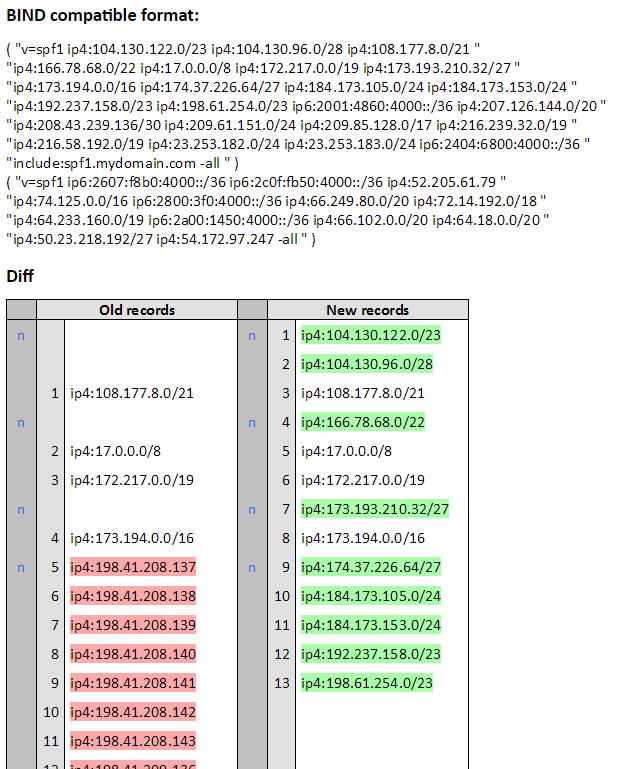
When the hashsum of your IP Addresses changes, it will send out an email (or just dump HTML if it can’t find an email server) with a handy diff & BIND format for viewing what has changed, and promptly updating it.
You could theoretically extract the flat IP records from the resulting JSON file and automatically update your DNS configuration with it.
How do I install it?
via git clone
Clone this repo and run
pip install -r requirements.txt
python setup.py install
You can also do this from within a virtualenv if that tickles your fancy (I recommend it).
via pip
pip install sender_policy_flattenerHow do I use it?
Python 2.7, or 3.3+ is required.
Here’s the usage:
usage: spflat [-h] [-c CONFIG] [-r RESOLVERS] [-e MAILSERVER] [-t TOADDR]
              [-f FROMADDR] [-s SUBJECT] [-D SENDING_DOMAIN] [-d DOMAINS]
              [-o OUTPUT]

A script that crawls and compacts SPF records into IP networks. This helps to
avoid exceeding the DNS lookup limit of the Sender Policy Framework (SPF)
https://tools.ietf.org/html/rfc7208#section-4.6.4

optional arguments:
  -h, --help            show this help message and exit
  -c CONFIG, --config CONFIG
                        Name/path of JSON configuration file
  -r RESOLVERS, --resolvers RESOLVERS
                        Comma separated DNS servers to be used
  -e MAILSERVER, -mailserver MAILSERVER
                        Server to use for mailing alerts
  -t TOADDR, -to TOADDR
                        Recipient address for email alert
  -f FROMADDR, -from FROMADDR
                        Sending address for email alert
  -s SUBJECT, -subject SUBJECT
                        Subject string, must contain {zone}
  -D SENDING_DOMAIN, --sending-domain SENDING_DOMAIN
                        The domain which emails are being sent from
  -d DOMAINS, --domains DOMAINS
                        Comma separated domain:rrtype to flatten to IP
                        addresses. Imagine these are your SPF include
                        statements.
  -o OUTPUT, --output OUTPUT
                        Name/path of output file
Example
spflat --resolvers 8.8.8.8,8.8.4.4 \
       --to me@mydomain.com \
       --from admin@mydomain.com \
       --subject 'SPF for {zone} has changed!' \
       --domains gmail.com:txt,sendgrid.com:txt,yahoo.com:a \
       --sending-domain mydomain.com
or
spflat --config spf.jsonYou can specify a config file, or you can specify all of the optional arguments from the command line.
I’ve provided a settings.json file with an example configuration file.
3rd party dependencies
netaddr
dnspython
Example email format
Release history Release notifications | RSS feed


Download files
Download the file for your platform. If you're not sure which to choose, learn more about installing packages.
Source Distribution
File details
Details for the file sender_policy_flattener-0.1.2.zip.
File metadata
- Download URL: sender_policy_flattener-0.1.2.zip
- Upload date:
- Size: 14.1 kB
- Tags: Source
- Uploaded using Trusted Publishing? No
File hashes
| Algorithm | Hash digest | |
|---|---|---|
| SHA256 |
0d7a409dc4a39b3f8117c429d0986e427ea019402d45a57862d02369cc042b80
|
|
| MD5 |
cd857dc82d04cf823d11abe2de312da0
|
|
| BLAKE2b-256 |
cf1b75cfa80822a96c4a17fc5b71448b7b039ec4f2791dc5941805ac1018dace
|






