
⠀⠀⠀⣀⣀⣀⣤⠶⠚⠛⠛⠓⠶⣤⣀⣀⣀⠀⠀⠀
⠀⠈⠉⠉⠉⠁⢀⡤⠞⠋⠙⠳⢤⡀⠈⠉⠉⠉⠁⠀
⢠⣤⡤⠴⠶⠚⠉⠀⣀⣤⣤⣀⠀⠉⠓⠶⠦⢤⣤⡄   S E N N E T.
⠀⠀⠀⠀⢀⣠⡴⠛⠁⠀⠀⠈⠛⢦⣄⡀⠀⠀⠀⠀   Talk to your coding agents.
⠀⠛⠛⠋⠉⠁⠀⠀⣀⣀⣀⣀⠀⠀⠈⠉⠙⠛⠛⠀
⠀⠀⢤⣤⣤⠴⠖⠛⠉⠁⠈⠉⠛⠲⠦⣤⣤⡤⠀⠀
Sennet is a free, open source, self-hosted voice interface for coding agents. Speak a request from your phone or desktop, let Codex or Claude Code work on your own computer under your existing subscription, approve what it wants to do, and hear what it did.
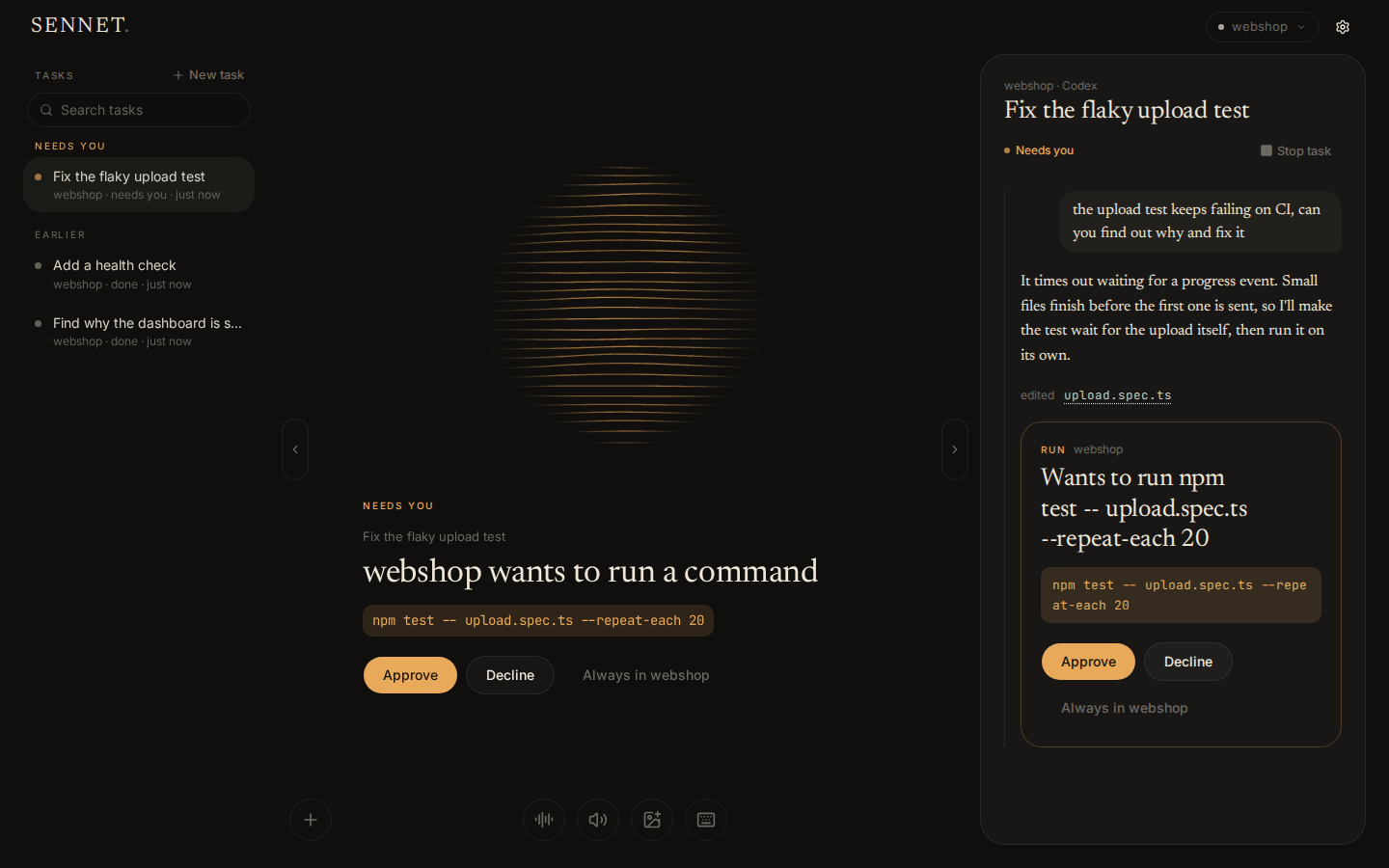
- Your agents, your subscription. Sennet drives the official agent CLIs under your own login. It never holds API keys or calls a provider itself.
- Speech stays on your machine. Recognition and the voice run locally, on CPU or an NVIDIA GPU. The only cloud traffic is what the agent CLIs already send.
- Talk like a conversation. Push to talk, or open the mic and just talk: interrupt a reply by speaking over it, or start with a wake word.
- You stay in charge. The agent asks before running anything outside its trusted set, with a chime and a card you answer with a tap.
- From anywhere. Pair your phone once and reach Sennet over Tailscale or any HTTPS reverse proxy.
Status: 0.3. Codex and Claude Code work today; Gemini CLI is coming. Linux, and macOS as experimental. English only. See what might come next.
Quick start
You need Linux or macOS, uv, and at least one agent
logged in: the Codex CLI (codex login) or
Claude Code (claude auth login, on a Claude
subscription).
uv tool install sennet
sennet setup                                   # speech, the phone address, the background service
sennet project add ~/code/my-app --name app    # a project you can talk to
sennet pair                                    # a one-time link or QR code for this browser or your phone
Open the link sennet pair prints, pick your project, hold the disc and talk. sennet doctor checks everything if something doesn't work.
Setup looks at your hardware and recommends where speech runs. It downloads about 0.8 GB of speech models for CPU, or 2.9 GB for a GPU.
Documentation
For users:
- Install and set up: requirements, setup, the service, upgrading and removing
- Reach Sennet from your phone: Tailscale, Caddy or nginx, and pairing
- Using Sennet: projects, talking, conversations, the wake word, approvals and voice commands
- Configuration: every setting in
config.toml - Troubleshooting
For contributors:
- Contributing: dev setup, tests and how changes are made
- Architecture: a tour of the code
- All documents, including the design and the milestone notes
Security
Sennet lets a paired device run an agent on your computer, as you. Only pair devices you own, keep the server on its default loopback address behind HTTPS, and unpair devices you stop using. To report a vulnerability, see SECURITY.md.
Licence
Sennet's own code is Apache-2.0. Its speech dependencies include phonemizer and espeak-ng, which are GPL-3, so an install that bundles Sennet with them is GPL-3. The speech models carry their own licences, and the optional wake words are for non-commercial use only. All of it is listed in NOTICES.
1 maintainer

Metadata
1 maintainer
Release files for sennet 0.3.0
For a detailed explanation of source distributions (sdists) and built distributions (wheels), please see the package formats documentation.
Source distribution (sdist)
| File | Size | Uploaded | Provenance | Actions |
|---|---|---|---|---|
| sennet-0.3.0.tar.gz | 2.3 MB | With provenance | Details for sennet-0.3.0.tar.gz |
Built distribution (wheel)
| File | Interpreter | ABI | Platform | Actions Reset |
|---|---|---|---|---|
| sennet-0.3.0-py3-none-any.whl | Python 3 | none | any | Details for sennet-0.3.0-py3-none-any.whl |
Total release size: 4.0 MB
Release files / sennet-0.3.0.tar.gz
| Download URL | sennet-0.3.0.tar.gz |
|---|---|
| Size | 2.3 MB |
| Tags | Source |
|
SHA-256 checksum How to use checksums |
683d73eac27603de2d46e31a7f2f551fd8708623f3564f03e54ac00d23728adb
|
|
BLAKE2b-256 checksum How to use checksums |
0d2cfdc9b97f1393356f10702aec7719b5445be342d9893699729e9146fe62bb
|
| Upload date | |
|
Uploaded using Trusted Publishing? What is trusted publishing? |
Yes |
| Uploaded via |
twine/7.0.0 CPython/3.13.16
|
Provenance
Provenance describes where a file came from. On PyPI, provenance is shared via attestations, which provide a verifiable record of the build or publishing details. View details, limitations and caveats.


PyPI Publish Attestation
PyPI verified that this artifact, at this checksum, originated from the publisher listed below.
Signed by GitHub Actions, verified by PyPI on Oct 29, 2026.
Transparency logRelease files / sennet-0.3.0-py3-none-any.whl
| Download URL | sennet-0.3.0-py3-none-any.whl |
|---|---|
| Size | 1.7 MB |
| Tags | Python 3 |
|
SHA-256 checksum How to use checksums |
b79b32c6d462cdae25638eb748bdd5068c0ecd30fd859f63b8df252fc2b4b7a0
|
|
BLAKE2b-256 checksum How to use checksums |
4438e0a6a73288ed29762be428859ac5c7afd0d67f2a92ae76fe195cf2865efc
|
| Upload date | |
|
Uploaded using Trusted Publishing? What is trusted publishing? |
Yes |
| Uploaded via |
twine/7.0.0 CPython/3.13.16
|
Provenance
Provenance describes where a file came from. On PyPI, provenance is shared via attestations, which provide a verifiable record of the build or publishing details. View details, limitations and caveats.
PyPI Publish Attestation
PyPI verified that this artifact, at this checksum, originated from the publisher listed below.
Signed by GitHub Actions, verified by PyPI on Oct 29, 2026.
Transparency logSecurity for sennet 0.3.0
Provenance
Provenance describes where a file came from. On PyPI, provenance is shared via attestations, which provide a verifiable record of the build or publishing details. View details, limitations and caveats.
Full provenance
Both files in this release have been uploaded with provenance metadata.
Attestation for sennet-0.3.0.tar.gz
PyPI Publish Attestation
PyPI verified that this artifact, at this checksum, originated from the publisher listed below.
Signed by GitHub Actions, verified by PyPI on Oct 29, 2026.
Transparency logA note on package security
PyPI is a repository for distributing packages, not a service for auditing them. While third-party security researchers and our staff do their best to detect and remove malicious packages, PyPI cannot guarantee the quality, security or suitability of any given package.
To learn more about protecting yourself from malicious actors, visit our package security documentation.














