
Python I2C Driver for Sensirion STS3X
This repository contains the Python driver to communicate with a Sensirion sensor of the STS3X family over I2C.

Click here to learn more about the Sensirion STS3X sensor family.
Supported sensor types
| Sensor name | I²C Addresses |
|---|---|
| STS30 | 0x4A, 0x4B |
| STS30A | 0x4A, 0x4B |
| STS31A | 0x4A, 0x4B |
| STS31 | 0x4A, 0x4B |
| STS32 | 0x4A, 0x4B |
| STS33 | 0x4A, 0x4B |
| STS35 | 0x4A, 0x4B |
The following instructions and examples use a STS30.
Connect the sensor
You can connect your sensor over a SEK-SensorBridge. For special setups you find the sensor pinout in the section below.
Sensor pinout
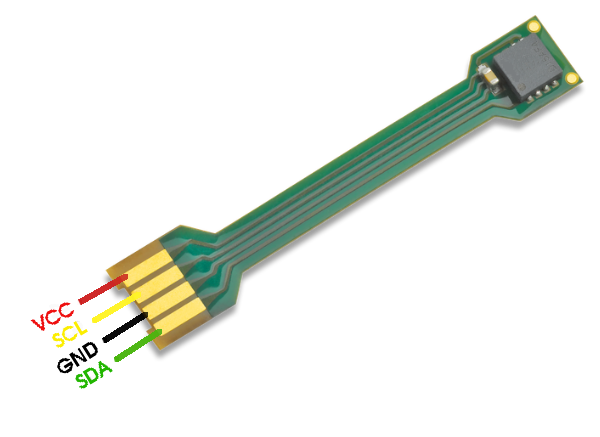
| Pin | Cable Color | Name | Description | Comments |
|---|---|---|---|---|
| 1 | green | SDA | I2C: Serial data input / output | |
| 2 | black | GND | Ground | |
| 3 | yellow | SCL | I2C: Serial clock input | |
| 4 | red | VDD | Supply Voltage | 2.15V to 5.5V |
Documentation & Quickstart
See the documentation page for an API description and a quickstart example.
Contributing
We develop and test this driver using our company internal tools (version
control, continuous integration, code review etc.) and automatically
synchronize the master branch with GitHub. But this doesn't mean that we
don't respond to issues or don't accept pull requests on GitHub. In fact,
you're very welcome to open issues or create pull requests :-)
Check coding style
The coding style can be checked with flake8:
pip install -e .[test]  # Install requirements
flake8                  # Run style check
In addition, we check the formatting of files with
editorconfig-checker:
pip install editorconfig-checker==2.0.3   # Install requirements
editorconfig-checker                      # Run check
License
See LICENSE.
1 maintainer

Metadata
1 maintainer
Release files for sensirion-i2c-sts3x 1.0.0
For a detailed explanation of source distributions (sdists) and built distributions (wheels), please see the package formats documentation.
Source distribution (sdist)
| File | Size | Uploaded | Provenance | Actions |
|---|---|---|---|---|
| sensirion_i2c_sts3x-1.0.0.tar.gz | 9.3 kB | Without provenance | Details for sensirion_i2c_sts3x-1.0.0.tar.gz |
Built distribution (wheel)
| File | Interpreter | ABI | Platform | Actions Reset |
|---|---|---|---|---|
| sensirion_i2c_sts3x-1.0.0-py3-none-any.whl | Python 3 | none | any | Details for sensirion_i2c_sts3x-1.0.0-py3-none-any.whl |
Total release size: 19.2 kB
Release files / sensirion_i2c_sts3x-1.0.0.tar.gz
| Download URL | sensirion_i2c_sts3x-1.0.0.tar.gz |
|---|---|
| Size | 9.3 kB |
| Tags | Source |
|
SHA-256 checksum How to use checksums |
204bd0da816a638a3508e33c9153ade4731ae408d7dcf4c65fa068b94a8147f1
|
|
BLAKE2b-256 checksum How to use checksums |
bc0dc12184b87f760da46ed4de40f09e6cd399939a0fb166d6611c1f83142d06
|
| Upload date | |
|
Uploaded using Trusted Publishing? What is trusted publishing? |
No |
| Uploaded via |
twine/1.12.1 pkginfo/1.9.6 requests/2.27.1 setuptools/39.0.1 requests-toolbelt/1.0.0 tqdm/4.64.1 CPython/3.6.9
|
Release files / sensirion_i2c_sts3x-1.0.0-py3-none-any.whl
| Download URL | sensirion_i2c_sts3x-1.0.0-py3-none-any.whl |
|---|---|
| Size | 9.9 kB |
| Tags | Python 3 |
|
SHA-256 checksum How to use checksums |
54246293cd91298dbc9d574216f8576bdca7279dcce77a7b8010f1efc0e65690
|
|
BLAKE2b-256 checksum How to use checksums |
25e9712b0365b83e7adcf3509c375595860d1a8cc76b1000e56cf3aef99d6feb
|
| Upload date | |
|
Uploaded using Trusted Publishing? What is trusted publishing? |
No |
| Uploaded via |
twine/1.12.1 pkginfo/1.9.6 requests/2.27.1 setuptools/39.0.1 requests-toolbelt/1.0.0 tqdm/4.64.1 CPython/3.6.9
|
Security for sensirion-i2c-sts3x 1.0.0
Provenance
Provenance describes where a file came from. On PyPI, provenance is shared via attestations, which provide a verifiable record of the build or publishing details. View details, limitations and caveats.
No provenance found
None of the files in this release were uploaded with provenance metadata.
A note on package security
PyPI is a repository for distributing packages, not a service for auditing them. While third-party security researchers and our staff do their best to detect and remove malicious packages, PyPI cannot guarantee the quality, security or suitability of any given package.
To learn more about protecting yourself from malicious actors, visit our package security documentation.













