
Seqcore

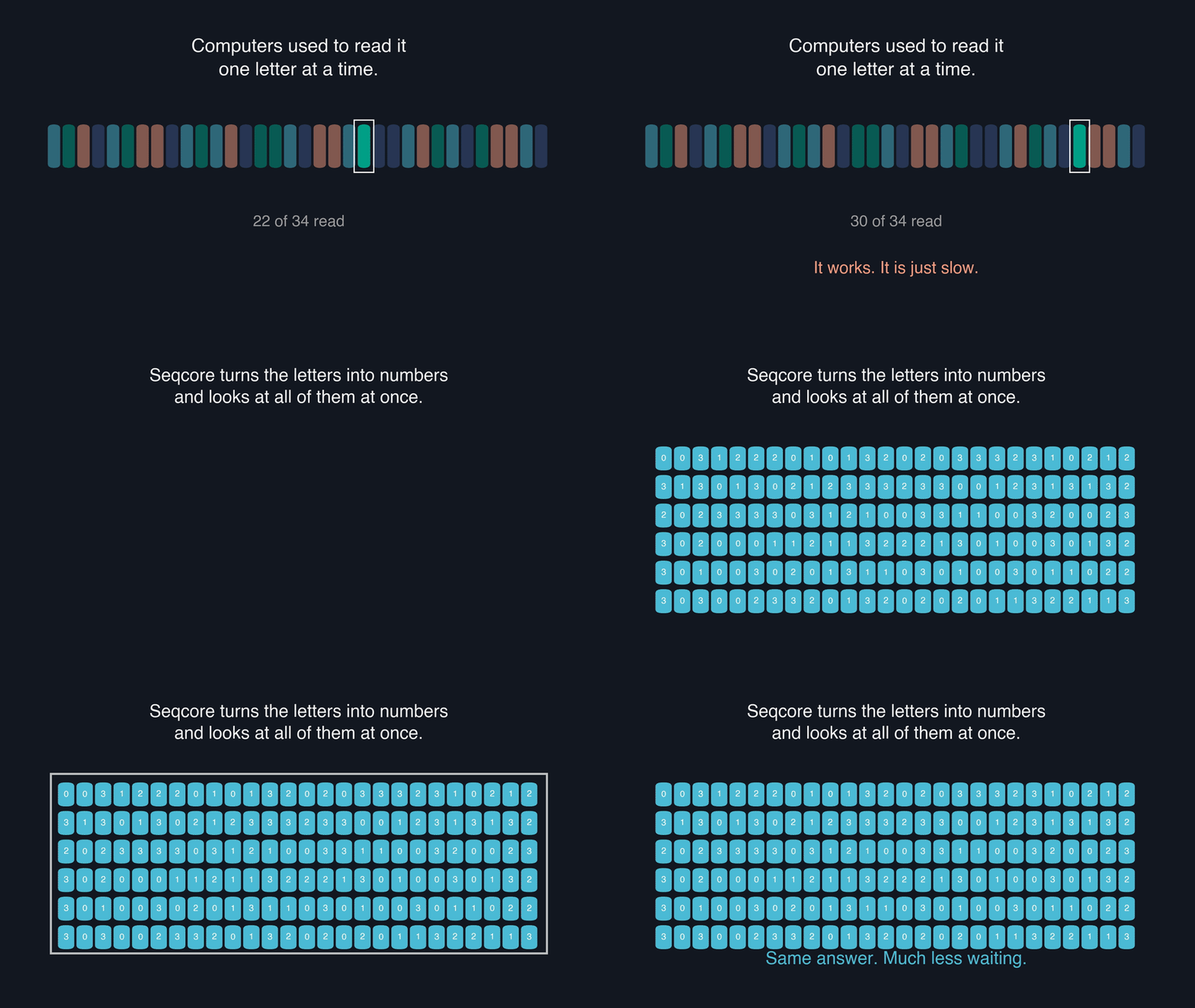
Reading one letter at a time, versus reading the whole batch at once.
Watch the full 90-second explainer.
High-performance biological sequence analysis library for Python.
A unified, NumPy-vectorized library for genomics, proteomics, structural biology, and drug design.
Note on GPU support: Seqcore ships CuPy device-management utilities (
gpu_available,gpu_info,device,set_memory_limit,clear_gpu_cache), but the analysis kernels themselves still execute on NumPy. GPU dispatch for the compute functions is planned, not implemented -- see Roadmap.
Installation
pip install seqcore
With GPU support:
pip install seqcore[gpu]
With all optional dependencies:
pip install seqcore[full]
Quick Start
import seqcore as sc

# DNA sequences - efficient 2-bit encoding
dna = sc.DNAArray("ACGTACGTACGT" * 1_000_000)

# Batch operations
sequences = sc.DNAArray([
    "ACGTACGT",
    "TGCATGCA",
    "GGGGCCCC",
])

# Vectorized operations
gc = sc.gc_content(sequences)
lengths = sc.length(sequences)
rev_comp = sc.reverse_complement(sequences)

# Translation
proteins = sc.translate(sequences)
Features
Sequence Operations
# GC content, molecular weight, length
gc = sc.gc_content(dna)
mw = sc.molecular_weight(protein)

# Transcription and translation
rna = sc.transcribe(dna)
protein = sc.translate(dna, frame=0)

# K-mer operations
kmers = sc.extract_kmers(sequences, k=21)
kmer_counts = sc.count_kmers(sequences, k=21)
Sequence Alignment
# Pairwise alignment
result = sc.align(query, reference)
print(result.score, result.identity, result.cigar)

# Distance matrices
dm = sc.pairwise_distance(sequences, metric="edit")

# Pattern matching
matches = sc.find_pattern(sequences, "ATG[ACGT]{30,100}TAA")
File I/O
# Auto-detect format
data = sc.read("sequences.fasta")
data = sc.read("structure.pdb")
data = sc.read("reads.fastq.gz")

# Streaming for large files
for batch in sc.read_stream("huge.fastq.gz", batch_size=100_000):
    results = process(batch)

# Single-cell matrices: AnnData (.h5ad) and 10x CellRanger (.h5)
sc_data = sc.read("filtered_feature_bc_matrix.h5")
counts = sc_data["X"]                    # cells x genes, SciPy sparse
cells = sc_data["obs"]["_index"]         # barcodes
genes = sc_data["var"]["_index"]         # gene symbols

# Database fetching
seq = sc.fetch("NP_000509")      # NCBI/UniProt
structure = sc.fetch("1ABC")     # PDB
Structural Biology
# Load structure
structure = sc.read("protein.pdb")

# Access data
print(structure.chains)      # ['A', 'B']
print(structure.n_residues)  # 265

# Distance matrix
dm = sc.distance_matrix(structure, selection="CA")

# Find contacts
contacts = sc.find_contacts(structure, cutoff=4.0)

# RMSD calculation
rmsd = sc.rmsd(structure1, structure2, align=True)

# Surface analysis
sasa = sc.sasa(structure)
surface = sc.surface_residues(structure, threshold=25.0)

# Binding pockets
pockets = sc.find_pockets(structure)
Drug Design
# Small molecules
mol = sc.Molecule.from_smiles("CCO")

# Molecular properties
# Note: sc.molecular_weight is the sequence version. For molecules, import the
# molecules one directly -- the two share a name and the sequence one wins.
from seqcore.molecules import molecular_weight
mw = molecular_weight(molecules)
logp = sc.logp(molecules)
hbd = sc.h_bond_donors(molecules)

# ADMET filters
passes_lipinski = sc.lipinski_filter(molecules)
bbb_permeable = sc.bbb_filter(molecules)

# Fingerprints and similarity
fps = sc.morgan_fingerprint(molecules, radius=2)
similarity = sc.tanimoto_similarity(fps)

# Substructure search
matches = sc.substructure_search(molecules, "c1ccccc1")
Phylogenetics
# Tree construction
tree = sc.neighbor_joining(sequences)
tree = sc.upgma(sequences)

# Tree operations
print(tree.newick())
dist = tree.distance("Species_A", "Species_B")
subtree = tree.prune(["A", "B", "C"])
Population Genetics
# Variant analysis
variants = sc.read("variants.vcf")
af = sc.allele_frequency(variants)
maf = sc.minor_allele_frequency(variants)

# Population statistics
fst = sc.fst(pop1, pop2)
pi = sc.nucleotide_diversity(sequences)
d = sc.tajimas_d(sequences)

# Linkage disequilibrium
ld = sc.linkage_disequilibrium(variants)
GPU Utilities
These manage CuPy devices and memory. They do not move Seqcore's analysis functions onto the GPU -- those run on NumPy today.
# Check GPU availability
if sc.gpu_available():
    print(sc.gpu_info())

# Select the active CuPy device for your own CuPy code
with sc.device("cuda:0"):
    xp = sc.core.device.get_array_module()  # cupy when a GPU is active

# Memory management
sc.set_memory_limit("8GB")
sc.clear_gpu_cache()

# Timing (works on any code)
with sc.timer() as t:
    result = sc.align(sequences, reference)
print(f"Completed in {t.elapsed:.2f}s")
Interoperability
# NumPy
arr = sequences.to_numpy()
sequences = sc.DNAArray.from_numpy(arr)

# pandas
df = sequences.to_dataframe()
df = structure.to_dataframe()

# Biopython
bio_seq = sequences[0].to_biopython()
sc_seq = sc.DNAArray.from_biopython(bio_seq)

# RDKit
rdkit_mol = molecule.to_rdkit()
sc_mol = sc.Molecule.from_rdkit(rdkit_mol)
Performance
Seqcore stores a batch of sequences as one padded integer matrix, so batch-wide operations are single NumPy calls rather than per-sequence loops. That wins decisively where work amortizes across the batch, and loses where a compiled per-element implementation already exists. Both cases are reported below.
100,000 sequences x 1000 bp. Speedup is Seqcore vs the faster of Biopython
and idiomatic pure Python; values below 1.0 mean Seqcore is slower.
| Operation | AWS g5.2xlarge (EPYC 7R32) | Mac mini (M4 Pro) |
|---|---|---|
| GC content | 6.3x | 9.4x |
| Translation | 17.9x | 13.8x |
| k-mer counting (k=8, 2000 seqs) | 9.2x | 7.2x |
| k-mer counting (k=12) | 1.4x | 1.7x |
| Reverse complement | 0.85x | 0.86x |
| Global alignment (L=3200) | 0.03x | 0.06x |
Both machines run Python 3.12, NumPy 2.5.2, Biopython 1.88; best of 5 runs,
each implementation in a fresh subprocess. Raw results in benchmarks/results/.
Every conclusion holds on both machines — the same operations win and lose, in the same order — but the magnitudes differ, so treat any single speedup figure as a point estimate rather than a property of the library.
The Mac mini is 1.7–2.2x faster than the cloud instance in absolute terms. We still quote the cloud instance in the paper, because it is the reproducible one: its ratios agree to within 2% across runs made 14 hours apart, whereas the same ratios on a desktop that is also being used for other work moved by 35–52% between an idle session and a busy one. If you benchmark on your own laptop, measure it twice.
Reproduce with:
python benchmarks/benchmark_suite.py
Domain modules
The molecules, structural biology and phylogenetics modules are benchmarked
separately by benchmarks/benchmark_modules.py against RDKit, SciPy, Biopython
and a NumPy reference.
| Operation | Reference | Seqcore | vs reference |
|---|---|---|---|
| SASA (5,000 atoms) | — | 0.17s | — |
find_contacts (5,000 atoms) |
scipy cKDTree | 0.12s | 0.06x |
tanimoto_similarity (2000x2000) |
RDKit bulk | 0.076s | 0.66x |
morgan_fingerprint (2,000 mols) |
RDKit | 0.045s | 0.32x |
molecular_weight (2,000 mols) |
RDKit | 0.0005s | 0.68x |
Neighbour-joining, metric="hamming" |
Biopython | 0.028s @ 64 taxa | 3.0x |
allele_frequency (2,000 variants) |
NumPy | 0.003s | 2.5x |
The molecule functions wrap RDKit and are not expected to beat it — the goal is that they no longer charge a large multiple for the convenience.
python benchmarks/benchmark_modules.py
When to use something else
- Pairwise alignment is a NumPy anti-diagonal wavefront. Far faster than a scalar Python loop, but still 15–29x slower than Biopython's C aligner. For alignment-bound work, use a dedicated aligner.
- Reverse complement is memory-bandwidth bound and sits at rough parity with
Biopython's
str.translate. No vectorization advantage is available. - k-mer counting switches to a
Counterover strings once4**kexceeds the number of windows, because past that point almost every k-mer is unique. - Tree building is still an O(n³) Python loop. With
metric="hamming"that, rather than the distance matrix, is the bottleneck above a few hundred taxa. nucleotide_diversityandtajimas_dare O(n²) over sequence pairs (0.21s for 160 sequences).- GPU: not used by any compute path. See below.
Choosing a phylogenetic distance metric
neighbor_joining() and upgma() default to metric="identity", which aligns
every pair with Needleman–Wunsch. That is correct for unaligned sequences and
costs O(n²L²).
If your input is already an alignment, pass metric="hamming":
tree = sc.neighbor_joining(aligned, metric="hamming") # 48 taxa: 6.2s -> 0.016s
The two are not interchangeable — once sequences diverge enough for the aligner to open gaps they give different distances (up to 0.24 apart in our tests), which is why the faster path is opt-in rather than the default.
Requirements
- Python 3.9+
- NumPy 1.22+
Optional:
- CuPy (GPU acceleration)
- Biopython (interoperability)
- RDKit (molecular operations)
- MDAnalysis (structure analysis)
Roadmap
- GPU dispatch for the core kernels (
gc_content,translate,reverse_complement, k-mer counting) via CuPy, wired throughget_array_module. - Compiled pairwise alignment kernel to replace the current pure-NumPy dynamic programming implementation.
- Published API reference on Read the Docs.
Contributing
Contributions welcome. See CONTRIBUTING.md.
License
MIT License. See LICENSE.
Author
Dr. Pritam Kumar Panda Stanford University Email: pritam@stanford.edu
Citation
If you use Seqcore in your research, please cite:
@software{seqcore,
  author = {Panda, Pritam Kumar},
  title = {Seqcore: High-performance biological sequence analysis},
  url = {https://github.com/pritampanda15/seqcore},
  version = {0.5.1},
  year = {2026},
  institution = {Stanford University}
}
1 maintainer

Download files
Download the file for your platform. If you're not sure which to choose, learn more about installing packages.
Source Distribution
Built Distribution
Filter files by name, interpreter, ABI, and platform.
If you're not sure about the file name format, learn more about wheel file names.
Copy a direct link to the current filters
File details
Details for the file seqcore-0.5.1.tar.gz.
File metadata
- Download URL: seqcore-0.5.1.tar.gz
- Upload date:
- Size: 88.5 kB
- Tags: Source
- Uploaded using Trusted Publishing? Yes
- Uploaded via:
twine/7.0.0 CPython/3.13.14
File hashes
| Algorithm | Hash digest | |
|---|---|---|
| SHA256 |
60bc183788459e8373318504531df93dd789092ccfdd0dd4d9430084019071b8
|
|
| MD5 |
3a9f8cec5d564b7e220d959c6cde771f
|
|
| BLAKE2b-256 |
70e17811484588f567dea8b726fa80f9b30857519e6b5659db3bd1283800295b
|
Provenance
The following attestation bundles were made for seqcore-0.5.1.tar.gz:
Publisher:
publish.yml on pritampanda15/Seqcore
-
Statement:
-
Statement type:
https://in-toto.io/Statement/v1 -
Predicate type:
https://docs.pypi.org/attestations/publish/v1 -
Subject name:
seqcore-0.5.1.tar.gz -
Subject digest:
60bc183788459e8373318504531df93dd789092ccfdd0dd4d9430084019071b8 - Sigstore transparency entry: 2769891177
- Sigstore integration time:
-
Permalink:
pritampanda15/Seqcore@454afd30bcf89a6bcc42a133fe65dca2aecd7588 -
Branch / Tag:
refs/tags/v0.5.1 - Owner: https://github.com/pritampanda15
-
Access:
public
-
Token Issuer:
https://token.actions.githubusercontent.com -
Runner Environment:
github-hosted -
Publication workflow:
publish.yml@454afd30bcf89a6bcc42a133fe65dca2aecd7588 -
Trigger Event:
release
-
Statement type:
File details
Details for the file seqcore-0.5.1-py3-none-any.whl.
File metadata
- Download URL: seqcore-0.5.1-py3-none-any.whl
- Upload date:
- Size: 58.9 kB
- Tags: Python 3
- Uploaded using Trusted Publishing? Yes
- Uploaded via:
twine/7.0.0 CPython/3.13.14
File hashes
| Algorithm | Hash digest | |
|---|---|---|
| SHA256 |
b15d26db4e299901665160cc39464fb1e170ba9cf54437c1fc0060a08f74e9c0
|
|
| MD5 |
7fd43abee8d62390fc5d5cc31589a799
|
|
| BLAKE2b-256 |
53bcfaad0a80817f94be1c65e5e476e690e3b7ae3024f68a146c5a3688547620
|
Provenance
The following attestation bundles were made for seqcore-0.5.1-py3-none-any.whl:
Publisher:
publish.yml on pritampanda15/Seqcore
-
Statement:
-
Statement type:
https://in-toto.io/Statement/v1 -
Predicate type:
https://docs.pypi.org/attestations/publish/v1 -
Subject name:
seqcore-0.5.1-py3-none-any.whl -
Subject digest:
b15d26db4e299901665160cc39464fb1e170ba9cf54437c1fc0060a08f74e9c0 - Sigstore transparency entry: 2769891201
- Sigstore integration time:
-
Permalink:
pritampanda15/Seqcore@454afd30bcf89a6bcc42a133fe65dca2aecd7588 -
Branch / Tag:
refs/tags/v0.5.1 - Owner: https://github.com/pritampanda15
-
Access:
public
-
Token Issuer:
https://token.actions.githubusercontent.com -
Runner Environment:
github-hosted -
Publication workflow:
publish.yml@454afd30bcf89a6bcc42a133fe65dca2aecd7588 -
Trigger Event:
release
-
Statement type:














