

This package is for aiding in developing and running sequence regression models. The main use case is for boiling heat flux prediction via hydrophone, AE sensor, and optical image data. However, it is presented in a such a way where it can utilized for general sequence regression models if the data is prepared in the proper format. This package uses tensorflow and sklearn.
Installation:
This package requires the installation of tensorflow, scikit-learn, numpy, and pandas. After ensuring those are installed then install the package via pip:
pip install seqreg
Use:
Saving Data Format
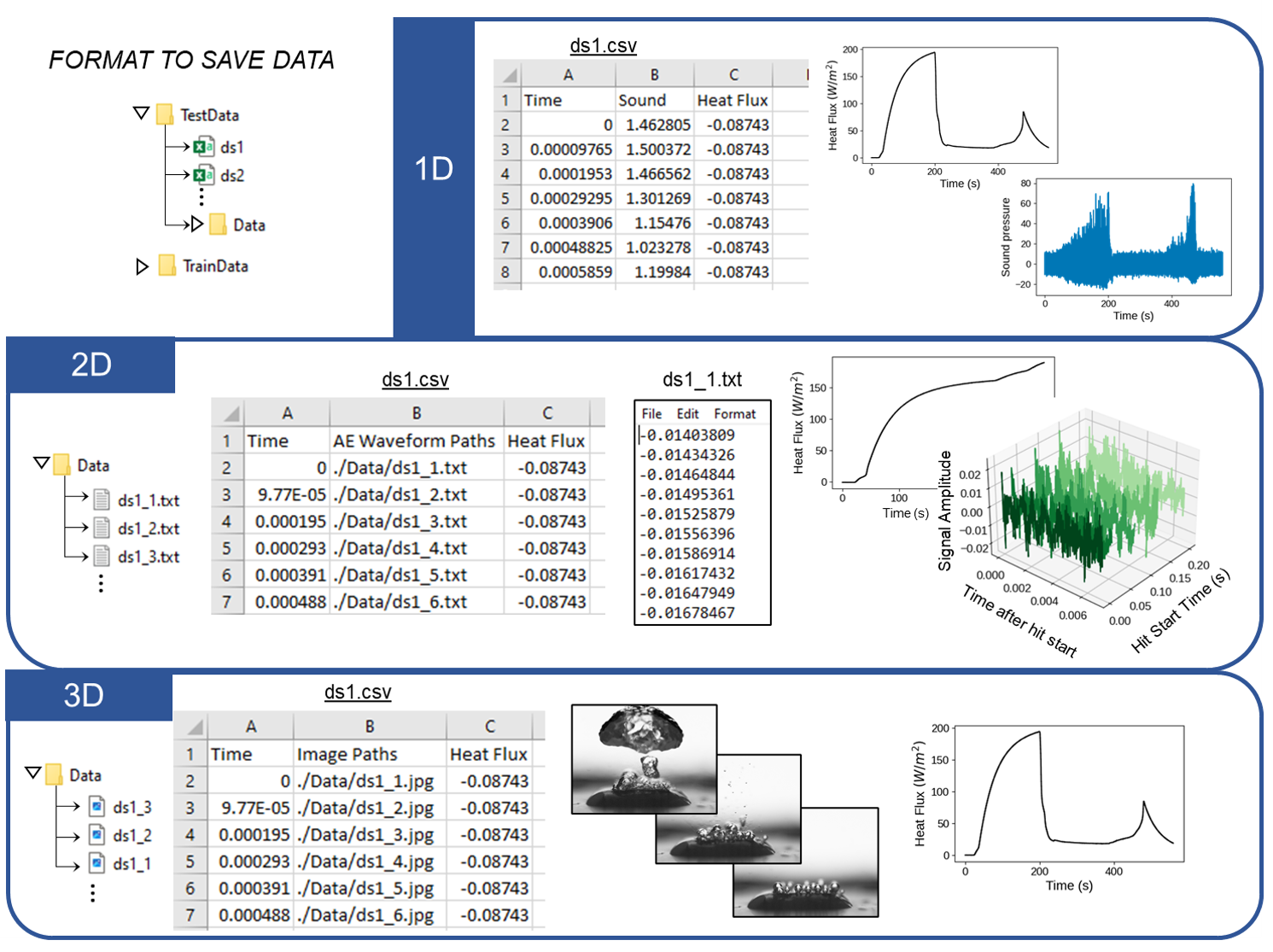
SeqReg can be used for regression from 1D, 2D, or 3D (wip) inputs. It is designed to work with multiple sets of experimental data. Each experimental dataset must be saved in a csv. One column should contain time (or index) one should contain the output labels (in this case heat flux) corresponding to each input at the specified time. The other column should contain the model inputs. This could be just a single value, a path relative to the csv to an array saved in a txt file, or a path to an image.
Using SeqReg
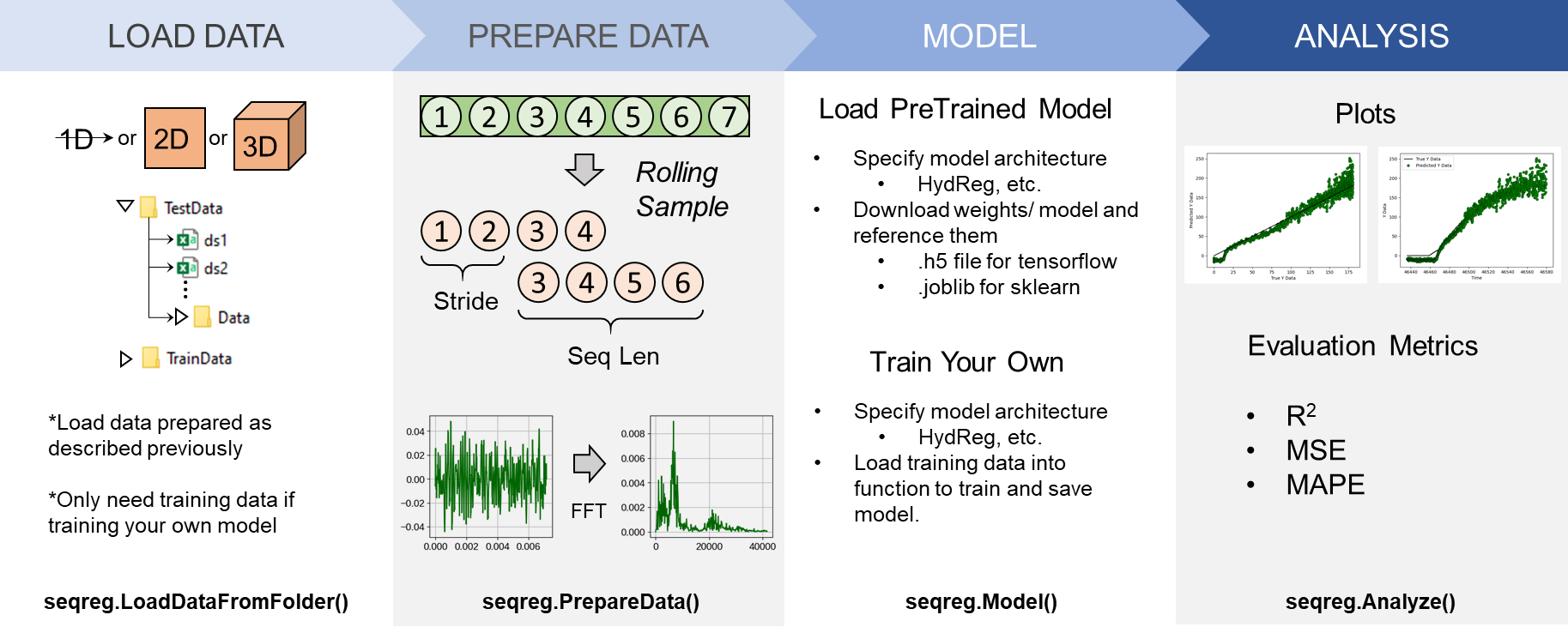
To use SeqReg there are four main functions that must be used:
- Load Data: This function will load in the data from the folders given they follow the format described. The user will input the location of the data and type. This function can be used for loading both training and testing data depending on the overall end goal.
- Prepare Data: This function is used to convert the long sequences from each dataset into shorter sequences and the outputs. It also includes the option for converting each sequence into the frequency domain.
- Model: This function provides a few options for defining the model:
-
Load Pre-Trained Model: For loading pretrained models, first the correct architecture must be defined. Additionally the corresponding weights must be downloaded and the path should be included in the function. There are currently 2 pretrained models provided from past work.
Model Name Weights Location Description Parameters HydReg Link Predicts heat flux from hydrophone sound data recorded in pool boiling experiments [1] FFT=True, SeqLen=4000 Hit2Flux Link Predicts heat flux from ae sensor hit data recored in pool boiling experiments [2] FFT=True, SeqLen=25, seqout=True -
Train on Your Own Data: If you want to use a predefined model achitecture with your own data just set train to true, pass in training data, and define the weights location as where you want the weights/model to be saved. Set the model name to one of the already defined models.
-
Train Your Own Data on Custom Model: pending
-
- Analysis: This function allows for performance visualization and returns a dictionary of performance metrics.
References
[1] C. Dunlap, H. Pandey, E. Weems, and H. Hu, “Nonintrusive Heat Flux Quantification Using Acoustic Emissions During Pool Boiling,” Appl Therm Eng, p. 120558, Apr. 2023, doi: 10.1016/j.applthermaleng.2023.120558.
[2]
[3] C. Dunlap, C. Li, H. Pandey, Y. Sun, and H. Hu, “A Temporal-Spatial Framework for Efficient Heat Flux Monitoring of Transient Boiling,” IEEE Trans Instrum Meas, 2024, doi: 10.1109/TIM.2024.3460944.
1 maintainer

Metadata
1 maintainer
Release files for seqreg 0.0.11
For a detailed explanation of source distributions (sdists) and built distributions (wheels), please see the package formats documentation.
Source distribution (sdist)
| File | Size | Uploaded | Provenance | Actions |
|---|---|---|---|---|
| seqreg-0.0.11.tar.gz | 14.5 kB | Without provenance | Details for seqreg-0.0.11.tar.gz |
Built distribution (wheel)
| File | Interpreter | ABI | Platform | Actions Reset |
|---|---|---|---|---|
| seqreg-0.0.11-py3-none-any.whl | Python 3 | none | any | Details for seqreg-0.0.11-py3-none-any.whl |
Total release size: 28.3 kB
Release files / seqreg-0.0.11.tar.gz
| Download URL | seqreg-0.0.11.tar.gz |
|---|---|
| Size | 14.5 kB |
| Tags | Source |
|
SHA-256 checksum How to use checksums |
930e7072caa79a15aab2a07fd36414312993b31bc92fa3a9a9c6fa27012be149
|
|
BLAKE2b-256 checksum How to use checksums |
fa7559625bafafa1d6135e7f68b7764e233bedebe7eda642da4c77038f138480
|
| Upload date | |
|
Uploaded using Trusted Publishing? What is trusted publishing? |
No |
| Uploaded via |
twine/6.0.1 CPython/3.10.16
|
Release files / seqreg-0.0.11-py3-none-any.whl
| Download URL | seqreg-0.0.11-py3-none-any.whl |
|---|---|
| Size | 13.8 kB |
| Tags | Python 3 |
|
SHA-256 checksum How to use checksums |
a57ef859c188151653060fe727097df1fdd1c94014cda926ae15e147411337e4
|
|
BLAKE2b-256 checksum How to use checksums |
fd3cd0b8865e5e3bfde63a5aae38be8951312d51b729a94a95dbefa2de8dd035
|
| Upload date | |
|
Uploaded using Trusted Publishing? What is trusted publishing? |
No |
| Uploaded via |
twine/6.0.1 CPython/3.10.16
|
Security for seqreg 0.0.11
Provenance
Provenance describes where a file came from. On PyPI, provenance is shared via attestations, which provide a verifiable record of the build or publishing details. View details, limitations and caveats.
No provenance found
None of the files in this release were uploaded with provenance metadata.
A note on package security
PyPI is a repository for distributing packages, not a service for auditing them. While third-party security researchers and our staff do their best to detect and remove malicious packages, PyPI cannot guarantee the quality, security or suitability of any given package.
To learn more about protecting yourself from malicious actors, visit our package security documentation.














