session-peer

Local and SSH messaging for coding agent sessions. This project continues cc-peer; its Git history and issue numbers are preserved.

Codex sessions

session-peer list --agent codex
session-peer list --agent codex --host worker
session-peer send --to codex:<full-thread-uuid> "message"
session-peer send --host worker --to codex:<full-thread-uuid> "message"
session-peer send --to codex:<full-thread-uuid> --dry-run "message"

The default agent remains Claude. Codex discovery reads state_5.sqlite using a read-only SQLite connection. This internal schema is experimental, tested with Codex CLI 0.154.0 on macOS; the core CI also runs on Linux and Windows. Saved sessions are not necessarily active. --all includes archived threads.

--codex-home overrides the destination's CODEX_HOME (default ~/.codex). --codex-bin overrides its PATH lookup of codex. On SSH these are remote paths; session-peer itself need not be installed remotely, but Codex must be installed.

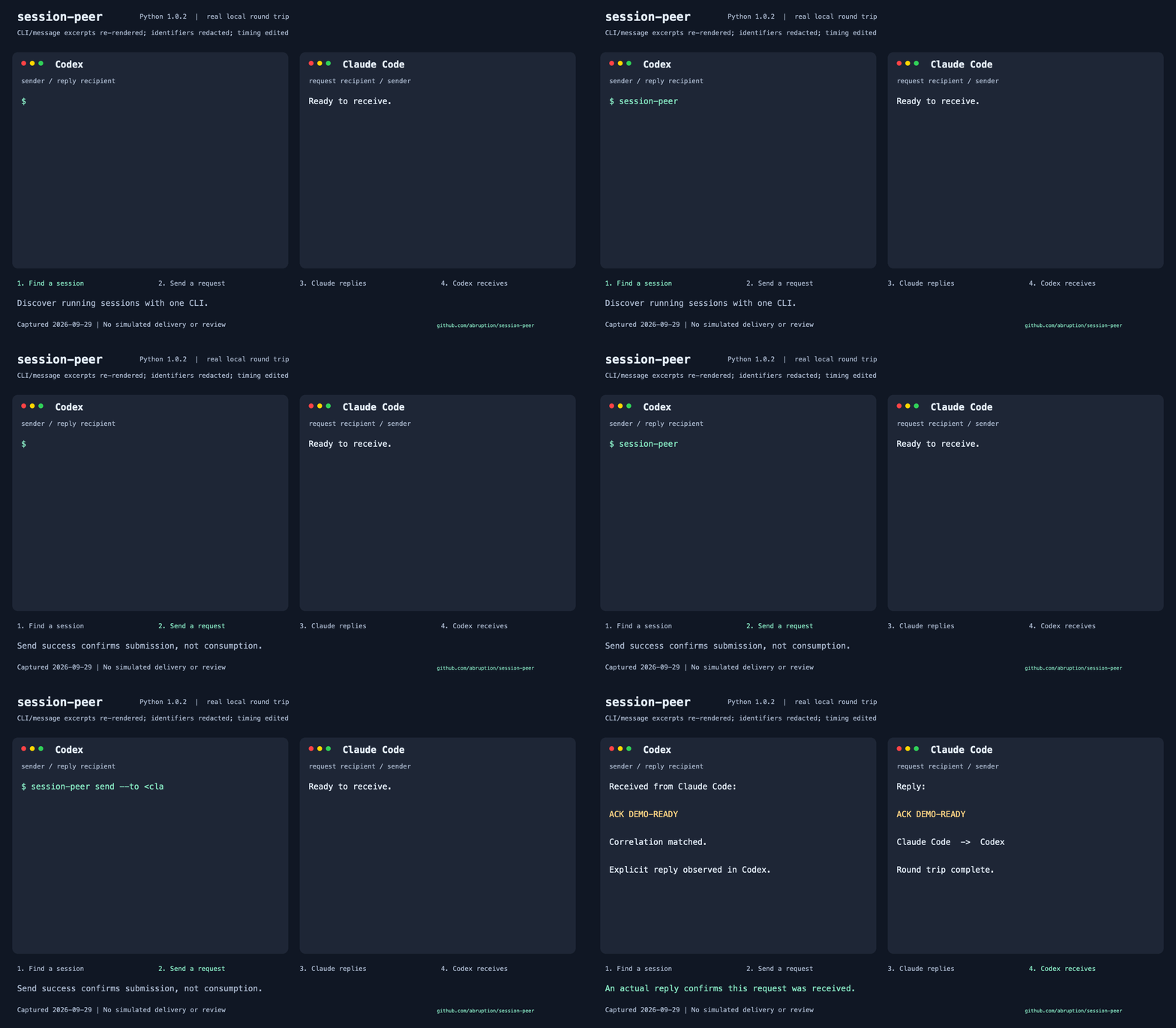
Submission uses codex queue, never direct database writes. queued means the CLI accepted the submission, not that a turn consumed it or acknowledged it. session-peer does not wake or resume sessions. Queue DB writes and Claude socket connections may require approval in the caller's execution environment; the tool does not change sandbox or inbound policies. A timeout has an unknown submission outcome: inspect the destination before retrying.

Codex messages are limited to 32 KiB of UTF-8 including sender/reply headers, as a session-peer portability policy rather than a measured Codex server limit. NUL characters cannot be passed as CLI arguments. --dry-run verifies the executable and saved target but cannot guarantee a later submission will succeed.

Codex list JSON retains the {sessions, version} local envelope. Each entry has agent, id, name (first line, at most 120 characters), cwd, updatedAt (Unix seconds), and archived. Send adds target: {agent, id} and status: queued (or validated under dry-run) to the existing {ok, chars, dryRun} envelope; queueId is optional. Remote results retain host attribution and status. Claude output stays compatible. A missing dry-run target returns exit 2; CLI execution/submission failures return exit 1. Existing identity/reply detection identifies Claude senders, not Codex senders.

Moving from cc-peer

Install the new product explicitly: pipx install session-peer (or uv tool install session-peer, or python -m pip install session-peer in a virtual environment). No cc-peer command alias is installed. Both products can coexist. After checking your workflows, remove the old package with the same manager that installed it, e.g. pipx uninstall cc-peer. For a script installation, use the install.sh --uninstall from the pinned cc-peer v0.5.1 tag; check its paths before running it. New uninstall only removes session-peer files.

The standalone installer places the program in ~/.local/share/session-peer/session_peer.py, its CLI link in ~/.local/bin, and its Claude skill in ${CLAUDE_CONFIG_DIR:-~/.claude}/skills/session-peer. Pip installs only the CLI. Claude/Codex configuration and old installations are not migrated or removed automatically. SESSION_PEER_REPLY_HOST takes precedence over the compatibility input CC_PEER_REPLY_HOST.

cc-peer 0.5.1 is the final Claude-only compatibility line, not an ongoing feature or security-maintenance promise. The frozen root cc_peer.py is retained in tags for old self-update URLs but is excluded from the new wheel and sdist. Its local update command directs users here instead of installing a different product.

Package-managed installations must use their package manager to upgrade. session-peer update replaces only independently installed scripts; remote updates push the standalone program to the destination's neutral data directory.

PyPI CI License: MIT Python 3.9+

For Claude Code, the original SSH inbox workflow remains available:

$ session-peer list --host build-server
Sessions on build-server:
NAME             PID    STATUS  CWD
api-worker       4011   idle    /srv/api
migration-watch  4614   busy    /srv/api

$ session-peer send --host build-server --to api-worker "Schema migration landed; rebase is safe now."
Posted to api-worker's inbox on build-server (44 chars).

Use the official feature first

Claude Code has cross-session messaging built in, and it already covers most cases:

Target How the official feature delivers it
Same machine Per-session Unix socket. Never touches Anthropic's servers.
Another machine Through Anthropic's servers, over Remote Control.
Claude on the web Through Anthropic's servers.

If Remote Control works for you, use it — it needs no scripts and it gives the receiving Claude a reply address.

session-peer is for the cases where it isn't available:

  • Bedrock / Vertex / Foundry — Remote Control is disabled on those providers.
  • API-key auth — finding sessions beyond this machine needs a claude.ai sign-in.
  • Air-gapped or compliance-bound networks — where relaying through a third party is the problem.
  • Unattended workers — a headless box nobody is around to connect to Remote Control.

If none of those describe you, you probably don't need this.

How it works

Claude Code binds a Unix domain socket per session as that session's inbox, and documents it under The session's inbox socket — explicitly "when you want a script or hook to post into a session". Posting is one JSON line:

{"type":"user","message":{"role":"user","content":"your message"}}

That socket is local to its machine, and forwarding it doesn't help: Claude Code verifies the peer process and uid on the connection, so ssh -L gets refused as "an endpoint that isn't the expected process".

So session-peer doesn't forward the socket. It runs the same write inside a remote shell, where the connection is local again. --host pipes this script over SSH to python3 -, so nothing needs to be installed on the remote machine.

Read the socket path; never guess it

Session records live in ~/.claude/sessions/<pid>.json and carry the socket path. It is not always /tmp/cc-socks/ — on two Ubuntu hosts running the same Claude Code build, one bound under /tmp/cc-socks/ and the other under /run/user/1001/cc-socks/. Claude Code also falls back to a private per-user directory when it rejects the one it would have used. session-peer reads messagingSocketPath out of the record and treats a live PID with no bound socket as unreachable.

Install

Python 3.9+, standard library only — no external dependencies.

pip

pip install session-peer

Or with pipx for an isolated install:

pipx install session-peer

pip installs the session-peer command but not the Claude Code skill. To add the skill so Claude can use session-peer on its own:

mkdir -p ~/.claude/skills/session-peer
curl -fsSL -o ~/.claude/skills/session-peer/SKILL.md \
  https://raw.githubusercontent.com/abruption/session-peer/main/skills/session-peer/SKILL.md

install.sh

Installs both the command and the skill in one step. Use this for air-gapped hosts or remote deployment over SSH:

git clone https://github.com/abruption/session-peer && cd session-peer

./install.sh                          # this machine
./install.sh --host build-server      # a remote machine, over SSH
./install.sh --host web-01 --host db  # several at once

That places session_peer.py in ~/.local/share/session-peer/, installs the Claude Code skill in ~/.claude/skills/session-peer/, and links ~/.local/bin/session-peer. Existing cc-peer files are preserved. Remove it with ./install.sh --uninstall [--host ...].

session-peer update refreshes this machine from the latest GitHub release. For another machine, ./install.sh --host <host> pushes this copy over SSH — deliberately, since a target with no route to GitHub is one of the cases this tool exists for. session-peer update --host reports what that machine has rather than trying to make it fetch.

Remote installs push the files over the SSH connection itself, so the target needs no internet access — which matters, since air-gapped hosts are one of the reasons this exists. It needs python3 and your SSH access, nothing more.

Or skip the installer entirely and copy the one file:

curl -O https://raw.githubusercontent.com/abruption/session-peer/main/session_peer.py
chmod +x session_peer.py

The skill

Installing puts a skill next to the script, so Claude picks the target session and writes the message itself when you ask it to reach a session on another box. The script keeps the deterministic part — resolving a session, writing the socket — and the skill only decides what to send where. Discovery leans on a session-record schema that isn't part of Claude Code's documented interface, so it is described in prose the agent can adapt rather than hardcoded logic that silently breaks.

Usage

session-peer list                                  # sessions on this machine
session-peer list --host web-01                    # sessions over there
session-peer list --host web-01 --all              # include stale records / no inbox

session-peer send --to api-worker "message"        # local session
session-peer send --host web-01 --to api-worker "message"
session-peer send --host web-01 --to 4011 "message"          # address by pid
git log --oneline -5 | session-peer send --host web-01 --to api-worker -   # stdin

session-peer send --host web-01 --to api-worker --dry-run "x"   # resolve only
session-peer list --host web-01 --json             # machine-readable

# Versions. list --host reports what that machine has installed and flags a
# mismatch, since a host left behind by a release won't say so on its own.
session-peer update --check                        # is there a newer release?
session-peer update                                # replace this installation
session-peer update --host web-01                  # report what's over there
session-peer send --host web-01 --ssh-opt=-p --ssh-opt=2222 --to api-worker "..."   # note the '='

# Envelope. Sends carry who they're from and how to answer, both resolved from
# the session session-peer is running inside.
session-peer send --host web-01 --to api-worker --no-reply-to "..."         # no return address
session-peer send --host web-01 --to api-worker --no-from "..."             # no From: header
session-peer send --host web-01 --to api-worker --reply-to 100.64.0.5 "..." # state the address

Exit codes: 0 posted, 1 error, 2 no such session, 130 interrupted (Ctrl-C).

Environment variables

Variable Effect
SESSION_PEER_REPLY_HOST Override the reply address. Resolution order: --reply-to flag → SESSION_PEER_REPLY_HOST → auto-detected Tailscale IP. Useful on VPNs where Tailscale isn't installed — set it once instead of passing --reply-to on every call.
CLAUDE_CONFIG_DIR Where Claude Code keeps its config (default ~/.claude). Respected by session-peer list for session discovery and by install.sh for skill placement.
ANTHROPIC_CONFIG_DIR Fallback if CLAUDE_CONFIG_DIR is unset.

The receiving side decides what happens next

"Posted" is not "delivered." Writing to the socket succeeds; whether Claude ever reads the message is up to that session's inbound controls.

The default that surprises people: a session running with --dangerously-skip-permissions holds every incoming message for its user's approval, unless the sender identifies itself as also bypassing. A script can't make that claim, so on an unattended bypass-mode worker your message sits in an approval dialog and expires after dialogExpiry (5 minutes by default).

For a worker meant to take messages unattended, set this in its settings:

{ "crossSessionInbound": "accept" }

Or start it with --settings '{"crossSessionInbound":"accept"}'. Do this deliberately: it means anything that can write to that socket can start a turn on that machine.

Two things worth knowing before you set it:

  • It applies to sessions that are already running. No restart needed. Measured on two sessions up for 144h and 4h that predated the setting entirely — both took a posted message ~3s later with no approval dialog, while still showing ⏵⏵ bypass permissions on.
  • User settings are per OS user, not per session. Putting accept in ~/.claude/settings.json opens every session that user runs, not just the worker you meant. Scope it with project settings or --settings if you want one session to accept and the rest to keep asking.

Why not tmux send-keys?

ssh host 'tmux send-keys -t sess "msg" Enter' needs no script, and for a quick nudge it's fine. It breaks down as soon as timing or payload get interesting:

tmux send-keys inbox socket
Session is mid-tool-call Keystrokes land wherever focus is — possibly a subprocess's stdin Queued, read at a turn boundary
Quotes, backticks, $, newlines, emoji Shell and terminal both get a say Delivered byte-for-byte in JSON
Rapid sends Races Native queue, burst limits, duplicate drop
Attribution Looks like the user typed it Arrives marked as another session, and can't approve permissions

That last row matters: a message posted to the inbox cannot answer a permission prompt or change configuration. Text typed via send-keys is indistinguishable from you.

Limits

  • The receiver is told who sent the message. Claude Code records a socket-posted message with from: "unknown" — it has a field for the sender and nothing to put in it. Sends therefore open with From: <user>@<host> (<session>). What Claude Code already supplies, session-peer does not repeat: it prefaces peer messages and appends its own guidance about what a peer may ask for, so duplicating either would compound with every hop.
  • Replies depend on SSH working the other way. Sends append a Reply: line naming this machine's tailnet address and this session, so the receiver can answer — but only if that machine can SSH back. When it can't, neither side is told. The line grants nothing on its own: anyone who can reply could already have sent unprompted. What it adds is knowing that.
  • No discovery across a bastion. --host is a single SSH hop; chain it yourself with an SSH config ProxyJump.
  • Same OS user. The socket is restricted to the user that owns the session, so session-peer gives you nothing you couldn't already do with your own shell on that host. It is not a privilege-escalation path — but it does mean anyone with that shell can start a turn.
  • --host and --ssh-opt are as trusted as your ssh config. They are handed to ssh, so whoever controls them controls where you connect. Values that would make ssh run a local command (ProxyCommand and friends) are refused, and a --host starting with - is rejected outright — but if you allowlist session-peer for an agent, treat it as granting SSH, not just messaging. Message bodies and session names carry no such risk: they are quoted before they reach any shell.
  • Windows support. Native Windows sessions use named pipes instead of Unix sockets, and require an auth line before the message. Both are handled automatically — the auth token is read from the session's .key file. install.sh is POSIX sh and won't run on Windows; use pip install session-peer there instead.

Tests

python3 -m unittest test_session_peer -v

No network, no SSH, no Claude Code — standard library only. CI runs them on Ubuntu and macOS against Python 3.9 and 3.13, plus shellcheck on the installer.

The cases cover what has actually been wrong here: the argument quoting that stops --to reaching a remote shell, the caps that weren't enforced under --dry-run, and the reply line's user and absolute path. A regression in any of those is silent otherwise.

Verified

Claude Code v2.1.263 across five machines over Tailscale SSH — two macOS 26 (Apple silicon), two Ubuntu 24.04 (arm64, Oracle Ampere A1 in separate regions), and one Windows 10 22H2. What was actually exercised:

  • Posting from macOS to Linux sessions in two regions; each landed in the receiving transcript as type: user with origin.kind: "peer".
  • Payload integrity — quotes, backticks, $HOME, and emoji arrive byte-for-byte.
  • The held path: a bypass-mode session raised an approval dialog, then logged Released 1 held cross-session message once approved.
  • Both socket layouts in the wild: /tmp/cc-socks/ on one Ubuntu host, /run/user/1001/cc-socks/ on another running the same build.
  • Windows named pipe transport (\\.\pipe\LOCAL\cc-msg-<hash>) with mandatory auth line read from the session's .key file. list, send, and --host all verified on the Windows machine.

The session record schema (~/.claude/sessions/*.json) is not part of Claude Code's documented interface and can change between releases. The socket protocol is documented; discovery is inference. If a release moves things, session-peer list --all is the first thing to run.

License

MIT

Download files

Download the file for your platform. If you're not sure which to choose, learn more about installing packages.

Source Distribution

session_peer-0.6.0.tar.gz (22.0 kB view details)

Uploaded Source

Built Distribution

If you're not sure about the file name format, learn more about wheel file names.

session_peer-0.6.0-py3-none-any.whl (23.0 kB view details)

Uploaded Python 3

File details

Details for the file session_peer-0.6.0.tar.gz.

File metadata

  • Download URL: session_peer-0.6.0.tar.gz
  • Upload date:
  • Size: 22.0 kB
  • Tags: Source
  • Uploaded using Trusted Publishing? Yes
  • Uploaded via: twine/7.0.0 CPython/3.13.14

File hashes

Hashes for session_peer-0.6.0.tar.gz
Algorithm Hash digest
SHA256 da214e5847ba43b6468a53a5ae01704f8678e3f3f2d41a4fb087fe508309f328
MD5 4b226c334da126a3a6226406cc557d87
BLAKE2b-256 e5b0c608aef48693f76423d69765f7725decbbaf81415aa5453039fca2b0c908

See more details on using hashes here.

Provenance

The following attestation bundles were made for session_peer-0.6.0.tar.gz:

Publisher: publish.yml on abruption/session-peer

Attestations: Values shown here reflect the state when the release was signed and may no longer be current.

File details

Details for the file session_peer-0.6.0-py3-none-any.whl.

File metadata

  • Download URL: session_peer-0.6.0-py3-none-any.whl
  • Upload date:
  • Size: 23.0 kB
  • Tags: Python 3
  • Uploaded using Trusted Publishing? Yes
  • Uploaded via: twine/7.0.0 CPython/3.13.14

File hashes

Hashes for session_peer-0.6.0-py3-none-any.whl
Algorithm Hash digest
SHA256 b1026f5f280a744d09ec33fa0f29fe8ebabcedc84c4c6be35f659839e4515ef9
MD5 a1d652df4027e5c8273c15a1d91e4a17
BLAKE2b-256 36a64b33ce4e4f2650bdfb939dfc8b33907640ddc9e02c5cec114601a3c2b1d1

See more details on using hashes here.

Provenance

The following attestation bundles were made for session_peer-0.6.0-py3-none-any.whl:

Publisher: publish.yml on abruption/session-peer

Attestations: Values shown here reflect the state when the release was signed and may no longer be current.

Release history Release notifications | RSS feed

This release

0.6.0 This release

2 files

Anthropic, PBC Visionary sponsor Bloomberg Visionary sponsor Hudson River Trading Visionary sponsor Meta Visionary sponsor NVIDIA Visionary sponsor Microsoft Sustainability sponsor Depot Continuous Integration AWS Cloud computing and Security Sponsor Datadog Monitoring Fastly CDN Google Download Analytics Sentry Error logging StatusPage Status page