
Sether (Python)
Hide personal data from your AI before it reaches any LLM provider.
Named for the Hebrew sether (סֵתֶר), the hiding place. Psalm 32:7.
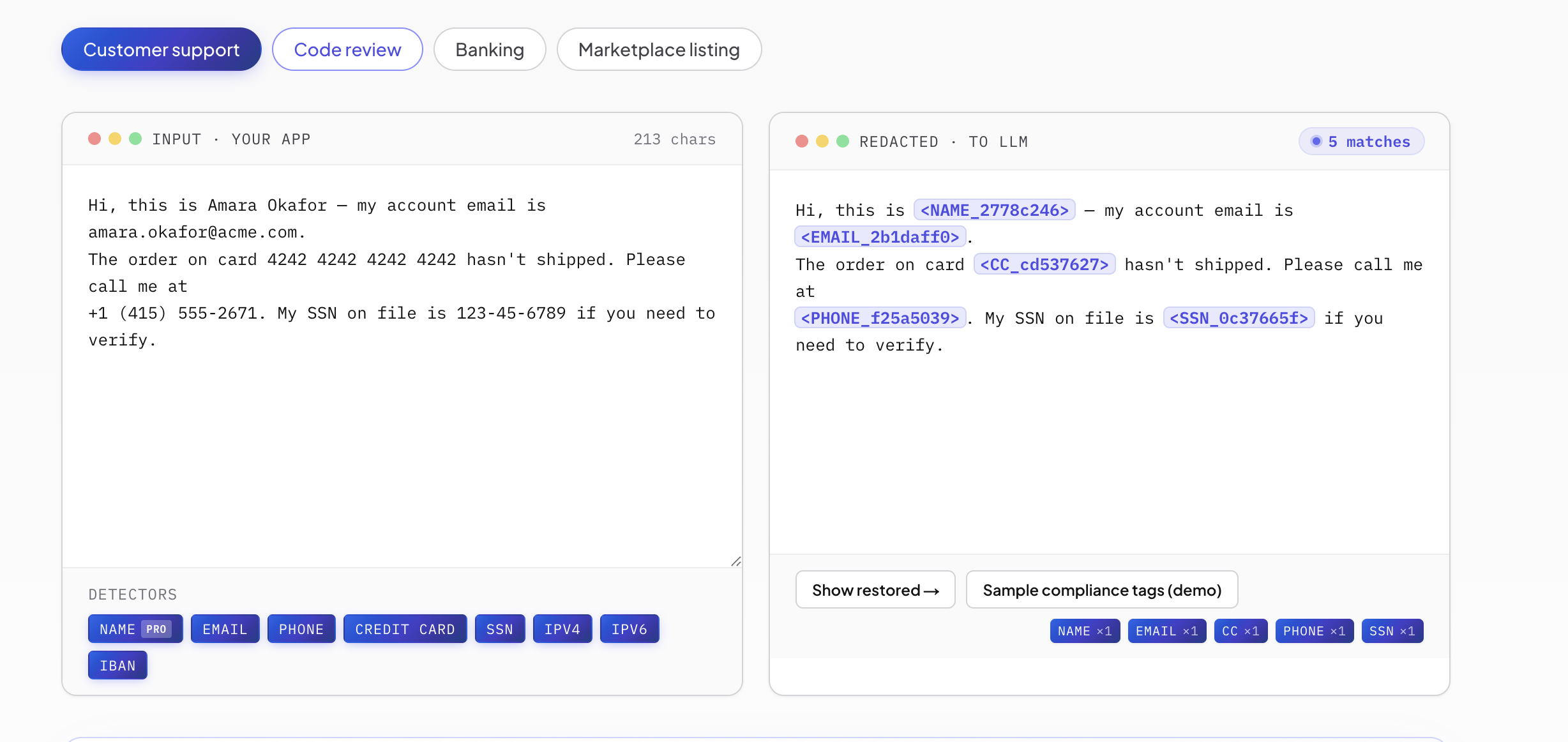
Your app → Sether redacts locally → LLM. The token vault stays in your infrastructure; restore_sync() swaps the originals back into the reply.
Sether is a streaming PII-redaction layer that sits between your application and any LLM API. It detects sensitive data (email, phone, SSN, credit card, IBAN, IP addresses, secrets, and labelled identity fields), swaps each match for a stable token before the request leaves your boundary, then restores the original values transparently in the response.
This is the Python port of @raeven-co/sether.
Same detection engine, same token format, same chunk-boundary streaming safety,
ported faithfully to Python with both synchronous and asynchronous streaming and
drop-in integrations for httpx, ASGI (FastAPI / Starlette), WSGI (Flask),
the OpenAI SDK, and the Anthropic SDK.
A product of Raeven Company LTD.
Why this exists
If your application sends a customer's email, phone number, or any other PII to
an LLM provider, that is a sub-processor disclosure under GDPR Article 28.
Credit-card data pulls you into PCI DSS scope. Health identifiers trigger HIPAA.
Sether stops the leak at the boundary: sensitive substrings become stable tokens
before the bytes leave your process, and restore() swaps them back so your
application code does not need to branch on redacted text.
This package does not phone home. Streams are not sent to Raeven. The vault
stays in your process (or your own backing store if you implement Vault).
Install
pip install sether
Requires Python 3.9+. The phone detector uses phonenumbers
(installed automatically). Integration extras are optional:
pip install "sether[openai]"      # wrap_openai
pip install "sether[anthropic]"   # wrap_anthropic
pip install "sether[httpx]"       # wrap_httpx
pip install "sether[all]"         # all of the above
The ASGI and WSGI middlewares have no extra dependency.
60-second quickstart
from sether import Sether

sether = Sether()

# Outgoing: redact before sending to the LLM.
safe = sether.redact_sync("my email is alice@example.com")
# -> "my email is <EMAIL_xxxxxxxx-xxxx-xxxx-xxxx-xxxxxxxxxxxx>"

# Incoming: restore before showing the user.
back = sether.restore_sync(safe)
# -> "my email is alice@example.com"
The same Sether instance shares its vault between redaction and restoration,
which is how the round-trip identity is preserved.
Streaming (sync and async)
sether = Sether()

# Synchronous: any iterable of text chunks.
def chunks():
    yield "Contact alice@"
    yield "example.com or call "
    yield "+1 415 555 2671."

redacted = "".join(sether.redact_stream(chunks()))
restored = "".join(sether.restore_stream([redacted]))

# Asynchronous: any async iterable (e.g. an LLM token stream).
async def run(llm_stream):
    async for piece in sether.aredact_stream(llm_stream):
        await forward_to_model(piece)
The redact stream holds back safe_distance_bytes (default 256) at the tail of
each chunk so a PII pattern crossing a chunk boundary is still detected when the
next chunk arrives. A long whitespace-free value (a JWT, an API key) is held
back up to max(safe_distance_bytes * 4, 8192) bytes so it is never emitted
partially across a boundary. For values larger than that bound, raise
safe_distance_bytes or use redact_sync on complete payloads. This round-trip
identity is verified by property-based tests over 60 random chunk partitions.
Detectors
By default Sether runs the basic pack. Pass an explicit list to narrow scope, or add the opt-in packs.
from sether import Sether, basic_detectors, secrets_detectors, identity_detectors

sether = Sether(detectors=[*basic_detectors, *secrets_detectors, *identity_detectors])
Basic pack (basic_detectors)
| Detector | Type | Method |
|---|---|---|
email_detector |
EMAIL |
RFC-5321-style regex. ASCII-only. |
phone_detector |
PHONE |
phonenumbers (international format). For national-format numbers use create_phone_detector(default_country="US"). |
credit_card_detector |
CC |
Bounded regex + Luhn check. |
ssn_detector |
SSN |
Regex + SSA invalid-prefix rules. |
ipv4_detector |
IPV4 |
Strict octet-bounded regex. |
ipv6_detector |
IPV6 |
Candidate regex + in-tree validator. |
iban_detector |
IBAN |
Regex + mod-97 checksum. |
Secrets pack (secrets_detectors)
aws_access_key_detector, openai_key_detector, anthropic_key_detector,
github_pat_detector (classic + fine-grained), slack_token_detector,
stripe_key_detector, jwt_detector, high_entropy_detector
(Shannon entropy >= 3.5 bits/char).
Identity pack (identity_detectors, opt-in)
Label-anchored detection for names, dates of birth, passport numbers, and
addresses. A value is redacted only when it appears with the label that
introduces it (Name:, DOB:, Passport No:, Address:) or, for a few
distinctive standalone shapes (a street line with a house number, a UK
postcode), a structure strong enough to keep false positives low. Labels are
recognised across many languages (Latin-script plus CJK, Cyrillic, Arabic), and
value capture is Unicode-aware.
Free-text NER (unlabelled names, organisations, locations in running prose) is
not covered here; that is the separate sether-ner roadmap item.
Custom detectors
Anything with a type string and a detect(text) method works:
import re
from sether import DetectorMatch

class OrderIdDetector:
    type = "ORDER_ID"
    _re = re.compile(r"\bORD-\d{8}\b")

    def detect(self, text):
        return [DetectorMatch(m.start(), m.end(), m.group(0)) for m in self._re.finditer(text)]
Token vault
Tokens map back to originals through a vault. Sether ships an in-memory LRU
vault (10,000 entries, 1-hour TTL by default). Implement the Vault protocol to
change eviction, encrypt at rest, or namespace tokens per tenant.
from sether import Vault   # a runtime-checkable Protocol: set/get/has/delete/size/clear

class NamespacedVault:
    def __init__(self, prefix):
        self._store = {}
        self._prefix = prefix
    def set(self, token, value): self._store[self._prefix + token] = value
    def get(self, token): return self._store.get(self._prefix + token)
    def has(self, token): return (self._prefix + token) in self._store
    def delete(self, token): return self._store.pop(self._prefix + token, None) is not None
    def size(self): return len(self._store)
    def clear(self): self._store.clear()

sether = Sether(vault=NamespacedVault("tenant-42:"))
The Vault interface is synchronous: restore substitutes tokens as bytes
flow through and cannot await a lookup per token. Front an async store (Redis,
Postgres) with a synchronous in-process cache you hydrate before the restore
pass, or keep the vault in-process.
SSE / JSON-stream mode
OpenAI and Anthropic streaming responses come back as Server-Sent Events. The
SSE-aware stream redacts payloads inside data: lines while preserving the
data: / event: / id: / retry: framing and blank-line separators
verbatim.
from sether import create_sse_redact_stream, basic_detectors, MemoryVault

vault = MemoryVault()
stream = create_sse_redact_stream(basic_detectors, vault)
out = stream.feed(sse_chunk) + stream.finish()
# or the iterator helpers: sse_redact_iter(chunks, detectors, vault)
Drop-in integrations
from sether import Sether
sether = Sether()
httpx
import httpx
from sether import wrap_httpx

client = wrap_httpx(httpx.Client(), detectors=sether.detectors, vault=sether.vault)
r = client.post("https://api.example.com/v1/chat",
                json={"q": "email alice@example.com"})
# The request carried <EMAIL_...>; r.text has any tokens the server echoed restored.
Works on httpx.Client and httpx.AsyncClient. Binary bodies pass through
untouched.
ASGI (FastAPI / Starlette)
from fastapi import FastAPI
from sether import SetherASGIMiddleware

app = FastAPI()
app.add_middleware(SetherASGIMiddleware, detectors=sether.detectors, vault=sether.vault)
WSGI (Flask)
from flask import Flask
from sether import SetherWSGIMiddleware

app = Flask(__name__)
app.wsgi_app = SetherWSGIMiddleware(app.wsgi_app, detectors=sether.detectors, vault=sether.vault)
OpenAI SDK
from openai import OpenAI
from sether import wrap_openai

client = wrap_openai(OpenAI(), detectors=sether.detectors, vault=sether.vault)
# Redacts messages out, restores choices back. Sync, async, and streaming clients.
Anthropic SDK
import anthropic
from sether import wrap_anthropic

client = wrap_anthropic(anthropic.Anthropic(), detectors=sether.detectors, vault=sether.vault)
# Redacts messages/system out, restores content blocks back.
The SDK wrappers are structurally typed. Sether never imports openai or
anthropic; any object matching the chat.completions.create /
messages.create shape works.
Audit events
Each redaction can be described by a structured AuditEvent that maps to the
regulation it satisfies (GDPR Art. 28, SOC 2 CC6.7, HIPAA, PCI DSS, and more,
see DEFAULT_REGULATION_MAPPINGS). The original value is never carried in an
event, only its length. The JSON wire shape matches the TypeScript package
(camelCase keys) so events are interchangeable across both.
from sether import AuditEvent, ConsoleAuditSink, MemoryAuditSink

sink = ConsoleAuditSink()   # JSONL to stderr; MemoryAuditSink accumulates for tests
sink.write(AuditEvent(timestamp="...", detector="EMAIL", value_length=17, token="<EMAIL_x>"))
Honest limitations
These match the TypeScript package's documented limits:
- Email detection is ASCII-only. IDN/Unicode local parts do not match.
- IPv6
::1(loopback) is not detected. The candidate regex requires 4+ chars. Loopback is not customer PII. - Credit-card regex is permissive, then validated by Luhn. False positives in dense numeric content are possible.
- Names / DOB / passport / address are label-anchored, not free-text NER.
- Very large whitespace-free values split across chunk boundaries are held
back only up to
max(safe_distance_bytes * 4, 8192)bytes. Raisesafe_distance_bytesor useredact_syncon complete payloads.
Parity with the TypeScript package
This port reproduces the audited TypeScript engine 1:1: the same detector
regexes (compiled with re.ASCII so \b / \d stay ASCII-only as in JS), the
same Luhn / mod-97 / SSA validation, the same overlap resolution (longest match
wins), the same <TYPE_uuid> token format, and the same safe-distance and
long-value streaming guards. 76 tests cover detectors, vault, streaming
(including a property-based chunk-partition round-trip), SSE, audit, and all
five integrations.
License
MIT (c) Godfrey Lebo / Raeven Company LTD
Reporting security issues
Email emorylebo@gmail.com. Do not file public issues for security findings.
1 maintainer

Metadata
1 maintainer
Release files for sether 0.2.0
For a detailed explanation of source distributions (sdists) and built distributions (wheels), please see the package formats documentation.
Source distribution (sdist)
| File | Size | Uploaded | |
|---|---|---|---|
| sether-0.2.0.tar.gz | 45.1 kB | Details |
Built distribution (wheel)
| File | Interpreter | ABI | Platform | Reset |
|---|---|---|---|---|
| sether-0.2.0-py3-none-any.whl | Python 3 | none | any | Details |
Total release size: 86.2 kB
Release files / sether-0.2.0.tar.gz
| Download URL | sether-0.2.0.tar.gz |
|---|---|
| Size | 45.1 kB |
| Tags | Source |
|
SHA-256 checksum How to use checksums |
baed4601b0cbca2066262706b3f6cf86c9daecd67ce61333037e9685e0b750bf
|
|
BLAKE2b-256 checksum How to use checksums |
ac0c802d5112a638c755dcec3007c37177beaf793289656ff5a541771290f852
|
| Upload date | |
|
Uploaded using Trusted Publishing? What is trusted publishing? |
No |
| Uploaded via |
twine/6.2.0 CPython/3.14.5
|
Release files / sether-0.2.0-py3-none-any.whl
| Download URL | sether-0.2.0-py3-none-any.whl |
|---|---|
| Size | 41.1 kB |
| Tags | Python 3 |
|
SHA-256 checksum How to use checksums |
8eb63ea23da511158dd7d075debd5bc66c1f4e8f74478cbbc7ba7e31b67e5b31
|
|
BLAKE2b-256 checksum How to use checksums |
44c1bad1fe16078525e701baa788e06a80f1c583487ba2bd36605f0a12b0c173
|
| Upload date | |
|
Uploaded using Trusted Publishing? What is trusted publishing? |
No |
| Uploaded via |
twine/6.2.0 CPython/3.14.5
|














