
Floatview Stats
| Latest Release |

|
| PyPI Downloads |

|
#Introduction to SCGI Inventory
Version
This is version 1.0.0 of the SGCI Resource Description Specification schema. This work is released under an Apache 2.0
license <https://raw.githubusercontent.com/SGCI/sgci-resource-inventory/master/LICENSE>_ .
Introduction
The user-facing components of the Cyberinfrastructure (CI) ecosystem, science gateways and scientific workflow systems, share a common need of interfacing with physical resources (storage systems and execution environments) to manage data and execute codes (applications).
However, there is no uniform, platform-independent way to describe either the resources or the applications. To address this, we propose uniform semantics for describing resources and applications that will be relevant to a diverse set of stakeholders.
The SGCI Resource Description Specification provides a standard way for institutions and service providers to describe storage and computing infrastructure broadly available to the research computing and science gateway community. SGCI Resource descriptions provide a foundation for interoperability across gateway components and other cyberinfrastructure software.
The current, initial version of the resource description language focuses on “traditional” HPC and high-throughput storage and computing resources
Installation
pip install sgci-resource
Usage
from sgci_resource import core
gh = core.SCGICatalogXsede()
#gh = core.SCGICatalogLocal(folder="REPO_PATH")
#gh = core.SCGICatalogGithub(token="GITHUB_TOKEN")


#print available resources
l = gh.listResources()
print(l)


# Print json description
resource = gh.getResource('RESOURCE.IDENTIFICATION.KEY') # e.g. stampede2.tacc.xsede
print(resource)

# Print json description
namehost = gh.searchPath("[name, host]", resource)
print(namehost)
#Integration
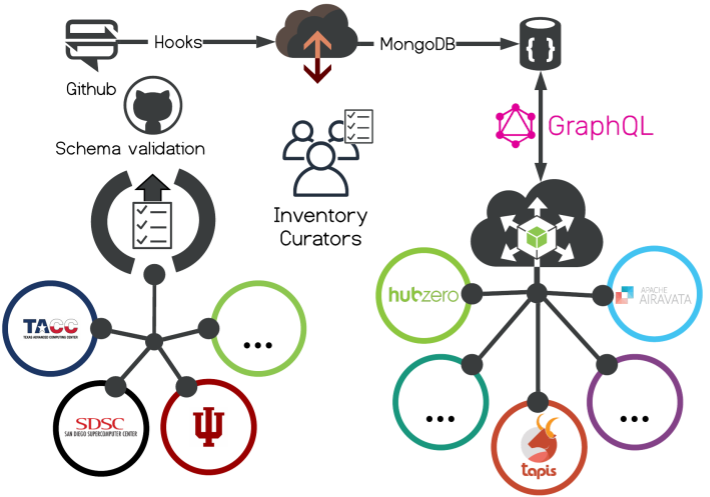
The SCGI Inventory is currently been integrated with Airavata, HUBzero |reg| , and Tapis. We expect the inventory to be adapted by others soon.
Links:
https://github.com/SGCI/sgci-resource-inventory
https://github.com/SGCI/sgci-resource-inventory-cache-service
Get Involved!
Issues, Comments, PRs all welcome!
SGCI: help@sciencegateways.org
Email: jstubbs at tacc.utexas.edu, smarru at iu.edu, dmejiapa at purdue.edu
1 maintainer

Metadata
1 maintainer
Release files for sgci-resource 0.0.1
For a detailed explanation of source distributions (sdists) and built distributions (wheels), please see the package formats documentation.
Source distribution (sdist)
| File | Size | Uploaded | Provenance | |
|---|---|---|---|---|
| sgci-resource-0.0.1.tar.gz | 6.0 kB | Without provenance | Details |
Built distribution (wheel)
| File | Interpreter | ABI | Platform | Reset |
|---|---|---|---|---|
| sgci_resource-0.0.1-py3-none-any.whl | Python 3 | none | any | Details |
Total release size: 11.8 kB
Release files / sgci-resource-0.0.1.tar.gz
| Download URL | sgci-resource-0.0.1.tar.gz |
|---|---|
| Size | 6.0 kB |
| Tags | Source |
|
SHA-256 checksum How to use checksums |
bd68b6947819687c662a92d197f3cb06c22f0693fb4824fb36c8e826af4c2746
|
|
BLAKE2b-256 checksum How to use checksums |
0a1bdc6731b5bbd1c241fe0e61f8b748227d0b29aa6918f5ff45cac2bcfd0115
|
| Upload date | |
|
Uploaded using Trusted Publishing? What is trusted publishing? |
No |
| Uploaded via |
twine/3.7.0 importlib_metadata/4.8.2 pkginfo/1.8.2 requests/2.26.0 requests-toolbelt/0.9.1 tqdm/4.62.3 CPython/3.9.7
|
Release files / sgci_resource-0.0.1-py3-none-any.whl
| Download URL | sgci_resource-0.0.1-py3-none-any.whl |
|---|---|
| Size | 5.8 kB |
| Tags | Python 3 |
|
SHA-256 checksum How to use checksums |
8d03e0bc7f4b602ade1a3dcfa7e8b246d72db20c191af16eade39ef7374e5fdd
|
|
BLAKE2b-256 checksum How to use checksums |
13c63ca0ad0401081b5de81fce378634c47b40c95a0fd814349c9d6db37b2574
|
| Upload date | |
|
Uploaded using Trusted Publishing? What is trusted publishing? |
No |
| Uploaded via |
twine/3.7.0 importlib_metadata/4.8.2 pkginfo/1.8.2 requests/2.26.0 requests-toolbelt/0.9.1 tqdm/4.62.3 CPython/3.9.7
|
Security for sgci-resource 0.0.1
Provenance
Provenance describes where a file came from. On PyPI, provenance is shared via attestations, which provide a verifiable record of the build or publishing details. View details, limitations and caveats.
No provenance found
None of the files in this release were uploaded with provenance metadata.
A note on package security
PyPI is a repository for distributing packages, not a service for auditing them. While third-party security researchers and our staff do their best to detect and remove malicious packages, PyPI cannot guarantee the quality, security or suitability of any given package.













