
Speech enhancement model using SGMSE

Project description
Speech Enhancement and Dereverberation with Diffusion-based Generative Models
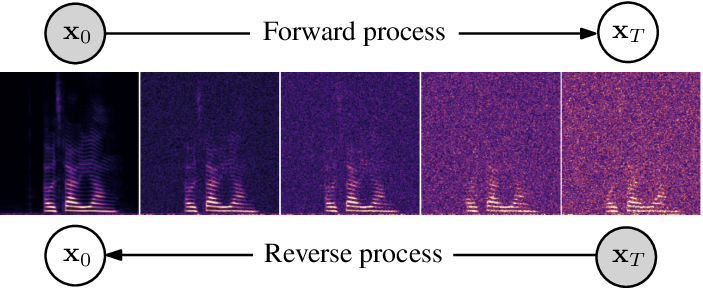
This repository contains the official PyTorch implementations for the papers:
- Simon Welker, Julius Richter, Timo Gerkmann, "Speech Enhancement with Score-Based Generative Models in the Complex STFT Domain", ISCA Interspeech, Incheon, Korea, Sept. 2022. [bibtex]
- Julius Richter, Simon Welker, Jean-Marie Lemercier, Bunlong Lay, Timo Gerkmann, "Speech Enhancement and Dereverberation with Diffusion-Based Generative Models", IEEE/ACM Transactions on Audio, Speech, and Language Processing, vol. 31, pp. 2351-2364, 2023. [bibtex]
- Julius Richter, Yi-Chiao Wu, Steven Krenn, Simon Welker, Bunlong Lay, Shinji Watanabe, Alexander Richard, Timo Gerkmann, "EARS: An Anechoic Fullband Speech Dataset Benchmarked for Speech Enhancement and Dereverberation", ISCA Interspecch, Kos, Greece, Sept. 2024. [bibtex]
- Julius Richter, Danilo de Oliveira, Timo Gerkmann, "Investigating Training Objectives for Generative Speech Enhancement" (preprint), 2024. [bibtex]
Audio examples and supplementary materials are available on our SGMSE project page, EARS project page, and Investigating training objectives project page.
Follow-up work
Please also check out our follow-up work with code available:
- Jean-Marie Lemercier, Julius Richter, Simon Welker, Timo Gerkmann, "StoRM: A Diffusion-based Stochastic Regeneration Model for Speech Enhancement and Dereverberation", IEEE/ACM Transactions on Audio, Speech, Language Processing, vol. 31, pp. 2724 -2737, 2023. [github]
- Bunlong Lay, Simon Welker, Julius Richter, Timo Gerkmann, "Reducing the Prior Mismatch of Stochastic Differential Equations for Diffusion-based Speech Enhancement", ISCA Interspeech, Dublin, Ireland, Aug. 2023. [github]
Installation
- Create a new virtual environment with Python 3.11 (we have not tested other Python versions, but they may work).
- Install the package dependencies via
pip install -r requirements.txt.- Let pip resolve the dependencies for you. If you encounter any issues, please check
requirements_version.txtfor the exact versions we used.
- Let pip resolve the dependencies for you. If you encounter any issues, please check
- If using W&B logging (default):
- Set up a wandb.ai account
- Log in via
wandb loginbefore running our code.
- If not using W&B logging:
- Pass the option
--nologtotrain.py. - Your logs will be stored as local CSVLogger logs in
lightning_logs/.
- Pass the option
Pretrained checkpoints
- For the speech enhancement task, we offer pretrained checkpoints for models that have been trained on the VoiceBank-DEMAND and WSJ0-CHiME3 datasets, as described in our journal paper [2]. You can download them here.
- SGMSE+ trained on VoiceBank-DEMAND:
gdown 1_H3EXvhcYBhOZ9QNUcD5VZHc6ktrRbwQ - SGMSE+ trained on WSJ0-CHiME3:
gdown 16K4DUdpmLhDNC7pJhBBc08pkSIn_yMPi
- SGMSE+ trained on VoiceBank-DEMAND:
- For the dereverberation task, we offer a checkpoint trained on our WSJ0-REVERB dataset. You can download it here.
- SGMSE+ trained on WSJ0-REVERB:
gdown 1eiOy0VjHh9V9ZUFTxu1Pq2w19izl9ejD - Note that this checkpoint works better with sampler settings
--N 50 --snr 0.33.
- SGMSE+ trained on WSJ0-REVERB:
- For 48 kHz models [3], we offer pretrained checkpoints for speech enhancement, trained on the EARS-WHAM dataset, and for dereverberation, trained on the EARS-Reverb dataset. You can download them here.
- SGMSE+ trained on EARS-WHAM:
gdown 1t_DLLk8iPH6nj8M5wGeOP3jFPaz3i7K5 - SGMSE+ trained on EARS-Reverb:
gdown 1PunXuLbuyGkknQCn_y-RCV2dTZBhyE3V
- SGMSE+ trained on EARS-WHAM:
- For the investigating training objectives checkpoints [4], we offer the pretrained checkpoints here
- M1:
wget https://www2.informatik.uni-hamburg.de/sp/audio/publications/icassp2025_gense/checkpoints/m1.ckpt - M2:
wget https://www2.informatik.uni-hamburg.de/sp/audio/publications/icassp2025_gense/checkpoints/m2.ckpt - M3:
wget https://www2.informatik.uni-hamburg.de/sp/audio/publications/icassp2025_gense/checkpoints/m3.ckpt - M4:
wget https://www2.informatik.uni-hamburg.de/sp/audio/publications/icassp2025_gense/checkpoints/m4.ckpt - M5:
wget https://www2.informatik.uni-hamburg.de/sp/audio/publications/icassp2025_gense/checkpoints/m5.ckpt - M6:
wget https://www2.informatik.uni-hamburg.de/sp/audio/publications/icassp2025_gense/checkpoints/m6.ckpt - M7:
wget https://www2.informatik.uni-hamburg.de/sp/audio/publications/icassp2025_gense/checkpoints/m7.ckpt - M8:
wget https://www2.informatik.uni-hamburg.de/sp/audio/publications/icassp2025_gense/checkpoints/m8.ckpt
- M1:
Usage:
- For resuming training, you can use the
--ckptoption oftrain.py. - For evaluating these checkpoints, use the
--ckptoption ofenhancement.py(see section Evaluation below).
Training
Training is done by executing train.py. A minimal running example with default settings (as in our paper [2]) can be run with
python train.py --base_dir <your_base_dir>
where your_base_dir should be a path to a folder containing subdirectories train/ and valid/ (optionally test/ as well). Each subdirectory must itself have two subdirectories clean/ and noisy/, with the same filenames present in both. We currently only support training with .wav files.
To see all available training options, run python train.py --help. Note that the available options for the SDE and the backbone network change depending on which SDE and backbone you use. These can be set through the --sde and --backbone options.
Note:
- Our journal [2] uses
--backbone ncsnpp. - For the 48 kHz model [3], use
--backbone ncsnpp_48k --n_fft 1534 --hop_length 384 --spec_factor 0.065 --spec_abs_exponent 0.667 --sigma-min 0.1 --sigma-max 1.0 --theta 2.0 - Our Interspeech paper [1] uses
--backbone dcunet. You need to pass--n_fft 512to make it work.- Also note that the default parameters for the spectrogram transformation in this repository are slightly different from the ones listed in the first (Interspeech) paper (
--spec_factor 0.15rather than--spec_factor 0.333), but we've found the value in this repository to generally perform better for both models [1] and [2].
- Also note that the default parameters for the spectrogram transformation in this repository are slightly different from the ones listed in the first (Interspeech) paper (
- For the investigating training objectives paper [4], we use
--backbone ncsnpp_v2. - For the Schrödinger bridge model [4], we use e.g.
--backbone ncsnpp_v2 --sde sbve --loss_type data_prediction --pesq_weight 5e-4.
Evaluation
To evaluate on a test set, run
python enhancement.py --test_dir <your_test_dir> --enhanced_dir <your_enhanced_dir> --ckpt <path_to_model_checkpoint>
to generate the enhanced .wav files, and subsequently run
python calc_metrics.py --test_dir <your_test_dir> --enhanced_dir <your_enhanced_dir>
to calculate and output the instrumental metrics.
Both scripts should receive the same --test_dir and --enhanced_dir parameters. The --cpkt parameter of enhancement.py should be the path to a trained model checkpoint, as stored by the logger in logs/.
Citations / References
We kindly ask you to cite our papers in your publication when using any of our research or code:
@inproceedings{welker22speech,
  author={Simon Welker and Julius Richter and Timo Gerkmann},
  title={Speech Enhancement with Score-Based Generative Models in the Complex {STFT} Domain},
  year={2022},
  booktitle={Proc. Interspeech 2022},
  pages={2928--2932},
  doi={10.21437/Interspeech.2022-10653}
}
@article{richter2023speech,
  title={Speech Enhancement and Dereverberation with Diffusion-based Generative Models},
  author={Richter, Julius and Welker, Simon and Lemercier, Jean-Marie and Lay, Bunlong and Gerkmann, Timo},
  journal={IEEE/ACM Transactions on Audio, Speech, and Language Processing},
  volume={31},
  pages={2351-2364},
  year={2023},
  doi={10.1109/TASLP.2023.3285241}
}
@inproceedings{richter2024ears,
  title={{EARS}: An Anechoic Fullband Speech Dataset Benchmarked for Speech Enhancement and Dereverberation},
  author={Richter, Julius and Wu, Yi-Chiao and Krenn, Steven and Welker, Simon and Lay, Bunlong and Watanabe, Shinjii and Richard, Alexander and Gerkmann, Timo},
  booktitle={ISCA Interspeech},
  pages={4873--4877},
  year={2024}
}
@article{richter2024investigating,
  title={Investigating Training Objectives for Generative Speech Enhancement},
  author={Richter, Julius and de Oliveira, Danilo and Gerkmann, Timo},
  journal={arXiv preprint arXiv:2409.10753},
  year={2024}
}
[1] Simon Welker, Julius Richter, Timo Gerkmann. "Speech Enhancement with Score-Based Generative Models in the Complex STFT Domain", ISCA Interspeech, Incheon, Korea, Sep. 2022.
[2] Julius Richter, Simon Welker, Jean-Marie Lemercier, Bunlong Lay, Timo Gerkmann. "Speech Enhancement and Dereverberation with Diffusion-Based Generative Models", IEEE/ACM Transactions on Audio, Speech, and Language Processing, vol. 31, pp. 2351-2364, 2023.
[3] Julius Richter, Yi-Chiao Wu, Steven Krenn, Simon Welker, Bunlong Lay, Shinji Watanabe, Alexander Richard, Timo Gerkmann. "EARS: An Anechoic Fullband Speech Dataset Benchmarked for Speech Enhancement and Dereverberation", ISCA Interspeech, Kos, Greece, 2024.
[4] Julius Richter, Danilo de Oliveira, Timo Gerkmann. "Investigating Training Objectives for Generative Speech Enhancement", arXiv preprint arXiv:2409.10753, 2024.
Release history Release notifications | RSS feed


Download files
Download the file for your platform. If you're not sure which to choose, learn more about installing packages.
Source Distribution
Built Distribution
Filter files by name, interpreter, ABI, and platform.
If you're not sure about the file name format, learn more about wheel file names.
Copy a direct link to the current filters
File details
Details for the file sgmse-0.1.1.tar.gz.
File metadata
- Download URL: sgmse-0.1.1.tar.gz
- Upload date:
- Size: 39.0 kB
- Tags: Source
- Uploaded using Trusted Publishing? No
- Uploaded via: twine/5.1.1 CPython/3.11.5
File hashes
| Algorithm | Hash digest | |
|---|---|---|
| SHA256 |
3a38ca99186e86546730909075aed27754448fb1a3e5ae9d9565bf2df6e6f1c6
|
|
| MD5 |
4cff5b6aa37722e171d0ef7c2f34b0d4
|
|
| BLAKE2b-256 |
54ce83c088be3f642f086256e9037357cfb1b30d40c542ee65bf9ded80be06a9
|
File details
Details for the file sgmse-0.1.1-py3-none-any.whl.
File metadata
- Download URL: sgmse-0.1.1-py3-none-any.whl
- Upload date:
- Size: 46.7 kB
- Tags: Python 3
- Uploaded using Trusted Publishing? No
- Uploaded via: twine/5.1.1 CPython/3.11.5
File hashes
| Algorithm | Hash digest | |
|---|---|---|
| SHA256 |
9000d8a58c647e1028483d3b3b020a50fdfcab03b5795541b6370e48aa895688
|
|
| MD5 |
d82deb6e3e4e4d1e2a8e0dbb5cb499b2
|
|
| BLAKE2b-256 |
90e98847ec338114f502a7c145b3aefaaf3ff2a6155f8ad33aea0aead2f9f341
|






