
ShadowLM Trainer — fine-tune any open model, from any harness, with any method.
Verified details
These details have been verified by PyPIProject links
GitHub Statistics
Maintainers

Project description




Table of contents
ShadowLM Trainer
A fine-tuning SDK. Any open model. Any harness. Any method.
pip install 'shadowlm[all]'      # the full package — every dependency included
pip install shadowlm             # core SDK only (zero dependencies)
import shadowlm as slm

ds    = slm.Dataset.from_jsonl("data.jsonl").as_chat()       # datasets
model = slm.load("mlx-community/Qwen2.5-0.5B-Instruct-4bit",  # load
                 accelerator="shadow")
run   = model.finetune(ds, method="lora", max_steps=60)      # finetune
print(run.loss, run.sparkline())                             # live metrics
print(model.generate("What is the capital of France?"))      # inference
model.save("out/", fmt="adapter")                            # ship it
Change method="lora" to qlora, dora, full, dpo, grpo, bitfit,
prompt, adapter, more… and nothing else changes. That's the whole idea.
Why "shadow"? Because the model you train here is meant to shadow the
frontier model behind your agent: slm.capture() records the traffic the big
rented model handles, you fine-tune a small open model on it, run it in the
big one's shadow until it performs identically — then switch, and own the
weights. The SDK is that engine; ShadowLM Studio will run
the full loop.
Why ShadowLM Trainer
- Twelve training methods, one argument. LoRA to full fine-tuning to DPO to RL-from-rewards to soft prompts — every technique is a declarative spec the backends read. Adding your own is one file.
- Mixture of Retrieval Experts (
more) — ShadowLM's signature method: facts fused into attention so the model looks them up instead of hallucinating them (details below). - Agent RL, built in. Collect multi-step rollouts, score whole episodes with
an LLM judge, train with DPO or trajectory-level GRPO. No reward math required.
slm.capture(model)turns any OpenAI-compatible harness into trajectories — the harness runs unchanged. - The shadow accelerator. One knob (
accelerator="shadow") that turns on the optimizations that are safe for your model and hardware — and logs exactly what it enabled. No silent magic. - Runs are records. Every finetune persists status, config, and metrics. Terminal loss charts, sparklines, resumable checkpoints, run history that survives the process.
- Honest engineering. No mock backends, no silently-ignored arguments (the mlx backend tells you when a torch-only knob doesn't apply), base-model requirements enforced with errors that say what to do instead.
- Pure-stdlib core.
pip install shadowlmhas zero dependencies; training backends are opt-in extras for your hardware.
Backends
torch (CUDA) is the production backend — PyTorch + transformers + trl
peft, the stack serious training runs on.mlxexists so the same code develops fast on an Apple laptop before it ships to a GPU box.
| backend | hardware | engine |
|---|---|---|
torch |
CUDA GPU (production), or CPU (device="cpu") |
transformers + trl + peft — SFT / DPO / GRPO |
mlx |
Apple Silicon | mlx-lm — the local dev loop |
auto resolves CUDA → torch, else Apple Silicon → mlx, else torch on CPU.
One device knob, no mock fallback. The whole torch path — SFT, DPO, GRPO, eval,
generation — is exercised in CI-style on CPU, so the code a CUDA box runs is
tested code, not blind code.
The pipeline is the standard HuggingFace flow — datasets formats and chat
templates, LoRA/QLoRA adapters, chat-template inference.
Training methods
Each technique lives in its own module under shadowlm/methods/ as a declarative
spec — backends read the spec (adapter kind, base requirements, data rendering),
never the method name.
| method | what it does | base model | default LR |
|---|---|---|---|
lora |
LoRA adapters | either | 2e-4 |
qlora |
LoRA adapters, lowest memory | 4-bit required | 2e-4 |
dora |
weight-decomposed LoRA, often better at low rank | either | 2e-4 |
full |
update every transformer weight | unquantized required | 2e-5 |
cpt |
continued pretraining on raw domain text (no chat template) | either | 5e-5 |
dpo |
preference optimization on {prompt, chosen, rejected} pairs vs a frozen reference (beta=0.1) |
either | 5e-6 |
grpo |
RL from reward functions (reward_fns=[...]) or collected TrajectoryGroups |
either | 5e-6 |
more |
mixture of retrieval experts — facts embedded into a frozen index fused into attention; near-zero-hallucination recall (retrieval_k, retrieval_layers) |
either | 1e-4 |
bitfit |
train only the bias terms (~0.1% of params) | unquantized required | 5e-4 |
prompt |
soft prompts — num_virtual_tokens learned vectors, model frozen (torch) |
either | 5e-3 |
ptuning |
p-tuning — prompt embeddings via a small encoder (torch) | either | 5e-3 |
adapter |
bottleneck adapter modules after each layer (width = lora_r) |
either | 1e-4 |
SFT methods train on chat/instruction/text data; dpo trains on preference
pairs (the preference format, auto-detected from chosen/rejected columns);
grpo trains on {prompt[, answer]} rows with your reward functions:
def prefers_blue(prompts, completions, answer, types=None):
    return [1.0 if "blue" in c.lower() else 0.0 for c in completions]

run = model.finetune(rows, method="grpo", reward_fns=[prefers_blue],
                     grpo_group_size=4)
On CUDA, dpo/grpo ride on trl (DPOTrainer / GRPOTrainer); on Apple Silicon
they need pip install shadowlm[preference]. ORPO / PPO-style RLHF exist in
the substrates and follow the same trainer= slot.
Mixture of Retrieval Experts — teach facts, not vibes
more is for facts: each training fact is embedded into a frozen FAISS
index; wrapped attention layers retrieve each token's nearest memories and
attend over them through small trainable projections (plus LoRA for capacity).
The model learns to look facts up instead of hallucinating them, and the index
travels inside the adapter dir — load(adapter=...) rebuilds everything
(verified on both backends: exact recall of held-in facts, before and after
reload). Needs pip install shadowlm[retrieval].
Train any harness without opening the box
Every agent must call a model, so the model API is the one boundary that
always exists. slm.capture(model) serves an OpenAI-compatible endpoint
(SSE streaming included; parallel calls serialized safely), records every
call your harness makes, and reconstructs multi-turn episodes (prefix-merged,
branch-safe) into trajectories:
with slm.capture(model) as proxy:            # http://127.0.0.1:8327/v1
    run_my_agent(base_url=proxy.base_url)    # any OpenAI-client harness, unchanged
trajectories = proxy.trajectories()
group = slm.judge_group(slm.TrajectoryGroup(trajectories), judge=judge)
run = model.finetune([group], method="grpo")
The async rollout-service tier (gateways, prewarming, fleet-scale trainers) belongs to the studio.
Agent RL: trajectories + judge rewards
For multi-step agents, score whole episodes instead of writing reward math:
group = slm.TrajectoryGroup(                 # several attempts at one task
    slm.Trajectory(messages=rollout_messages, reward=0.0) for _ in range(6))
group = slm.judge_group(group, judge=judge_model)   # LLM-as-judge scores 0–1
run = model.finetune(group.to_preference_rows(), method="dpo")
judge_group asks a judge model to score attempts against a rubric (with a
best/worst ranking fallback that keeps small local judges reliable). Train on
the scored groups two ways: group.to_preference_rows() → DPO, or directly —
model.finetune(groups, method="grpo") runs advantage-weighted policy
gradient over the trajectories (rewards normalized within each group, loss on
assistant tokens only). Collect on-policy rollouts, score, train, repeat.
Bring your own method
Base requirements are enforced with clear errors (e.g. qlora on a 16-bit model
tells you to load a 4-bit one). Adding a technique is one file:
# shadowlm/methods/my_method.py  (or methods.register(...) at runtime)
from .base import TrainingMethod, register

register(TrainingMethod(
    name="my-method",
    description="LoRA variant with my defaults",
    default_learning_rate=1e-4,
))
Install & run
pip install 'shadowlm[all]' gives you everything for a CUDA / CPU box.
Prefer picking parts? Each extra is independent:
| extra | what it adds |
|---|---|
[torch] |
training on CUDA / CPU — transformers + trl + peft + torch |
[mlx] |
the local-dev backend (mlx-lm) |
[preference] |
dpo / grpo on the mlx backend (mlx-lm-lora) |
[retrieval] |
the more method — fact index (sentence-transformers) |
[mlx-all] |
everything for the local dev loop |
To run the examples, grab the repo:
git clone https://github.com/open-gitagent/shadowLM && cd shadowLM
python3 -m venv .venv && source .venv/bin/activate && pip install -e '.[mlx]'
python examples/quickstart.py    # datasets → finetune → inference, end to end
No hardware handy? examples/colab_quickstart.ipynb runs the same flow on a
free Colab GPU.
Output (mlx backend, a 0.5B model — 3.5 seconds of training):
Dataset('sample_dataset', format='chat', rows=8)
before: The capital of France is Paris.
[shadow] enabled: gradient checkpointing
[mlx:gpu] finetuning Qwen2.5-0.5B-Instruct-4bit · lora · 8 examples · 40 iters · lora r=16 on 24 layers · lr 0.0002 (linear, warmup 5)
  [████████████████████████] step   40/40  loss 0.0718  lr 5.00e-05  11.7 st/s  1,048 tok/s
[mlx] done · final loss 0.0718 · adapter ~/.shadowlm/runs/Qwen2.5-0.5B-Instruct-4bit-…

  loss  ▇▆█▇▆▇▇█▅▅▄▅▃▂▃▃▁▂▂▂▁▁▁▁▁▁▁▁▁▁▁▁▁▁▁▁▁▁▁▁  4.2120 → 0.0718
  ♥ succeeded · 40 steps · 3.5s

after: The capital of France is Paris.
The CLI
Everything above, without opening Python — installed with the package:
shadowlm finetune data.jsonl --model Qwen/Qwen2.5-0.5B-Instruct --method lora
shadowlm runs                  # run history: status, steps, losses, duration
shadowlm plot <run-id>         # terminal loss charts for any recorded run
shadowlm chat out/adapter/     # talk to what you trained (base model auto-resolved)
shadowlm methods               # the registered methods, defaults included
Every TrainConfig hyperparameter is a flag (--max-steps, --lora-r,
--num-train-epochs, …) — generated from the dataclass, so the CLI can't
drift from the SDK. shadowlm finetune --help lists them all.
CUDA box
model = slm.load("Qwen/Qwen2.5-0.5B-Instruct", backend="torch",
                 accelerator="shadow", load_in_4bit=True)
run = model.finetune(ds, method="qlora", max_steps=60)
model.save("out/", fmt="merged")
The shadow accelerator
accelerator="shadow" is ShadowLM's in-house optimization layer. It sits on top of
whichever backend is active and turns on the speed/memory optimizations that are
safe for the current model and hardware:
- gradient checkpointing (trade compute for VRAM on bigger models)
- flash-attention-2 (on CUDA, when available)
- a fused optimizer
Modes: "auto" (default — enable what helps at the current size), "shadow"
(force all on), "none" (off). It is honest — it logs exactly what it enabled and
no-ops when an optimization wouldn't help.
Training parameters
finetune(**hyperparams) accepts the full TrainConfig surface:
- adapters —
lora_r,lora_alpha,lora_dropout,target_modules("all"/"attention"/"mlp"presets, or explicit names),use_rslora* - optimization —
learning_rate(default per method),per_device_train_batch_size,gradient_accumulation_steps,warmup_steps/warmup_ratio,max_steps/num_train_epochs,weight_decay,max_grad_norm,lr_scheduler_type(linear / cosine / constant — real schedules on both backends),optim,seed - data —
max_seq_length,packing*,train_on_completions(mask the prompt, learn only on responses — mlx; torch masks via prompt/completion data automatically) - logging / checkpoints —
logging_steps,eval_steps(int, or a 0–1 fraction of total steps),save_steps(mid-run checkpoints),resume_from_checkpoint,report_to*
* torch-backend only; the mlx backend logs a note instead of silently ignoring.
API surface
| Call | What it does |
|---|---|
slm.Dataset.load(path) |
any supported file by extension (.jsonl/.json/.csv/.parquet) |
slm.Dataset.from_jsonl / from_csv / from_json / from_parquet / from_list |
format auto-detected: ChatML (messages), ShareGPT (conversations), alpaca instruction, raw text — or force with format= |
slm.Dataset.from_hf(repo, subset=, split=, token=) |
HuggingFace Hub datasets |
ds.as_chat() / ds.as_text() |
force chat or raw-text format |
ds.split(test_size=0.1, seed=0) |
held-out train/eval split → (train, eval) |
ds[0:100], ds.head(), ds.columns, len(ds) |
row slicing & inspection |
slm.load(name, backend=, accelerator=, device=, load_in_4bit=, adapter=) |
load a model (or attach a trained adapter) |
model.finetune(ds, method=<any of 12 — see Training methods>, eval_dataset=ds|"auto", reward_fns=, on_step=, on_eval=, **hyperparams) |
train; returns a TrainingRun (eval_dataset="auto" holds out 10%) |
model.generate(prompt, ...) |
single-prompt inference |
model.chat(messages, tools=...) → Reply |
multi-turn chat via the model's chat template; OpenAI-style tool schemas in, parsed reply.tool_calls out |
model.save(path, fmt="adapter"|"merged") |
export |
run.loss, run.eval_loss, run.step, run.progress, run.sparkline(), run.checkpoint |
live + final run state |
slm.runs.list() / latest() / load(id) / delete(id) |
run history — every finetune persists a run.json (status, config, metrics) |
run.plot("loss"|"eval_loss"|"lr"|"grad_norm", smooth=, window=, log=, clip=) |
terminal charts — raw dots + EMA overlay, view window, log scale, p95/p99 clip |
run.series(name), run.smoothed(weight) |
raw (steps, values) series + EMA — the data feed for any UI chart |
Every run records itself — succeeded, failed (with the error), or stopped
(Ctrl-C) — so history survives the process. Resume any recorded run with
model.finetune(ds, resume_from_checkpoint=run.checkpoint); pass save_steps=N
to keep mid-run checkpoints so even interrupted runs are resumable.
Pass on_step / on_eval to finetune to stream Metric(step, loss, lr, ...)
as training happens — that's the hook ShadowLM Studio's live charts will use.
Train / eval split
Hold out a validation set so you can see overfitting, not just training loss:
train, val = slm.Dataset.from_jsonl("data.jsonl").split(test_size=0.2)
run = model.finetune(train, eval_dataset=val, eval_steps=10, max_steps=40)

print(run.loss)              # final train loss
print(run.eval_loss)         # final held-out eval loss
print([(m.step, m.loss) for m in run.eval_metrics])
# e.g. (0, 4.02) (10, 1.62) (20, 0.83) (30, 0.92) (40, 1.09)
#                                  ^ eval bottoms out, then rises = overfitting
Eval runs on both backends (mlx val_dataset; torch eval_strategy="steps").
Tool calling
Both ends of function calling work. Training: chat rows may carry
tool_calls messages and a per-row tools list of schemas — they're rendered
through the model's chat template (ShareGPT rows keep their tools through
conversion). Inference:
reply = model.chat(messages, tools=[{"type": "function", "function": {...}}])
reply.tool_calls            # [{"name": "get_weather", "arguments": {...}}]
messages.append(reply.to_message())
messages.append({"role": "tool", "content": json.dumps(result)})
final = model.chat(messages, tools=tools)   # uses the tool result
Layout
shadowlm/
  __init__.py          public surface: load, Dataset, TrainingRun, Metric, TrainConfig
  data.py              Dataset — load + format detection + chat normalization
  training.py          TrainConfig, Metric, TrainingRun (sparkline, progress)
  models.py            Model (finetune / generate / save) and load()
  runs.py              run history — list / load / resume / delete past runs
  accel.py             the shadow accelerator — optimization planning
  more.py              mixture of retrieval experts (index + attention fusion)
  bottleneck.py        Houlsby-style bottleneck adapters
  rl.py                Trajectory, TrajectoryGroup, judge rewards
  capture.py           OpenAI-compatible capture proxy — record any harness
  cli.py               the `shadowlm` command — finetune/runs/plot/chat/methods
  methods/             training techniques — one module per method
    base.py            TrainingMethod spec + registry
    lora qlora dora full cpt dpo grpo more bitfit soft_prompt ptuning adapter
  backends/
    base.py            Backend interface + Callbacks bridge
    mlx.py             MLXBackend  — Apple Silicon (Metal GPU)
    torch.py           TorchBackend — PyTorch (CUDA / CPU)
examples/
  quickstart.py        datasets → finetune → inference, end to end
  train_eval_split.py  held-out validation + overfitting signal
  infer_adapter.py     train → save → reload adapter in a fresh model → infer
  dpo_preferences.py   preference pairs → style transfer on unseen prompts
  grpo_rewards.py      RL from programmable reward functions
  judge_rewards.py     LLM-as-judge rewards → preference pairs → DPO
  tool_calling.py      tool schemas in, parsed calls out, tool loop, training
  runs_and_charts.py   run history + terminal loss/LR/eval charts
  harness_capture.py   record a black-box agent through the proxy, then train
  colab_quickstart.ipynb  the full tour on a Colab GPU
  colab_gpu_tests.ipynb   CUDA verification suite (method × precision matrix)
  retrieval_experts.py mixture of retrieval experts — exact fact recall
  sample_dataset.jsonl
tests/
  gpu/test_cuda.py     CUDA verification — every method × every legal precision,
                       each cell: train → reload → generate → continue training
The road ahead
The SDK is the core, and it ships first. Everything that follows wraps this exact API — nothing gets reimplemented.
ShadowLM Studio
The multi-user destination: a web service and remote-GPU workers wrapping this SDK. Studio runs the enterprise migration loop end to end — baseline on the rented frontier model → collect & fine-tune → shadow mode (your model runs behind the same agent until it's proven) → gradual switch.
- Job queue → CUDA workers — submit from the browser or the SDK, train on the GPU pool; the torch backend is already the production path.
- Live training charts — streamed over the
on_step/on_evalhooks that exist today;run.series()is the data feed. - Team run history — the
run.jsonrecords every finetune already writes, made shared and searchable. - Dataset + adapter registry — upload, version, and one-click attach what
the SDK's
Datasetandload(adapter=)already understand. - Eval gates — advance traffic only when quality holds and the savings beat the cost: task-level evals and cost-per-task, built on the SDK's run records.
Current status:
- SDK: datasets → finetune → inference on mlx / torch
- 12 training methods incl. MoRE, trajectory GRPO, judge rewards
- Train/eval split with held-out validation loss
- Shadow accelerator (gradient checkpointing, flash-attn, fused optim)
- Harness capture proxy — OpenAI-compatible, SSE streaming, trajectory reconstruction
- ShadowLM CLI — finetune / runs / plot / chat / methods from the shell
- ShadowLM Studio
Contributing
Adding a training method is one file (see Bring your own method); bug reports with a failing snippet are gold. Fork → branch → PR. Give the repo a ⭐ if it trains something for you — it genuinely helps others find it.
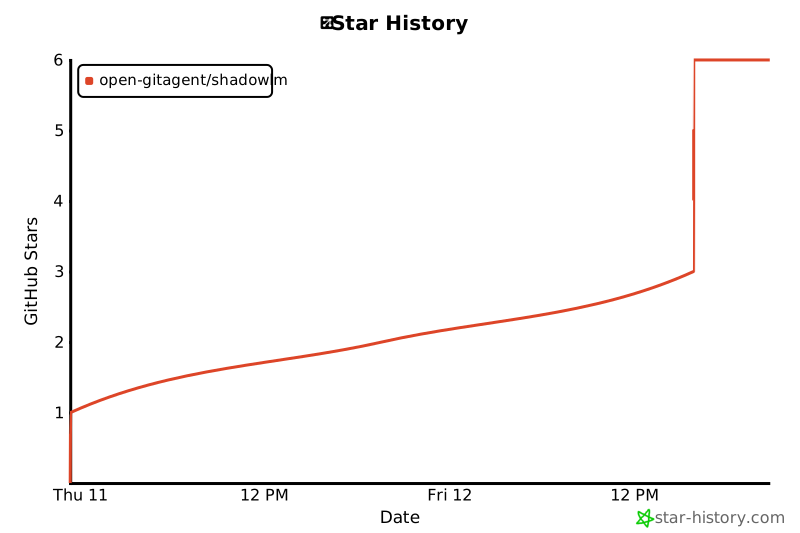
Star history
License
MIT — built by Lyzr Research Labs · maintained by
Khush Patel · slm♥
Project details
Verified details
These details have been verified by PyPIProject links
GitHub Statistics
Maintainers
Release history Release notifications | RSS feed


Download files
Download the file for your platform. If you're not sure which to choose, learn more about installing packages.
Source Distribution
Built Distribution
Filter files by name, interpreter, ABI, and platform.
If you're not sure about the file name format, learn more about wheel file names.
Copy a direct link to the current filters
File details
Details for the file shadowlm-0.1.0.tar.gz.
File metadata
- Download URL: shadowlm-0.1.0.tar.gz
- Upload date:
- Size: 76.0 kB
- Tags: Source
- Uploaded using Trusted Publishing? Yes
- Uploaded via: twine/6.1.0 CPython/3.13.12
File hashes
| Algorithm | Hash digest | |
|---|---|---|
| SHA256 |
38d69678f3a7394bd38c2ee422db4fe55f4bc031a611f03cad2bb265f10ea307
|
|
| MD5 |
b6450e3475c3587a74d390e11956f3e6
|
|
| BLAKE2b-256 |
893d80c3d6091f67562415a6985c6d3dd00dd7599f70c68c0b92e0a731e53ed6
|
Provenance
The following attestation bundles were made for shadowlm-0.1.0.tar.gz:
Publisher:
publish.yml on open-gitagent/shadowLM
-
Statement:
-
Statement type:
https://in-toto.io/Statement/v1 -
Predicate type:
https://docs.pypi.org/attestations/publish/v1 -
Subject name:
shadowlm-0.1.0.tar.gz -
Subject digest:
38d69678f3a7394bd38c2ee422db4fe55f4bc031a611f03cad2bb265f10ea307 - Sigstore transparency entry: 1793760926
- Sigstore integration time:
-
Permalink:
open-gitagent/shadowLM@7f4a321358954cc9c61762f0f0ff3c9a8f7cce8e -
Branch / Tag:
refs/tags/v0.1.0 - Owner: https://github.com/open-gitagent
-
Access:
public
-
Token Issuer:
https://token.actions.githubusercontent.com -
Runner Environment:
github-hosted -
Publication workflow:
publish.yml@7f4a321358954cc9c61762f0f0ff3c9a8f7cce8e -
Trigger Event:
push
-
Statement type:
File details
Details for the file shadowlm-0.1.0-py3-none-any.whl.
File metadata
- Download URL: shadowlm-0.1.0-py3-none-any.whl
- Upload date:
- Size: 79.0 kB
- Tags: Python 3
- Uploaded using Trusted Publishing? Yes
- Uploaded via: twine/6.1.0 CPython/3.13.12
File hashes
| Algorithm | Hash digest | |
|---|---|---|
| SHA256 |
9f5b42e19becc87635b4b7bc7c923cd441d5fbff517116770106b4073e9acc2e
|
|
| MD5 |
9dd1b510b2ad05ee1557be041f36b5dc
|
|
| BLAKE2b-256 |
b04e225b80eb568949442075204128de90fd045c66d9447a17bd47c1ccb89894
|
Provenance
The following attestation bundles were made for shadowlm-0.1.0-py3-none-any.whl:
Publisher:
publish.yml on open-gitagent/shadowLM
-
Statement:
-
Statement type:
https://in-toto.io/Statement/v1 -
Predicate type:
https://docs.pypi.org/attestations/publish/v1 -
Subject name:
shadowlm-0.1.0-py3-none-any.whl -
Subject digest:
9f5b42e19becc87635b4b7bc7c923cd441d5fbff517116770106b4073e9acc2e - Sigstore transparency entry: 1793761471
- Sigstore integration time:
-
Permalink:
open-gitagent/shadowLM@7f4a321358954cc9c61762f0f0ff3c9a8f7cce8e -
Branch / Tag:
refs/tags/v0.1.0 - Owner: https://github.com/open-gitagent
-
Access:
public
-
Token Issuer:
https://token.actions.githubusercontent.com -
Runner Environment:
github-hosted -
Publication workflow:
publish.yml@7f4a321358954cc9c61762f0f0ff3c9a8f7cce8e -
Trigger Event:
push
-
Statement type:






