
Package to generate and analyse distorted defect structures, in order to identify ground-state and metastable defect configurations.


Reason this release was yanked:
Switch to SemVer
Project description







ShakeNBreak (SnB)
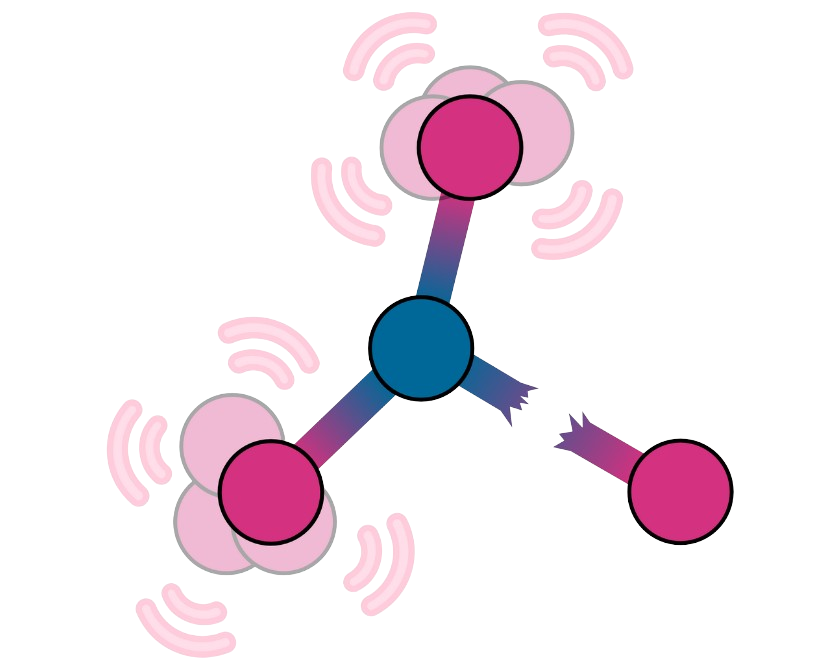
ShakeNBreak is a defect structure-searching method employing chemically-guided bond distortions to locate ground-state and metastable structures of point defects in solid materials.
Main features include:
- Defect structure generation:
- Automatic generation of distorted structures for input defects
- Optionally, input file generation for geometry optimisation with several codes (
VASP,CP2K,Quantum-Espresso,CASTEP&FHI-aims)
- Analysis:
- Parsing of geometry relaxation results
- Plotting of final energies versus distortion to demonstrate what energy-lowering reconstructions have been identified
- Coordination & bonding analysis to investigate the physico-chemical factors driving an energy-lowering distortion
- Magnetisation analysis (currently only supported for
VASP)
The code currently supports VASP, CP2K, Quantum-Espresso, CASTEP & FHI-aims. Code contributions to support additional solid-state packages are welcome.

Literature
- Preview: Mosquera-Lois, I.; Kavanagh, S. R. In Search of Hidden Defects, Matter 4 (8), 2602-2605, 2021
- Code: Mosquera-Lois, I. & Kavanagh, S. R.; Walsh, A.; Scanlon, D. O. ShakeNBreak: Navigating the defect configurational landscape, Journal of Open Source Software 7 (80), 4817, 2022
- Theory/Method: Mosquera-Lois, I. & Kavanagh, S. R.; Walsh, A.; Scanlon, D. O. Identifying the Ground State Structures of Defects in Solids, npj Comput Mater 9, 25 2023
- News & Views: Mannodi-Kanakkithodi, A. The Devil is in the Defects, Nature Physics 2023 (Free-to-read link)
Installation
ShakeNBreak can be installed using pip:
pip install shakenbreak
Alternatively if needed, it can also be installed from conda with:
conda install -c conda-forge shakenbreak
If using VASP, in order for ShakeNBreak to automatically generate the pseudopotential input files (POTCARs), your local VASP pseudopotential directory must be set in the pymatgen configuration file $HOME/.pmgrc.yaml as follows:
PMG_VASP_PSP_DIR: <Path to VASP pseudopotential top directory>
Within your VASP pseudopotential top directory, you should have a folder named POT_GGA_PAW_PBE which contains the POTCAR.X(.gz) files (in this case for PBE POTCARs). Please refer to the doped README instructions if you have difficulty with this.
The font Montserrat (Open Font License) will be installed with the package, and will be used by default for plotting.
Developer installation
For development work, ShakeNBreak can also be installed from a copy of the source directory:
- Download
ShakeNBreaksource code using the command:
git clone https://github.com/SMTG-UCL/ShakeNBreak
- Navigate to root directory:
cd ShakeNBreak
- Install the code, using the command:
pip install -e .
This command tries to obtain the required packages and their dependencies and install them automatically.
Usage
Python API
ShakeNBreak can be used through a Python API, as exemplified in the SnB Python API tutorial, with more info available on the docs.
Command line interface
Alternatively, the code can be used via the command line:

The functions provided include:
snb-generate: Generate distorted structures for a given defectsnb-generate_all: Generate distorted structures for all defects present in the specified/current directorysnb-run: Submit geometry relaxations to the HPC schedulersnb-parse: Parse the results of the geometry relaxations and write them to ayamlfilesnb-analyse: Generatecsvfiles with energies and structural differences between the final configurationssnb-plot: Generate plots of energy vs distortion, with the option to include a colorbar to quantify structural differencessnb-regenerate: Identify defect species undergoing energy-lowering distortions and test these distortions for the other charge states of the defectsnb-groundstate: Save the ground state structures to aGroundstatedirectory for continuation runs
More information about each function and its inputs/outputs are available from the CLI section of the docs or using -h help option (e.g. snb -h).
We recommend at least looking through the tutorials when first starting to use ShakeNBreak, to familiarise yourself with the full functionality and workflow.
Code Compatibility
ShakeNBreak is built to natively function using pymatgen Defect objects (docs available here) and be compatible with the most recent version of pymatgen.
If you are receiving pymatgen-related errors when using ShakeNBreak, you may need to update pymatgen and/or ShakeNBreak, which can be done with:
pip install --upgrade pymatgen shakenbreak
ShakeNBreak can take pymatgen Defect objects as input (to then generate the trial distorted structures),
but also can take in pymatgen Structure objects, doped defect dictionaries or structure files
(e.g. POSCARs for VASP) as inputs. As such, it should be compatible with any defect code
(such as doped, pydefect,
PyCDT, PyLada,
DASP, Spinney,
DefAP, PyDEF...) that generates these files.
Please let us know if you have any issues with compatibility, or if you would like to see any additional features added to ShakeNBreak to make it more compatible with your code.
Contributing
Bugs reports, feature requests and questions
Please use the Issue Tracker to report bugs or request new features.
Contributions to extend this package are very welcome! Please use the "Fork and Pull" workflow to do so and follow the PEP8 style guidelines.
See the Contributing Documentation for detailed instructions.
Tests
Unit tests are in the tests directory and can be run from the top directory using unittest.
Automatic testing is run on the master and develop branches using Github Actions. Please run tests and add new tests for any new features whenever submitting pull requests.
Acknowledgements
ShakeNBreak has benefitted from feedback from many members of the Walsh and Scanlon research groups who have used / are using it in their work, including Adair Nicolson, Xinwei Wang, Katarina Brlec, Joe Willis, Zhenzhu Li, Jiayi Cen, Lavan Ganeshkumar, Daniel Sykes, Luisa Herring-Rodriguez, Alex Squires, Sabrine Hachmioune and Chris Savory.
Studies using ShakeNBreak
We'll add papers that use ShakeNBreak to this list as they come out!
- A. T. J. Nicolson et al. Journal of Materials Chemistry A 2023
- X. Wang et al. arXiv 2023
- J. Cen et al. Journal of Materials Chemistry A 2023
- Q. Zhou, J. Willis; Q. Zhou MSc Thesis, UCL Chemistry, 2022. Publication in preparation.
- I. Mosquera-Lois & S. R. Kavanagh, A. Walsh, D. O. Scanlon npj Computational Materials 2023
- Y. T. Huang & S. R. Kavanagh et al. Nature Communications 2022
- S. R. Kavanagh, D. O. Scanlon, A. Walsh, C. Freysoldt Faraday Discussions 2022
- S. R. Kavanagh, D. O. Scanlon, A. Walsh ACS Energy Letters 2021
- C. J. Krajewska et al. Chemical Science 2021 (early version)
- (News & Views): A. Mannodi-Kanakkithodi Nature Physics 2023 (Free-to-read link)
License and Citation
ShakeNBreak is made available under the MIT License.
If you use it in your research, please cite:
- Code: Mosquera-Lois, I. & Kavanagh, S. R.; Walsh, A.; Scanlon, D. O. ShakeNBreak: Navigating the defect configurational landscape. Journal of Open Source Software 7 (80), 4817, 2022
- Theory/Method: Mosquera-Lois, I. & Kavanagh, S. R.; Walsh, A.; Scanlon, D. O. Identifying the Ground State Structures of Defects in Solids npj Comput Mater 9, 25 2023
You may also find this Preview paper useful, which discusses the general problem of defect structure prediction:
- Mosquera-Lois, I.; Kavanagh, S. R. In Search of Hidden Defects. Matter 4 (8), 2602-2605, 2021
BibTeX entries for these papers are provided in the CITATIONS.md file.
Requirements
ShakeNBreak is compatible with Python 3.8, 3.9 & 3.10 and requires the following open-source python packages:
Release history Release notifications | RSS feed


Download files
Download the file for your platform. If you're not sure which to choose, learn more about installing packages.
Source Distribution
Built Distribution
Filter files by name, interpreter, ABI, and platform.
If you're not sure about the file name format, learn more about wheel file names.
Copy a direct link to the current filters
File details
Details for the file shakenbreak-23.6.23.tar.gz.
File metadata
- Download URL: shakenbreak-23.6.23.tar.gz
- Upload date:
- Size: 33.3 MB
- Tags: Source
- Uploaded using Trusted Publishing? No
- Uploaded via: twine/4.0.2 CPython/3.9.17
File hashes
| Algorithm | Hash digest | |
|---|---|---|
| SHA256 |
afc7d6d0077162a9c75fcde41d441a890d99b4d5c0866eca4eeadddd07d3675b
|
|
| MD5 |
e35099b4f912255b314ded00e5a52f83
|
|
| BLAKE2b-256 |
f6f1a08070c8df2b3191cb726864a5990ce10c15c5e1a808646b0c720be7293d
|
File details
Details for the file shakenbreak-23.6.23-py3-none-any.whl.
File metadata
- Download URL: shakenbreak-23.6.23-py3-none-any.whl
- Upload date:
- Size: 8.7 MB
- Tags: Python 3
- Uploaded using Trusted Publishing? No
- Uploaded via: twine/4.0.2 CPython/3.9.17
File hashes
| Algorithm | Hash digest | |
|---|---|---|
| SHA256 |
259a9adcdc727d5037fd4e9b4ae96dbd079abbe52fd515102907cea12e52f754
|
|
| MD5 |
8ac539fe045a99d28a9c0937b7d49f2f
|
|
| BLAKE2b-256 |
06c3d880c48705599d11dcf5700f2cbecf7e1276ac2154397d1b10492c793edf
|






