
Shelxfile
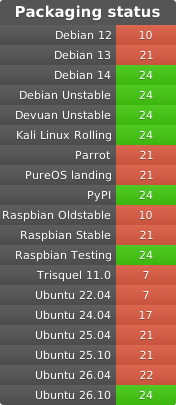


This is a full implementation of the SHELXL[1] file syntax. Additionally it is able to edit SHELX properties using Python. The implementation is Python3-only and supports SHELXL after 2017 (you should not use old versions anyway). Shelxfile is used as file parser in StructureFinder[3].
Shelxfile always keeps the file order intact. Every SHELX instruction like DFIX or an atom is stored as a class object in the list Shelxfile._reslist. When writing the Shelxfile content to disk, it writes the _reslist content to disk.
Shelxfile tries to detect all possible syntax errors that SHELXL would not like either. Use verbose=True during initialization for more output about syntax and other errors. Use debug=True to halt on errors. Otherwise, the parser is quiet except for really severe errors like a missing unit cell.
Not every part of Shelxfile is complete, for example it will not recognize if you add restraints with atom names that are not in the SHELX file. Please help me improving it!
Source Code
You can find the ShelXfile source code at GitHub.
Installation
pip install shelxfile
Quick Start
from shelxfile import Shelxfile

shx = Shelxfile(verbose=True)  # or debug=True, debug will halt on errors.
shx.read_file('tests/resources/p21c.res')  # or shx.read_string('...')
Examples
Unit Cell
>>> shx.cell
CELL 0.71073 10.5086 20.9035 20.5072 90 94.13 90

>>> list(shx.cell)
[10.5086, 20.9035, 20.5072, 90.0, 94.13, 90.0]

>>> shx.cell.volume
4493.047384590458

>>> shx.cell.a
10.5086
CIF Export
>>> shx.to_cif('test.cif')
# Writes a CIF file from the content of p21c.res
# Optionally pass a custom template: shx.to_cif('test.cif', template='my_template.tmpl')
Modifying SHELX Instructions
You can overwrite any parameter in a SHELX file:
>>> shx.plan
PLAN 20

>>> shx.plan.npeaks
20

>>> shx.plan.set('PLAN 30')
>>> shx.plan
PLAN 30
Atoms
>>> shx.atoms
O1     3    0.074835    0.238436    0.402457   ...
C1     1    0.028576    0.234542    0.337234   ...
C2     1    0.121540    0.194460    0.298291   ...
...

>>> len(shx.atoms)
148

>>> shx.atoms.number
148

>>> shx.atoms.hydrogen_atoms
[Atom ID: 134, Atom ID: 141, Atom ID: 148, ...]

>>> shx.atoms.hydrogen_atoms[1].name
'H32'

>>> shx.atoms.n_hydrogen_atoms
24

# Atoms with a riding model (e.g. hydrogen atom riding on a carbon atom):
>>> shx.atoms.riding_atoms
[Atom ID: 134, Atom ID: 141, Atom ID: 148, ...]

# Q-peaks in the file:
>>> shx.atoms.q_peaks
[Atom ID: 328, Atom ID: 329, ...]

# Number of anisotropic/isotropic atoms:
>>> shx.atoms.n_anisotropic_atoms
124
>>> shx.atoms.n_isotropic_atoms
24

# Residue numbers present:
>>> shx.atoms.residues
[0, 1, 2, 3, 4]
Working with Individual Atoms
>>> a = shx.atoms.get_atom_by_name('F1_2')  # Atom F1 in residue 2
>>> a
Atom ID: 258  # The Atom ID is the index number in Shelxfile._reslist

>>> str(a)
'F1    4    0.245205    0.192674    0.649231   -21.00000    0.05143    0.03826      0.03193   -0.00579   -0.01865   -0.00485'

>>> a.name
'F1'

>>> a.element
'F'

>>> a.resinum
2

>>> a.part.n
2

>>> a.sfac_num
4

>>> a.occupancy
0.51904

>>> a.frac_coords
(0.245205, 0.192674, 0.649231)

>>> a.cart_coords
(1.617897551082389, 4.027560959000001, 13.279336538026431)

>>> a.is_hydrogen
False

>>> a.is_isotropic
False

>>> a.atomid  # position in the SHELX .res file (_reslist index)
258

>>> str(shx._reslist[a.atomid])  # In regular code, do not access shx._reslist directly!
'F1    4    0.245205    0.192674    0.649231   -21.00000    0.05143    ...'
atom.occupancy resolves the SHELXL free-variable encoding of atom.sof:
| sof | meaning |
|---|---|
11.00000 |
full occupancy |
21.00000 |
1.0 × FVAR₂ |
-21.00000 |
1.0 × (1 − FVAR₂) |
30.33333 |
0.33333 × FVAR₃ (special position) |
-30.33333 |
0.33333 × (1 − FVAR₃) (special position) |
A PART or AFIX instruction only overrides the sof of the atom line if it
carries an explicit sof of its own (a sof of 11.0 means "not specified").
If both do, the instruction closer to the atom wins.
Displacement Parameters
>>> c = shx.atoms.get_atom_by_name('C1')

# Equivalent isotropic U (trace of U_cart / 3, IUCr definition):
>>> c.ueq
0.019868...

# For riding hydrogen atoms SHELXL stores a negative multiplier of the pivot
# atom's Ueq. Both ueq and Uiso resolve that encoding (Uiso is an alias of ueq):
>>> h = shx.atoms.get_atom_by_name('H34')
>>> h.pivot.name       # the carbon H34 rides on
'C34'
>>> h.uvals[0]         # raw SHELXL value in the .res file
-1.2
>>> h.Uiso             # = 1.2 × C34.ueq
0.02956...
>>> h.Uiso == h.pivot.Uiso * 1.2
True
SHELXL actually overloads a U value into three encodings, all stored unchanged
in atom.uvals (so the file is written back exactly as read) and resolved on
access via ueq/Uiso:
uvals[0] |
Meaning |
|---|---|
| a plain value | the U(iso) value itself |
-T (0.5 < T < 5) |
riding atom: T × reference.ueq |
10*m + p (abs(p) < 5) |
references FVAR: abs(m) == 1 fixes it at p, m > 1 means p × FVAR(m), m < -1 means abs(p) × (1 − FVAR(m)) |
For a riding atom, the reference is atom.pivot for hydrogens (the
non-hydrogen atom it rides on) and atom.u_reference for any other element
(the previous atom in the file whose own U is not itself a riding code).
Atom.is_riding_u(uvals) tells the two negative encodings apart.
>>> shx2 = Shelxfile()
>>> shx2.read_file('tests/resources/u_codes.res')
>>> c2 = shx2.atoms.get_atom_by_name('C2')  # riding on the non-hydrogen C1
>>> c2.uvals[0], c2.pivot, c2.u_reference.name
(-1.5, None, 'C1')
>>> c2.Uiso == 1.5 * c2.u_reference.Uiso
True

>>> c3 = shx2.atoms.get_atom_by_name('C3')  # 10.05 -> fixed at 0.05
>>> c3.uvals[0], c3.Uiso
(10.05, 0.05)

>>> c4 = shx2.atoms.get_atom_by_name('C4')  # 20.05 -> 0.05 * FVAR_2
>>> c4.uvals[0], c4.Uiso
(20.05, 0.015)

>>> c5 = shx2.atoms.get_atom_by_name('C5')  # -20.05 -> 0.05 * (1 - FVAR_2), not riding
>>> c5.uvals[0], c5.Uiso
(-20.05, 0.034999999999999996)

# Full anisotropic U-value chain (numpy arrays):
>>> c.ucif              # 3×3 U(cif) matrix  [U11 U12 U13 / U12 U22 U23 / U13 U23 U33]
array(...)
>>> c.ustar             # U(star) = N @ U(cif) @ N.T,  N = diag(a*, b*, c*)
array(...)
>>> c.u_cart            # U(cart) = A @ U(star) @ A.T,  A = orthogonalisation matrix
array(...)
Connectivity Table
# Pairwise bond connectivity for all atoms in the asymmetric unit:
>>> conn = shx.atoms.conntable   # tuple of (i, j) index pairs
>>> conn[0]
(0, 1)
Bond List
# Human-friendly bond list (sorted by atom name):
>>> for bond in shx.atoms.bonds:
...     print(bond)
AL1    – O1      1.7236 Å
AL1    – O2      1.7278 Å
C1     – C2      1.5210 Å
C1     – H1      1.0900 Å
...

# Total number of bonds:
>>> len(shx.atoms.bonds)
199

# Access individual bond attributes:
>>> b = shx.atoms.bonds[0]
>>> b.atom1.name, b.atom2.name, b.distance
('AL1', 'O1', 1.7236...)

# Tuple-style unpacking:
>>> atom1, atom2, dist = shx.atoms.bonds[0]

# Machine-readable repr:
>>> repr(shx.atoms.bonds[0])
"Bond(AL1, O1, 1.7236 Å)"
Full Bond List (with Symmetry Neighbors)
Shows every atom in the asymmetric unit together with all its bonded
neighbors, including those reached by a crystallographic symmetry operation,
in the same style as SHELXL's .lst file.
>>> for bond in shx.atoms.full_bond_list():
...     print(bond)
AL1    – O1      1.7236 Å          # plain asymmetric-unit bond
AL1    – O2 [-x, y+1/2, -z+1/2]  1.7095 Å   # symmetry-generated neighbor
C1     – C2      1.5454 Å
...

# Total bonds (plain + symmetry):
>>> bl = shx.atoms.full_bond_list()
>>> plain = [b for b in bl if not b.is_symmetry_bond]
>>> symm  = [b for b in bl if b.is_symmetry_bond]

# 4-field unpacking (atom1, atom2, distance, symm_label):
>>> atom1, atom2, dist, label = shx.atoms.full_bond_list()[0]
>>> label   # '' for plain bonds, e.g. '-x, y+1/2, -z+1/2' for symmetry bonds

# Include Q-peaks:
>>> shx.atoms.full_bond_list(with_qpeaks=True)
Modifying Atoms
# Make an atom isotropic:
>>> a.to_isotropic()
>>> str(a)
'F1    4    0.245205    0.192674   0.649231  -21.00000    0.04000'

# Introduce a new element (automatically updates the SFAC table):
>>> a.element = 'Na'
>>> shx.sfac_table
SFAC C  H  O  F  Al  Ga  Na
Adding and Deleting Atoms
# Add a new atom (isotropic carbon, fully occupied, default Uiso = 0.04):
>>> a = shx.add_atom(name='C99', coordinates=[0.1, 0.2, 0.3])
# The atom is inserted directly before HKLF (after the last real atom).
# write_shelx_file() produces a valid file immediately.

# Specify element, disorder part, and occupancy (high-level style):
>>> shx.add_atom(name='N1', coordinates=[0.5, 0.5, 0.5], element='N',
...              occupancy=0.5, part=1)      # → sof = 1*10 + 0.5 = 10.5

# Tie occupancy to a specific free variable (e.g. fvar 2):
>>> shx.add_atom(name='C2A', coordinates=[0.1, 0.2, 0.3],
...              occupancy=1.0, fvar=2, part=1)   # → sof = 21.0
>>> shx.add_atom(name='C2B', coordinates=[0.1, 0.2, 0.35],
...              occupancy=-1.0, fvar=2, part=2)  # → sof = 19.0 (complementary)

# Raw SHELXL sof encoding is still accepted when occupancy is not given:
>>> shx.add_atom(name='N1', coordinates=[0.5, 0.5, 0.5], sof=21.0)

# Mixing the two styles raises ValueError:
>>> shx.add_atom(name='N1', coordinates=[0.5, 0.5, 0.5], occupancy=0.5, sof=10.5)
ValueError: Specify occupation using either 'occupancy'/'fvar' or 'sof', not both.

# Anisotropic displacement parameters [U11, U22, U33, U23, U13, U12]:
>>> shx.add_atom(name='C99', coordinates=[0.1, 0.2, 0.3],
...              uvals=[0.03, 0.04, 0.05, 0.001, 0.002, 0.003])

# A single Uiso value is automatically expanded to six parameters:
>>> shx.add_atom(name='C99', coordinates=[0.1, 0.2, 0.3], uvals=[0.05])

# Insert directly after a specific atom in the file:
>>> anchor = shx.atoms.get_atom_by_name('C1')
>>> shx.add_atom(name='C99', coordinates=[0.1, 0.2, 0.3], after=anchor)

# Provide Cartesian coordinates (auto-converted to fractional):
>>> shx.add_atom(name='C99', coordinates=[1.0, 2.0, 3.0],
...              coords_are_cartesian=True)

# Elements not yet in the SFAC table are registered automatically:
>>> shx.add_atom(name='XE1', coordinates=[0.1, 0.2, 0.3], element='Xe')
>>> shx.sfac_table
SFAC C  H  O  F  Al  Ga  Xe

# Get the next available atom name for an element (max 4 chars: C→C999, Fe→Fe99):
>>> shx.unused_atom_name('C')
'C149'   # (or whichever number is free)
>>> shx.unused_atom_name('Fe')
'Fe1'    # two-char element: up to Fe99

# Combine: generate a unique name and add the atom in one go:
>>> name = shx.unused_atom_name('N')
>>> shx.add_atom(name=name, coordinates=[0.3, 0.3, 0.3], element='N')

# Duplicate names raise ValueError:
>>> shx.add_atom(name='C99', coordinates=[0.2, 0.2, 0.2])  # already exists
ValueError: Atom 'C99_0' already exists in the structure.

# Delete atoms around a given atom:
>>> for x in a.find_atoms_around(dist=2.5, only_part=2):
...     x.delete()
Finding Nearby Atoms
>>> a.find_atoms_around(dist=2.0, only_part=1)
[Atom ID: 239, Atom ID: 241, Atom ID: 245]

>>> [str(x) for x in a.find_atoms_around(dist=2.2, only_part=2)]
['C2     1    0.192984    0.140449    ...', 'F2     4    ...', 'F3     4    ...']
SFAC Table Lookups
>>> shx.sfac2elem(4)
'F'

>>> shx.elem2sfac('F')
4
Restraints
>>> shx.restraints[1]
SADI_CCF3 0.02 C1 C2 C1 C3 C1 C4

>>> str(shx.restraints[1])
'SADI_CCF3 0.02 C1 C2 C1 C3 C1 C4'

>>> shx.restraints[1].residue_class
'CCF3'

# The residue class 'CCF3' has three residues with these numbers:
>>> shx.restraints[1].residue_number
[4, 1, 2]

# The esd of the SADI restraint:
>>> shx.restraints[1].s
0.02
Distances and Angles
# Distance between two atoms (by name):
>>> shx.atoms.distance('O1', 'C1')
1.3505645511659556

# Bond angle between three atoms:
>>> at1 = shx.atoms.get_atom_by_name('O1_4')
>>> at2 = shx.atoms.get_atom_by_name('C1_4')
>>> at3 = shx.atoms.get_atom_by_name('C2_4')
>>> shx.atoms.angle(at1, at2, at3)
109.68812347

# Torsion angle between four atoms:
>>> at1 = shx.atoms.get_atom_by_name('O1')
>>> at2 = shx.atoms.get_atom_by_name('C1')
>>> at3 = shx.atoms.get_atom_by_name('C2')
>>> at4 = shx.atoms.get_atom_by_name('F1')
>>> shx.atoms.torsion_angle(at1, at2, at3, at4)
74.09573117980119
Symmetry Cards
Symmetry cards that are implied by lattice symmetry are generated on-the-fly:
>>> shx.symmcards
| 1  0  0|   | 0.0|
| 0  1  0| + | 0.0|
| 0  0  1|   | 0.0|

|-1  0  0|   | 0.0|
| 0 -1  0| + | 0.0|
| 0  0 -1|   | 0.0|

|-1  0  0|   | 0.0|
| 0  1  0| + | 0.5|
| 0  0 -1|   | 0.5|

| 1  0  0|   | 0.0|
| 0 -1  0| + |-0.5|
| 0  0  1|   |-0.5|
Growing Structures
Complete or "grow" structures with higher symmetry:
>>> shx2 = Shelxfile()
>>> shx2.read_file('tests/resources/p-31c.res')
>>> len(shx2.atoms)
88
>>> p = shx2.grow()
>>> len(p)
208
Writing a Grown Structure to File
write_grown_file() calls grow() and writes the complete molecule(s) to a
standalone .res file in P1 symmetry. The output:
- Uses
LATT -1(primitive, non-centrosymmetric) with noSYMMcards, so that SHELXL and viewers like fastmolwidget do not re-apply symmetry to the already-grown atoms (preventing duplicate atoms and wrong bonds). - Preserves disorder parts via
PARTcards so the bond graph is correct (atoms in different disorder alternatives are not connected to each other). - Strips restraints,
AFIX,HFIXand other cards that only make sense in the context of the original asymmetric unit. - Adds a
REMwarning that the file is not suited for refinement.
>>> shx2 = Shelxfile()
>>> shx2.read_file('tests/resources/p-31c.res')
>>> shx2.write_grown_file('grown_p1.res')
# grown_p1.res is a valid P1 .res file with 208 atoms and PART cards
Packing the Unit Cell
pack() applies all symmetry operations to the asymmetric unit and folds every
position back into [0, 1) fractional coordinates, removing duplicates.
Unlike grow(), it does not stitch molecular fragments together — it simply
fills one unit cell.
>>> shx2 = Shelxfile()
>>> shx2.read_file('tests/resources/p-31c.res')
>>> len(shx2.atoms)          # asymmetric unit
88
>>> packed = shx2.pack()
>>> len(packed)              # full unit cell (Z × asymm unit, minus special positions)
304
>>> all(0.0 <= a.x < 1.0 and 0.0 <= a.y < 1.0 and 0.0 <= a.z < 1.0 for a in packed)
True
The result is a plain list of Atom objects — the Shelxfile object itself is
not modified. Q-peaks can be included with shx.pack(with_qpeaks=True).
Writing Files
Writes the current shx object to a SHELX file.
All lines in Shelxfile._reslist get wrapped after 79 characters with " =\n " as
specified by SHELXL during the file writing.
>>> shx.write_shelx_file('test.ins')
Optional C++ Acceleration
The SDM (Shortest Distance Matrix), which underlies grow() and pack(), ships
with an optional C++ extension (shelxfile.sdm_cpp) compiled with pybind11 and OpenMP.
When present it is used automatically and can give a 5–10× speedup on large
structures; if it is absent the pure-Python fallback is used silently.
# Build the extension (requires a C++17 compiler):
pip install pybind11
pip install -e . --no-build-isolation

# macOS only — OpenMP support:
brew install libomp
from shelxfile.shelx.sdm import HAS_CPP
print(HAS_CPP)   # True when the extension is installed
Sum Formula
# Sum formula based on UNIT instruction:
>>> shx.sum_formula
'C0.25 H0.5 O0.75 F1 AL1.25 GA1.5'

# Exact sum formula from all atom occupancies:
>>> shx.sum_formula_exact
'C34 H24 O4 F36 Al1 Ga1'
Residuals from .res File
These values are parsed from REM lines written by SHELXL into .res files:
>>> shx.R1
0.04

>>> shx.wr2
0.1005

>>> shx.goof
1.016

>>> shx.space_group
'P2(1)/c'

>>> shx.wavelength
0.71073
Refinement (Requires SHELXL)
No matter if you loaded a .res or .ins file, refine() runs SHELXL on the Shelxfile object:
>>> shx.insert_anis()
>>> shx.refine(2)

 Running SHELXL with "/usr/local/bin/shelxl -b3000 ..." and "L.S. 2"
 wR2 =  0.1143 before cycle   1 for   10786 data and    945 /    945 parameters
 wR2 =  0.1025 before cycle   2 for   10786 data and    945 /    945 parameters
 wR2 =  0.1006 before cycle   3 for   10786 data and      0 /    945 parameters
 SHELXL Version 2018/3
References
[1] http://shelx.uni-goettingen.de/, G. M. Sheldrick, Acta Cryst. (2015). C71, 3-8. https://doi.org/10.1107/S2053229614024218
1 maintainer

Release files for shelxfile 27
For a detailed explanation of source distributions (sdists) and built distributions (wheels), please see the package formats documentation.
Built distributions (wheels)
| File | Reset | |||
|---|---|---|---|---|
| shelxfile-27-cp314-cp314-win_amd64.whl | CPython 3.14 | CPython 3.14 | Windows x86-64 | Details |
| shelxfile-27-cp314-cp314-musllinux_1_2_x86_64.whl | CPython 3.14 | CPython 3.14 | Linux musl 1.2+ x86-64 | Details |
| shelxfile-27-cp314-cp314-manylinux_2_24_x86_64.manylinux_2_28_x86_64.whl | CPython 3.14 | CPython 3.14 | Linux glibc 2.24+ x86-64, Linux glibc 2.28+ x86-64 | Details |
| shelxfile-27-cp314-cp314-macosx_14_0_universal2.whl | CPython 3.14 | CPython 3.14 | macOS 14.0+ universal2 (ARM64, x86-64) | Details |
| shelxfile-27-cp313-cp313-win_amd64.whl | CPython 3.13 | CPython 3.13 | Windows x86-64 | Details |
| shelxfile-27-cp313-cp313-musllinux_1_2_x86_64.whl | CPython 3.13 | CPython 3.13 | Linux musl 1.2+ x86-64 | Details |
| shelxfile-27-cp313-cp313-manylinux_2_24_x86_64.manylinux_2_28_x86_64.whl | CPython 3.13 | CPython 3.13 | Linux glibc 2.24+ x86-64, Linux glibc 2.28+ x86-64 | Details |
| shelxfile-27-cp313-cp313-macosx_14_0_universal2.whl | CPython 3.13 | CPython 3.13 | macOS 14.0+ universal2 (ARM64, x86-64) | Details |
| shelxfile-27-cp312-cp312-win_amd64.whl | CPython 3.12 | CPython 3.12 | Windows x86-64 | Details |
| shelxfile-27-cp312-cp312-musllinux_1_2_x86_64.whl | CPython 3.12 | CPython 3.12 | Linux musl 1.2+ x86-64 | Details |
| shelxfile-27-cp312-cp312-manylinux_2_24_x86_64.manylinux_2_28_x86_64.whl | CPython 3.12 | CPython 3.12 | Linux glibc 2.28+ x86-64, Linux glibc 2.24+ x86-64 | Details |
| shelxfile-27-cp312-cp312-macosx_14_0_universal2.whl | CPython 3.12 | CPython 3.12 | macOS 14.0+ universal2 (ARM64, x86-64) | Details |
| shelxfile-27-cp311-cp311-win_amd64.whl | CPython 3.11 | CPython 3.11 | Windows x86-64 | Details |
| shelxfile-27-cp311-cp311-musllinux_1_2_x86_64.whl | CPython 3.11 | CPython 3.11 | Linux musl 1.2+ x86-64 | Details |
| shelxfile-27-cp311-cp311-manylinux_2_24_x86_64.manylinux_2_28_x86_64.whl | CPython 3.11 | CPython 3.11 | Linux glibc 2.28+ x86-64, Linux glibc 2.24+ x86-64 | Details |
| shelxfile-27-cp311-cp311-macosx_14_0_universal2.whl | CPython 3.11 | CPython 3.11 | macOS 14.0+ universal2 (ARM64, x86-64) | Details |
Total release size: 17.4 MB
Release files / shelxfile-27-cp314-cp314-win_amd64.whl
| Download URL | shelxfile-27-cp314-cp314-win_amd64.whl |
|---|---|
| Size | 181.7 kB |
| Tags | CPython 3.14 Windows x86-64 |
|
SHA-256 checksum How to use checksums |
c16154865d9ceb9237d44eaa7eafae856cc691ff848520087ab996161d1c77cd
|
|
BLAKE2b-256 checksum How to use checksums |
fedfaca1dc0c7208b907a03b29f71ddfc194d15616bdbb848798917f1ece7dfc
|
| Upload date | |
|
Uploaded using Trusted Publishing? What is trusted publishing? |
Yes |
| Uploaded via |
twine/7.0.0 CPython/3.13.14
|
Provenance
Provenance describes where a file came from. On PyPI, provenance is shared via attestations, which provide a verifiable record of the build or publishing details. View details, limitations and caveats.


PyPI Publish Attestation
PyPI verified that this artifact, at this checksum, originated from the publisher listed below.
Signed by GitHub Actions, verified by PyPI on Sep 10, 2026.
Transparency logRelease files / shelxfile-27-cp314-cp314-musllinux_1_2_x86_64.whl
| Download URL | shelxfile-27-cp314-cp314-musllinux_1_2_x86_64.whl |
|---|---|
| Size | 2.5 MB |
| Tags | CPython 3.14 Linux musl 1.2+ x86-64 |
|
SHA-256 checksum How to use checksums |
a5fb1b62e7b669a8bbb29d22f8d21a6296baf9bf7d90fb030d0a403d6d473bbf
|
|
BLAKE2b-256 checksum How to use checksums |
10b02a1a7eb9e9c15f9a22cc9ffbb1e215589a668bbb38ffd4c40333583a3dae
|
| Upload date | |
|
Uploaded using Trusted Publishing? What is trusted publishing? |
Yes |
| Uploaded via |
twine/7.0.0 CPython/3.13.14
|
Provenance
Provenance describes where a file came from. On PyPI, provenance is shared via attestations, which provide a verifiable record of the build or publishing details. View details, limitations and caveats.
PyPI Publish Attestation
PyPI verified that this artifact, at this checksum, originated from the publisher listed below.
Signed by GitHub Actions, verified by PyPI on Sep 10, 2026.
Transparency logRelease files / shelxfile-27-cp314-cp314-manylinux_2_24_x86_64.manylinux_2_28_x86_64.whl
| Download URL | shelxfile-27-cp314-cp314-manylinux_2_24_x86_64.manylinux_2_28_x86_64.whl |
|---|---|
| Size | 1.4 MB |
| Tags | CPython 3.14 Linux glibc 2.24+ x86-64 Linux glibc 2.28+ x86-64 |
|
SHA-256 checksum How to use checksums |
8083e49ed5b2fb66ef5aa9e31f6e62e560352c6cfbe6c21b25903a03c3e04ea7
|
|
BLAKE2b-256 checksum How to use checksums |
b4dccb16e213ee4962c9407795d9bf7440279ad72666243f7a696d934399cd21
|
| Upload date | |
|
Uploaded using Trusted Publishing? What is trusted publishing? |
Yes |
| Uploaded via |
twine/7.0.0 CPython/3.13.14
|
Provenance
Provenance describes where a file came from. On PyPI, provenance is shared via attestations, which provide a verifiable record of the build or publishing details. View details, limitations and caveats.
PyPI Publish Attestation
PyPI verified that this artifact, at this checksum, originated from the publisher listed below.
Signed by GitHub Actions, verified by PyPI on Sep 10, 2026.
Transparency logRelease files / shelxfile-27-cp314-cp314-macosx_14_0_universal2.whl
| Download URL | shelxfile-27-cp314-cp314-macosx_14_0_universal2.whl |
|---|---|
| Size | 258.1 kB |
| Tags | CPython 3.14 macOS 14.0+ universal2 (ARM64, x86-64) |
|
SHA-256 checksum How to use checksums |
32149f1fdc44d0dae9b1d3c34157e744aee256a875a742117c72adf63ac4347d
|
|
BLAKE2b-256 checksum How to use checksums |
d7dcfc63a9fc28a12aafccd144e288a4bcf8a5b7e5c6de11fbfb5d7bdcba74a9
|
| Upload date | |
|
Uploaded using Trusted Publishing? What is trusted publishing? |
Yes |
| Uploaded via |
twine/7.0.0 CPython/3.13.14
|
Provenance
Provenance describes where a file came from. On PyPI, provenance is shared via attestations, which provide a verifiable record of the build or publishing details. View details, limitations and caveats.
PyPI Publish Attestation
PyPI verified that this artifact, at this checksum, originated from the publisher listed below.
Signed by GitHub Actions, verified by PyPI on Sep 10, 2026.
Transparency logRelease files / shelxfile-27-cp313-cp313-win_amd64.whl
| Download URL | shelxfile-27-cp313-cp313-win_amd64.whl |
|---|---|
| Size | 179.4 kB |
| Tags | CPython 3.13 Windows x86-64 |
|
SHA-256 checksum How to use checksums |
9bfa0f657c2f54d0c9aa7c42a541ca10fb70598667a631b45a25c2c9be1bf0f0
|
|
BLAKE2b-256 checksum How to use checksums |
d735b7c8e682805af83441dff1548849ae30e4c62db8a3b824a32a0b03968acd
|
| Upload date | |
|
Uploaded using Trusted Publishing? What is trusted publishing? |
Yes |
| Uploaded via |
twine/7.0.0 CPython/3.13.14
|
Provenance
Provenance describes where a file came from. On PyPI, provenance is shared via attestations, which provide a verifiable record of the build or publishing details. View details, limitations and caveats.
PyPI Publish Attestation
PyPI verified that this artifact, at this checksum, originated from the publisher listed below.
Signed by GitHub Actions, verified by PyPI on Sep 10, 2026.
Transparency logRelease files / shelxfile-27-cp313-cp313-musllinux_1_2_x86_64.whl
| Download URL | shelxfile-27-cp313-cp313-musllinux_1_2_x86_64.whl |
|---|---|
| Size | 2.5 MB |
| Tags | CPython 3.13 Linux musl 1.2+ x86-64 |
|
SHA-256 checksum How to use checksums |
6013cc6d60ab657a4558313cb943a471ab6f6b8c2bde09c8d8df6257c858b717
|
|
BLAKE2b-256 checksum How to use checksums |
6699e14bb5f1d9ee0054c7992c5feceef99266133e2ec369bcc5902be6cefb16
|
| Upload date | |
|
Uploaded using Trusted Publishing? What is trusted publishing? |
Yes |
| Uploaded via |
twine/7.0.0 CPython/3.13.14
|
Provenance
Provenance describes where a file came from. On PyPI, provenance is shared via attestations, which provide a verifiable record of the build or publishing details. View details, limitations and caveats.
PyPI Publish Attestation
PyPI verified that this artifact, at this checksum, originated from the publisher listed below.
Signed by GitHub Actions, verified by PyPI on Sep 10, 2026.
Transparency logRelease files / shelxfile-27-cp313-cp313-manylinux_2_24_x86_64.manylinux_2_28_x86_64.whl
| Download URL | shelxfile-27-cp313-cp313-manylinux_2_24_x86_64.manylinux_2_28_x86_64.whl |
|---|---|
| Size | 1.4 MB |
| Tags | CPython 3.13 Linux glibc 2.24+ x86-64 Linux glibc 2.28+ x86-64 |
|
SHA-256 checksum How to use checksums |
4058e66ecf09019c0adf3bd6bc16ad0441a80477eb2042726c2011050fcb73a8
|
|
BLAKE2b-256 checksum How to use checksums |
041b20fe6945455aa35e2895fa941477ea6aa042796f3bb6dcba54492fa2f8b3
|
| Upload date | |
|
Uploaded using Trusted Publishing? What is trusted publishing? |
Yes |
| Uploaded via |
twine/7.0.0 CPython/3.13.14
|
Provenance
Provenance describes where a file came from. On PyPI, provenance is shared via attestations, which provide a verifiable record of the build or publishing details. View details, limitations and caveats.
PyPI Publish Attestation
PyPI verified that this artifact, at this checksum, originated from the publisher listed below.
Signed by GitHub Actions, verified by PyPI on Sep 10, 2026.
Transparency logRelease files / shelxfile-27-cp313-cp313-macosx_14_0_universal2.whl
| Download URL | shelxfile-27-cp313-cp313-macosx_14_0_universal2.whl |
|---|---|
| Size | 258.1 kB |
| Tags | CPython 3.13 macOS 14.0+ universal2 (ARM64, x86-64) |
|
SHA-256 checksum How to use checksums |
3e4b331cd225cea0b3aca39d99b754e1f6bdf901235f55cdfef84cf17c683ed4
|
|
BLAKE2b-256 checksum How to use checksums |
50ec4ed52b89bacfdcc0dd4b55d6e20a1f96c395f805fc19a15e887aa2478688
|
| Upload date | |
|
Uploaded using Trusted Publishing? What is trusted publishing? |
Yes |
| Uploaded via |
twine/7.0.0 CPython/3.13.14
|
Provenance
Provenance describes where a file came from. On PyPI, provenance is shared via attestations, which provide a verifiable record of the build or publishing details. View details, limitations and caveats.
PyPI Publish Attestation
PyPI verified that this artifact, at this checksum, originated from the publisher listed below.
Signed by GitHub Actions, verified by PyPI on Sep 10, 2026.
Transparency logRelease files / shelxfile-27-cp312-cp312-win_amd64.whl
| Download URL | shelxfile-27-cp312-cp312-win_amd64.whl |
|---|---|
| Size | 179.3 kB |
| Tags | CPython 3.12 Windows x86-64 |
|
SHA-256 checksum How to use checksums |
2e515554c63ea4b73d9f75615cbaa94209a01e95aa3e4482e2fff100f96918a0
|
|
BLAKE2b-256 checksum How to use checksums |
0d05aac4273dd9f4b8d6d72d6b06cb74a630b93b9f881859565cfbbbca558af4
|
| Upload date | |
|
Uploaded using Trusted Publishing? What is trusted publishing? |
Yes |
| Uploaded via |
twine/7.0.0 CPython/3.13.14
|
Provenance
Provenance describes where a file came from. On PyPI, provenance is shared via attestations, which provide a verifiable record of the build or publishing details. View details, limitations and caveats.
PyPI Publish Attestation
PyPI verified that this artifact, at this checksum, originated from the publisher listed below.
Signed by GitHub Actions, verified by PyPI on Sep 10, 2026.
Transparency logRelease files / shelxfile-27-cp312-cp312-musllinux_1_2_x86_64.whl
| Download URL | shelxfile-27-cp312-cp312-musllinux_1_2_x86_64.whl |
|---|---|
| Size | 2.5 MB |
| Tags | CPython 3.12 Linux musl 1.2+ x86-64 |
|
SHA-256 checksum How to use checksums |
5f5cc74973e9f576f2565694ab6d2423480fdcb3bbad6057482ade190813431f
|
|
BLAKE2b-256 checksum How to use checksums |
a07076e449abafdfbd4ff7071364993009701ade0d230fff2351060b6b6ec702
|
| Upload date | |
|
Uploaded using Trusted Publishing? What is trusted publishing? |
Yes |
| Uploaded via |
twine/7.0.0 CPython/3.13.14
|
Provenance
Provenance describes where a file came from. On PyPI, provenance is shared via attestations, which provide a verifiable record of the build or publishing details. View details, limitations and caveats.
PyPI Publish Attestation
PyPI verified that this artifact, at this checksum, originated from the publisher listed below.
Signed by GitHub Actions, verified by PyPI on Sep 10, 2026.
Transparency logRelease files / shelxfile-27-cp312-cp312-manylinux_2_24_x86_64.manylinux_2_28_x86_64.whl
| Download URL | shelxfile-27-cp312-cp312-manylinux_2_24_x86_64.manylinux_2_28_x86_64.whl |
|---|---|
| Size | 1.4 MB |
| Tags | CPython 3.12 Linux glibc 2.24+ x86-64 Linux glibc 2.28+ x86-64 |
|
SHA-256 checksum How to use checksums |
6189afcb6a4f3f1a0c24632e0e2178658f4e17b5ee0925951ae44a3511a8b8a5
|
|
BLAKE2b-256 checksum How to use checksums |
dfe8a0f49e55d601af0daf5775d91ccfba243eb45f8c91a11d57249313f4bdbb
|
| Upload date | |
|
Uploaded using Trusted Publishing? What is trusted publishing? |
Yes |
| Uploaded via |
twine/7.0.0 CPython/3.13.14
|
Provenance
Provenance describes where a file came from. On PyPI, provenance is shared via attestations, which provide a verifiable record of the build or publishing details. View details, limitations and caveats.
PyPI Publish Attestation
PyPI verified that this artifact, at this checksum, originated from the publisher listed below.
Signed by GitHub Actions, verified by PyPI on Sep 10, 2026.
Transparency logRelease files / shelxfile-27-cp312-cp312-macosx_14_0_universal2.whl
| Download URL | shelxfile-27-cp312-cp312-macosx_14_0_universal2.whl |
|---|---|
| Size | 258.0 kB |
| Tags | CPython 3.12 macOS 14.0+ universal2 (ARM64, x86-64) |
|
SHA-256 checksum How to use checksums |
9d6b0f167edd9c937210ddd4665a1a789f92b912b14103a15948338b86f7158b
|
|
BLAKE2b-256 checksum How to use checksums |
db0b58367ab69d5333d1751ce6a953b0295fa9dc410bb9eca8e6c0e5a7e6e13d
|
| Upload date | |
|
Uploaded using Trusted Publishing? What is trusted publishing? |
Yes |
| Uploaded via |
twine/7.0.0 CPython/3.13.14
|
Provenance
Provenance describes where a file came from. On PyPI, provenance is shared via attestations, which provide a verifiable record of the build or publishing details. View details, limitations and caveats.
PyPI Publish Attestation
PyPI verified that this artifact, at this checksum, originated from the publisher listed below.
Signed by GitHub Actions, verified by PyPI on Sep 10, 2026.
Transparency logRelease files / shelxfile-27-cp311-cp311-win_amd64.whl
| Download URL | shelxfile-27-cp311-cp311-win_amd64.whl |
|---|---|
| Size | 178.0 kB |
| Tags | CPython 3.11 Windows x86-64 |
|
SHA-256 checksum How to use checksums |
aa5aeddc572288121d829f02fd8ff8257202b70c4ff70bdcf7c6cc9e67684e23
|
|
BLAKE2b-256 checksum How to use checksums |
d62270cf76a7740f27c576094ff8bbeb817022ad945c970d73ff76d54b553dce
|
| Upload date | |
|
Uploaded using Trusted Publishing? What is trusted publishing? |
Yes |
| Uploaded via |
twine/7.0.0 CPython/3.13.14
|
Provenance
Provenance describes where a file came from. On PyPI, provenance is shared via attestations, which provide a verifiable record of the build or publishing details. View details, limitations and caveats.
PyPI Publish Attestation
PyPI verified that this artifact, at this checksum, originated from the publisher listed below.
Signed by GitHub Actions, verified by PyPI on Sep 10, 2026.
Transparency logRelease files / shelxfile-27-cp311-cp311-musllinux_1_2_x86_64.whl
| Download URL | shelxfile-27-cp311-cp311-musllinux_1_2_x86_64.whl |
|---|---|
| Size | 2.5 MB |
| Tags | CPython 3.11 Linux musl 1.2+ x86-64 |
|
SHA-256 checksum How to use checksums |
a7db87dbd347fff318b6ad3e582450e6e46b42fd3a7ab5a8349f2bbb4e52fb83
|
|
BLAKE2b-256 checksum How to use checksums |
205e59c25880666d6bbfc7ca79dda75ca480603082e2db05f79e6b2271097e70
|
| Upload date | |
|
Uploaded using Trusted Publishing? What is trusted publishing? |
Yes |
| Uploaded via |
twine/7.0.0 CPython/3.13.14
|
Provenance
Provenance describes where a file came from. On PyPI, provenance is shared via attestations, which provide a verifiable record of the build or publishing details. View details, limitations and caveats.
PyPI Publish Attestation
PyPI verified that this artifact, at this checksum, originated from the publisher listed below.
Signed by GitHub Actions, verified by PyPI on Sep 10, 2026.
Transparency logRelease files / shelxfile-27-cp311-cp311-manylinux_2_24_x86_64.manylinux_2_28_x86_64.whl
| Download URL | shelxfile-27-cp311-cp311-manylinux_2_24_x86_64.manylinux_2_28_x86_64.whl |
|---|---|
| Size | 1.4 MB |
| Tags | CPython 3.11 Linux glibc 2.24+ x86-64 Linux glibc 2.28+ x86-64 |
|
SHA-256 checksum How to use checksums |
603ee616031ca13b710bf788a053a563e39e60a02a70b8d6e8e6bb737d5660f8
|
|
BLAKE2b-256 checksum How to use checksums |
924d855eb4a81c217be42d9ffcd9e42bee6ca4c24e2d463370ef82aa5c1b46d2
|
| Upload date | |
|
Uploaded using Trusted Publishing? What is trusted publishing? |
Yes |
| Uploaded via |
twine/7.0.0 CPython/3.13.14
|
Provenance
Provenance describes where a file came from. On PyPI, provenance is shared via attestations, which provide a verifiable record of the build or publishing details. View details, limitations and caveats.
PyPI Publish Attestation
PyPI verified that this artifact, at this checksum, originated from the publisher listed below.
Signed by GitHub Actions, verified by PyPI on Sep 10, 2026.
Transparency logRelease files / shelxfile-27-cp311-cp311-macosx_14_0_universal2.whl
| Download URL | shelxfile-27-cp311-cp311-macosx_14_0_universal2.whl |
|---|---|
| Size | 255.1 kB |
| Tags | CPython 3.11 macOS 14.0+ universal2 (ARM64, x86-64) |
|
SHA-256 checksum How to use checksums |
28f6c3841f46cfd273967cea4c8d5c01aeccda7d8b20fd8dd58d4cf29c480c73
|
|
BLAKE2b-256 checksum How to use checksums |
e1631ae22399345d962b57853f81f2ef4983ec01f070502e297497c34410b394
|
| Upload date | |
|
Uploaded using Trusted Publishing? What is trusted publishing? |
Yes |
| Uploaded via |
twine/7.0.0 CPython/3.13.14
|
Provenance
Provenance describes where a file came from. On PyPI, provenance is shared via attestations, which provide a verifiable record of the build or publishing details. View details, limitations and caveats.
PyPI Publish Attestation
PyPI verified that this artifact, at this checksum, originated from the publisher listed below.
Signed by GitHub Actions, verified by PyPI on Sep 10, 2026.
Transparency log













