
Scientific tooling and benchmark workflows for reliability under tabular distribution shift.
Verified details
These details have been verified by PyPIProject links
GitHub Statistics
Maintainers

Project description
ShiftStat




Scientific Python tooling for reliability under tabular distribution shift.
ShiftStat helps answer a practical research question:
A model looked reliable on yesterday's data. What exactly breaks when tomorrow's deployment population is different?
Most model evaluation pipelines stop at aggregate accuracy, AUC, or loss. Those numbers can remain calm while calibration collapses in a high-confidence bin, an operational subgroup loses reliability, or abstention improves average risk while abandoning the wrong population. ShiftStat is built to expose those failures with transparent statistical objects: feature-level shift tests, density-ratio weights, calibration profiles, subgroup audits, selective prediction curves, certified worst-group alarms, and reproducible benchmark artifacts.
The package is designed for researchers, applied scientists, and ML engineers working with tabular classifiers under dataset shift, especially when the goal is not only to report a score but to understand, reproduce, and defend the reliability conclusion.
Installation
pip install shiftstat
ShiftStat supports Python >=3.10 and follows the standard src/ package
layout. The public package name is:
import shiftstat
print(shiftstat.__version__)
The Problem In One Picture
In deployment, the reference distribution and the target distribution are rarely the same:
reference data              target deployment data
P_ref(X, Y)                 P_tgt(X, Y)
     |                            |
     v                            v
train / validate model       audit reliability under shift
The target risk of a predictor f is
![R_tgt(f) = E_{(X,Y)~P_tgt}[ell(Y, f(X))]](https://pypi-camo.freetls.fastly.net/76fad5a6de28324a0c836c4569ac9ed84a541824/68747470733a2f2f7261772e67697468756275736572636f6e74656e742e636f6d2f4d656864694f75646768697269312f7368696674737461742f6d61696e2f646f63732f6173736574732f6571756174696f6e732f7461726765742d7269736b2e7376673f763d302e362e36)
If only reference labels are abundant, the naive reference estimate
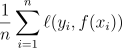
can be biased for the target population. Under covariate shift,

the target risk can be estimated with density-ratio weights:
![R_tgt(f) = E_{P_ref}[w(X) ell(Y, f(X))]](https://pypi-camo.freetls.fastly.net/761e97adfcb1d1cd9173632c06a06c2f73773cd0/68747470733a2f2f7261772e67697468756275736572636f6e74656e742e636f6d2f4d656864694f75646768697269312f7368696674737461742f6d61696e2f646f63732f6173736574732f6571756174696f6e732f77656967687465642d7461726765742d7269736b2e7376673f763d302e362e36)
ShiftStat turns this idea into an inspectable workflow rather than a black-box dashboard.
What ShiftStat Does
| Layer | Scientific question | Main tools |
|---|---|---|
| Shift detection | Which features moved, and is the full covariate table distinguishable from the reference sample? | Kolmogorov-Smirnov tests, chi-square tests, PSI, Wasserstein distance, classifier two-sample tests |
| Importance weighting | Can reference observations be reweighted toward the target covariate distribution? | Domain-classifier density ratios, logistic weighting, clipping, normalization, effective sample size |
| Calibration and reliability | Are probabilities still meaningful under shift? | ECE, MCE, Brier score, log loss, calibration slope/intercept, reliability diagrams |
| Recalibration | Can post-hoc calibration repair probability quality? | Temperature scaling, Platt/logistic calibration, isotonic calibration |
| Subgroup auditing | Are failures hidden inside operational slices? | Group metrics, support diagnostics, worst-group summaries, hidden-failure flags |
| Selective prediction | Does abstention reduce accepted-set risk without hiding failure modes? | Confidence, entropy, margin, learned-risk policies, risk-coverage curves |
| Certification | Is a worst-group alarm statistically supported, or just noisy? | Local effective sample size, simultaneous radii, learned-weight sensitivity, certified excess |
| Experiments | Can the whole evaluation be reproduced later? | Benchmark scenarios, YAML/JSON experiment configs, CSV/Markdown/LaTeX/figure artifact export |
Core Scientific Quantities
1. Density-ratio weighting
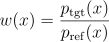
ShiftStat estimates target-over-reference weights by fitting a domain classifier that predicts whether a row came from the target sample:

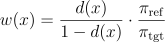
The weighted empirical risk is then
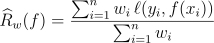
and the Kish effective sample size diagnoses whether the weighted estimate is stable:
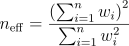
Large weights with small n_eff are treated as evidence limitations, not as a
license to overclaim.
2. Calibration under shift
For a predicted probability p_i and binary label y_i, ShiftStat computes
bin-wise reliability gaps. With bins B_1, ..., B_K, Expected Calibration Error
is

The weighted version replaces counts and means with weighted mass:

ShiftStat also reports Brier score, log loss, maximum calibration error, and logistic calibration slope/intercept so a single scalar cannot hide the shape of the failure.
3. Selective prediction and risk-coverage curves
Selective prediction introduces an acceptance function

The accepted-set target risk is
![R_tgt(f, phi) = E_tgt[phi(X) ell(Y, f(X))] / E_tgt[phi(X)]](https://pypi-camo.freetls.fastly.net/e2dc4c2ead0007591cc44e1c36b30424b1b52884/68747470733a2f2f7261772e67697468756275736572636f6e74656e742e636f6d2f4d656864694f75646768697269312f7368696674737461742f6d61696e2f646f63732f6173736574732f6571756174696f6e732f73656c6563746976652d7269736b2e7376673f763d302e362e36)
![coverage(phi) = E_tgt[phi(X)]](https://pypi-camo.freetls.fastly.net/dd43b2df111698d8e3b6254f6ad928952bce7149/68747470733a2f2f7261772e67697468756275736572636f6e74656e742e636f6d2f4d656864694f75646768697269312f7368696674737461742f6d61696e2f646f63732f6173736574732f6571756174696f6e732f73656c6563746976652d636f7665726167652e7376673f763d302e362e36)
ShiftStat sweeps score thresholds to build the risk-coverage curve: lower risk is only useful if the retained coverage and subgroup composition still make operational sense.
4. Certified worst-group reliability
For a subgroup-bin cell c, ShiftStat audits the weighted residual gap

It then computes a local effective sample size and a simultaneous finite-family
radius over K tested cells:
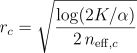
When learned weights are uncertain, a sensitivity envelope rho_c can be added.
With practical tolerance tau and optional population radius gamma, the
certified excess is

The result is not just a sorted list of scary cells. Each cell receives an explicit decision:
certified_failureinsufficient_evidenceno_detected_failureout_of_scope
This distinction is central to the library: an alarming point estimate with low local support should trigger better data collection, not an unsupported claim.
Quickstart
This example creates a synthetic covariate-shift problem, trains a classifier, uses importance weighting, tunes an abstention threshold, and prints a compact deployment report.
from sklearn.linear_model import LogisticRegression

from shiftstat.datasets import make_covariate_shift_classification
from shiftstat.selective import evaluate_selective_under_shift

bundle = make_covariate_shift_classification(random_state=3)

result = evaluate_selective_under_shift(
    LogisticRegression(max_iter=2000),
    bundle.X_ref,
    bundle.y_ref,
    bundle.X_target,
    bundle.y_target,
    apply_importance_weighting=True,
    use_weighted_threshold_tuning=True,
    target_coverage=0.8,
    random_state=3,
)

print(result.summary_frame())
print(result.to_report().to_markdown())
The output is designed to be inspectable: coverage, abstention rate, accepted-set risk, calibration, risk reduction, weighting diagnostics, and target-domain comparison tables remain available as ordinary pandas objects.
A Full Reliability Workflow
from sklearn.ensemble import RandomForestClassifier

from shiftstat.datasets import make_covariate_shift_classification
from shiftstat.detect import ShiftDetector
from shiftstat.reliability import evaluate_under_shift

bundle = make_covariate_shift_classification(random_state=11)

detector = ShiftDetector(random_state=11).fit(bundle.X_ref, bundle.X_target)
print(detector.summary().head())

report = evaluate_under_shift(
    RandomForestClassifier(random_state=11),
    bundle.X_ref,
    bundle.y_ref,
    bundle.X_target,
    bundle.y_target,
    apply_importance_weighting=True,
    recalibration="temperature",
    random_state=11,
)

print(report.to_report().to_markdown())
Conceptually, the workflow is:
tabular reference and target data
        |
        v
detect feature and dataset shift
        |
        v
estimate density-ratio weights
        |
        v
compare reference, weighted-reference, and target reliability
        |
        v
audit subgroups, abstention behavior, and certified worst-group cells
        |
        v
export tables, figures, summaries, and manifests
Certified Worst-Group Audit Example
from shiftstat.certification import CertifiedWorstGroupAuditor
from shiftstat.reweight import CrossFittedImportanceWeighter

weights = CrossFittedImportanceWeighter(
    method="logistic",
    n_folds=5,
    random_state=7,
).fit_predict(X_source, X_target)

audit = CertifiedWorstGroupAuditor(
    n_bins=6,
    tolerance=0.12,
    alpha=0.10,
    min_local_ess=5.0,
).fit(
    y_source=y_source,
    scores_source=scores_source,
    scores_target=scores_target,
    weights=weights,
    groups=source_groups,
    target_groups=target_groups,
)

report = audit.report()

print(report.certified_failures())
print(report.insufficient_evidence())
print(report.to_markdown())
Use this when the scientific question is not merely "which group looks worst?" but "which worst-group findings survive support-aware uncertainty accounting?"
Reproducible Benchmarks And Paper-Ready Artifacts
ShiftStat includes repeated-seed benchmark scenarios and a config-driven experiment runner. A benchmark can be launched from Python:
from shiftstat.bench import BenchmarkRunner, make_covariate_shift_sweep_scenario

scenario = make_covariate_shift_sweep_scenario(
    severities=[0.2, 0.8, 1.4],
    seeds=[7, 19, 43],
    baseline_names=[
        "raw_model",
        "weighting_only",
        "recalibration_only",
        "confidence_abstention",
    ],
)

result = BenchmarkRunner().run(scenario)
artifacts = result.export_artifacts("artifacts/covariate_shift_demo")

print(result.aggregate_frame())
print(artifacts["figures"])
or from the command line:
shiftstat-experiment paper_assets/configs/publication_suite.yaml
Generated artifacts are ordinary files:
- per-scenario run CSVs
- aggregate summary CSVs
- Markdown reports
- LaTeX tables
- figures
- copied configs
- manifests
- logs
That design is deliberate. Scientific results should be reproducible without requiring a private dashboard or hidden state.
Package Map
| Import path | Purpose |
|---|---|
shiftstat.detect |
Feature-wise and dataset-level shift detection |
shiftstat.reweight |
Importance weighting and effective sample size diagnostics |
shiftstat.calibration |
Calibration metrics and post-hoc recalibration |
shiftstat.reliability |
End-to-end reliability evaluation under shift |
shiftstat.subgroup |
Grouped reliability and support-aware subgroup summaries |
shiftstat.audit |
Conditional audits and failure-slice discovery |
shiftstat.selective |
Abstention policies and risk-coverage analysis |
shiftstat.certification |
Certified worst-group reliability audits |
shiftstat.bench |
Repeated-seed benchmark scenarios and baselines |
shiftstat.experiments |
Config-driven experiment runner and CLI |
shiftstat.plotting |
Publication-friendly plotting helpers |
shiftstat.reports |
Markdown, table, and dictionary report objects |
Documentation
- Installation
- Quickstart
- Theory notes
- Reliability theory
- Subgroup auditing
- Selective prediction
- Certified worst-group audits
- Benchmarking
- Publication workflow
Scientific Positioning
ShiftStat is not a monitoring SaaS product and not a single metric. It is a research-oriented Python library for building auditable evidence about tabular model behavior under shift.
It is intentionally modular:
- detection does not hide the test statistics;
- weighting exposes clipping, AUC, and effective sample size;
- calibration reports both scalar and bin-level summaries;
- subgroup audits surface support and coverage caveats;
- selective prediction reports the cost of rejection, not only the gain in risk;
- certification separates
certified_failurefrominsufficient_evidence.
The library is strongest when used as part of a transparent evaluation protocol: state the target population, inspect overlap, compare weighted and unweighted conclusions, audit important subgroups, and report uncertainty whenever support is thin.
Development Quality
The project includes:
- typed package code with
py.typed; - a public API organized around estimator-style objects and result containers;
- regression tests for detection, weighting, calibration, reliability, subgroup analysis, selective prediction, certification, benchmarks, examples, and CLI behavior;
- Ruff linting and mypy type checking;
- GitHub Actions for Linux, macOS, Windows, and Python 3.10 through 3.12;
- wheel build and smoke-install checks;
- documentation and reproducible experiment configuration.
For local development:
pip install -e .[dev,docs]
pytest -m "not slow"
ruff check .
mypy src
mkdocs build
The optional examples extra includes notebook tooling and external datasets:
pip install -e .[examples]
Limitations
ShiftStat is designed for scientific diagnostics, not automatic guarantees.
- Most reliability and certification workflows currently focus on binary classification probabilities.
- Importance weighting depends on overlap between reference and target covariate distributions.
- Target labels, when available, should be used directly for empirical target reliability checks.
- A low local effective sample size is a warning about audit power, not evidence that a model is safe.
- Multiclass certification and sharper adaptive-search theory are intentionally future work.
Citation And License
ShiftStat is released under the BSD 3-Clause License.
If you use ShiftStat in scientific work, please cite the software metadata in
CITATION.cff.
Release history is maintained in
CHANGELOG.md.
Project details
Verified details
These details have been verified by PyPIProject links
GitHub Statistics
Maintainers


Download files
Download the file for your platform. If you're not sure which to choose, learn more about installing packages.
Source Distribution
Built Distribution
Filter files by name, interpreter, ABI, and platform.
If you're not sure about the file name format, learn more about wheel file names.
Copy a direct link to the current filters
File details
Details for the file shiftstat-0.6.6.tar.gz.
File metadata
- Download URL: shiftstat-0.6.6.tar.gz
- Upload date:
- Size: 107.6 kB
- Tags: Source
- Uploaded using Trusted Publishing? Yes
- Uploaded via: twine/6.1.0 CPython/3.13.12
File hashes
| Algorithm | Hash digest | |
|---|---|---|
| SHA256 |
2bc16b856da699b9fe7ef566da86ced568f7899084ae9f5f308f8000b900bc24
|
|
| MD5 |
b0e33a9373014347c31ad7d79e78e0c6
|
|
| BLAKE2b-256 |
b29579c982b7c967a2627d9ffad216882ac734a5cf7fe2a268f705fd1e5ba4ad
|
Provenance
The following attestation bundles were made for shiftstat-0.6.6.tar.gz:
Publisher:
release.yml on MehdiOudghiri1/shiftstat
-
Statement:
-
Statement type:
https://in-toto.io/Statement/v1 -
Predicate type:
https://docs.pypi.org/attestations/publish/v1 -
Subject name:
shiftstat-0.6.6.tar.gz -
Subject digest:
2bc16b856da699b9fe7ef566da86ced568f7899084ae9f5f308f8000b900bc24 - Sigstore transparency entry: 1357246924
- Sigstore integration time:
-
Permalink:
MehdiOudghiri1/shiftstat@cce3dee16b3f3111ddd4acc2e6e8a8c65691a05c -
Branch / Tag:
refs/tags/v0.6.6 - Owner: https://github.com/MehdiOudghiri1
-
Access:
public
-
Token Issuer:
https://token.actions.githubusercontent.com -
Runner Environment:
github-hosted -
Publication workflow:
release.yml@cce3dee16b3f3111ddd4acc2e6e8a8c65691a05c -
Trigger Event:
push
-
Statement type:
File details
Details for the file shiftstat-0.6.6-py3-none-any.whl.
File metadata
- Download URL: shiftstat-0.6.6-py3-none-any.whl
- Upload date:
- Size: 118.8 kB
- Tags: Python 3
- Uploaded using Trusted Publishing? Yes
- Uploaded via: twine/6.1.0 CPython/3.13.12
File hashes
| Algorithm | Hash digest | |
|---|---|---|
| SHA256 |
b96bb237fc1471f11df23063471a014a716e62fe41faf52eed2b03e2657659b0
|
|
| MD5 |
813bf878a6625e4163095fdc49bfbca0
|
|
| BLAKE2b-256 |
eec23da7158ebf20813c99db8956c11e634fb948c338899f01cc240982760bde
|
Provenance
The following attestation bundles were made for shiftstat-0.6.6-py3-none-any.whl:
Publisher:
release.yml on MehdiOudghiri1/shiftstat
-
Statement:
-
Statement type:
https://in-toto.io/Statement/v1 -
Predicate type:
https://docs.pypi.org/attestations/publish/v1 -
Subject name:
shiftstat-0.6.6-py3-none-any.whl -
Subject digest:
b96bb237fc1471f11df23063471a014a716e62fe41faf52eed2b03e2657659b0 - Sigstore transparency entry: 1357246931
- Sigstore integration time:
-
Permalink:
MehdiOudghiri1/shiftstat@cce3dee16b3f3111ddd4acc2e6e8a8c65691a05c -
Branch / Tag:
refs/tags/v0.6.6 - Owner: https://github.com/MehdiOudghiri1
-
Access:
public
-
Token Issuer:
https://token.actions.githubusercontent.com -
Runner Environment:
github-hosted -
Publication workflow:
release.yml@cce3dee16b3f3111ddd4acc2e6e8a8c65691a05c -
Trigger Event:
push
-
Statement type:






