
Observability for LLM applications: tracing, agent graphs, prompt registry and governance, cost allocation, and PII masking. Works with Langfuse, LiteLLM and any Python stack.

Project description
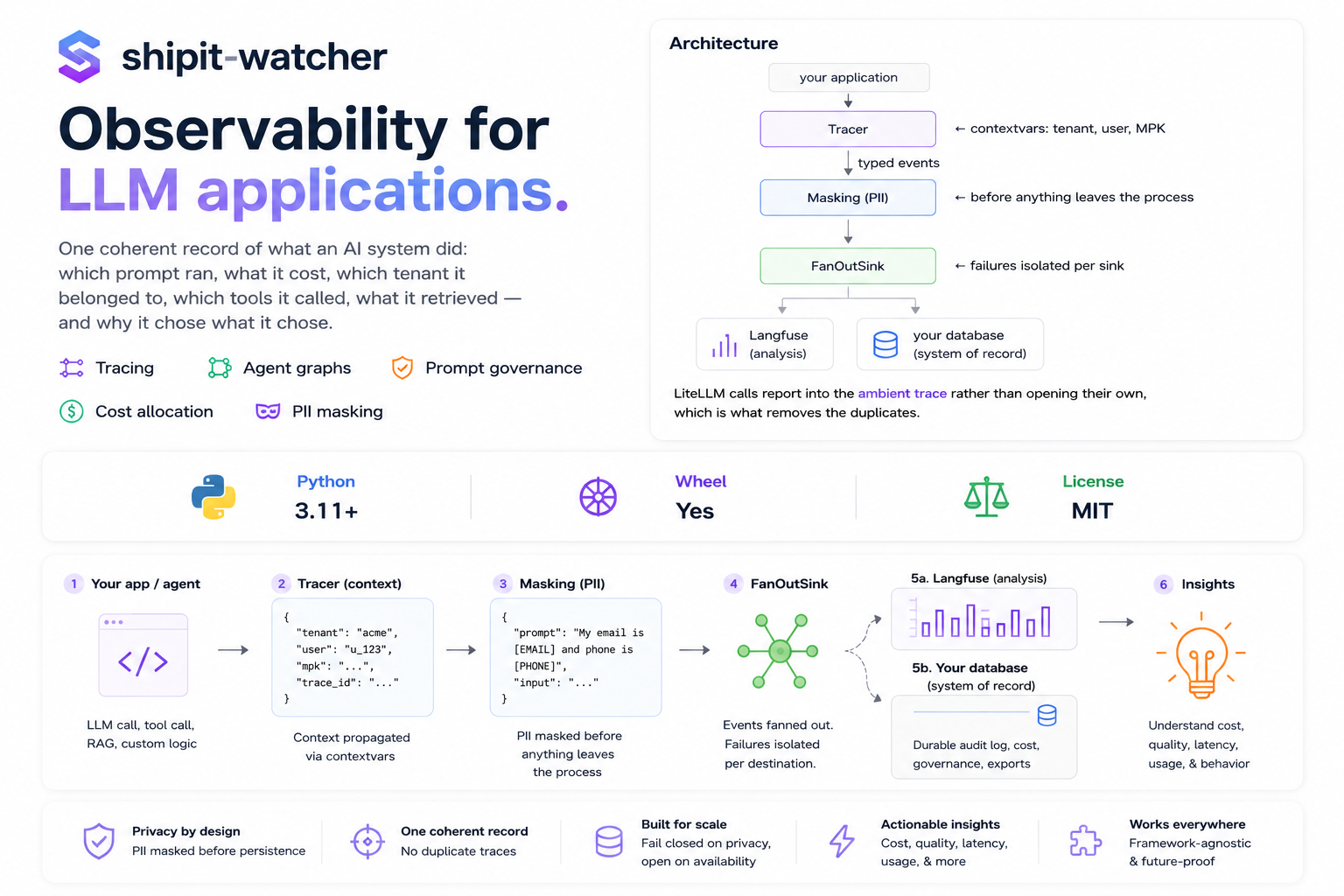
Observability for LLM applications.
Tracing · Agent graphs · Prompt governance · Cost allocation · PII masking





Python 3.11+ · zero required dependencies · framework-agnostic · 288 tests
pip install shipit-watcher
One coherent record of what an AI system did: which prompt ran, what it cost, which tenant it belonged to, which tools it called, what it retrieved — and why it chose what it chose.
Contents
- The problem
- Install
- Quick start
- Core concepts
- Prompt identity
- Prompt registry
- Agent graphs
- Datasets and experiments
- PII masking
- The event model
- Sinks
- The local ledger
- Reporting
- Configuration
- Architecture
- Design rules
- Testing
- Integration guide
The problem
A typical LLM stack records LLM calls and nothing else. Ours recorded them three times:
litellm-acompletion   407 → 476   $0.001312   {}
litellm-completion    407 → 476   $0.001312   {}     ← same call
OpenAI-generation                             {}     ← same call again
Same tokens, same cost, three entries, no metadata, no tool calls.
The cause is double instrumentation. litellm.success_callback = ["langfuse"]
makes LiteLLM open its own trace, the application opens another, and a
proxy-side callback opens a third. None of them carries the tenant, the cost
centre, or which prompt produced the answer.
Watcher settles the ownership question — exactly one component traces — then adds the dimensions that let a trace answer a business question.
Install
pip install shipit-watcher[all]     # langfuse + litellm + django
pip install shipit-watcher          # core only, no dependencies
Every integration degrades to a no-op when its library is absent, so the core is safe to import anywhere.
Quick start
import shipit_watcher as wt

wt.configure(service_name="my-app", environment="production")
wt.instrument_litellm()          # one trace per call, not three

with wt.trace("chat.request",
              company_id=str(company.id),
              user_id=str(user.id),
              cost_center="support-ops"):

    with wt.get_tracer().tool("list_orders") as tool:
        tool.output = list_cars(company)

    wt.get_tracer().decision(
        "route.expert",
        chosen="billing-analysis",
        options=["billing-analysis", "customer-outreach"],
        rationale="query mentions billing",
        confidence=0.87,
    )
Everything inside the block attaches to the trace automatically. Nothing needs
a trace_id parameter threaded through it.
Decorators
@wt.observe_agent("planner")       # opens a root trace
async def run_agent(query: str): ...

@wt.observe_tool("search_docs")   # records a tool invocation
def search_docs(q: str): ...

@wt.observe("summarise")           # a plain span
def summarise(text: str): ...
Sync, async, generators and async generators are all handled. Generators are consumed inside the span — a decorator that returned the generator object unconsumed would record a 0 ms span and never see the real work or its errors.
Core concepts
| Concept | What it is |
|---|---|
| Trace | One unit of work — typically one user request |
| Event | One observation inside a trace: a span, decision, tool call, retrieval |
| Context | Ambient tenant / user / cost-centre, propagated via contextvars |
| Sink | A destination: Langfuse, your database, the console |
| Prompt identity | Name + version + content fingerprint, carried on every call |
Context propagates through contextvars, so it follows the logical flow of
execution across await boundaries and into tasks — without being global state
shared between concurrent requests.
with wt.bind(company_id="acme", cost_center="support-ops"):
    ...    # every event here carries both
Prompt identity
"Prompt identity carried in every call — precondition for enforce, nothing else works without it." — design note
Without it a trace can say which model ran and what it cost, but not which prompt version produced this answer — so governance, replay and "why this answer" have nothing to hang off.
prompt = wt.identify_prompt(
    agent.system_prompt,
    name=f"agent:{agent.slug}",
    version="v3",
    registered=True,          # came from a managed registry
)
| Field | Meaning |
|---|---|
name |
Where the prompt came from — agent:inbox-manager |
version |
Registry version, when one exists |
fingerprint |
SHA-256 over normalised text — changes exactly when the prompt does |
registered |
Defaults to False — the gap report is only useful if its default is honest |
The fingerprint makes a compliance gap report possible on day one, with no registry: group by fingerprint, and any prompt with no registry entry is by definition unregistered.
Prompt registry
Fingerprints tell you which prompt ran. The registry decides what runs — so a prompt change becomes a release someone can review, label and roll back, instead of a diff buried in a Python string.
The whole turn, in one call
answer = wt.run_prompt(
    "support-assistant",
    variables={"company": "Acme", "vehicles": 142, "drivers": 100},
    user_message="How many items do we have?",
)

answer.text            # the answer
answer.total_cost      # what it cost
answer.total_tokens    # 467 → 121
run_prompt resolves the live prompt, compiles it, takes model,
temperature and max_tokens from the prompt's own config, calls the
model, links the generation to that exact version, and records all of it.
Credentials default to LITELLM_API_BASE / LITELLM_API_KEY, so the common
case passes neither.
Everything below is that call taken apart, for when you need the pieces.
One prompt per agent
An application with several agents should not share one prompt namespace.
Prompts are keyed agent:<slug>, and the slug is derived from the agent so
"Support Assistant" and "support-assistant" can never resolve to two
different prompts:
prompt = wt.get_agent_prompt(agent, fallback=agent.system_prompt)
system = prompt.compile(company=company.name, items=142)
Passing the agent's own system_prompt as fallback makes adoption
incremental — agents with a registry entry are managed from Langfuse, agents
without one keep working exactly as before, and prompt.registered tells the
compliance report which is which.
wt.agent_prompt_name("Billing Expert") # → "agent:billing-expert"
Attributing calls you cannot reach
A litellm.completion three frames deep inside a tool has no way to pass a
prompt identity. Bind it to the scope instead:
with wt.use_prompt(prompt):
    ...                       # every LLM call in here is attributed
Without this, prompt attribution only covers the call sites you remembered to
annotate — which is exactly the gap governance cannot have. Works for
LLMClient and for direct litellm calls under instrument_litellm().
Fetch the latest stable prompt
This is the call an agent makes on every turn:
import shipit_watcher as wt

prompt = wt.get_prompt("support-assistant", fallback=LOCAL_DEFAULT)

system = prompt.compile(
    company="Acme",
    items=142,
    customers=100,
    language="English",
)
get_prompt returns the version currently labelled production — not the
newest version. Publishing and releasing are separate acts: a new version goes
live only when the production label moves onto it, which you do from the
Langfuse UI or from code, with no deploy.
| Argument | Default | What it selects |
|---|---|---|
label |
"production" |
The deployment channel. "staging" to try one first. |
version |
– | An exact version. Pins a run; overrides label. |
fallback |
– | Template used if the prompt cannot be resolved at all. |
Why it does not fail your request
Prompts sit on the critical path of every turn, so resolution degrades in steps rather than raising:
fresh cache  →  registry  →  stale cache  →  fallback
   0.01ms        ~30ms       last good      your string
The stale rung is the one that earns its keep. If Langfuse is unreachable
the agent keeps answering with the last prompt it successfully fetched, marked
prompt.stale is True so a dashboard can show the degradation instead of the
outage hiding.
Fallbacks are cached too. A prompt missing from the registry is missing on every request, so without caching each one pays a round-trip and a 404 to learn the same thing.
Wire it into an agent
The identity travels with the call, so every generation in Langfuse says which
prompt version produced it — and config lets the prompt carry its own model
settings, so tuning temperature is also a registry change, not a deploy:
prompt = wt.get_prompt("support-assistant", fallback=LOCAL_DEFAULT)

client = wt.LLMClient(
    model=prompt.config.get("model", "gemini-2.5-pro"),
    api_base=os.environ["LITELLM_API_BASE"],
    api_key=os.environ["LITELLM_API_KEY"],
    temperature=prompt.config.get("temperature", 0.2),
)

with wt.trace("agent.turn", user_id=user.email, session_id=session.id) as ctx:
    answer = client.complete(
        [{"role": "system", "content": prompt.compile(**variables)},
         {"role": "user", "content": question}],
        prompt=prompt.identity,        # ← links the generation to the version
    )
    ctx.set_output({"answer": answer.text})
With WATCHER_GOVERNANCE=enforce, a prompt that did not come from the
registry is refused before the call is made — see
Configuration.
Publish a version
wt.create_prompt(
    "support-assistant",
    "You are {{company}}'s support assistant. Scope: {{items}} vehicles.",
    labels=["production"],                 # omit to stage without releasing
    tags=["my-app", "agent"],
    config={"model": "gemini-2.5-pro", "temperature": 0.2, "max_tokens": 2000},
    commit_message="Tighten citation rule",
)
Langfuse versions by name — this never overwrites, it appends version n+1.
Publishing with labels=[] stages the prompt for review; moving the
production label is the release.
Unlike get_prompt, this raises on failure. A write that did not land is
a release that did not happen, and a release script must not report success
having changed nothing.
Chat prompts
Pass a message list and the type is inferred:
wt.create_prompt("triage", [
    {"role": "system", "content": "You triage support incidents."},
    {"role": "user", "content": "{{incident}}"},
])
They fingerprint like text prompts — the messages are joined before hashing — so a chat prompt is just as traceable as a string one.
Agent graphs
Langfuse draws a graph of a trace only when its observations carry a semantic
type — agent, tool, retriever, embedding, guardrail, chain,
evaluator. A trace of undifferentiated spans renders as a list, because
nothing in it says which box is an agent and which is a tool it called.
Turn it on:
export WATCHER_LANGFUSE_TRANSPORT=otlp
Then write the turn as you would anyway — the types come from which helper you reach for, not from extra arguments:
with wt.trace("app.agent.turn", user_id=user.email, session_id=sid) as ctx:
    with wt.tool("list_orders") as t:          # → tool node
        t.output = runner.run("list_orders")

    wt.retrieval("kb.search", query=q, chunks=chunks)   # → retriever node
    answer = client.complete(messages, prompt=prompt.identity)   # → generation
    ctx.set_output({"answer": answer.text})
renders as:
[AGENT]      app.agent.turn      4.20s
  ├ [TOOL]       list_orders            0.55s
  ├ [TOOL]       list_customers         1.40s
  └ [GENERATION] llm.support_assistant     1.22s   571 tok   $0.000400
| Watcher call | Langfuse node |
|---|---|
wt.trace(...) |
agent (the graph's entry point) |
wt.tool(...) |
tool |
wt.retrieval(...) |
retriever |
wt.generation(...) / LLMClient |
generation |
wt.policy(...) |
guardrail |
wt.decision(...) |
chain |
wt.handoff(...) |
agent |
wt.span(...) |
span — no graph node, by design |
Why a separate transport
Semantic types cannot be sent over the classic ingestion API. Offered one, a Langfuse v3 server replies:
"Invalid option: expected one of \"GENERATION\"|\"SPAN\"|\"EVENT\""
They exist only over OTLP, as the span attribute
langfuse.observation.type. The Langfuse Python SDK exposes this as as_type=
from 3.3.1 — but v3 also removed client.trace(), which most existing
integrations call. So this sink speaks OTLP directly over plain HTTP, with no
OpenTelemetry dependency and no SDK upgrade: only the server has to be v3.
Requirements: a Langfuse server ≥ 3.x. Check yours with
curl $LANGFUSE_HOST/api/public/health.
sdk vs otlp
sdk (default) |
otlp |
|
|---|---|---|
| Server needed | any | v3+ |
| Agent graph | ✗ | ✓ |
| Observation types | span / generation | all ten |
| Delivery | Langfuse client's own batching | one request per finished trace |
Both carry user, session, tags, tokens, cost and prompt version. The only
difference is the graph — so sdk stays the default, and otlp is a
one-variable upgrade when your server supports it.
Datasets and experiments
The Langfuse UI has an Add to dataset button on every trace. Right idea, wrong ergonomics: the cases worth keeping are the ones nobody was watching, and by the time you notice a bad answer you are scrolling for it.
Capture as it happens
with wt.trace("agent.turn", user_id=user.email) as ctx:
    answer = run_agent(question)
    ctx.set_output({"answer": answer})

    if user_reported_it_wrong:
        wt.capture("regressions", input=question, metadata={"reported_by": user.email})
Called inside a trace, the origin fills itself in — the row keeps a link back to the trace that produced it, so a failing example can be re-examined rather than just re-read. The dataset is created on first use, so a capture path never fails because nobody clicked "New dataset" first.
Replay and compare
results = wt.run_experiment(
    "regressions",
    task=lambda item: agent.answer(item.input),
    run_name="prompt-v7",
    evaluators=[wt.LLMJudge(judge, criterion="faithfulness")],
)
Each item gets its own trace, linked to the dataset row under run_name. That
is the difference between "the new prompt feels better" and "the new prompt
scores 0.82 against 0.71 on the same 40 cases".
An item whose task raises is recorded as a failure and the run continues — aborting would throw away the results already gathered, and a task that fails on one input is itself a finding.
| Call | What it does |
|---|---|
wt.capture(dataset, …) |
add the current turn, linked to its trace |
wt.add_item(dataset, …) |
add an example directly; item_id makes it idempotent |
wt.get_items(dataset) |
read every example back |
wt.create_dataset(name) |
create; existing datasets are left alone |
wt.run_experiment(…) |
replay, score, and record as a named run |
PII masking
Applied before anything is persisted or leaves the process. Masking at display time is theatre once the raw value is on someone else's infrastructure.
wt.mask_text("Jan Kowalski PESEL 44051401359, jan@example.pl")
# 'Jan Kowalski PESEL [PESEL], [EMAIL]'

wt.mask_text("Odometer 1234567890 km")
# unchanged — ten digits, but not a valid NIP
Polish identifiers are first-class and checksum-validated:
| Detector | Validation |
|---|---|
| PESEL | weights 1,3,7,9 · complement mod 10 |
| NIP | weights 6,5,7,2,3,4,5,6,7 · mod 11 |
| REGON | 9- and 14-digit variants |
| IBAN | ISO 13616 mod-97 |
| Card | Luhn |
| Email / Phone / IP | pattern, digit-boundary anchored |
Checksums are the point. A business database is full of ten-digit numbers that are not tax IDs. Validating the check digit is what stops this redacting the data the traces exist to explain.
wt.configure(mask_pii=True)                       # default
policy = wt.MaskingPolicy(enabled_rules=frozenset({"EMAIL"}))   # relax explicitly
The event model
Typed, because a decision path cannot be rendered from span(name="something").
| Event | Carries |
|---|---|
GenerationEvent |
model, provider, tokens, cost, prompt identity |
DecisionEvent |
chosen, options_considered, rationale, confidence |
ToolInvocationEvent |
tool name, arguments, success, error |
RetrievalEvent |
query, knowledge base, chunks with provenance |
HandoffEvent |
from_agent → to_agent, reason |
PolicyEvent |
policy name, blocked, reason |
HumanReviewEvent |
reviewer, verdict, comment |
Two fields do the heavy lifting:
options_considered — recorded at the moment of choosing, "why not the
other option" is answerable. Reconstructed afterwards, it is a guess.
RetrievedChunk.content_hash — a citation without one cannot prove the
source said what the answer claims. The document may have changed since.
tracer.retrieval("kb.policy", query="fuel policy",
    chunks=[wt.RetrievedChunk(source="policy_2026.pdf", score=0.93,
                              version="4", content_hash="9f2a1b")])
Sinks
| Sink | Purpose |
|---|---|
LangfuseSink |
analysis surface — supports both v2 and v3 client shapes |
DjangoSink |
the local ledger — retention, cost-centre reporting, your boundary |
ConsoleSink |
development |
FanOutSink isolates them: if Langfuse is unreachable the database row is
still written, and vice versa. A sink that raises is logged once and skipped,
never retried in-line — that would put a failing backend on the user's
critical path.
Adding ClickHouse later is a new file, not a change to any call site.
The local ledger
Langfuse is where you look at traces. The database is where they are kept.
LLMCallRecord — the cost ledger
One row per generation: tenant, cost centre, model, tokens, cost, prompt
identity, latency, and the trace_id that joins back to Langfuse.
Enable it with WATCHER_PERSIST_DB=true (Django apps only — the sink is
imported lazily, so nothing here loads in a process without an ORM).
User identity is not assumed to be a primary key. user is a FK and
resolves only when the value is a pk; user_ref always holds the raw
identifier you passed, whether that is a UUID, an email, or an SSO subject.
Both are indexed. Without this split, Django rejects the entire row for a
non-UUID user — so tracing by email lost the record altogether, with only a
warning in the log:
with wt.trace("turn", user_id="user@example.com", session_id=session.id):
    ...
# LLMCallRecord(user=None, user_ref="user@example.com", session_id=…)
session_id is stored verbatim, so a conversation in your database and a
session in Langfuse are the same string and join without a mapping table.
TraceEventRecord — the full tree (opt-in)
Every event including parent/child edges, so the decision path is reconstructable from your own database:
wt.configure(persist_to_database=True, persist_all_events=True)
├─ span         planning
│  ├─ decision      route.expert   → billing-analysis  ✗['customer-outreach']
├─ span         execution
│  ├─ tool          list_orders
│  ├─ retrieval     kb.policy      → policy.pdf #9f2a1b
│  ├─ generation    llm.completion → 883 tok $0.001312
├─ span         validation
│  ├─ policy        pii_masking
Children finish before their parents, so the parent FK is usually null at
insert time. parent_event_id always records the edge; resolve the relations
once the trace completes:
DjangoSink.stitch_parents(trace_id)
Volume is real — one agent turn emits a dozen events — so persist_all_events
is off by default. Enable it for the systems under audit.
Reporting
Because generations land in your own table, the reports are SQL:
# Spend per cost centre cost centre
LLMCallRecord.objects.values('cost_center').annotate(
    calls=Count('id'), tokens=Sum('total_tokens'), cost=Sum('total_cost'))

# Spend per tenant
LLMCallRecord.objects.values('company__name').annotate(cost=Sum('total_cost'))

# Prompt compliance gap
LLMCallRecord.objects.filter(prompt_registered=False).values(
    'prompt_name', 'prompt_fingerprint').annotate(n=Count('id'))

# Every decision this tenant made
TraceEventRecord.objects.filter(company=company, event_type='decision')
Configuration
Environment first, configure() overrides, safe defaults throughout.
The three you actually have to set
export LANGFUSE_PUBLIC_KEY=pk-lf-…
export LANGFUSE_SECRET_KEY=sk-lf-…
export LANGFUSE_HOST=https://langfuse.example.com   # your instance
LANGFUSE_HOST is the base URL, and it is not optional for self-hosting:
it defaults to Langfuse Cloud, so leaving it unset silently ships your traces
to cloud.langfuse.com — where the keys do not work and nothing appears. The
keys are two rather than one because Langfuse itself issues them that way: the
public key identifies the project, the secret key authorises the write, and
they are sent as an HTTP Basic pair.
Everything below has a working default. Nothing else is required to start.
| Variable | Default | Meaning |
|---|---|---|
WATCHER_LANGFUSE_TRANSPORT |
sdk |
otlp for the agent graph |
WATCHER_DATASET |
– | default dataset for capture() |
WATCHER_SERVICE |
unknown-service |
tags every trace |
WATCHER_ENV |
development |
environment |
WATCHER_ENABLED |
true |
master switch |
WATCHER_MASK_PII |
true |
redact before persistence |
WATCHER_CAPTURE_CONTENT |
true |
false = metrics-only traces |
WATCHER_SAMPLE_RATE |
1.0 |
fraction of traces kept |
WATCHER_PERSIST_DB |
false |
enable the local ledger |
WATCHER_PERSIST_ALL_EVENTS |
false |
persist the whole tree |
WATCHER_GOVERNANCE |
audit |
audit / warn / enforce |
LANGFUSE_PUBLIC_KEYLANGFUSE_SECRET_KEYLANGFUSE_HOST |
— | Langfuse |
Architecture
        your application
               │
               ▼
    ┌──────────────────────┐
    │       Tracer         │  ← contextvars: tenant, user, cost centre
    └──────────┬───────────┘
               │  typed events
               ▼
    ┌──────────────────────┐
    │   masking (PII)      │  ← before anything leaves the process
    └──────────┬───────────┘
               ▼
    ┌──────────────────────┐
    │     FanOutSink       │  ← failures isolated per sink
    └───┬──────────┬───────┘
        ▼          ▼
   Langfuse    your database
   (analysis)  (system of record)
LiteLLM calls report into the ambient trace rather than opening their own, which is what removes the duplicates.
Design rules
- Observability never breaks the request it observes. Every entry point swallows its own failures. Failing to record is a monitoring incident; failing a user's request because recording broke is a worse one.
- Exactly one component owns tracing.
instrument_litellm()removes LiteLLM's Langfuse callback. Keep both and the duplicates return. - PII is masked before persistence, never at display time.
- Fail closed on privacy, open on availability. A masking error redacts the whole value; a sink error is dropped and logged.
- Exceptions propagate unchanged. The tracer marks the span and re-raises.
- Sampling never drops errors. A 10% sample that also discards 90% of failures is useless precisely when it is needed.
Testing
pytest shipit_watcher/tests -q --cov=shipit_watcher --cov-report=term-missing
148 tests · 90% coverage.
The negative cases carry as much weight as the positive ones. Over-masking destroys the data traces exist to explain, so "an odometer reading survives untouched" is as much a requirement as "a PESEL is redacted".
Bugs the suite caught during development, rather than assumptions that shipped:
- a
PHONEpattern matching inside a ten-digit number REGONalternation precedence- a double-
yieldintrace()that replaced the caller's exception with"generator didn't stop after throw()" - a public
tracer()helper shadowing theshipit_watcher.tracersubmodule - typed events not inheriting their parent, flattening the decision path
Integration guide
# settings.py or AppConfig.ready()
import shipit_watcher as wt

wt.configure(
    service_name="my-app",
    environment=os.getenv("ENV", "development"),
    persist_to_database=True,
)
wt.instrument_litellm()
Then wrap your entry point:
with wt.trace("chat.request",
              company_id=str(company.id),
              user_id=str(user.id),
              session_id=str(session.id),
              cost_center=company.cost_center):
    ...
⚠️ Do not run both.
instrument_litellm()replaces LiteLLM's native Langfuse callback. To keep LiteLLM's own traces instead, passreplace_langfuse_callback=False— but then do not create application traces as well, or you are back to duplicates.
What is and is not built
Honest status, so nobody discovers a gap in production.
| Capability | Status |
|---|---|
| Filter by service, model, user, prompt, date, cost centre | ✅ |
| Prompt identity on every call | ✅ |
| Compliance gap report (which calls used an unregistered prompt) | ✅ |
Refuse unregistered prompts (governance=enforce) |
✅ blocks pre-call |
| Agent graphs (typed observations over OTLP) | ✅ needs a Langfuse v3 server |
| Prompt registry: fetch, publish, per-agent keys, stale fallback | ✅ |
| Event model with retrieval provenance and decision paths | ✅ data model — bring your own UI |
| Cost-centre tagging and allocation | ✅ tagging; hierarchies and rules stay yours |
| Budgets and alert ladders | ❌ not started |
| PII masking before persistence | ✅ |
| LLM-as-a-judge scoring | ✅ |
| Langfuse datasets / experiment runs | ✅ |


Download files
Download the file for your platform. If you're not sure which to choose, learn more about installing packages.
Source Distribution
Built Distribution
Filter files by name, interpreter, ABI, and platform.
If you're not sure about the file name format, learn more about wheel file names.
Copy a direct link to the current filters
File details
Details for the file shipit_watcher-1.3.0.tar.gz.
File metadata
- Download URL: shipit_watcher-1.3.0.tar.gz
- Upload date:
- Size: 1.4 MB
- Tags: Source
- Uploaded using Trusted Publishing? No
- Uploaded via: twine/7.0.0 CPython/3.12.3
File hashes
| Algorithm | Hash digest | |
|---|---|---|
| SHA256 |
38b25de1d75388ace357cc4a39395e91c488c426d9c6596794e6f7f9fb1bc4fb
|
|
| MD5 |
fce9d7652cc4ce252c17b7dda19a5a91
|
|
| BLAKE2b-256 |
1d9dd3be850f3d0c1fc2a860ba4d533ed2332159a64f56b023b15cf0f7256ffb
|
File details
Details for the file shipit_watcher-1.3.0-py3-none-any.whl.
File metadata
- Download URL: shipit_watcher-1.3.0-py3-none-any.whl
- Upload date:
- Size: 104.6 kB
- Tags: Python 3
- Uploaded using Trusted Publishing? No
- Uploaded via: twine/7.0.0 CPython/3.12.3
File hashes
| Algorithm | Hash digest | |
|---|---|---|
| SHA256 |
64647e1402fe9509b6264c2376a19b75be767e60317f0fc7c6898293944eb3fa
|
|
| MD5 |
29396c88608e815d4faa40785bceb41e
|
|
| BLAKE2b-256 |
2ae81df16aad7fb5f5c6ee9312fe67b297a7cd444e81eaa3da4e73e0778cdd55
|






