
Why?
In Python we now have async subprocesses which allows to execute several subprocesses at the same time. The purpose of this library is to:
provide an acceptable asyncio subprocess wrapper for my syntaxic taste,
can stream stderr and stdout in real time while capturing it,
real time output must be prefixed for when you execute several commands at the time so that you know which line is for which process, like with docker-compose logs,
output coloration in real time with regexps to make even more readable.
This code was copy/pasted between projects and finally extracted on its own.
Demo
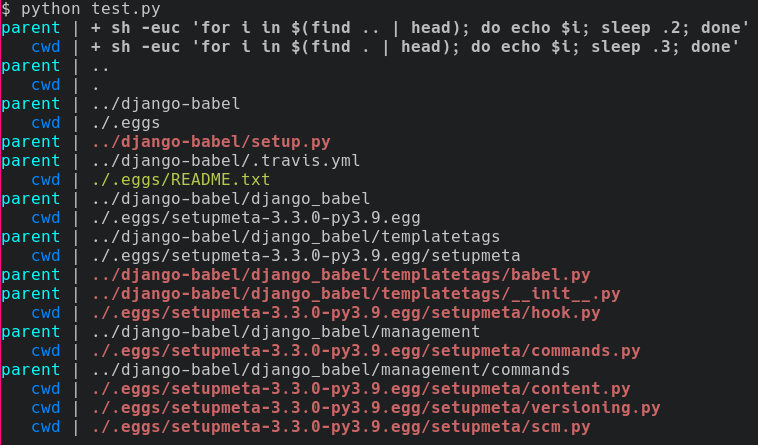
You will find the demo script in demo.py in this repository.
Usage
Basics
Basic example, this will both stream output and capture it:
from shlax import Subprocess
proc = await Subprocess('echo hi').wait()
print(proc.rc, proc.out, proc.err, proc.out_raw, proc.err_raw)
Longer
If you want to start the command and wait for completion elsewhere then call any of start() and wait(), or both, explicitely:
proc = Subprocess('echo hi')
await proc.start()  # start the process
await proc.wait()   # wait for completion
Proc alias
Note that shlax defines an alias Proc to Subprocess so this also works:
from shlax import Proc
proc = await Proc('echo hi').wait()
Quiet
To disable real time output streaming use the quiet argument:
proc = await Subprocess('echo hi', quiet=True).wait()Prefix
Using prefixes, you can have real time outputs of parallel commands and at the same time know which output belongs to which process:
proc0 = Subprocess('find /', prefix='first')
proc1 = Subprocess('find /', prefix='second')
await asyncio.gather(proc0.wait(), proc1.wait())
Coloration and output patching
You can add coloration or patch real time output with regexps, note that it will be applied line by line:
import sys
regexps = {
    '^(.*).py$': '{cyan}\\1',
}
await asyncio.gather(*[
    Subprocess(
        f'find {path}',
        regexps=regexps,
    ).wait()
    for path in sys.path
])
Where is the rest?
Shlax used to be the name of a much more ambitious poc-project, that you can still find in the OLD branch of this repository. It has been extracted in two projects with clear boundaries, namely sysplan and podplan which are still in alpha state, although Shlax as it is feature complete and stable.
1 maintainer

Metadata
1 maintainer
Release files for shlax 1.0.1
For a detailed explanation of source distributions (sdists) and built distributions (wheels), please see the package formats documentation.
Source distribution (sdist)
| File | Size | Uploaded | Provenance | Actions |
|---|---|---|---|---|
| shlax-1.0.1.tar.gz | 4.4 kB | Without provenance | Details for shlax-1.0.1.tar.gz |
Release files / shlax-1.0.1.tar.gz
| Download URL | shlax-1.0.1.tar.gz |
|---|---|
| Size | 4.4 kB |
| Tags | Source |
|
SHA-256 checksum How to use checksums |
b809062977f430b392b322327b67246fb9f619ba68b4f2d27a1bdf8f488a34a4
|
|
BLAKE2b-256 checksum How to use checksums |
a03dd66d31bba2a0721919c833e6522a2d94b1120668173dcc7f4f7c5738bd45
|
| Upload date | |
|
Uploaded using Trusted Publishing? What is trusted publishing? |
No |
| Uploaded via |
twine/3.6.0 importlib_metadata/4.8.2 pkginfo/1.7.1 requests/2.26.0 requests-toolbelt/0.9.1 tqdm/4.62.3 CPython/3.9.7
|
Security for shlax 1.0.1
Provenance
Provenance describes where a file came from. On PyPI, provenance is shared via attestations, which provide a verifiable record of the build or publishing details. View details, limitations and caveats.
No provenance found
None of the files in this release were uploaded with provenance metadata.
A note on package security
PyPI is a repository for distributing packages, not a service for auditing them. While third-party security researchers and our staff do their best to detect and remove malicious packages, PyPI cannot guarantee the quality, security or suitability of any given package.
To learn more about protecting yourself from malicious actors, visit our package security documentation.














