

shotgate
Container-native CI/CD quality gates for quantum circuits.
Statistically validate the probabilistic output of quantum programs across simulators and real quantum processing units (QPUs), defined as code.




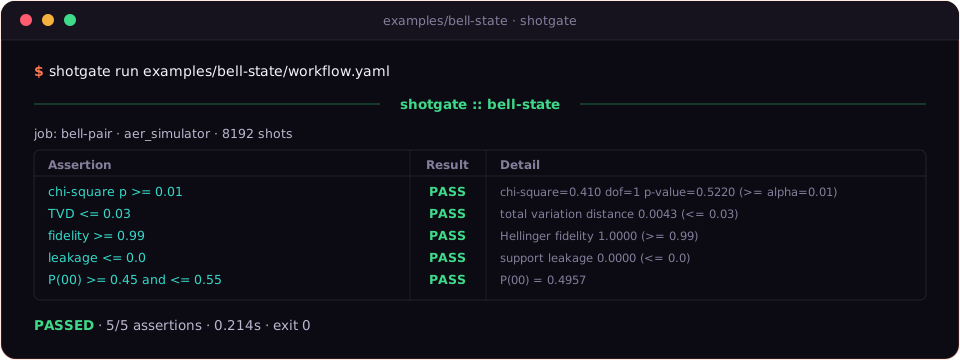
Representative output of shotgate run examples/bell-state/workflow.yaml.
Why shotgate exists
Classical CI/CD relies on determinism: the same input gives the same output, so assert x == y
holds. Quantum programs break that assumption. Run the same circuit twice and the shot counts
differ, so a pipeline cannot gate on exact equality. The community has noted the same gap:
"Unlike deterministic classical programs, quantum algorithms often produce probabilistic results, requiring specialized validation and error mitigation strategies in CI/CD pipelines." (DevOps community guidance)
"Terraform modules and Helm charts may need support for quantum backends, simulators..."
The statistical oracles that handle probabilistic output are established in the literature (QUTest, QuCheck, chi-square as oracle): chi-square goodness-of-fit (GoF), total variation distance (TVD), and Hellinger fidelity. They live mostly in research prototypes rather than in production DevOps tooling. shotgate packages them so a quantum circuit can be gated in an ordinary pipeline. It:
- Defines quantum test workflows as declarative YAML ("quantum workflow as code").
- Executes circuits on simulators or real QPUs through a pluggable backend layer.
- Validates the output distribution statistically and emits JUnit, JSON, and Markdown reports.
- Returns exit code 0 on pass and 1 on failure, so it drops into a CI quality gate directly.
- Ships an Infrastructure-as-Code layer (Terraform) and isolation tiers (Podman, KVM/QEMU).
See docs/architecture.md for the design and
docs/motivation.md for the market and community analysis with sources.
What it looks like
# Trimmed from examples/bell-state/workflow.yaml
apiVersion: shotgate.dev/v1alpha1
kind: QuantumWorkflow
metadata:
  name: bell-state
defaults:
  backend: { provider: local-aer, shots: 8192, seed: 1234 }
jobs: [
  { name: bell-pair,
    circuit: { format: qasm2, path: bell.qasm },
    assertions: [
      { type: chi_square,       expected: { "00": 0.5, "11": 0.5 }, significance: 0.01 },
      { type: distribution_tvd, expected: { "00": 0.5, "11": 0.5 }, max_distance: 0.03 },
      { type: allowed_states,   states: ["00", "11"], max_leakage: 0.0 }
    ]
  }
]
$ shotgate run examples/bell-state/workflow.yaml
─────────────────────────── shotgate :: bell-state ───────────────────────────
 job: bell-pair · aer_simulator · 8192 shots
 ┏━━━━━━━━━━━━━━━━━━━━━━━━━━━┳━━━━━━━━┳━━━━━━━━━━━━━━━━━━━━━━━━━━━━━━━━━━━━━━━━━━━┓
 ┃ Assertion                 ┃ Result ┃ Detail                                    ┃
 ┡━━━━━━━━━━━━━━━━━━━━━━━━━━━╇━━━━━━━━╇━━━━━━━━━━━━━━━━━━━━━━━━━━━━━━━━━━━━━━━━━━━┩
 │ chi-square p >= 0.01      │  PASS  │ chi-square=0.410 dof=1 p-value=0.5220     │
 │ TVD <= 0.03               │  PASS  │ total variation distance 0.0043 (<= 0.03) │
 │ fidelity >= 0.99          │  PASS  │ Hellinger fidelity 1.0000 (>= 0.99)       │
 │ leakage <= 0.0            │  PASS  │ support leakage 0.0000 (<= 0.0)           │
 │ P(00) >= 0.45 and <= 0.55 │  PASS  │ P(00) = 0.4957                            │
 └───────────────────────────┴────────┴───────────────────────────────────────────┘
 PASSED · 5/5 assertions · 0.214s
The same run drops into a pipeline through the Markdown reporter (--markdown), rendered
as a step summary or a PR comment:
shotgate:
bell-state(✅ passed)
- Jobs: 1, failed: 0
- Assertions: 5, failed: 0
- Duration: 0.214s
Job Backend Shots Assertion Result Detail bell-pairaer_simulator 8192 chi-square p >= 0.01 ✅ chi-square=0.410 dof=1 p-value=0.5220 (>= alpha=0.01) bell-pairaer_simulator 8192 TVD <= 0.03 ✅ total variation distance 0.0043 (<= 0.03) bell-pairaer_simulator 8192 fidelity >= 0.99 ✅ Hellinger fidelity 1.0000 (>= 0.99) bell-pairaer_simulator 8192 leakage <= 0.0 ✅ support leakage 0.0000 (<= 0.0) bell-pairaer_simulator 8192 P(00) >= 0.45 and <= 0.55 ✅ P(00) = 0.4957
Install and run
Two install paths are supported and produce identical validation results. Use the container
when you want a pinned, reproducible runtime with the simulator baked in; use the pip package
when you want the shotgate CLI or the pytest plugin inside an existing Python environment.
Path A: Podman (pull and run)
Pull the published image and gate a workflow without installing anything into your host Python:
# --userns=keep-id --user maps you through the container's user namespace so the
# JUnit report is written back owned by you (the image runs as a non-root user).
podman run --rm --userns=keep-id --user "$(id -u):$(id -g)" \
  -v "$PWD:/work:Z" -w /work \
  ghcr.io/coldqubit/shotgate:latest \
  run examples/bell-state/workflow.yaml --junit report.xml
For the cloud/QPU path, use the IBM-enabled image variant and pass a token:
podman run --rm -e SHOTGATE_IBM_TOKEN \
  -v "$PWD:/work:Z" -w /work \
  ghcr.io/coldqubit/shotgate:latest-ibm \
  run examples/bell-state-hardware/workflow.yaml --backend ibm
The same images are mirrored to Docker Hub if you prefer it: swap the registry prefix for
docker.io/coldqubit/shotgate (tags latest, latest-ibm, and each version). GHCR is the
canonical registry; the Docker Hub copy is a convenience mirror.
Path B: pip (CLI and pytest plugin)
Install the package with the backend extra you need (aer for the local simulator, ibm for
IBM Quantum). This installs the shotgate CLI and registers a pytest plugin:
pip install 'shotgate[aer]'
shotgate run examples/bell-state/workflow.yaml --junit report.xml
The pytest plugin turns each declared assertion into one pytest item. Point it at a workflow
with --shotgate, or rely on auto-collection of files named exactly workflow.yaml:
pytest --shotgate examples/bell-state/workflow.yaml
A workflow whose backend dependencies are absent skips with a reason naming the extra to
install, rather than erroring at import. The shotgate_paths ini key collects the same way
without a command-line flag.
Exit code 0 means all assertions passed, 1 means a gate failed, and 2 means a bad workflow or usage error, so either path drops into a pipeline. The container is the default for this repo's own development (see Build from source) because the tests run against the source tree.
Build from source
make build         # podman build -t shotgate:dev .
make run WORKFLOW=examples/bell-state/workflow.yaml
make test          # full test suite in a container
For hardware-isolated runs (each pipeline in a throwaway KVM micro-VM), see
infra/qemu/. For declarative provisioning, see the Terraform module in
infra/terraform/.
The assertion catalog
| Type | Oracle | Use it for |
|---|---|---|
chi_square |
Pearson χ² GoF test (p-value vs α) | Formal hypothesis test; simulator-only (see catalog) |
distribution_tvd |
Total variation distance (TVD) ≤ bound | Default distribution check; interpretable, shot-count-agnostic |
hellinger_fidelity |
Classical fidelity ≥ threshold | Fidelity tracking against an ideal distribution |
state_probability |
Marginal P(state) in a window / ≈ target | Single-outcome amplitude checks (e.g. Grover) |
allowed_states |
Probability mass outside support ≤ budget | Structural/leakage guarantees (e.g. GHZ corners) |
kl_divergence |
KL D(obs‖exp) ≤ bound (bits) | Information-theoretic distance; simulator-only (zero-support) |
shannon_entropy |
Entropy in a min/max window (bits) | Assert the intended randomness/concentration |
expectation_value |
<Z..Z> in [-1, 1] via window / target |
Correlation/parity observable tracking |
most_frequent_outcome |
Modal state (optional min probability) | Single intended answer (e.g. Grover) |
Full reference: docs/assertions.md. The statistical core is pure Python
(no SciPy), including a from-scratch χ² survival function via the regularised incomplete gamma
function. See src/shotgate/validation/metrics.py.
Architecture at a glance
flowchart LR
    subgraph dev["Author"]
        wf["workflow.yaml<br/>(quantum workflow as code)"]
        qasm["circuit.qasm"]
    end
    subgraph shotgate["shotgate (in a Podman container)"]
        cfg["Schema / validation<br/>(pydantic)"]
        ld["Circuit loader"]
        be["Backend registry"]
        val["Statistical oracles<br/>χ² · TVD · fidelity"]
        rep["Reporters<br/>JUnit · JSON · MD"]
    end
    subgraph targets["Execution targets"]
        aer["Local Aer<br/>simulator"]
        ibm["IBM Quantum<br/>(QPU/cloud)"]
    end
    wf --> cfg --> ld --> be
    qasm --> ld
    be --> aer & ibm
    aer & ibm --> val --> rep
    rep -->|exit 0/1| ci["CI/CD gate"]
The layers are decoupled: the validation core has no quantum-SDK dependency, so the metrics and schema run anywhere, and heavy SDKs are imported lazily only when a backend is actually used. The same artifact therefore runs in a small CI container and against a real QPU.
Repository layout
shotgate/
├── src/shotgate/          # the package (validation core, backends, runner, CLI, pytest plugin)
├── examples/              # runnable workflows: bell/ghz/grover + backend & oracle variants
├── tests/                 # unit tests (core) + integration tests (gated on aer)
├── infra/
│   ├── terraform/         # IaC module: "quantum workflow as code"
│   └── qemu/              # ephemeral KVM/QEMU runner (cloud-init)
├── docs/                  # architecture, pipeline schema, ADRs, specs, diagrams
├── .github/workflows/     # Podman-based CI + release
├── Containerfile          # the shotgate runtime image
└── Makefile               # Podman/QEMU task runner
Backends
| Provider | Status |
|---|---|
local-aer (Qiskit Aer simulator) |
Working, default, baked into the image |
ibm (IBM Quantum via Qiskit Runtime) |
Validated on real hardware (ibm_fez, 2026-06-11: Bell/GHZ/Grover gates passed at 4096 shots; measured baseline) |
braket (AWS Braket via qiskit-braket-provider) |
Working: local simulation (no AWS account). Cloud devices need AWS credentials; not yet validated on real Braket hardware. |
| Error mitigation (Mitiq) | Planned |
Roadmap
- v0.1: YAML workflows, local Aer backend, χ²/TVD/fidelity/structural oracles, JUnit/JSON/MD reporters, Podman and KVM/QEMU isolation, Terraform module, pytest plugin, PyPI package, published GHCR image with an IBM-enabled variant.
- v0.2: statistical gates validated against real quantum hardware (
ibm_fez, 2026-06-11, Bell/GHZ/Grover at 4096 shots; measured baseline and runbook indocs/hardware-validation.md), hardware example gates for GHZ and Grover, and a dispatchable QPU validation workflow. - v0.3.0 (latest release): the OpenQASM 3 fix and fail-closed validation, four more
oracles (
kl_divergence,shannon_entropy,expectation_value,most_frequent_outcome), declarative noise-model simulation and noise-aware expected distributions (sochi_square/kl_divergencecan gate on hardware), and the AWS Braket backend (local simulation; the cloud path awaits validation on real hardware). - Planned: error mitigation via Mitiq, multi-backend differential testing, circuit fixtures and property-based generation, a Helm chart, an optional OpenTelemetry exporter for the telemetry layer (kept out of the core dependencies), and validation of the Braket cloud path on real hardware.
See CHANGELOG.md and the ADRs for decisions and rationale.
Contributing and security
Contributions are welcome. Start with CONTRIBUTING.md and the
CODE_OF_CONDUCT.md. Report vulnerabilities per SECURITY.md.
Maintainers
shotgate is an independent open-source project, developed in the open under the coldqubit project home. It is maintained today by one maintainer; co-maintainers and new contributors are welcome. See MAINTAINERS.md for the current roster and how to join it, GOVERNANCE.md for how decisions are made, and CONTRIBUTING.md to get started.
License
Apache-2.0 © 2026 coldqubit.
shotgate is free and open source under the Apache License 2.0. You may use, modify, and redistribute it for any purpose, including commercial and closed-source software, provided you retain the license text and the copyright and attribution notices (Apache-2.0 sections 4(a) through 4(d)).
Note on prior art: the existing
coveooss/terraform-provider-quantumis unrelated to quantum circuits; it manipulates JSON.
1 maintainer

Metadata
1 maintainer
Release files for shotgate 0.3.0
For a detailed explanation of source distributions (sdists) and built distributions (wheels), please see the package formats documentation.
Source distribution (sdist)
| File | Size | Uploaded | |
|---|---|---|---|
| shotgate-0.3.0.tar.gz | 109.4 kB | Details |
Built distribution (wheel)
| File | Interpreter | ABI | Platform | Reset |
|---|---|---|---|---|
| shotgate-0.3.0-py3-none-any.whl | Python 3 | none | any | Details |
Total release size: 154.8 kB
Release files / shotgate-0.3.0.tar.gz
| Download URL | shotgate-0.3.0.tar.gz |
|---|---|
| Size | 109.4 kB |
| Tags | Source |
|
SHA-256 checksum How to use checksums |
411b27f93afcf7a0f80d54b3c04da2e3de455cc9a2641be66e0f88a9b38a429f
|
|
BLAKE2b-256 checksum How to use checksums |
078739903fca37159f1b0f91a12eee13cfbb3eb47520250eaceea091d863ba0f
|
| Upload date | |
|
Uploaded using Trusted Publishing? What is trusted publishing? |
Yes |
| Uploaded via |
twine/6.1.0 CPython/3.13.12
|
Provenance
Provenance describes where a file came from. On PyPI, provenance is shared via attestations, which provide a verifiable record of the build or publishing details. View details, limitations and caveats.


PyPI Publish Attestation
PyPI verified that this artifact, at this checksum, originated from the publisher listed below.
Signed by GitHub Actions, verified by PyPI on Jun 26, 2026.
Transparency logRelease files / shotgate-0.3.0-py3-none-any.whl
| Download URL | shotgate-0.3.0-py3-none-any.whl |
|---|---|
| Size | 45.3 kB |
| Tags | Python 3 |
|
SHA-256 checksum How to use checksums |
c66c5f1efe99b6453b47b1ba6f1108eee619676c94c2c1e1ce42c704a6561ff0
|
|
BLAKE2b-256 checksum How to use checksums |
5843b26292958cf86fb84afc5263f69df7a42f47cae5d255c1ea0357491d2d5f
|
| Upload date | |
|
Uploaded using Trusted Publishing? What is trusted publishing? |
Yes |
| Uploaded via |
twine/6.1.0 CPython/3.13.12
|
Provenance
Provenance describes where a file came from. On PyPI, provenance is shared via attestations, which provide a verifiable record of the build or publishing details. View details, limitations and caveats.
PyPI Publish Attestation
PyPI verified that this artifact, at this checksum, originated from the publisher listed below.
Signed by GitHub Actions, verified by PyPI on Jun 26, 2026.
Transparency log













