
sign-language-data-loading (sldl)
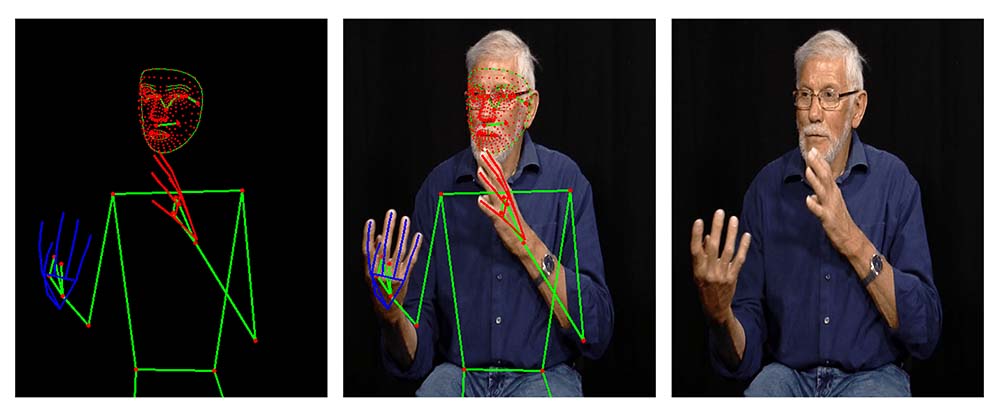
Efficient, PyTorch-friendly data loading for sign language datasets stored as WebDataset shards — poses, videos, and temporal annotations, with windowing and target encoding built in.
Installation
You can simply install it in your Python environment:
pip install sign-language-data-loading
The package is imported as sldl (see examples).
Some features need extra dependencies. Typically, data-loaders and custom targets need PyTorch. If you load the videos too, torchcodec is required. You can install them along with:
# For SignLanguageCollator and the built-in target encoders (sldl.targets.*)
pip install "sign-language-data-loading[torch]"

# For on-the-fly video loading (load_videos=True)
pip install "sign-language-data-loading[video]"
However, we do recommend setting them up yourself in your environment before installing sign-language-data-loading.
Quickstart
Load an isolated-sign dataset
from sldl import SignLanguageDataset
from sldl.configs import LSFBIsolConfig

dataset = SignLanguageDataset.from_config(
    LSFBIsolConfig(
        root="path/to/lsfb-isol",
        variant="500",
        split="training",
    )
)

sample = dataset[0]
print(sample["label"])          # e.g. "bonjour"
print(sample["poses"]["upper_pose"].shape)
Load a continuous dataset
from sldl import SignLanguageDataset
from sldl.configs import LSFBContConfig

dataset = SignLanguageDataset.from_config(
    LSFBContConfig(
        root="path/to/lsfb-cont",
        split="training",
    )
)

sample = dataset[0]
print(sample["annotations"]["both_hands"].head())
Batch samples for training
from torch.utils.data import DataLoader
from sldl import SignLanguageCollator

loader = DataLoader(dataset, batch_size=8, collate_fn=SignLanguageCollator())
batch = next(iter(loader))
print(batch["poses"]["upper_pose"].shape)   # (batch, max_n_frames, ...)
print(batch["masks"].shape)                 # (batch, max_n_frames)
Going further
- Custom dataset paths, windowing, and target encoders: see
SignLanguageDatasetandsldl.targets. - Full worked examples (loading, visualizing poses/video, windowing, target encoding) are in
examples/.
Related projects
- sign-language-tools (PyPI) — pose and annotation transforms (e.g.
SegmentsToFrameLabels,SegmentsToBoundaryOffsets) used by some of the built-in target encoders (sldl.targets.FrameLabelsTarget,sldl.targets.TemporalBoundaryOffsetsTarget). - lsfb-cont dataset — French-Belgian Sign Language (LSFB) dataset, available on HuggingFace. It is very useful for Sign Language Processing tasks that requires a Continuous Sign Language Dataset, such as Continuous Sign Language Recognition (CSLR) and Sign Language Segmentation (SLS).
- lsfb-isol dataset — Isolated version, i.e. ONE sign per video, of the LSFB dataset. Very useful for Isolated Sign Language Recognition (ISLR).
1 maintainer

Metadata
1 maintainer
Release files for sign-language-data-loading 1.0.2
For a detailed explanation of source distributions (sdists) and built distributions (wheels), please see the package formats documentation.
Source distribution (sdist)
| File | Size | Uploaded | Provenance | Actions |
|---|---|---|---|---|
| sign_language_data_loading-1.0.2.tar.gz | 20.1 kB | With provenance | Details for sign_language_data_loading-1.0.2.tar.gz |
Built distribution (wheel)
| File | Interpreter | ABI | Platform | Actions Reset |
|---|---|---|---|---|
| sign_language_data_loading-1.0.2-py3-none-any.whl | Python 3 | none | any | Details for sign_language_data_loading-1.0.2-py3-none-any.whl |
Total release size: 48.7 kB
Release files / sign_language_data_loading-1.0.2.tar.gz
| Download URL | sign_language_data_loading-1.0.2.tar.gz |
|---|---|
| Size | 20.1 kB |
| Tags | Source |
|
SHA-256 checksum How to use checksums |
2ee0d24c892f57f80ed0c74d31d053366eb17f6bd7423d155267a2072437692b
|
|
BLAKE2b-256 checksum How to use checksums |
5354f4d037ead2f142140d5981d8bb4178accc0e34d3b0e5c9b63d3900dde041
|
| Upload date | |
|
Uploaded using Trusted Publishing? What is trusted publishing? |
Yes |
| Uploaded via |
twine/6.1.0 CPython/3.13.14
|
Provenance
Provenance describes where a file came from. On PyPI, provenance is shared via attestations, which provide a verifiable record of the build or publishing details. View details, limitations and caveats.


PyPI Publish Attestation
PyPI verified that this artifact, at this checksum, originated from the publisher listed below.
Signed by GitHub Actions, verified by PyPI on Jul 23, 2026.
Transparency logRelease files / sign_language_data_loading-1.0.2-py3-none-any.whl
| Download URL | sign_language_data_loading-1.0.2-py3-none-any.whl |
|---|---|
| Size | 28.6 kB |
| Tags | Python 3 |
|
SHA-256 checksum How to use checksums |
a92d2001a2da32675da8e8931b02e2362094ba401c94b80e4a7f660c78868d41
|
|
BLAKE2b-256 checksum How to use checksums |
84af2923008f0816ab8a5b413e19c3a9080ff9f47fa592cab8e2c66671a5ae26
|
| Upload date | |
|
Uploaded using Trusted Publishing? What is trusted publishing? |
Yes |
| Uploaded via |
twine/6.1.0 CPython/3.13.14
|
Provenance
Provenance describes where a file came from. On PyPI, provenance is shared via attestations, which provide a verifiable record of the build or publishing details. View details, limitations and caveats.
PyPI Publish Attestation
PyPI verified that this artifact, at this checksum, originated from the publisher listed below.
Signed by GitHub Actions, verified by PyPI on Jul 23, 2026.
Transparency logSecurity for sign-language-data-loading 1.0.2
Provenance
Provenance describes where a file came from. On PyPI, provenance is shared via attestations, which provide a verifiable record of the build or publishing details. View details, limitations and caveats.
Full provenance
All 2 files in this release have been uploaded with provenance metadata.
Attestation for sign_language_data_loading-1.0.2.tar.gz
PyPI Publish Attestation
PyPI verified that this artifact, at this checksum, originated from the publisher listed below.
Signed by GitHub Actions, verified by PyPI on Jul 23, 2026.
Transparency logA note on package security
PyPI is a repository for distributing packages, not a service for auditing them. While third-party security researchers and our staff do their best to detect and remove malicious packages, PyPI cannot guarantee the quality, security or suitability of any given package.
To learn more about protecting yourself from malicious actors, visit our package security documentation.














