
Sillage
Your language model forgets everything. Sillage gives it a memory — and a way to keep learning — in a fixed handful of megabytes, with no gradients and no index that grows.
sillage (n., French) — the trace left behind by something that has passed: a ship's wake, a scent in a room. What a model keeps of what it read.
A frozen language model reads your documents, remembers them, and predicts better next time. No gradients, no fine-tuning, no vector database. One Hebbian matrix written as the model reads, a semantic tier routed by confidence, a cold store that consolidates by surprise, and a rank-16 adapter on the readout — four mechanisms, four preprints, one command-line tool. Everything runs on a laptop CPU.
Install
pip install sillage
Use
sillage index notes.md                # instant: no model, already queryable
sillage ask "what did the report say?"

sillage read notes.md                 # memorize it (CPU: ~8 min per 10k tokens)
sillage complete "The report said"    # generate WITH the memory
sillage status                        # what it knows, tier by tier
sillage forget --all
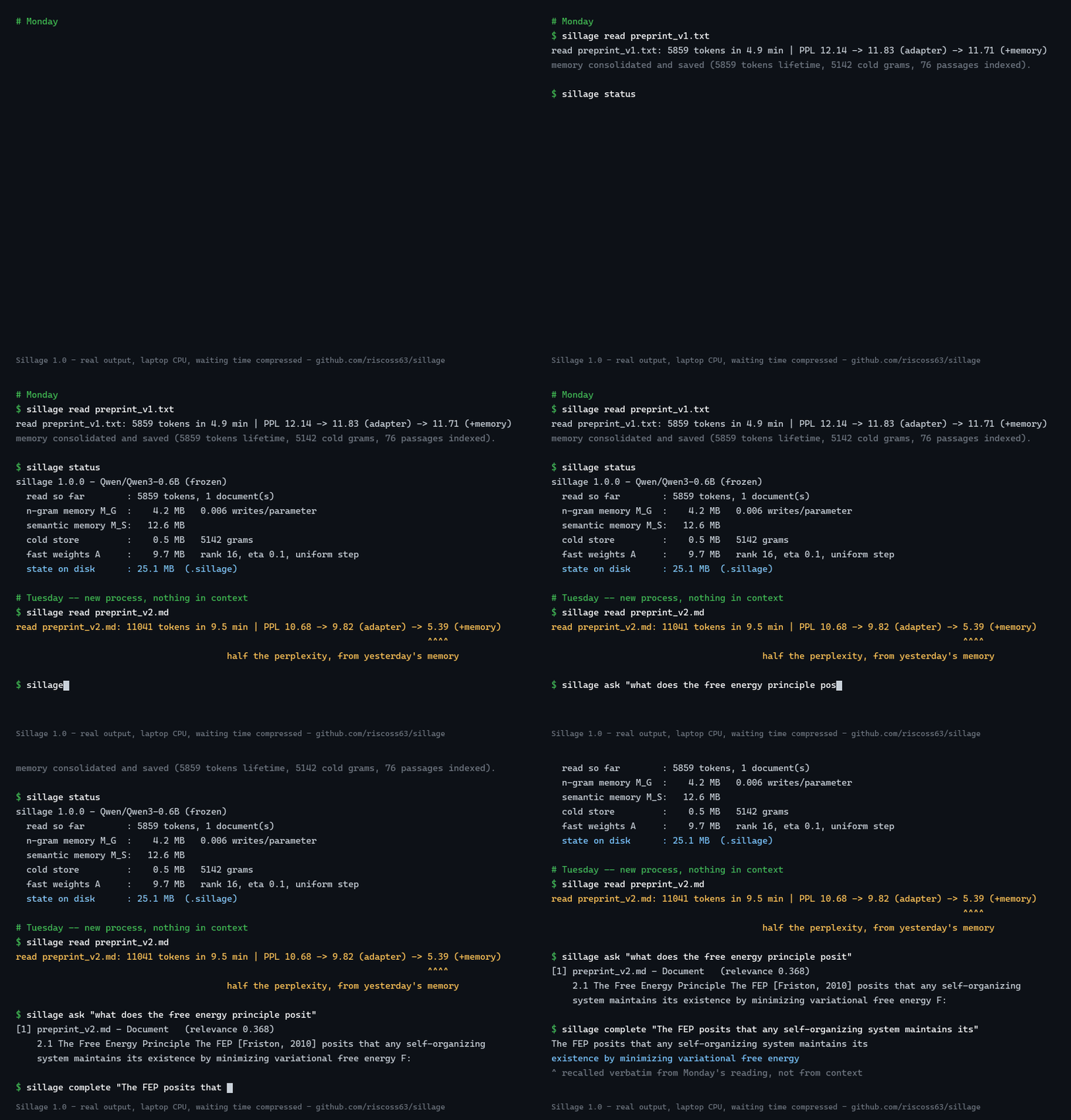
$ sillage read preprint_v1.txt                    # Monday, memory empty
read preprint_v1.txt: 5859 tokens in 4.9 min | PPL 12.14 -> 11.83 (adapter) -> 11.71 (+memory)

$ sillage read preprint_v2.md                     # Tuesday, a new process
read preprint_v2.md: 11041 tokens in 9.5 min | PPL 10.68 -> 9.82 (adapter) -> 5.39 (+memory)
Three numbers per file: what the frozen model alone predicts, what the
rank-16 adapter adds, and what the memory of everything read so far adds on
top. The state lives in ./.sillage, survives restarts, and never grows:
7.4 MB with GPT-2, 25 MB with Qwen3, the same after one document or ten
thousand. It never learns from its own generations — only from what you give
it to read.
From Python:
from sillage import Sillage

s = Sillage(model="gpt2")          # any causal LM; omit it and the state
                                   # says which model it belongs to
s.read("notes.md")                 # read, memorize, index -- then save
s.ask("what did the report say?")  # exact passages, nothing generated
print(s.complete("The report said"))
How much better, exactly?
On 36k tokens of technical text the model had never seen (frozen GPT-2 124M, every system tuned identically on a held-out prefix, 95 % bootstrap CIs):
| system | perplexity | change | memory used |
|---|---|---|---|
| frozen GPT-2 | 31.2 | — | 0 |
| + RAG-style retrieve & rescore | 29.9 | −4 % | corpus + index |
| + kNN-LM, unbounded store | 23.6 | −24 % | 55 MB, grows forever |
| + this memory (fixed) | 19.2 | −38 % | 4.2 MB, constant |
| + memory and fast weights | 16.6 | −47 % | 7.4 MB, constant |
The fixed 4.2 MB memory beats the unbounded datastore it was designed to approximate — paired bootstrap P = 1.000, replicated over 5 random seeds and on a second model (Qwen3-0.6B).
Where it does not win: on long, low-repetition narrative text, kNN-LM still beats it. This memory captures verbatim recurrence; that is its regime, and it is measured and published rather than hidden.
Any causal language model
sillage read notes.md --model qwen                          # shortcut
sillage read notes.md --model HuggingFaceTB/SmolLM2-135M    # any hub id
sillage read notes.md --model ./my-finetuned-llama          # any local folder
Verified across three architectures (GPT-2, Qwen3, GPT-NeoX). For a model
nobody has tuned, the readout calibrates itself on a rolling window of what
you read, following the papers' protocol; for the two the papers did tune,
their published settings are kept. A memory is written in one model's token
space, so give each model its own --state directory.
The four preprints
| # | title | DOI |
|---|---|---|
| 1 | Sillage: Surprise-Gated Amplitude Memory for Frozen Language Models | 10.5281/zenodo.22079016 |
| 2 | Route the Scores, Not the Keys | 10.5281/zenodo.22079444 |
| 3 | One Signal, Three Tiers | 10.5281/zenodo.22079471 |
| 4 | Memory Remembers, Fast Weights Adapt | 10.5281/zenodo.22079481 |
Sources, figures, every number as committed JSON, the reproduction pipeline and the three negative results are on GitHub: https://github.com/riscoss63/sillage
Citation
@article{sghairi2026sillage,
  title  = {Sillage: Surprise-Gated Amplitude Memory
            for Frozen Language Models},
  author = {Sghairi, Abderrahmane},
  year   = {2026},
  doi    = {10.5281/zenodo.22079016},
  url    = {https://doi.org/10.5281/zenodo.22079016}
}
MIT licensed.
1 maintainer

Download files
Download the file for your platform. If you're not sure which to choose, learn more about installing packages.
Source Distribution
Built Distribution
Filter files by name, interpreter, ABI, and platform.
If you're not sure about the file name format, learn more about wheel file names.
Copy a direct link to the current filters
File details
Details for the file sillage-1.0.0.tar.gz.
File metadata
- Download URL: sillage-1.0.0.tar.gz
- Upload date:
- Size: 36.3 kB
- Tags: Source
- Uploaded using Trusted Publishing? No
- Uploaded via:
twine/7.0.0 CPython/3.10.11
File hashes
| Algorithm | Hash digest | |
|---|---|---|
| SHA256 |
371c9273ee4cddd980eeb7b3d7462826fa6f19cb4a15ddec8fcf4c7d0f936368
|
|
| MD5 |
a277ab536000ec558bf33ac9a4f31891
|
|
| BLAKE2b-256 |
e087c157e2f3aa6ebc70733f481bb11bfe9ffc9adb88a4f2b6555ebc8c9d60c5
|
File details
Details for the file sillage-1.0.0-py3-none-any.whl.
File metadata
- Download URL: sillage-1.0.0-py3-none-any.whl
- Upload date:
- Size: 29.8 kB
- Tags: Python 3
- Uploaded using Trusted Publishing? No
- Uploaded via:
twine/7.0.0 CPython/3.10.11
File hashes
| Algorithm | Hash digest | |
|---|---|---|
| SHA256 |
d34a9761dd475a6f8087a836cb81702565cb3f9eb1ecd30fddd115c1d6a9bd7c
|
|
| MD5 |
5bd9a472730a7865dba28c3a203a1aef
|
|
| BLAKE2b-256 |
62ae0428749c2a36c588f72be3097a5d411dfb605fe490700aa6d60b9812ba28
|







