
silver-diagnostics

Turn training telemetry into a health score and a ranked next-action list.




Framework-neutral ML data and training diagnostics for Silver. A Python package designed for ML researchers who need robust data validation and training stability checks across different frameworks.
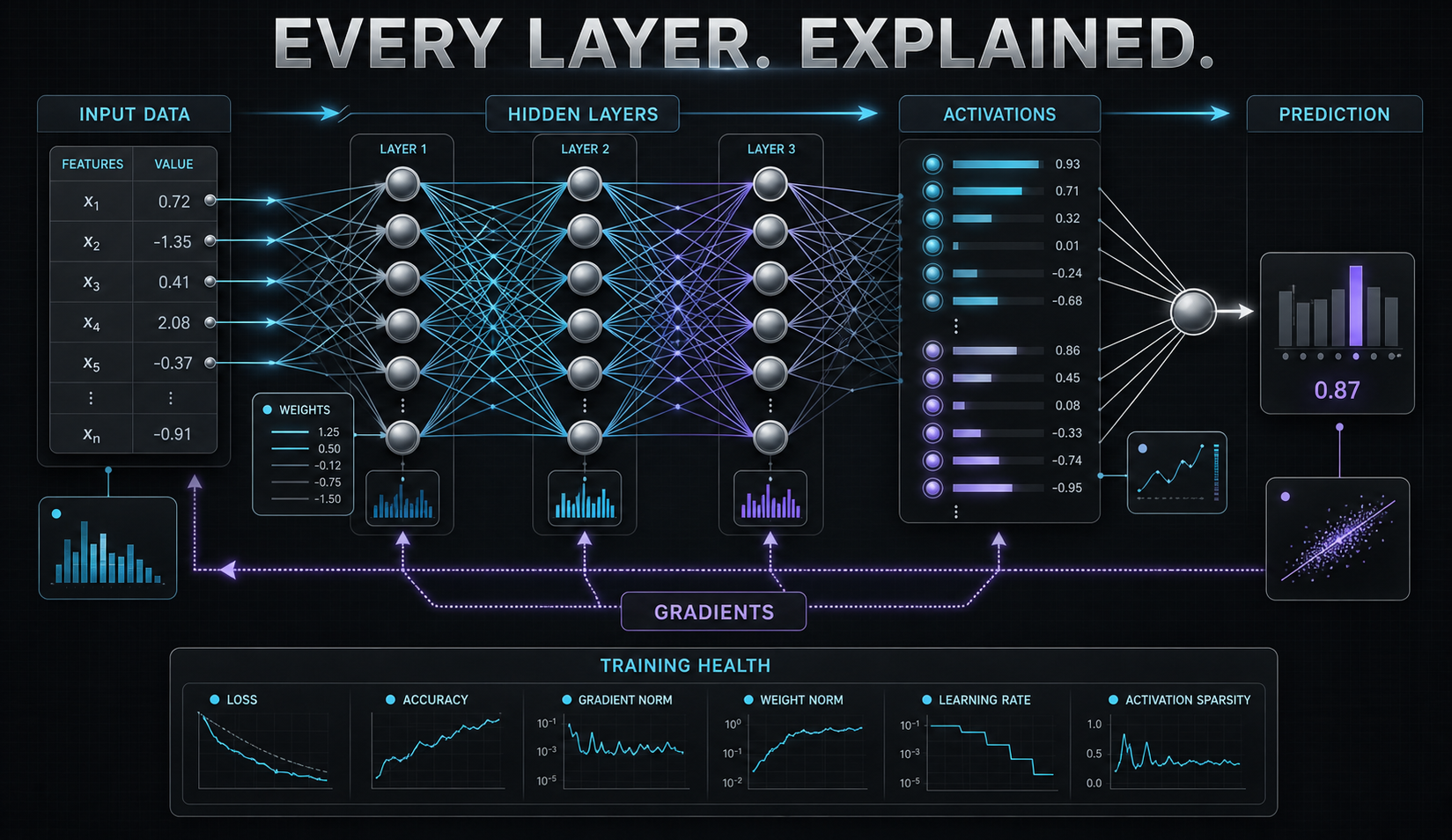
Visual neural health
from silver_diagnostics import diagnose_layer_health, diagnose_training_health

training = diagnose_training_health(history)
open("training-health.svg", "w", encoding="utf-8").write(training.to_svg(history))

layers = diagnose_layer_health(model_inspection.to_dict()["layers"])
open("layer-health.svg", "w", encoding="utf-8").write(layers.to_svg())
Real curves expose convergence and overfitting; measured activation sparsity, variance, and gradient RMS expose unhealthy layers. See the signal definitions and limits.
Installation
pip install silver-diagnostics
Quick Start
Training health, not just warnings
from silver_diagnostics import diagnose_training_health

health = diagnose_training_health([
    {"loss": 1.0, "val_loss": 1.1},
    {"loss": 0.6, "val_loss": 0.7},
    {"loss": 0.4, "val_loss": 0.9},
])

print(health.status, health.score, health.best_step)
for action in health.recommendations:
    print(action.priority, action.title, action.action)

open("training-health.md", "w").write(health.to_markdown())
The health engine detects missing/non-finite metrics, exploding gradients, plateaus, true divergence, regression, and probable overfitting. Reports are machine-readable, Markdown-ready, and framework-neutral.
from silver_diagnostics import diagnose_dataset, diagnose_metrics

# Diagnose dataset issues
features = [[1.0, 2.0], [3.0, 4.0], [5.0, 6.0]]
labels = [0.0, 1.0, 0.0]

report = diagnose_dataset(features, labels)
if not report.valid:
    print("Dataset issues found:")
    for diagnostic in report.diagnostics:
        print(f"  [{diagnostic.severity}] {diagnostic.message}")

# Diagnose metrics issues
metrics = {"loss": 0.5, "accuracy": 0.9, "gradient_norm": 1e6}
report = diagnose_metrics(metrics)
for diagnostic in report.diagnostics:
    print(f"[{diagnostic.severity}] {diagnostic.message}")
Deep classification analysis
from silver_diagnostics import analyze_confusion_matrix

report = analyze_confusion_matrix(
    [[92, 6, 2], [8, 84, 8], [1, 9, 90]],
    labels=["healthy", "warning", "failure"],
    hierarchy={"healthy": "state", "warning": "state", "failure": "state"},
)
print(report.macro_f1, report.top_confusions)
Reports include per-class precision, recall, F1, specificity, support,
normalized matrices, top error pairs, and optional parent-group confusion.
Use analyze_hierarchical_confusion() for coarse-to-fine levels.
Supervised-learning readiness
Use the registry to assess architecture-specific dataset requirements before training:
from silver_diagnostics import assess_supervised_system

assessment = assess_supervised_system("transformer", "classification", {
    "labels": True, "finite_features": True,
    "train_validation_test": True, "sequence_order": True,
    "scaled_numeric": True,
})
if not assessment.valid:
    raise ValueError(assessment.blockers)
Features
- Dataset Validation: Comprehensive checks for empty data, length mismatches, and structural issues
- Non-Finite Detection: Automatic detection of NaN and infinity values in features and labels
- Metrics Diagnostics: Training metrics validation for numerical stability
- Exploding Gradient Detection: Specialized checks for gradient explosion during training
- Framework-Agnostic: Works with PyTorch, TensorFlow, JAX, or any numeric data
- Detailed Reporting: Structured diagnostic information with severity levels and context
- Type Safety: Full type hints for better IDE support and fewer bugs
Use Cases
Training Pipeline Validation
from silver_diagnostics import diagnose_dataset, diagnose_metrics
import torch

# Validate training data before training
train_features = torch.randn(1000, 10).numpy()
train_labels = torch.randint(0, 2, (1000,)).numpy()

report = diagnose_dataset(train_features.tolist(), train_labels.tolist())
if not report.valid:
    print("Cannot train with invalid dataset:")
    for diagnostic in report.diagnostics:
        print(f"  {diagnostic.code}: {diagnostic.message}")
else:
    print("Dataset is valid for training")
Training Stability Monitoring
from silver_diagnostics import diagnose_metrics

# Monitor training metrics for stability
def check_training_stability(metrics):
    report = diagnose_metrics(metrics)

    # Check for errors
    errors = [d for d in report.diagnostics if d.severity == "error"]
    if errors:
        print("Training stability issues:")
        for error in errors:
            print(f"  {error.code}: {error.message}")
            return False

    # Check for warnings
    warnings = [d for d in report.diagnostics if d.severity == "warning"]
    if warnings:
        print("Training stability warnings:")
        for warning in warnings:
            print(f"  {warning.code}: {warning.message}")

    return True

# During training loop
for epoch in range(10):
    loss = train_epoch()
    metrics = {
        "loss": loss,
        "gradient_norm": compute_gradient_norm(),
        "accuracy": evaluate()
    }

    if not check_training_stability(metrics):
        print("Training unstable - stopping")
        break
Data Quality Assurance
from silver_diagnostics import diagnose_dataset

def validate_ml_pipeline_data(X_train, y_train, X_val, y_val):
    """Validate all datasets in ML pipeline"""
    datasets = {
        "training": (X_train, y_train),
        "validation": (X_val, y_val)
    }

    all_valid = True
    for name, (features, labels) in datasets.items():
        report = diagnose_dataset(features.tolist(), labels.tolist())

        print(f"\n{name} dataset:")
        if report.valid:
            print(f"  ✓ Valid ({len(features)} samples)")
        else:
            print(f"  ✗ Invalid")
            for diagnostic in report.diagnostics:
                print(f"    {diagnostic.message}")
            all_valid = False

    return all_valid
Framework Integration
from silver_diagnostics import diagnose_dataset, diagnose_metrics
import tensorflow as tf
import torch

# Works with TensorFlow tensors
tf_features = tf.random.normal((100, 10))
tf_labels = tf.random.uniform((100,), maxval=2, dtype=tf.int32)

report = diagnose_dataset(
    tf_features.numpy().tolist(),
    tf_labels.numpy().tolist()
)

# Works with PyTorch tensors
torch_features = torch.randn(100, 10)
torch_labels = torch.randint(0, 2, (100,))

report = diagnose_dataset(
    torch_features.tolist(),
    torch_labels.tolist()
)
Advanced Usage
Custom Diagnostic Processing
from silver_diagnostics import diagnose_dataset, Diagnostic

def categorize_diagnostics(report):
    """Categorize diagnostics by type"""
    categories = {
        "structural": [],
        "data_quality": [],
        "numerical": []
    }

    for diagnostic in report.diagnostics:
        if diagnostic.code in ["empty_dataset", "length_mismatch", "feature_width_mismatch"]:
            categories["structural"].append(diagnostic)
        elif diagnostic.code in ["non_finite_feature", "non_finite_label"]:
            categories["numerical"].append(diagnostic)
        else:
            categories["data_quality"].append(diagnostic)

    return categories

report = diagnose_dataset(features, labels)
categories = categorize_diagnostics(report)

for category, diagnostics in categories.items():
    if diagnostics:
        print(f"{category.upper()} ({len(diagnostics)}):")
        for diag in diagnostics:
            print(f"  - {diag.message}")
Batch Validation
from silver_diagnostics import diagnose_dataset

def validate_multiple_datasets(dataset_dict):
    """Validate multiple datasets at once"""
    results = {}

    for name, (features, labels) in dataset_dict.items():
        report = diagnose_dataset(features, labels)
        results[name] = {
            "valid": report.valid,
            "error_count": sum(1 for d in report.diagnostics if d.severity == "error"),
            "warning_count": sum(1 for d in report.diagnostics if d.severity == "warning"),
            "diagnostics": report.diagnostics
        }

    return results

datasets = {
    "train": (X_train.tolist(), y_train.tolist()),
    "val": (X_val.tolist(), y_val.tolist()),
    "test": (X_test.tolist(), y_test.tolist())
}

validation_results = validate_multiple_datasets(datasets)
for name, result in validation_results.items():
    status = "✓" if result["valid"] else "✗"
    print(f"{status} {name}: {result['error_count']} errors, {result['warning_count']} warnings")
Requirements
- Python 3.10+
Development
# Install development dependencies
pip install -e ".[dev]"

# Run tests
pytest

# Run tests with coverage
pytest --cov=silver_diagnostics --cov-report=html

# Run linting
flake8 src/ tests/
mypy src/
Contributing
Contributions are welcome! Please see CONTRIBUTING.md for guidelines.
License
Apache-2.0 - see LICENSE file for details.
Related Packages
- silver-data - Dataset handling
- silver-run - Training lifecycle
- silver-adapters - Framework adapters
From visuals to fixes
build_debug_plan(...) combines training health, layer signals, input
profiles, and topology into a deterministic decision plan. Each ranked step
contains its evidence, a concrete action, the expected effect, and a
verification test; DecisionPlan.to_svg() makes the full reasoning reviewable
in code review or experiment artifacts.
1 maintainer

Release files for silver-diagnostics 1.4.0
For a detailed explanation of source distributions (sdists) and built distributions (wheels), please see the package formats documentation.
Source distribution (sdist)
| File | Size | Uploaded | |
|---|---|---|---|
| silver_diagnostics-1.4.0.tar.gz | 3.4 MB | Details |
Built distribution (wheel)
| File | Interpreter | ABI | Platform | Reset |
|---|---|---|---|---|
| silver_diagnostics-1.4.0-py3-none-any.whl | Python 3 | none | any | Details |
Total release size: 3.4 MB
Release files / silver_diagnostics-1.4.0.tar.gz
| Download URL | silver_diagnostics-1.4.0.tar.gz |
|---|---|
| Size | 3.4 MB |
| Tags | Source |
|
SHA-256 checksum How to use checksums |
b260279370a4b6a7f94465457e6e8ce22ea6fcd32179cdfbf045d7043dd5f79b
|
|
BLAKE2b-256 checksum How to use checksums |
f9b02e5c7304bd8f46ca01f33896d804013a88a9cd05f3a3c05fe3b2149690bb
|
| Upload date | |
|
Uploaded using Trusted Publishing? What is trusted publishing? |
Yes |
| Uploaded via |
twine/7.0.0 CPython/3.13.14
|
Provenance
Provenance describes where a file came from. On PyPI, provenance is shared via attestations, which provide a verifiable record of the build or publishing details. View details, limitations and caveats.


PyPI Publish Attestation
PyPI verified that this artifact, at this checksum, originated from the publisher listed below.
Signed by GitHub Actions, verified by PyPI on Aug 23, 2026.
Transparency logRelease files / silver_diagnostics-1.4.0-py3-none-any.whl
| Download URL | silver_diagnostics-1.4.0-py3-none-any.whl |
|---|---|
| Size | 27.6 kB |
| Tags | Python 3 |
|
SHA-256 checksum How to use checksums |
0de94ed61f92e80f70e1ba65c1c4ad8f7c9cdd5781b77aa0f09b16c7de150143
|
|
BLAKE2b-256 checksum How to use checksums |
0ea72679601ab88c88193fe405b6aa31be720d8a1343394c9ed49f1d615bb289
|
| Upload date | |
|
Uploaded using Trusted Publishing? What is trusted publishing? |
Yes |
| Uploaded via |
twine/7.0.0 CPython/3.13.14
|
Provenance
Provenance describes where a file came from. On PyPI, provenance is shared via attestations, which provide a verifiable record of the build or publishing details. View details, limitations and caveats.
PyPI Publish Attestation
PyPI verified that this artifact, at this checksum, originated from the publisher listed below.
Signed by GitHub Actions, verified by PyPI on Aug 23, 2026.
Transparency log













