
simargl
Semantic Index: Map Artifacts, Retrieve from Git Log
Task-to-code retrieval. Given a description of a change, finds which files and modules are likely affected — using semantic similarity over historical tasks or commits.
Exposes an MCP server (stdio transport) compatible with any MCP-aware agent system.
Install
pip install simargl
The default embedding model (bge-small, ~130MB) is downloaded automatically during install.
If that fails or you installed offline, download it manually:
simargl download
Step 1 — Index your project
You need two indexes: one for code files, one for tasks (or commits if no tracker).
# Index code files (walks the repo, chunks text files, stores vectors)
simargl index files C:/repos/sonar

# Index tasks from SQLite (auto-detects tasks vs commits)
simargl index units C:/data/sonar.db

# Check what was indexed
simargl status
Both indexes land in .simargl/default/ relative to your working directory.
If you want to index only part of the repo, or keep two sub-projects separate, use --project:
simargl index files C:/repos/sonar/server --project server
simargl index units C:/data/sonar.db --project server
simargl status --project server
Each project stores its vectors in .simargl/{project}/ independently.
--last N — index only recent history
For large repositories where development is continuous, the most recent tasks or commits describe the current codebase better than the full history. Use --last to limit the units index to the N most recent tasks (or commits), ordered by commit date:
simargl index units C:/data/sonar.db --last 1000
simargl index units C:/data/kafka.db --last 500 --mode commits
This is especially useful for aggr search mode, which averages unit vectors per file — recent units produce a more focused signal than a full multi-year history.
According to our research, --last 1000 produces better retrieval quality than either --last 100 (too narrow) or --last 10000 (too much noise from distant history). 1000 recent tasks is a good default for actively developed projects.
(experiment data and article links will be added here after publication)
Use --model bge-large if you need higher accuracy (uses more RAM and disk).
Available model keys:
# sentence-transformers — runs locally, CPU or GPU, downloads model on first use
--model bge-small                                  # default, 384 dims
--model bge-large                                  # better quality, 1024 dims

# Ollama — no model download, uses whatever is already pulled in Ollama
--model ollama://nomic-embed-text                  # localhost:11434
--model ollama://nomic-embed-text@192.168.1.10     # remote machine

# OpenAI-compatible local server — LM Studio, llama.cpp, LiteLLM, Jan, Koboldcpp
--model openai://localhost:1234/nomic-embed-text   # LM Studio
--model openai://localhost:8080/all-minilm         # llama.cpp server
--model openai://localhost:4000/nomic-embed-text   # LiteLLM
openai:// means OpenAI-compatible API — no cloud, no API key, runs entirely locally.
Export tasks/commits for a glossary
simargl also doubles as the data-preparation step for /flow glossary (1bcoder, vyrii) — it dumps TASKS/COMMITS rows to flat text files that glossary index can chunk and extract terms from. glossary.py itself never talks to SQLite — it only ever reads folders of files — so this export is the one place in the toolkit that needs to know the TASKS/COMMITS schema.
simargl export C:/data/myproject.db --project myproject
With no mode flag this defaults to --join: one file per task in .simargl/myproject/glossary_export/joined/<task>.txt, combining that task's TITLE/DESCRIPTION (per --level) with every commit linked to it via TASK_NAME — each commit as its own --- commit <sha> --- block (message + per-file diff, filtered per --diff-mode). Tasks with no linked commits still get a file (just the task text, no commit block). Commits with no TASK_NAME can't be attached to any task and are reported as orphaned/skipped rather than guessed at — the command prints how many.
/flow glossary index .simargl/myproject/glossary_export/joined --project myproject-joined
Modes — --join (default) / --all / --task / --commits, mutually exclusive:
simargl export myproject.db               # --join (default): one file per task+commits
simargl export myproject.db --all         # tasks/ and commits/ as separate corpora
simargl export myproject.db --task        # tasks only
simargl export myproject.db --commits     # commits only
Use --all instead of the default when you want tasks and commits as separate corpora — a glossary built from tasks and one from commit diffs carry knowledge at a different level, meant to be indexed as separate --project namespaces and cross-referenced later rather than pre-combined:
/flow glossary index .simargl/myproject/glossary_export/tasks --project myproject-tasks
/flow glossary index .simargl/myproject/glossary_export/commits --project myproject-diffs
Task detail level — same names as exp3's source variants (title/desc/comments), cumulative:
simargl export myproject.db --level title       # TITLE only
simargl export myproject.db --level desc        # TITLE + DESCRIPTION (default)
simargl export myproject.db --level comments    # TITLE + DESCRIPTION + COMMENTS
desc is the default because title+description consistently outperforms both title-only and the noisier +comments variant in our retrieval experiments.
Commit diff filtering:
simargl export myproject.db --diff-mode changed   # only +/-/@@ lines (default)
simargl export myproject.db --diff-mode full      # entire diff as stored
changed drops untouched context lines before the text ever reaches glossary chunking — the first line of defense against fact-explosion (every bug would otherwise turn into a handful of glossary "facts" mined from lines that were never actually modified). --unique at glossary-index time is the second line of defense.
| param | values | default |
|---|---|---|
--join / --all / --task / --commits |
mutually-exclusive flags | --join |
--level |
title, desc, comments |
desc |
--diff-mode |
changed, full |
changed |
--out |
path | <store-dir>/<project>/glossary_export |
Step 2 — Connect to 1bcoder
Launch 1bcoder from your project directory — the MCP subprocess inherits that working
directory, so .simargl resolves correctly with no extra flags.
cd C:/Project/my-app
1bcoder
If you indexed with the default project_id (no --project flag):
/mcp connect simargl simargl-mcp
If you indexed with a custom project_id:
/mcp connect simargl simargl-mcp --project-id bookcrossing
The first connect takes 30–60 s while the embedding model loads — this is normal. Tool calls are instant after that.
To connect to a project in a different directory without restarting 1bcoder, use --cwd:
/mcp connect simargl simargl-mcp --cwd C:/Project/other-app --project-id myproject
Check it connected:
/mcp tools simargl
You should see: find, index_files, index_units, status, vacuum, embedding, distance.
With --project-id set at server startup, you never need to pass project_id in tool calls.
Step 3 — Index
1bcoder MCP call syntax is /mcp call server/tool {json_args}.
/mcp call simargl/index_files {"path": "C:/Project/my-app"}
If you have a task SQLite (Jira/GitHub export):
/mcp call simargl/index_units {"db_path": "C:/data/myproject.db"}
Check what was indexed:
/mcp call simargl/status {}
Step 4 — Search
The call syntax is always /mcp call simargl/tool {json}.
Find files related to a description
/mcp call simargl/find {"query": "make author field longer in the book class"}
Default mode is task + sort=rank. If you only indexed files (no task SQLite), use mode=file:
/mcp call simargl/find {"query": "make author field longer in the book class", "mode": "file"}
All parameters
/mcp call simargl/find {
  "query": "make author field longer in the book class",
  "mode": "file",
  "top_n": 10
}
| param | values | default |
|---|---|---|
mode |
task, file, aggr |
task |
sort |
rank, freq |
rank |
top_n |
integer | 10 |
top_k |
integer | 10 |
include_diff |
true/false | false |
project_id |
string | default |
store_dir |
path | .simargl |
If you used a custom project_id at index time
/mcp call simargl/find {"query": "add author field", "project_id": "bookcrossing"}
To avoid passing project_id every time, re-index without it (uses default):
/mcp call simargl/index_files {"path": "C:/Project/my-app"}
Typical 1bcoder workflow
# 1. Find files
/mcp call simargl/find {"query": "make author field longer in the book class", "mode": "file"} -> find_result
/var set find_files matches

# 2. Read the most relevant files
/read {{find_files}}

# 3. Ask the model
make the author field longer in the Book class

# 4. Apply
/patch models.py code
Other tools
Check index status
/mcp call simargl/status {}
/mcp call simargl/status {"project_id": "bookcrossing"}
Compute embedding for any text
/mcp call simargl/embedding {"text": "add user authentication to login flow"} -> vector1
Stores the vector as {{vector1}}. Use later with distance.
Measure semantic distance between two things
/mcp call simargl/distance {"source1": "auth.py", "source2": "views.py"}
/mcp call simargl/distance {"source1": "add user auth", "source2": "auth.py"}
Returns cosine similarity (0–1).
Vacuum (reclaim disk after many incremental re-indexes)
/mcp call simargl/vacuum {}
Re-index after code changes
# Incremental (default) — only processes files modified since last run
simargl index files C:/repos/sonar --project sonar

# Full reindex — re-embeds everything regardless of mtime
simargl index files C:/repos/sonar --project sonar --full
Incremental index uses mtime comparison against the previous indexed_at timestamp:
- unchanged files → skipped
- modified files → old chunks soft-deleted, new chunks appended
- deleted files → chunks soft-deleted
Soft-deleted vectors stay in the int8 file until you vacuum. Run vacuum periodically (e.g. after a big refactor) to reclaim disk space:
simargl vacuum --project sonar
# or from 1bcoder:
/mcp simargl vacuum
Units index is separate — re-run index units only when the SQLite is updated.
Parameters reference
| Tool | Key params | Default |
|---|---|---|
find |
mode (tasks|files), sort (rank|freq), top_n, top_k, top_m, include_diff |
tasks, rank, 10, 10, 5, false |
index_files |
path, model_key, project_id, chunk_size |
—, bge-small, default, 400 |
index_units |
db_path, model_key, project_id, mode |
—, bge-small, default, auto |
export (CLI only) |
db_path, mode (join|all|task|commits), level (title|desc|comments), diff_mode (changed|full), out |
—, join, desc, changed, <store-dir>/<project>/glossary_export |
embedding |
text or file, project_id |
— |
distance |
source1, source2, project_id |
— |
Multiple projects
simargl index units kafka.db --project kafka
simargl index files C:/repos/kafka --project kafka
/mcp simargl find "add partition rebalance" project_id=kafka
/mcp simargl status project_id=kafka
Each project stores its vectors in .simargl/{project_id}/ independently.
Running on a dedicated machine or phone — LAN access
simargl can run on any machine on your LAN: a dedicated server, a Raspberry Pi, or an Android phone via Termux. The index, embedding model, MCP server, and web UI all run there — the laptop just opens a browser or connects an agent.
Web UI over LAN
The web UI binds to 0.0.0.0 by default, so it is immediately visible on the local network:
# on the server / phone
simargl ui --port 7860

# on any browser in the same LAN
http://192.168.1.42:7860
Install the UI extra if not already present:
pip install "simargl[ui]"
Keep it running in the background with tmux or nohup (see below). The UI lets you search all indexed projects, switch mode/sort, and browse results — no agent or CLI needed on the client side.
The UI includes a Download index section (collapsed accordion at the bottom). Select a project and click Prepare ZIP to download the full index (all six files: files.int8, files.db, units.int8, units.db, unit_files.db, meta.json) as a single ZIP. Extract it as .simargl/ on your local machine and run simargl search or simargl status without re-indexing.
unzip default.zip -d .simargl/
simargl status
simargl search "add author field to Book class"
Android (Termux) — full setup
With 8GB+ RAM Ollama + nomic-embed-text + simargl all fit comfortably on the phone. The laptop connects over LAN — no cloud, no GPU, everything local.
Phone setup (Termux)
# base tools
pkg update && pkg install python git

# Ollama for Android (ARM64)
pkg install ollama
ollama serve &
ollama pull nomic-embed-text      # 274MB embedding model
# optional: ollama pull nemotron-mini  (if you want LLM on phone too)

# simargl
pip install simargl
pip install simargl[http]         # adds starlette + uvicorn for LAN transport

# index your project (copy SQLite and repo to phone storage first)
simargl index units /sdcard/data/sonar.db \
    --project sonar \
    --model ollama://nomic-embed-text

simargl index files /sdcard/repos/sonar \
    --project sonar \
    --model ollama://nomic-embed-text

# start MCP server on LAN
simargl-mcp --http --port 8765
# → simargl MCP server — http://0.0.0.0:8765/sse
Laptop — connect to phone
Find phone IP: ip addr in Termux or check Wi-Fi settings.
1bcoder:
/mcp connect simargl http://192.168.1.42:8765/sse
/mcp tools simargl
Claude Desktop (claude_desktop_config.json):
{
  "mcpServers": {
    "simargl": {
      "url": "http://192.168.1.42:8765/sse"
    }
  }
}
Claude Code / OpenCode / Cursor — same URL pattern, see agent-specific config above.
Keep server running in Termux background
# run in background, log to file
nohup simargl-mcp --http --port 8765 > ~/.simargl-mcp.log 2>&1 &

# or use tmux (pkg install tmux)
tmux new -s simargl
simargl-mcp --http --port 8765
# Ctrl+B D  to detach
What runs where
| Component | Server / phone | Laptop / client |
|---|---|---|
| Vector index (.simargl/) | yes | — |
| Embedding model | yes (Ollama) | — |
| MCP server (simargl-mcp) | yes | — |
| Web UI (simargl ui) | yes | browser only |
| Agent / LLM (1bcoder, Claude) | — | yes |
| Repo source files | yes (for indexing) | yes (for editing) |
The phone stores the index and computes embeddings. The laptop runs the agent and edits code.
Both use the same .simargl/ directory — if you prefer, mount phone storage via sshfs
so the laptop can also run simargl index directly against it.
Connecting to agent systems
simargl-mcp uses stdio transport — the universal MCP default. Always pass --store-dir
with the absolute path to your project root so the subprocess always finds .simargl/
regardless of which directory the agent system uses as its working directory.
Claude Desktop
Config file:
- macOS:
~/Library/Application Support/Claude/claude_desktop_config.json - Windows:
%APPDATA%\Claude\claude_desktop_config.json
{
  "mcpServers": {
    "simargl": {
      "command": "simargl-mcp",
      "args": ["--store-dir", "C:/repos/sonar/.simargl", "--project-id", "sonar"]
    }
  }
}
Restart Claude Desktop after editing. Tools appear automatically in the UI.
Claude Code (CLI)
Option A — add to global settings ~/.claude/settings.json:
{
  "mcpServers": {
    "simargl": {
      "command": "simargl-mcp",
      "args": ["--store-dir", "C:/repos/sonar/.simargl", "--project-id", "sonar"]
    }
  }
}
Option B — connect interactively from any session (no restart needed):
/mcp add simargl simargl-mcp --store-dir C:/repos/sonar/.simargl --project-id sonar
Then call tools directly in your prompt:
use simargl find to locate files related to "add buildString to project analysis"
OpenCode
Config file: ~/.config/opencode/config.json
{
  "mcp": {
    "simargl": {
      "command": ["simargl-mcp"],
      "cwd": "C:/repos/sonar"
    }
  }
}
OpenAI Codex CLI
Config file: ~/.codex/config.yaml
mcp_servers:
  simargl:
    command: simargl-mcp
    cwd: C:/repos/sonar
Cursor
Config file: .cursor/mcp.json in your project root (or global ~/.cursor/mcp.json):
{
  "mcpServers": {
    "simargl": {
      "command": "simargl-mcp",
      "cwd": "${workspaceFolder}"
    }
  }
}
${workspaceFolder} resolves to the open project directory — simargl will look for .simargl/ there.
Windsurf (Codeium)
Config file: ~/.codeium/windsurf/mcp_settings.json
{
  "mcpServers": {
    "simargl": {
      "command": "simargl-mcp",
      "cwd": "C:/repos/sonar"
    }
  }
}
Any other MCP-compatible system
The pattern is always the same:
{
  "command": "simargl-mcp",
  "args": [],
  "cwd": "<directory where .simargl/ lives>"
}
If the agent system does not support cwd, pass it as an env variable instead and adjust the server startup — or simply cd to the right directory before launching.
Tip: multiple projects across agents
If you work on several repos, use project_id to keep their indexes separate under the same .simargl/ directory:
find files related to "add partition rebalance"  project_id=kafka
find files related to "add buildString to API"   project_id=sonar
PostgreSQL + pgvector backend
For larger codebases or when you want sub-linear search via HNSW index.
pip install simargl[postgres]
Requires PostgreSQL with pgvector extension:
CREATE EXTENSION IF NOT EXISTS vector;
Index with postgres backend
simargl index units sonar.db --project sonar \
    --backend postgres \
    --db-url postgresql://postgres:postgres@localhost/simargl

simargl index files C:/repos/sonar --project sonar \
    --backend postgres \
    --db-url postgresql://postgres:postgres@localhost/simargl
MCP server with postgres
simargl-mcp --backend postgres \
    --db-url postgresql://postgres:postgres@localhost/simargl
numpy vs postgres — when to choose which
| numpy | postgres | |
|---|---|---|
| Install | zero extra deps | psycopg2 + pgvector |
| Search speed | linear scan | sub-linear (HNSW) |
| Scales well to | ~500k chunks | millions of chunks |
| Vacuum | file rebuild | DELETE + VACUUM ANALYZE |
| Concurrent writes | no | yes |
| Termux / Android | yes | harder |
| Laptop / server | yes | yes |
For most projects (sonar.db = ~100k chunks) numpy is fast enough. Switch to postgres when search latency becomes noticeable or you index multiple large repos.
Part of the SIMARGL toolkit
simargl is one of eight tools that together form an intellectual development support system:
| Tool | Role |
|---|---|
| simargl | Task-to-code retrieval — given a task description, finds which files and modules are likely affected, using semantic similarity over git history |
| svitovyd | Project map — scans any codebase and produces a structural map of definitions and cross-file dependencies; exposes it as an MCP server |
| 1bcoder | AI coding assistant for small local models — surgical context management, agents, parallel inference, proc scripts |
| yasna | Session memory — indexes conversations from all AI agents so you can find what was discussed, when, and where |
| radogast | Context drift monitor — measures how far an AI agent's conversation has drifted from the original task |
| vyrii | Local AI web UI — chat, translate, web research, RAG, and file management via Gradio; powered by Ollama or any OpenAI-compatible backend |
| syryn | Bluetooth identity beacon — returns hostname, mDNS, and active network interfaces for headless devices |
| alkonost | Task-board viewer/editor — Trello-style board and backlog over 1bcoder's deepagent_task output, with full spec rendering and autosave |
- simargl answers: what code is related to this task?
- svitovyd answers: how is the code structured and what depends on what?
- 1bcoder answers: how do I work with local models efficiently?
- yasna answers: where did I already discuss this?
- radogast answers: is the AI agent still on track toward the goal?
- vyrii answers: how do I access all of this through a browser?
- syryn answers: what is the address of this headless device?
- alkonost answers: where do I see and edit the tasks generated from a spec tree?
Together they cover the full development loop: understand the codebase, find relevant history, work with AI locally, remember what was decided, and verify the context stays on target.
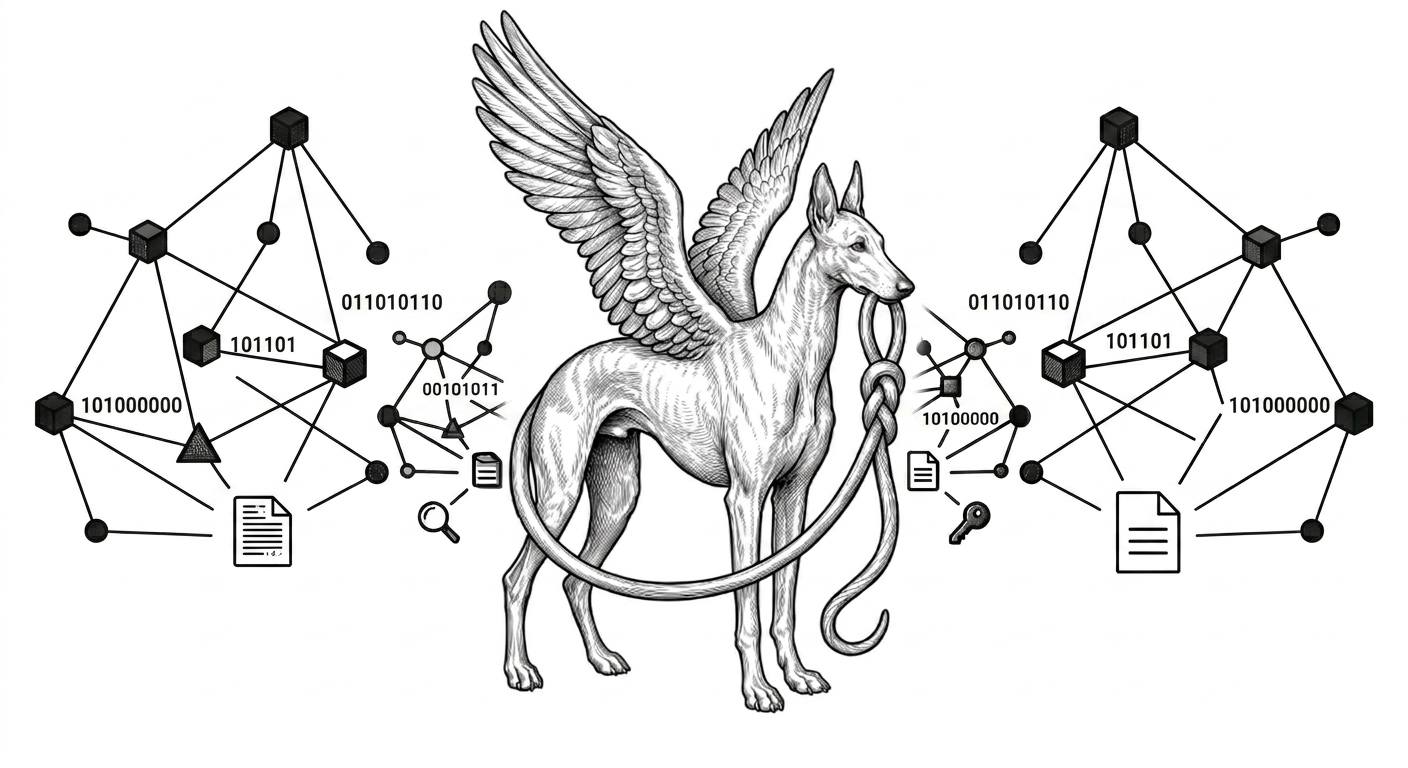
The name comes from Slavic mythology. Simargl (Симаргл) is a winged guardian spirit — a fiery dog with wings, protector of seeds and the earth, messenger between the heavens and the world of men. A fitting name for a tool that retrieves the seeds of code most relevant to any task.
About
(c) 2026 Stanislav Zholobetskyi, Oleh Andriichuk
Institute for Information Recording, National Academy of Sciences of Ukraine, Kyiv
PhD research: «Intelligent Technology for Software Development and Maintenance Support»
1 maintainer

Download files
Download the file for your platform. If you're not sure which to choose, learn more about installing packages.
Source Distribution
Built Distribution
Filter files by name, interpreter, ABI, and platform.
If you're not sure about the file name format, learn more about wheel file names.
Copy a direct link to the current filters
File details
Details for the file simargl-0.1.9.tar.gz.
File metadata
- Download URL: simargl-0.1.9.tar.gz
- Upload date:
- Size: 84.7 kB
- Tags: Source
- Uploaded using Trusted Publishing? No
- Uploaded via:
twine/7.0.0 CPython/3.12.9
File hashes
| Algorithm | Hash digest | |
|---|---|---|
| SHA256 |
5490eecb2780affad7af6af77551d08170e72c1ab33e03678efc8a50dc852555
|
|
| MD5 |
d6334957127cedd3f9aa1f748425c51d
|
|
| BLAKE2b-256 |
984bdba0a45c54b66ccc24d1c7fe0db1bd1e5de6665302b482f97a75e21cdc28
|
File details
Details for the file simargl-0.1.9-py3-none-any.whl.
File metadata
- Download URL: simargl-0.1.9-py3-none-any.whl
- Upload date:
- Size: 85.8 kB
- Tags: Python 3
- Uploaded using Trusted Publishing? No
- Uploaded via:
twine/7.0.0 CPython/3.12.9
File hashes
| Algorithm | Hash digest | |
|---|---|---|
| SHA256 |
49860e6ea5a5624858b52e59a9641e39f59872944e5ee924fd7d7e5b0b58e218
|
|
| MD5 |
9211c571c03f6ef04ba2d70b28c303dc
|
|
| BLAKE2b-256 |
4fe50ad735dc65f5684d377636add7bb303d744d2055c2be9273c2c08f3cf800
|














