

High-performance, zero-allocation 128-bit floating-point arithmetic powered by hardware SIMD.
















simd-f128
Read the Official Documentation: docs/index.md
Try the Live WebAssembly Demo: https://tiw302.github.io/simd-f128/demo/
Verified Compatibility — 17/17 CI Jobs Passing
| Architecture | Platform | CI Workflow | Backend |
|---|---|---|---|
| x86_64 | Linux | linux.yml |
Scalar |
| x86_64 | Linux | linux.yml |
SSE2 (Vectorized) |
| x86_64 | Linux | linux.yml |
AVX2 (Vectorized) |
| x86_64 | Windows (MSVC) | windows.yml |
Scalar |
| x86_64 | Windows (MSVC) | windows.yml |
AVX2 (Vectorized) |
| ARM64 (Apple) | macOS (M-series) | macos.yml |
NEON (Vectorized) |
| ARM64 | Linux/Android (QEMU) | mobile.yml |
NEON (Vectorized) |
| ARMv7 | Linux/Android (QEMU) | mobile.yml |
Scalar + VFPv4 |
| RISC-V64 | Linux (QEMU) | linux.yml |
Scalar C11 |
| WebAssembly | Node.js | wasm.yml |
WASM-SIMD128 |
| WebAssembly | Node.js | wasm.yml |
WASM Scalar |
| Python bindings | Linux | linux.yml |
Python 3.10 extension |
| Rust bindings | Linux | rust.yml |
FFI via cc |
| Rust bindings | Windows | rust.yml |
FFI via cc |
| Rust bindings | macOS | rust.yml |
FFI via cc |
Table of Contents
- simd-f128
- Table of Contents
- Introduction
- Who is this for?
- Why simd-f128?
- Design Philosophy
- Requirements
- Verified Toolchains
- Build and Installation
- Library Components
- Documentation
- Performance & Benchmarks
- Double-Double Arithmetic
- Examples
- Platform Support & CI Status
- Language Bindings
- Project Structure
- Used By
- Author's Note
- Contributing
- License
Introduction
simd-f128 is a professional-grade, header-only C library for 128-bit (Double-Double) floating-point arithmetic, featuring automatic hardware SIMD acceleration (AVX2, NEON, WASM-SIMD). It explicitly targets the precision gap between standard 64-bit IEEE 754 doubles and heavyweight arbitrary-precision libraries like GMP.
By delivering 31-32 decimal digits of accuracy with zero heap allocation overhead, simd-f128 is purpose-built for demanding workloads—such as fractal rendering, physical simulations, and orbital mechanics. While the core engine is pure C11, it provides seamless native bindings for C++, Python, WebAssembly, and Rust, allowing developers across multiple ecosystems to easily overcome the limits of standard double precision.
Who is this for?
simd-f128 is a good fit if you are:
- a graphics / demo-scene developer pushing Mandelbrot or Julia-set renders past the 64-bit precision wall (~10⁻¹⁴ zoom) and need stable coordinates without GMP overhead
- a numerical / scientific computing developer whose simulations accumulate floating-point error over long time steps — orbital mechanics, n-body, RK4 integrators — and need more mantissa without rewriting in Python/Julia
- a game / engine developer doing high-precision physics or world-space transforms where
doublecancellation becomes visible at large coordinates - a web developer or data scientist who needs more than 15 significant digits in the browser or in a Python script, and wants a compiled WASM/extension rather than a pure-JS BigDecimal library
- a C/C++ library author who needs a drop-in 128-bit scalar type that is header-only, zero-allocation, and works on every CI target without compiler flags
simd-f128 is probably not what you need if:
- you need arbitrary precision (thousands of digits) → use GMP/MPFR
- you need strict IEEE 754
binary128compliance for standards-conformant output → use GCC__float128or a software quad library - you are subtracting two nearly-equal values in a numerically sensitive inner loop without knowing about catastrophic cancellation → compensated summation (Kahan) or a different algorithm is the real fix
Why simd-f128?
Ever zoomed into a Mandelbrot set and watched the detail dissolve into grey mush? That's double precision dying — at zoom levels beyond ~10^-14, two distinct coordinates become the same value and the image collapses entirely. The same silent failure happens in long-running simulations, ill-conditioned linear algebra, and anywhere small errors compound over time.
The usual fixes each carry a significant cost:
| Option | Precision | Performance | Allocation | Portability |
|---|---|---|---|---|
double |
~15 digits | Native Hardware | None | Universal |
long double |
18-19 digits (x87) | Fast | None | Compiler-dependent |
__float128 (GCC) |
~33 digits | Emulated (Slow) | None | GCC/Clang only |
| GMP / MPFR | Arbitrary | Very Slow | Heap | Portable |
| simd-f128 | ~31 digits | Hardware SIMD (Fast) | None | Universal |
__float128 gets close on precision but locks you into GCC/Clang and is noticeably slower due to software emulation. GMP/MPFR are powerful but heap-allocating inside a render loop is a non-starter.
simd-f128 occupies the exact gap: it doubles usable precision with zero allocation, zero dependencies, and no compiler lock-in — proven in practice by mandelbrot-c, which achieves stable deep-zoom rendering at coordinates down to 10^-28, far beyond what standard double can represent.
Performance Benchmarks
Below is a benchmark comparison of basic arithmetic operations running on 10,000,000 iterations (latency mode):
| Data Type | Add (ms) | Mul (ms) | Div (ms) | Relative Multiplication Speed |
|---|---|---|---|---|
double (64-bit) |
8.80 | 8.07 | 33.06 | 1.00x (Baseline) |
long double (x87) |
16.66 | 17.28 | 38.58 | 0.47x |
__float128 (GCC) |
152.31 | 189.81 | 276.00 | 0.04x |
| simd-f128 (SIMD) | 73.60 | 56.15 | 159.70 | 0.14x (3.38x faster than GCC) |
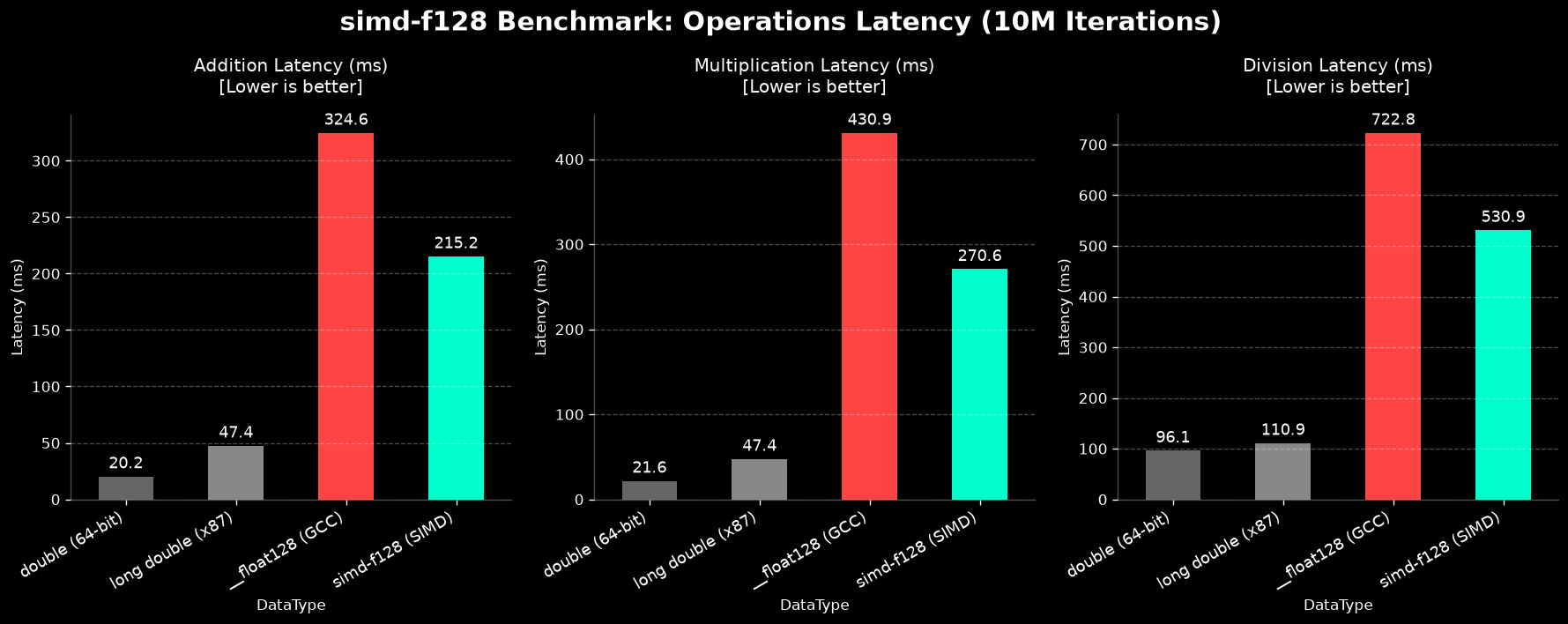
As shown, simd-f128 is 1.7x to 3.3x faster than GCC's software-emulated __float128, making it the highest-performance choice for 128-bit precision.
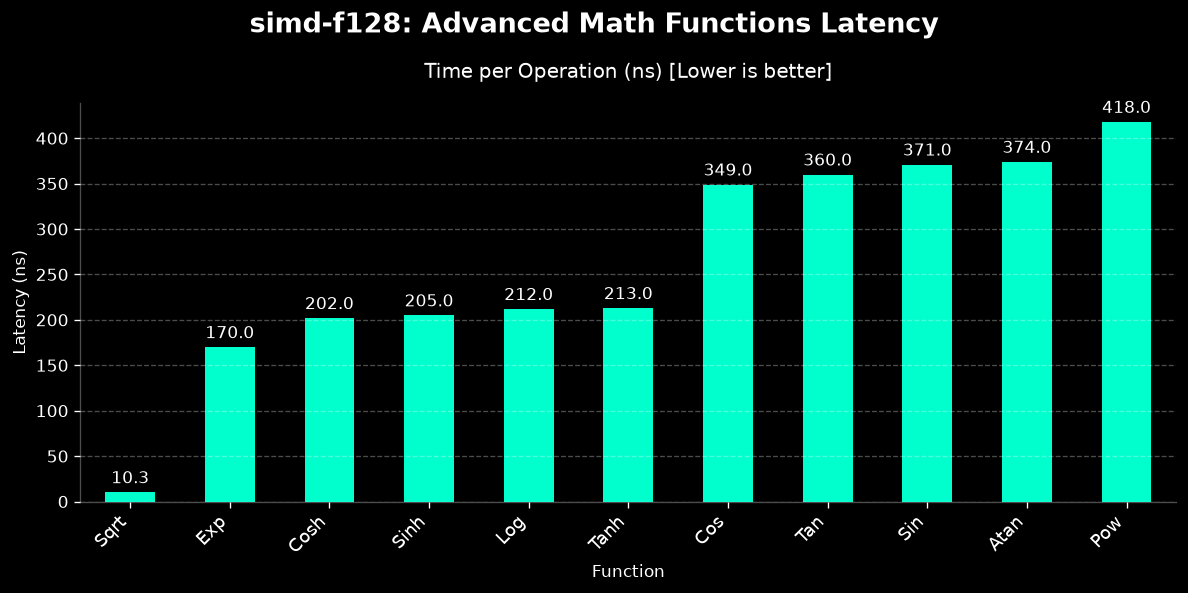
Advanced Math Functions (Nanosecond Latency)
Design Philosophy
The library is built around three constraints that were never relaxed during development:
Zero allocation. Every operation executes entirely in CPU registers. There are no calls to malloc, no temporary buffers, and no GC pressure. This makes simd-f128 suitable for use inside tight render loops, interrupt handlers, and embedded firmware where heap allocation is prohibited.
No configuration required. The correct SIMD backend — AVX2, SSE2, NEON, WASM-SIMD, or scalar — is selected automatically at compile time based on the target architecture. If a specific hardware SIMD instruction set is not detected by the compiler, it seamlessly and safely falls back to a highly portable scalar implementation.
Standard C foundation. The library is built entirely on IEEE 754 double arithmetic and C11 standard library functions. It does not rely on compiler extensions, non-standard intrinsics outside of guarded #ifdef blocks, or platform-specific ABI assumptions. The scalar fallback compiles and produces correct results on any C99-compliant toolchain.
Limitations & Technical Notes
Double-Double vs IEEE 754 128-bit:
Please note that simd-f128 uses Double-Double arithmetic (an unevaluated sum of two standard 64-bit double values) to achieve approximately 31 decimal digits of precision. It is not a strictly compliant IEEE 754 binary128 implementation.
While this approach offers massive performance benefits and is perfect for deeply zooming into fractals (like in mandelbrot-c), it is susceptible to Catastrophic Cancellation in specific scenarios (e.g., subtracting two nearly identical values). If you are building highly sensitive physics simulations or rigorous numerical analysis tools where IEEE 754 edge-case compliance is strictly required, a heavier library like GMP/MPFR or compiler-specific __float128 may be more appropriate.
Requirements
| Component | Requirement |
|---|---|
| C Standard | C11 or later (C99 compatible for scalar path) |
| C++ Standard | C++11 or later (for simd_f128.hpp only) |
| Compiler | GCC 4.9+, Clang 3.5+, MSVC 2019+, Emscripten 3.0+ |
| Math library | -lm required on Linux/UNIX (for fma()) |
Verified Toolchains
| Toolchain | Version | Platform | Backend |
|---|---|---|---|
| GCC | 11+ | Linux x86_64 | Scalar, SSE2, AVX2 |
| GCC (aarch64-linux-gnu) | 11+ | Linux ARM64 (QEMU) | NEON |
| GCC (arm-linux-gnueabihf) | 11+ | Linux ARMv7 (QEMU) | Scalar + VFPv4 |
| GCC (riscv64-linux-gnu) | 11+ | Linux RISC-V64 (QEMU) | Scalar |
| Clang | 14+ | macOS Apple Silicon | NEON |
| MSVC | 2022 | Windows x64 | Scalar, AVX2 |
| Emscripten | 3.0+ | WASM (Node.js/Web) | WASM-SIMD, Scalar |
Build and Installation
simd-f128 can be integrated natively via C/C++ headers, Python, JavaScript (WebAssembly), and Rust.
Language Bindings
Native bindings are available via standard package managers:
| Language | Package Manager | Install Command |
|---|---|---|
| Python | PyPI | pip install simd-f128 |
| Node.js | npm | npm install @tiw302/simd-f128 |
| Rust | Crates.io | cargo add simd-f128 |
C/C++ (Header Only)
simd-f128 is header-only. The simplest integration is copying the include/ directory directly into your project, then defining the implementation macro in exactly one translation unit:
#define SIMD_F128_IMPLEMENTATION
#include <simd_f128.h>
#include <simd_f128_io.h>   // optional
All other translation units include the headers without the macro.
For C++ projects, include the convenience wrapper instead:
#define SIMD_F128_IMPLEMENTATION
#include <simd_f128.hpp>   // pulls in all headers automatically
CMake
System Install (Recommended)
You can install the library system-wide to easily use find_package in other projects:
cmake -S . -B build
sudo cmake --install build
Then in your project's CMakeLists.txt:
find_package(simd_f128 REQUIRED)
target_link_libraries(my_app PRIVATE simd_f128::simd_f128)
FetchContent (Alternative)
If you prefer not to install the library system-wide, you can pull it directly into your build:
include(FetchContent)

FetchContent_Declare(
    simd_f128
    GIT_REPOSITORY https://github.com/tiw302/simd-f128.git
    GIT_TAG        v1.5.4
)
FetchContent_MakeAvailable(simd_f128)

target_link_libraries(my_app PRIVATE simd_f128::simd_f128)
Local Build Options
# Scalar backend (default - works everywhere)
cmake -S . -B build
cmake --build build

# AVX2 backend (Intel/AMD Haswell+)
cmake -S . -B build -DSIMD_F128_AVX2=ON
cmake --build build

# WebAssembly + SIMD128 (Chrome 91+, Firefox 89+, Safari 16.4+, Node.js 16+)
emcmake cmake -S . -B build -DSIMD_F128_WASM=ON
cmake --build build

# WebAssembly Scalar (maximum browser compatibility)
emcmake cmake -S . -B build
cmake --build build

# ARMv7 - optional flag for hardware FMA on VFPv4 cores
cmake -S . -B build -DCMAKE_C_FLAGS="-mfpu=neon-vfpv4 -mfloat-abi=hard"
cmake --build build
AArch64 (Apple Silicon, Graviton, Android ARM64) requires no flags - NEON is auto-detected. Run tests after building:
ctest --test-dir build
Library Components
All headers are static inline / header-only. A quick summary of what each header provides:
| Header | Purpose |
|---|---|
simd_f128.h |
Core type and arithmetic (add, sub, mul, div, sqrt) |
simd_f128_consts.h |
Pre-computed constants (π, e, √2, ln2 at full 106-bit precision) |
simd_f128_io.h |
String parsing and printf-style output at 32-digit precision |
simd_f128_math.h |
Transcendental and trig functions (exp, log, sin, cos, atan, sinh, floor, …) |
simd_f128_utils.h |
Comparison operators (lt, eq, ge, …) and abs/min/max |
simd_f128_matrix.h |
mat2/mat3/mat4 and vec2/vec3/vec4 at 128-bit precision |
simd_f128_random.h |
xoshiro256** PRNG producing uniform simd_f128 in [0, 1) |
simd_f128_vector.h |
4-lane vectorized ops (simd_f128x4) using AVX2 |
simd_f128.hpp |
C++ wrapper with operator overloading and std::ostream integration |
simd_f128_complex.hpp |
std::complex<f128::float128> interoperability |
simd_f128_eigen.hpp |
Eigen NumTraits so float128 works in Eigen::Matrix |
→ Full per-header documentation with code examples: docs/components.md
Documentation
- Components Guide: Detailed overview of all modules and their dependencies.
- API Reference: Full function-level reference with signatures and descriptions.
- Math Theory & Architecture: In-depth explanation of Double-Double arithmetic and SIMD optimizations.
Quick lookup — core functions:
| Function | Description |
|---|---|
simd_f128_from_double(d) |
Promote double to 128-bit. |
simd_f128_add(a, b) |
Double-Double addition (TwoSum). |
simd_f128_sub(a, b) |
Subtraction. |
simd_f128_mul(a, b) |
Multiplication (TwoProd + FMA). |
simd_f128_div(a, b) |
Division (Newton-Raphson). |
simd_f128_sqrt(x) |
Square root (Newton-Raphson + residual). |
simd_f128_exp(x) |
e^x. |
simd_f128_log(x) |
Natural log. |
simd_f128_sin(x) / simd_f128_cos(x) |
Sine / cosine (radians). |
simd_f128_print(x) |
Print to stdout at 32 digits. |
simd_f128_to_string(buf, n, x) |
Write to string buffer. |
simd_f128.h
| Function | Signature | Description |
|---|---|---|
simd_f128_from_double |
simd_f128 simd_f128_from_double(double d) |
Promote a double to 128-bit. lo is initialised to 0.0. |
simd_f128_extract |
void simd_f128_extract(simd_f128 x, double* hi, double* lo) |
Extract the hi and lo components into separate doubles. |
simd_f128_add |
simd_f128 simd_f128_add(simd_f128 a, simd_f128 b) |
Double-Double addition via Knuth's TwoSum. |
simd_f128_sub |
simd_f128 simd_f128_sub(simd_f128 a, simd_f128 b) |
Double-Double subtraction (negates b, then adds). |
simd_f128_mul |
simd_f128 simd_f128_mul(simd_f128 a, simd_f128 b) |
Double-Double multiplication via Dekker's TwoProd + FMA. |
simd_f128_div |
simd_f128 simd_f128_div(simd_f128 a, simd_f128 b) |
Double-Double division via Newton-Raphson reciprocal refinement. |
simd_f128_sqrt |
simd_f128 simd_f128_sqrt(simd_f128 x) |
Square root via inverse-sqrt Newton-Raphson + residual correction. |
simd_f128_consts.h
| Constant | Value (first 32 digits) |
|---|---|
SIMD_F128_PI |
3.14159265358979323846264338327950... |
SIMD_F128_E |
2.71828182845904523536028747135266... |
SIMD_F128_SQRT2 |
1.41421356237309504880168872420969... |
SIMD_F128_LN2 |
0.69314718055994530941723212145817... |
simd_f128_io.h
| Function | Signature | Description |
|---|---|---|
simd_f128_print |
void simd_f128_print(simd_f128 x) |
Print the value to stdout followed by a newline. |
simd_f128_to_string |
void simd_f128_to_string(char* buf, size_t buf_size, simd_f128 x) |
Write up to 32 decimal digits into buf. buf must be at least 64 bytes. Handles nan, inf, and negative values. |
simd_f128_math.h
| Function | Signature | Description |
|---|---|---|
simd_f128_exp |
simd_f128 simd_f128_exp(simd_f128 x) |
e^x. Returns +Inf for x > 709.78, 0 for x < -745. |
simd_f128_log |
simd_f128 simd_f128_log(simd_f128 x) |
Natural log. Returns NaN for x ≤ 0. |
simd_f128_log2 |
simd_f128 simd_f128_log2(simd_f128 x) |
Base-2 log. |
simd_f128_log10 |
simd_f128 simd_f128_log10(simd_f128 x) |
Base-10 log. |
simd_f128_pow |
simd_f128 simd_f128_pow(simd_f128 base, simd_f128 exp) |
base^exp. Handles base zero, infinity, and NaN per IEEE-754. |
simd_f128_cbrt |
simd_f128 simd_f128_cbrt(simd_f128 x) |
Cube root. |
simd_f128_sin |
simd_f128 simd_f128_sin(simd_f128 x) |
Sine (radians). |
simd_f128_cos |
simd_f128 simd_f128_cos(simd_f128 x) |
Cosine (radians). |
simd_f128_tan |
simd_f128 simd_f128_tan(simd_f128 x) |
Tangent (radians). |
simd_f128_sincos |
void simd_f128_sincos(simd_f128 x, simd_f128* s, simd_f128* c) |
Computes sine and cosine in a single pass. |
simd_f128_atan |
simd_f128 simd_f128_atan(simd_f128 x) |
Arctangent. |
simd_f128_atan2 |
simd_f128 simd_f128_atan2(simd_f128 y, simd_f128 x) |
atan(y/x) with quadrant correction. |
simd_f128_asin |
simd_f128 simd_f128_asin(simd_f128 x) |
Arcsine. Domain: [-1, 1]. |
simd_f128_acos |
simd_f128 simd_f128_acos(simd_f128 x) |
Arccosine. Domain: [-1, 1]. |
simd_f128_sinh |
simd_f128 simd_f128_sinh(simd_f128 x) |
Hyperbolic sine. |
simd_f128_cosh |
simd_f128 simd_f128_cosh(simd_f128 x) |
Hyperbolic cosine. |
simd_f128_tanh |
simd_f128 simd_f128_tanh(simd_f128 x) |
Hyperbolic tangent. |
simd_f128_floor |
simd_f128 simd_f128_floor(simd_f128 x) |
Floor. |
simd_f128_ceil |
simd_f128 simd_f128_ceil(simd_f128 x) |
Ceiling. |
simd_f128_trunc |
simd_f128 simd_f128_trunc(simd_f128 x) |
Truncate toward zero. |
simd_f128_round |
simd_f128 simd_f128_round(simd_f128 x) |
Round half-away from zero. |
simd_f128_fmod |
simd_f128 simd_f128_fmod(simd_f128 a, simd_f128 b) |
Floating-point remainder. |
simd_f128_utils.h
| Function | Signature | Description |
|---|---|---|
simd_f128_cmp |
int simd_f128_cmp(simd_f128 a, simd_f128 b) |
Returns -1 if a < b, 1 if a > b, 0 if equal. |
simd_f128_eq |
int simd_f128_eq(simd_f128 a, simd_f128 b) |
1 if a == b. |
simd_f128_gt |
int simd_f128_gt(simd_f128 a, simd_f128 b) |
1 if a > b. |
simd_f128_lt |
int simd_f128_lt(simd_f128 a, simd_f128 b) |
1 if a < b. |
simd_f128_ge |
int simd_f128_ge(simd_f128 a, simd_f128 b) |
1 if a >= b. |
simd_f128_le |
int simd_f128_le(simd_f128 a, simd_f128 b) |
1 if a <= b. |
simd_f128_abs |
simd_f128 simd_f128_abs(simd_f128 x) |
Absolute value. Correctly handles -0.0 in the lo component. |
simd_f128_min |
simd_f128 simd_f128_min(simd_f128 a, simd_f128 b) |
Returns the lesser of a and b. |
simd_f128_max |
simd_f128 simd_f128_max(simd_f128 a, simd_f128 b) |
Returns the greater of a and b. |
simd_f128.hpp (C++ only)
| Symbol | Kind | Description |
|---|---|---|
f128::float128 |
Class | C++ wrapper around simd_f128. |
f128::float128(double) |
Constructor | Construct from a double. |
f128::float128(simd_f128) |
Constructor | Construct from a raw simd_f128. |
float128::extract(hi, lo) |
Method | Extract hi and lo components. |
+, -, *, / |
Operators | Arithmetic operators. |
+=, -=, *=, /= |
Operators | Compound assignment operators. |
==, !=, <, >, <=, >= |
Operators | Comparison operators. |
operator-() |
Unary | Negation. |
float128::to_string() |
Method | Returns std::string with 32-digit representation. |
operator<< |
Stream | std::ostream integration. |
f128::exp, f128::log, f128::pow |
Free functions | Transcendental math. |
f128::sin, f128::cos, f128::sqrt, f128::abs |
Free functions | Trigonometric and utility math. |
f128::pi, f128::e, f128::sqrt2, f128::ln2 |
Constants | High-precision constants as float128. |
Precision Demonstration & Test Results
The core advantage of simd-f128 is preserving small values that standard 64-bit doubles silently discard. All operations execute strictly within SIMD registers without heap allocation.
Here is an actual test run and precision comparison from the Extreme Performance build:
~/Public/simd-f128 master* ⇡
❯ ctest --test-dir build -C Release
Test project /simd-f128/build
    Start 1: arithmetic_test
1/2 Test #1: arithmetic_test ..................   Passed    0.00 sec
    Start 2: arithmetic_test_cpp
2/2 Test #2: arithmetic_test_cpp ..............   Passed    0.00 sec

100% tests passed, 0 tests failed out of 2

~/Public/simd-f128 master* ⇡
❯ ./build/example_precision
--- precision comparison: double vs simd-f128 ---

[double]  1.0 + 1e-17 = 1.00000000000000000000
          precision lost: yes

[simd-f128] 1.0 + 1e-17 = 1.00000000000000001000000000000000
          precision lost: no


~/Public/simd-f128 master* ⇡
❯ ./build/example_mandelbrot
--- mandelbrot core loop (128-bit precision) ---

did not escape after 500 iterations (point is inside the Mandelbrot set)

final |z| components:
  zx = -0.78124578860038387003505655582563
  zy = 0.35443468442007221298624089031401
Performance & Benchmarks
Because simd-f128 operations are purely CPU-register bound, they are extremely fast.
1. Comparative Speed vs __float128
While raw nanoseconds are interesting, a direct comparison against __float128 demonstrates the massive advantage of hardware SIMD over software emulation. The test simulates loop-carried dependency latency (e.g., a = a + b) simulating tight inner-loops in numerical algorithms. Tests run for 10,000,000 operations.
| Data Type | Add (ms) | Mul (ms) | Div (ms) |
|---|---|---|---|
double (64-bit) |
9.24 | 9.23 | 41.83 |
long double (x87) |
20.70 | 20.66 | 48.49 |
__float128 (GCC) |
153.37 | 193.23 | 325.37 |
simd-f128 (AVX2) |
99.44 | 74.46 | 207.98 |
View raw console output from bench_compare
$ ./build/benchmarks/bench_compare

simd-f128 Manual Benchmark Comparison
Iterations: 10000000 operations per test (latency mode)

| Data Type          | Add (ms) | Mul (ms) | Div (ms) |
|--------------------|----------|----------|----------|
|--------------------|----------|----------|----------|
| double (64-bit)    |     9.24 |     9.23 |    41.83 |
| long double (x87)  |    20.70 |    20.66 |    48.49 |
| __float128 (GCC)   |   153.37 |   193.23 |   325.37 |
| simd-f128 (SIMD)   |    99.44 |    74.46 |   207.98 |
Analysis:
simd-f128 on AVX2 decisively outperforms GCC's software-emulated __float128. Specifically, multiplication is 2.59x faster, addition is 1.54x faster, and division is 1.56x faster. This is achieved through the aggressive use of Hardware FMA (Fused Multiply-Add), which rapidly resolves Dekker's split algorithms natively in silicon without relying on slower branching software emulation.
2. WebAssembly (In-Browser) Benchmarks
The library ships with dual WebAssembly modules to maximise both performance and compatibility. The benchmarks below reflect 1,000,000 continuous simd_f128_mul operations running entirely inside the V8 JavaScript engine (Chrome).
| Module Type | Time (ms) | Notes |
|---|---|---|
| WASM-SIMD128 | ~295 ms | Native 128-bit SIMD processing inside the browser. |
| WASM-Scalar | ~481 ms | Fallback for older browsers without SIMD support. |
Native JS Number |
~1.5 ms | Native 64-bit precision (loss of 15 digits of precision). |
Takeaway: WASM-SIMD128 achieves a ~1.6x speedup over scalar WASM inside the browser. While native JS Number is incredibly fast due to JIT compilation of single hardware instructions, it completely fails to preserve precision past 15 digits. simd-f128 enables software running in the browser to maintain 32-digit precision with highly acceptable latency for real-time visualization and mathematical processing.
3. Raw Speed (Google Benchmark)
A single simd_f128_mul completes in ~10 nanoseconds, and advanced math functions run in the ~170-490ns range.
Run on (12 X 3266.69 MHz CPU s)
CPU Caches:
  L1 Data 32 KiB (x6)
  L1 Instruction 32 KiB (x6)
  L2 Unified 512 KiB (x6)
  L3 Unified 16384 KiB (x1)
-----------------------------------------------------------
Benchmark                 Time             CPU   Iterations
-----------------------------------------------------------
BM_SimdF128_Add        11.7 ns         11.7 ns     60057911
BM_SimdF128_Mul        10.1 ns         10.1 ns     69579904
BM_SimdF128_Div        2.87 ns         2.86 ns    244206304
BM_SimdF128_Sqrt       6.05 ns         6.04 ns    115940003
BM_SimdF128_Exp         192 ns          192 ns      3646032
BM_SimdF128_Log         240 ns          240 ns      2920704
BM_SimdF128_Sin         192 ns          192 ns      3645663
BM_SimdF128_Cos         200 ns          199 ns      3510110
BM_SimdF128_Atan        402 ns          401 ns      1743733
BM_SimdF128_Pow         492 ns          491 ns      1426559
Double-Double Arithmetic
simd-f128 represents a value as the unevaluated sum of two IEEE 754 doubles — hi + lo where |lo| ≤ ½ ulp(hi). This non-overlapping constraint gives ~106 bits of mantissa (~31-32 decimal digits).
Core algorithms: TwoSum (Knuth) for addition, TwoProd (Dekker) + FMA for multiplication, Newton-Raphson for division and sqrt.
→ Full theory and known limitations: docs/math_theory.md
Examples
All examples are under examples/ and build via ./build.sh examples or cmake -DSIMD_F128_BUILD_EXAMPLES=ON.
C (examples/c/)
basic_arithmetic.c — starting point. Loads SIMD_F128_PI and SIMD_F128_E, does add/sub/mul, prints at full 32-digit precision.
precision_demo.c — side-by-side comparison of double vs simd_f128 on 1.0 + 1e-17. The double silently drops the small value; simd_f128 keeps it in the lo component.
mandelbrot_core.c — runs z = z² + c at a deep-zoom coordinate past the 64-bit precision boundary. Checks the escape condition |z|² > 4 and prints the final zx/zy at full precision.
matrix_transform.c — 4×4 transform matrix ops using simd_f128_matrix.h. Builds a rotation/scale matrix and multiplies it against a vec4, showing the precision advantage on accumulated transform errors.
chaotic_pendulum.c — simulates a double pendulum with RK4 integration. A good stress-test for accumulated floating-point error — two runs with slightly different initial conditions diverge, demonstrating why 128-bit precision matters for long-horizon simulations.
crypto_large_integer.c — big-integer-style modular arithmetic using double-double pairs as a precision substrate, relevant to cryptography primitives that need more than 53 bits of mantissa.
C++ (examples/cpp/)
cpp_operator_overload.cpp — demo of f128::float128 from simd_f128.hpp. Natural arithmetic (+, *, /), comparison operators, std::ostream output, and free math functions (f128::sin, f128::exp, etc.).
Python (examples/python/)
python_vanishing_gradient.py — simulates the vanishing gradient problem in a deep neural network using 128-bit precision. Compares gradient magnitudes computed with standard float64 vs simd_f128 over many layers.
JavaScript (examples/js/)
js_web_simulation.js — Node.js script that loads the WASM module and runs a physics simulation loop using 128-bit arithmetic, demonstrating the JS API.
Rust (examples/rust/)
Rust crate under examples/rust/ that calls the C FFI bindings and runs basic arithmetic ops from Rust.
Quick example — circle area at 32-digit precision:
#include <stdio.h>

#define SIMD_F128_IMPLEMENTATION
#include <simd_f128.h>
#include <simd_f128_consts.h>
#include <simd_f128_io.h>

int main() {
    simd_f128 r    = simd_f128_from_double(10.0);
    simd_f128 r2   = simd_f128_mul(r, r);
    simd_f128 area = simd_f128_mul(SIMD_F128_PI, r2);

    // output: 314.15926535897932384626433832795028
    printf("Circle Area: ");
    simd_f128_print(area);

    return 0;
}
Same thing in C++:
#define SIMD_F128_IMPLEMENTATION
#include <simd_f128.hpp>
#include <iostream>

int main() {
    f128::float128 r(10.0);
    f128::float128 area = f128::pi * r * r;

    // output: 314.15926535897932384626433832795028
    std::cout << "Circle Area: " << area << "\n";

    return 0;
}
Platform Support & CI Status
Every commit is tested across all backends via GitHub Actions. The table below maps each workflow to the platforms and backends it covers.
| Workflow | Platform | Backend | Runner |
|---|---|---|---|
 |
Linux x86_64 | Scalar, SSE2, AVX2 | ubuntu-latest |
|
Linux RISC-V64 | Scalar | ubuntu-latest + QEMU |
|
Python Bindings | CPython Extension | ubuntu-latest |
 |
Apple Silicon (M1/M2/M3) | NEON | macos-latest |
 |
Windows x64 (MSVC) | Scalar, AVX2 | windows-latest |
 |
WebAssembly (Node.js) | WASM-SIMD, Scalar | ubuntu-latest + Emscripten |
 |
Android ARM64, ARMv7 | NEON, Scalar | ubuntu-latest + QEMU |
 |
Rust Bindings | Rust FFI (Linux, macOS, Win) | ubuntu, macos, windows |
Language Bindings
simd-f128 is designed to provide 128-bit precision not just to C/C++, but to higher-level ecosystems.
Python
Using pybind11, the library is exposed as a native CPython extension, bringing 31-digit precision directly into Python scripts.
import simd_f128 as f128

a = f128.from_string("3.14159265358979323846")
b = f128.from_double(2.0)
print((a * b).to_string())
JavaScript / WebAssembly
Compiled via Emscripten, the JS bindings automatically select between WASM-SIMD128 and WASM-Scalar depending on the user's browser support, providing 31-digit precision directly in the browser or Node.js.
Rust
A fully memory-safe Rust wrapper (via cc and bindgen), exposing the C functions safely through idiomatic Rust structs and operator overloads.
Project Structure
.
├── assets/images/        # logo and documentation media
├── benchmarks/           # performance benchmarks (Google Benchmark & native)
│   ├── CMakeLists.txt
│   ├── bench_arithmetic.cpp
│   ├── bench_math.cpp
│   ├── bench_matrix.cpp
│   └── bench_compare.c
├── examples/             # runnable usage examples
│   ├── CMakeLists.txt
│   ├── c/                # C examples
│   ├── cpp/              # C++ examples
│   ├── js/               # JS/web examples
│   ├── python/           # Python examples
│   └── rust/             # Rust examples
├── tests/                # unit tests
│   ├── CMakeLists.txt
│   ├── c/                # C tests
│   ├── cpp/              # C++ tests
│   ├── js/               # JS tests
│   └── python/           # Python tests
├── .github/workflows/    # CI pipelines (linux, macos, windows, wasm, mobile)
├── include/              # core library headers
│   ├── simd_f128.h           # double-double arithmetic engine
│   ├── simd_f128_consts.h    # high-precision mathematical constants
│   ├── simd_f128_io.h        # string conversion and console output
│   ├── simd_f128_math.h      # math functions (exp, log, trig, hyperbolic, etc.)
│   ├── simd_f128_utils.h     # comparison and utility functions
│   ├── simd_f128_matrix.h    # mat2/mat3/mat4 and vec2/vec3/vec4 types
│   ├── simd_f128_random.h    # xoshiro256** PRNG producing simd_f128 uniform randoms
│   ├── simd_f128_array.h     # batch array operations
│   ├── simd_f128_vector.h    # vectorized 4-lane ops (simd_f128x4)
│   ├── simd_f128.hpp         # modern C++ wrapper with operator overloading
│   ├── simd_f128_complex.h   # complex number arithmetic
│   ├── simd_f128_complex.hpp # std::complex interoperability
│   └── simd_f128_eigen.hpp   # Eigen matrix traits
├── js/                   # JavaScript bindings and WebAssembly module
├── python/               # Python bindings (pybind11)
├── rust/                 # Rust bindings (FFI via cc)
├── docs/                 # MkDocs documentation
│   ├── index.md
│   ├── api_reference.md
│   ├── math_theory.md
│   └── demo/             # live WebAssembly demo
├── build.sh              # Unix build script
├── build.bat             # Windows build script
├── CMakeLists.txt        # cross-platform build configuration
└── LICENSE               # MIT license
Used By
| Project | Description |
|---|---|
| mandelbrot-c | Deep-zoom Mandelbrot renderer in C, using simd-f128 for 128-bit precision coordinates.    |
Author's Note
I'm just a kid building projects as a hobby. Thank you for showing interest in my little library! It really means a lot to me. :)
Contributing
I am still a learner in the field of numerical computing and low-level C programming. If you spot a precision bug, an incorrect algorithm, or an edge case I have missed — especially around FMA behaviour, normalisation stability, or platform-specific SIMD quirks — I would be genuinely grateful for the feedback. Every correction and suggestion is a lesson I would not have found on my own.
If you would like to help:
- Open an issue to discuss bugs, inaccuracies, or potential improvements.
- To contribute code, please fork the repository and open a pull request with a clear description of what was changed and why.
- If you have expertise in Double-Double arithmetic or compiler-level float optimisation, architectural feedback is especially welcome.
Thank you for taking the time to read this far, and for helping make this project more correct.
License
This project is licensed under the MIT License - see the LICENSE file for details.
1 maintainer

Download files
Download the file for your platform. If you're not sure which to choose, learn more about installing packages.
Source Distributions
Built Distributions
Filter files by name, interpreter, ABI, and platform.
If you're not sure about the file name format, learn more about wheel file names.
Copy a direct link to the current filters
File details
Details for the file simd_f128-1.6.0-cp313-cp313-musllinux_1_2_x86_64.whl.
File metadata
- Download URL: simd_f128-1.6.0-cp313-cp313-musllinux_1_2_x86_64.whl
- Upload date:
- Size: 3.6 MB
- Tags: CPython 3.13, musllinux: musl 1.2+ x86-64
- Uploaded using Trusted Publishing? No
- Uploaded via:
twine/7.0.0 CPython/3.13.14
File hashes
| Algorithm | Hash digest | |
|---|---|---|
| SHA256 |
4b6637a4fc883f2ead0c1a346e3858c711f7a9d9ca488a798b3d5d9128aa1448
|
|
| MD5 |
d01fe56384b49694c503d40c1e06fe46
|
|
| BLAKE2b-256 |
d0a5b33332e5945db4c48757f8aa4a612d49b8b2380f0fc0d9241f056bcf3964
|
File details
Details for the file simd_f128-1.6.0-cp313-cp313-musllinux_1_2_i686.whl.
File metadata
- Download URL: simd_f128-1.6.0-cp313-cp313-musllinux_1_2_i686.whl
- Upload date:
- Size: 3.6 MB
- Tags: CPython 3.13, musllinux: musl 1.2+ i686
- Uploaded using Trusted Publishing? No
- Uploaded via:
twine/7.0.0 CPython/3.13.14
File hashes
| Algorithm | Hash digest | |
|---|---|---|
| SHA256 |
8da3cd9386e625c56aa5e2f5f9ad46f9e59226543d0ef029488b5eccad94965b
|
|
| MD5 |
87bf42d6d3358f741cab2e29eb278fc9
|
|
| BLAKE2b-256 |
5bd2f232b0926bc764c95b89d9f4f34fed4fcd7864585d7ae5f4e96f9b8bf3a0
|
File details
Details for the file simd_f128-1.6.0-cp313-cp313-manylinux_2_17_x86_64.manylinux2014_x86_64.whl.
File metadata
- Download URL: simd_f128-1.6.0-cp313-cp313-manylinux_2_17_x86_64.manylinux2014_x86_64.whl
- Upload date:
- Size: 2.7 MB
- Tags: CPython 3.13, manylinux: glibc 2.17+ x86-64
- Uploaded using Trusted Publishing? No
- Uploaded via:
twine/7.0.0 CPython/3.13.14
File hashes
| Algorithm | Hash digest | |
|---|---|---|
| SHA256 |
0533cbea48523cdcc4a3380a7c22fedc30988ca5778260be611bd4c9824974e0
|
|
| MD5 |
a4186d39316677b49b3a413323663b73
|
|
| BLAKE2b-256 |
026bb4d0a6cde4386db76218fe44f4bd30be314b195cb3f205e027215a5652b7
|
File details
Details for the file simd_f128-1.6.0-cp313-cp313-manylinux_2_17_i686.manylinux2014_i686.whl.
File metadata
- Download URL: simd_f128-1.6.0-cp313-cp313-manylinux_2_17_i686.manylinux2014_i686.whl
- Upload date:
- Size: 2.5 MB
- Tags: CPython 3.13, manylinux: glibc 2.17+ i686
- Uploaded using Trusted Publishing? No
- Uploaded via:
twine/7.0.0 CPython/3.13.14
File hashes
| Algorithm | Hash digest | |
|---|---|---|
| SHA256 |
d8b9c7c37b647820491d8c20c0d99a61a27ec8ec19a33504207d0cf73c8f2e0d
|
|
| MD5 |
413a501d79a389b18d07c4a67ce766bc
|
|
| BLAKE2b-256 |
9df61da6cfd9e240195515aeff79669e5aa318e2520699255c97de327f5c5b2c
|
File details
Details for the file simd_f128-1.6.0-cp312-cp312-musllinux_1_2_x86_64.whl.
File metadata
- Download URL: simd_f128-1.6.0-cp312-cp312-musllinux_1_2_x86_64.whl
- Upload date:
- Size: 3.6 MB
- Tags: CPython 3.12, musllinux: musl 1.2+ x86-64
- Uploaded using Trusted Publishing? No
- Uploaded via:
twine/7.0.0 CPython/3.13.14
File hashes
| Algorithm | Hash digest | |
|---|---|---|
| SHA256 |
1965cc941729ead18a259893b96617e3d9d1f0c99aa681d820aa77c9eff626b3
|
|
| MD5 |
c5dbce1b596ce8e47e718725d4fd6718
|
|
| BLAKE2b-256 |
cc083944bd97b669eb1124af5da036d0988990bffb3ec64d8e39cac9fb7941a1
|
File details
Details for the file simd_f128-1.6.0-cp312-cp312-musllinux_1_2_i686.whl.
File metadata
- Download URL: simd_f128-1.6.0-cp312-cp312-musllinux_1_2_i686.whl
- Upload date:
- Size: 3.6 MB
- Tags: CPython 3.12, musllinux: musl 1.2+ i686
- Uploaded using Trusted Publishing? No
- Uploaded via:
twine/7.0.0 CPython/3.13.14
File hashes
| Algorithm | Hash digest | |
|---|---|---|
| SHA256 |
efa04b5634722d261c3519af41d8a5149d05f837fe5d70229156ed065458f548
|
|
| MD5 |
16ed36ba8fbf06808b0d86093cf2bda6
|
|
| BLAKE2b-256 |
93af6d238fc36132e6b62539bb08c6069669557c08cf4bb793405e7de929d879
|
File details
Details for the file simd_f128-1.6.0-cp312-cp312-manylinux_2_17_x86_64.manylinux2014_x86_64.whl.
File metadata
- Download URL: simd_f128-1.6.0-cp312-cp312-manylinux_2_17_x86_64.manylinux2014_x86_64.whl
- Upload date:
- Size: 2.7 MB
- Tags: CPython 3.12, manylinux: glibc 2.17+ x86-64
- Uploaded using Trusted Publishing? No
- Uploaded via:
twine/7.0.0 CPython/3.13.14
File hashes
| Algorithm | Hash digest | |
|---|---|---|
| SHA256 |
b57001b2b899806d1ad65970379d61b03db5e3626854086bf0006d9d2b0e967a
|
|
| MD5 |
a878329f80218312d40d2d9570d778f0
|
|
| BLAKE2b-256 |
ce98fcb82bbf6c703630023064f38d81d82d6c54d84f5e647c10a795bc0f0855
|
File details
Details for the file simd_f128-1.6.0-cp312-cp312-manylinux_2_17_i686.manylinux2014_i686.whl.
File metadata
- Download URL: simd_f128-1.6.0-cp312-cp312-manylinux_2_17_i686.manylinux2014_i686.whl
- Upload date:
- Size: 2.5 MB
- Tags: CPython 3.12, manylinux: glibc 2.17+ i686
- Uploaded using Trusted Publishing? No
- Uploaded via:
twine/7.0.0 CPython/3.13.14
File hashes
| Algorithm | Hash digest | |
|---|---|---|
| SHA256 |
16fae13795b7d4eda166a8481e2c5d8cdcc17f36c0451a23d5b7f3473747a206
|
|
| MD5 |
e426bbfad8063f19b135ff26bfea0177
|
|
| BLAKE2b-256 |
59cc169ca55c65ad7ca01b08d21c097288c4826cae27438af2f5bc3f123b4b3a
|
File details
Details for the file simd_f128-1.6.0-cp311-cp311-musllinux_1_2_x86_64.whl.
File metadata
- Download URL: simd_f128-1.6.0-cp311-cp311-musllinux_1_2_x86_64.whl
- Upload date:
- Size: 3.6 MB
- Tags: CPython 3.11, musllinux: musl 1.2+ x86-64
- Uploaded using Trusted Publishing? No
- Uploaded via:
twine/7.0.0 CPython/3.13.14
File hashes
| Algorithm | Hash digest | |
|---|---|---|
| SHA256 |
37c77e1d09482fcd7b874f2cddfbc2a210797689b88486fa2386f65f0aada4f3
|
|
| MD5 |
daf17586bcc65439272afed36f44c638
|
|
| BLAKE2b-256 |
6c7fddf855276acc7bdeee3838a1d5fab1bac8831c70f115566137622db5925b
|
File details
Details for the file simd_f128-1.6.0-cp311-cp311-musllinux_1_2_i686.whl.
File metadata
- Download URL: simd_f128-1.6.0-cp311-cp311-musllinux_1_2_i686.whl
- Upload date:
- Size: 3.6 MB
- Tags: CPython 3.11, musllinux: musl 1.2+ i686
- Uploaded using Trusted Publishing? No
- Uploaded via:
twine/7.0.0 CPython/3.13.14
File hashes
| Algorithm | Hash digest | |
|---|---|---|
| SHA256 |
f50ec9846f92737145404d8364deb59681bbb559d32213a5ebc8b49ed6e8ae99
|
|
| MD5 |
87a55b75b0ce01e1780895fd9e6c659c
|
|
| BLAKE2b-256 |
a54d59ac1cf21d199ccf31196d781dda9f011085c1c8d2607e2a9d6a792c4f9f
|
File details
Details for the file simd_f128-1.6.0-cp311-cp311-manylinux_2_17_x86_64.manylinux2014_x86_64.whl.
File metadata
- Download URL: simd_f128-1.6.0-cp311-cp311-manylinux_2_17_x86_64.manylinux2014_x86_64.whl
- Upload date:
- Size: 2.6 MB
- Tags: CPython 3.11, manylinux: glibc 2.17+ x86-64
- Uploaded using Trusted Publishing? No
- Uploaded via:
twine/7.0.0 CPython/3.13.14
File hashes
| Algorithm | Hash digest | |
|---|---|---|
| SHA256 |
db5930fd3cb6c51b259819991801516c7a76719c0a82adde88f5e4bb899922ee
|
|
| MD5 |
6cfe89ad4afb595d6967c27fe870791e
|
|
| BLAKE2b-256 |
8596d9a29b9ae9051108c70e3120b631fd96a804227b48a67dbac48e6db4eb88
|
File details
Details for the file simd_f128-1.6.0-cp311-cp311-manylinux_2_17_i686.manylinux2014_i686.whl.
File metadata
- Download URL: simd_f128-1.6.0-cp311-cp311-manylinux_2_17_i686.manylinux2014_i686.whl
- Upload date:
- Size: 2.5 MB
- Tags: CPython 3.11, manylinux: glibc 2.17+ i686
- Uploaded using Trusted Publishing? No
- Uploaded via:
twine/7.0.0 CPython/3.13.14
File hashes
| Algorithm | Hash digest | |
|---|---|---|
| SHA256 |
eecc2504eef3e14f4420e0ba62f4e1a3d46c5ce560ddd60beed532c09094acb1
|
|
| MD5 |
5ac94f4924c405619345cb5d8b9764c2
|
|
| BLAKE2b-256 |
06dac42950929bdebdce9addad7dcb5dc115a95ee6e2141222a993463d2080a3
|
File details
Details for the file simd_f128-1.6.0-cp310-cp310-musllinux_1_2_x86_64.whl.
File metadata
- Download URL: simd_f128-1.6.0-cp310-cp310-musllinux_1_2_x86_64.whl
- Upload date:
- Size: 3.5 MB
- Tags: CPython 3.10, musllinux: musl 1.2+ x86-64
- Uploaded using Trusted Publishing? No
- Uploaded via:
twine/7.0.0 CPython/3.13.14
File hashes
| Algorithm | Hash digest | |
|---|---|---|
| SHA256 |
3681957d656b7955be125426ff33b87def220c31f79927a83d0670b34ef9395c
|
|
| MD5 |
765cbaf7e311c39e8d7e8e2a653fcb73
|
|
| BLAKE2b-256 |
9b07e203d773b6e45ff171bc2dd7b56146089792b69655f47e431ccd3b7999e4
|
File details
Details for the file simd_f128-1.6.0-cp310-cp310-musllinux_1_2_i686.whl.
File metadata
- Download URL: simd_f128-1.6.0-cp310-cp310-musllinux_1_2_i686.whl
- Upload date:
- Size: 3.6 MB
- Tags: CPython 3.10, musllinux: musl 1.2+ i686
- Uploaded using Trusted Publishing? No
- Uploaded via:
twine/7.0.0 CPython/3.13.14
File hashes
| Algorithm | Hash digest | |
|---|---|---|
| SHA256 |
677a9e61635c1aed1db9b8cad251a8708bbdbc34923584fa6b3baa1fffc859d6
|
|
| MD5 |
4e965176d1d906114a87ef07ea9109fd
|
|
| BLAKE2b-256 |
eb5733baa5bcc53e78b9ccaf618cbdd76b7de97d83ad4818c5145bb2fce0b3b6
|
File details
Details for the file simd_f128-1.6.0-cp310-cp310-manylinux_2_17_x86_64.manylinux2014_x86_64.whl.
File metadata
- Download URL: simd_f128-1.6.0-cp310-cp310-manylinux_2_17_x86_64.manylinux2014_x86_64.whl
- Upload date:
- Size: 2.6 MB
- Tags: CPython 3.10, manylinux: glibc 2.17+ x86-64
- Uploaded using Trusted Publishing? No
- Uploaded via:
twine/7.0.0 CPython/3.13.14
File hashes
| Algorithm | Hash digest | |
|---|---|---|
| SHA256 |
ab3e5a0564115440c51effe3e5b9b147ed28c77337a20e6dfc29034946a12f87
|
|
| MD5 |
d1e6534369385d7e13b628a2c157c970
|
|
| BLAKE2b-256 |
82172b05f68bfa92c9a8427f88b0dc3329e0d83ef9f594b8854c5bd149ee55bc
|
File details
Details for the file simd_f128-1.6.0-cp310-cp310-manylinux_2_17_i686.manylinux2014_i686.whl.
File metadata
- Download URL: simd_f128-1.6.0-cp310-cp310-manylinux_2_17_i686.manylinux2014_i686.whl
- Upload date:
- Size: 2.5 MB
- Tags: CPython 3.10, manylinux: glibc 2.17+ i686
- Uploaded using Trusted Publishing? No
- Uploaded via:
twine/7.0.0 CPython/3.13.14
File hashes
| Algorithm | Hash digest | |
|---|---|---|
| SHA256 |
344a44cbae64756288ad4798b3b44fd3f46169885ce2a46b6fb4d5cc4bc5cb6a
|
|
| MD5 |
a95152773b304f472a48c1cf566c7ee8
|
|
| BLAKE2b-256 |
72945a330de46957754cd9e3ecd60f33adeaf0ca54aca399b57549c054d3517c
|
File details
Details for the file simd_f128-1.6.0-cp39-cp39-musllinux_1_2_x86_64.whl.
File metadata
- Download URL: simd_f128-1.6.0-cp39-cp39-musllinux_1_2_x86_64.whl
- Upload date:
- Size: 3.5 MB
- Tags: CPython 3.9, musllinux: musl 1.2+ x86-64
- Uploaded using Trusted Publishing? No
- Uploaded via:
twine/7.0.0 CPython/3.13.14
File hashes
| Algorithm | Hash digest | |
|---|---|---|
| SHA256 |
e62c8465e4bf520de8cfb4b1fed022cccad22df0f5fd32ecb51f0d5d0c18f68b
|
|
| MD5 |
cb4e8223c1ac07b867b83cab2ceab5a8
|
|
| BLAKE2b-256 |
181e963dbfc45d9ddef26cafcd2772e2afa6fdddf810ec87b1ca2a234f29d70b
|
File details
Details for the file simd_f128-1.6.0-cp39-cp39-musllinux_1_2_i686.whl.
File metadata
- Download URL: simd_f128-1.6.0-cp39-cp39-musllinux_1_2_i686.whl
- Upload date:
- Size: 3.6 MB
- Tags: CPython 3.9, musllinux: musl 1.2+ i686
- Uploaded using Trusted Publishing? No
- Uploaded via:
twine/7.0.0 CPython/3.13.14
File hashes
| Algorithm | Hash digest | |
|---|---|---|
| SHA256 |
2fda5ebaed45112f397162db3f0168282d914463053f28c74dd5005cb68490be
|
|
| MD5 |
3c28ea2f2cb4822991f0655b50ab9c08
|
|
| BLAKE2b-256 |
15a51625831ce385055a55f435c78d2f083338c794972ddbdae5525992dab9f4
|
File details
Details for the file simd_f128-1.6.0-cp39-cp39-manylinux_2_17_x86_64.manylinux2014_x86_64.whl.
File metadata
- Download URL: simd_f128-1.6.0-cp39-cp39-manylinux_2_17_x86_64.manylinux2014_x86_64.whl
- Upload date:
- Size: 2.6 MB
- Tags: CPython 3.9, manylinux: glibc 2.17+ x86-64
- Uploaded using Trusted Publishing? No
- Uploaded via:
twine/7.0.0 CPython/3.13.14
File hashes
| Algorithm | Hash digest | |
|---|---|---|
| SHA256 |
e0d377a59d626b5f8e84758b5f9a8d78137483c68b2d68359f7f66ff38f806ed
|
|
| MD5 |
e5f09f5497184a49b32e9fbc0245c00d
|
|
| BLAKE2b-256 |
52fc8659a31f5b6155aa410b62dd9abdba45290f543e4505c6a0018a6430fb00
|
File details
Details for the file simd_f128-1.6.0-cp39-cp39-manylinux_2_17_i686.manylinux2014_i686.whl.
File metadata
- Download URL: simd_f128-1.6.0-cp39-cp39-manylinux_2_17_i686.manylinux2014_i686.whl
- Upload date:
- Size: 2.5 MB
- Tags: CPython 3.9, manylinux: glibc 2.17+ i686
- Uploaded using Trusted Publishing? No
- Uploaded via:
twine/7.0.0 CPython/3.13.14
File hashes
| Algorithm | Hash digest | |
|---|---|---|
| SHA256 |
479b85239fe23b74fe0c4dd979c4c910ba1eb4ec8ab67d4f801aa19ac5520eb6
|
|
| MD5 |
9c12a6caa1b8e74c55de4b2e11f88bb7
|
|
| BLAKE2b-256 |
f738807205b3f60d88898346bb8df867d200f70a18f95126a3ddb7a3d0e37d9b
|
File details
Details for the file simd_f128-1.6.0-cp38-cp38-musllinux_1_2_x86_64.whl.
File metadata
- Download URL: simd_f128-1.6.0-cp38-cp38-musllinux_1_2_x86_64.whl
- Upload date:
- Size: 3.5 MB
- Tags: CPython 3.8, musllinux: musl 1.2+ x86-64
- Uploaded using Trusted Publishing? No
- Uploaded via:
twine/7.0.0 CPython/3.13.14
File hashes
| Algorithm | Hash digest | |
|---|---|---|
| SHA256 |
61c674fc57e84fa42330d9713cecfb3cc35c6078a0c4d96bce526037542afa10
|
|
| MD5 |
7d0ccf8a0948e8a08256614b1e353ee9
|
|
| BLAKE2b-256 |
f732dfeb1db87f7f23398e09ce9e805badd735ff84fd8abf7eda0400fa5d5139
|
File details
Details for the file simd_f128-1.6.0-cp38-cp38-musllinux_1_2_i686.whl.
File metadata
- Download URL: simd_f128-1.6.0-cp38-cp38-musllinux_1_2_i686.whl
- Upload date:
- Size: 3.5 MB
- Tags: CPython 3.8, musllinux: musl 1.2+ i686
- Uploaded using Trusted Publishing? No
- Uploaded via:
twine/7.0.0 CPython/3.13.14
File hashes
| Algorithm | Hash digest | |
|---|---|---|
| SHA256 |
7460f9025595cdce71a518a73215141a576174f8289b9d72267123c9b28e873a
|
|
| MD5 |
78c3f1431219342df3da364170725723
|
|
| BLAKE2b-256 |
dd30e36c054f30af061ea9e8801d8f6b963525c026a0516394318ac1b430ad06
|
File details
Details for the file simd_f128-1.6.0-cp38-cp38-manylinux_2_17_x86_64.manylinux2014_x86_64.whl.
File metadata
- Download URL: simd_f128-1.6.0-cp38-cp38-manylinux_2_17_x86_64.manylinux2014_x86_64.whl
- Upload date:
- Size: 2.5 MB
- Tags: CPython 3.8, manylinux: glibc 2.17+ x86-64
- Uploaded using Trusted Publishing? No
- Uploaded via:
twine/7.0.0 CPython/3.13.14
File hashes
| Algorithm | Hash digest | |
|---|---|---|
| SHA256 |
66109ab7e96f7c60970e720b305e1f470a1329a4d8ecf0358ad9059362c99241
|
|
| MD5 |
fd4124369060df5e681fd3bef216d16a
|
|
| BLAKE2b-256 |
e5fc3ea03bbea2dfd021339d080086d80cc8bb6e2b0e93a78ac964e7510727d4
|
File details
Details for the file simd_f128-1.6.0-cp38-cp38-manylinux_2_17_i686.manylinux2014_i686.whl.
File metadata
- Download URL: simd_f128-1.6.0-cp38-cp38-manylinux_2_17_i686.manylinux2014_i686.whl
- Upload date:
- Size: 2.4 MB
- Tags: CPython 3.8, manylinux: glibc 2.17+ i686
- Uploaded using Trusted Publishing? No
- Uploaded via:
twine/7.0.0 CPython/3.13.14
File hashes
| Algorithm | Hash digest | |
|---|---|---|
| SHA256 |
91ef68aecc303376d376a3aef8a79954e5931ce18cb9c081165d5ce26591aec8
|
|
| MD5 |
2e1051fae4f70d383be22213bd98e7be
|
|
| BLAKE2b-256 |
8cd4edee4c03603392f9bc67ff16589b5f64083499f52330f6889f0ace44b3de
|







