
simd-ml-kernels





simd-ml-kernels is a C++17 library of hand-written x86 SIMD kernels for the arithmetic at the core of neural-network inference: matrix multiplication (GEMM), the matrix-vector product (GEMV) that dominates generating text one token at a time, and activation and normalization functions. You call it from Python on NumPy arrays. Each kernel is tested against a float64 reference with a stated error bound and benchmarked against OpenBLAS, PyTorch or llama.cpp on the same core in the same run. The reasons behind each kernel's design are written next to the code and in docs/DESIGN.md.
Who it is for
Use it if you want to:
- read how a matrix multiply or a memory-bound matrix-vector product gets close to the hardware's limit, with the measurement behind each choice;
- compute decode-shaped
x @ W.T(one row of activations times a weight matrix) from NumPy, on FP32, FP16 or BF16 weights; - test or compare the scalar, AVX2 and AVX-512 tables on one machine:
sgemm(..., isa=...),SIMD_ML_ISA, Intel SDE. VNNI and BF16-dot are chosen inside a table; the matrix under Kernels says which kernel has which.
Do not use it if you just want a model to run fast on a CPU: use PyTorch (oneDNN), a BLAS such as OpenBLAS or MKL, or llama.cpp. This library is single-threaded by default, has no autograd, no model runtime and no batching logic, vectorizes only on x86-64, and loses to those libraries in several measured cases (Where it loses). It is pre-1.0 (0.4.0). What 1.0 means is Path to 1.0.
At a glance
Every number in these charts comes from a committed JSON file in
benchmarks/results/,
drawn by benchmarks/make_charts.py. Each chart names its machine, commit and
file. The tables behind them are under Performance.
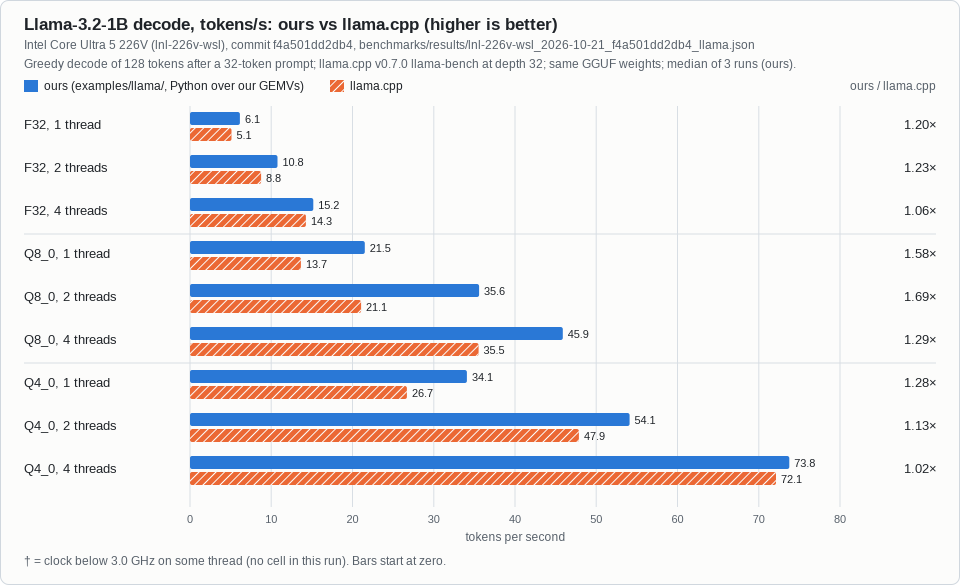
On this laptop, a Python loop over these kernels decodes Llama-3.2-1B 1.02–1.69× as fast as llama.cpp on the same weights; the gap is smallest at 4 threads (1.02–1.29×).
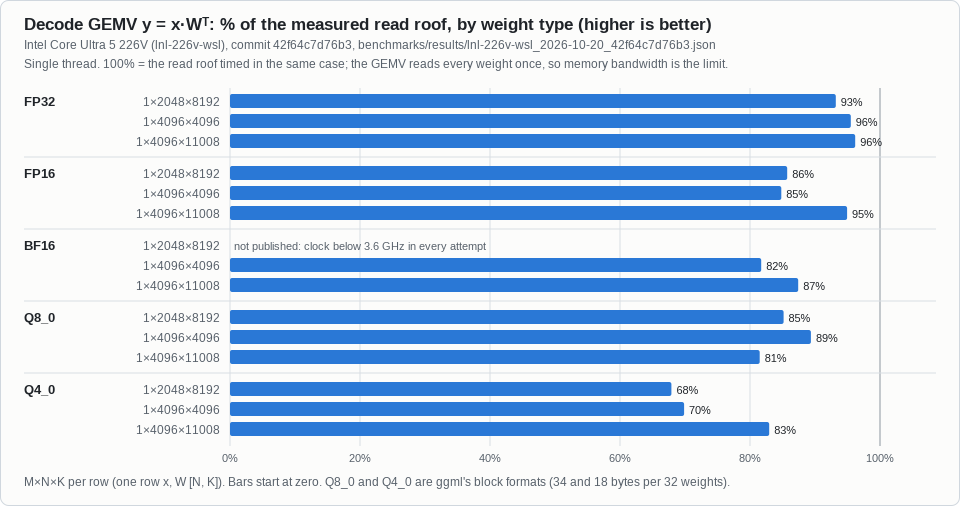
The decode GEMV reads its weights at 68–96% of what one core can read from memory: FP32 comes closest (93–96%) and Q4_0 is furthest (68–83%).
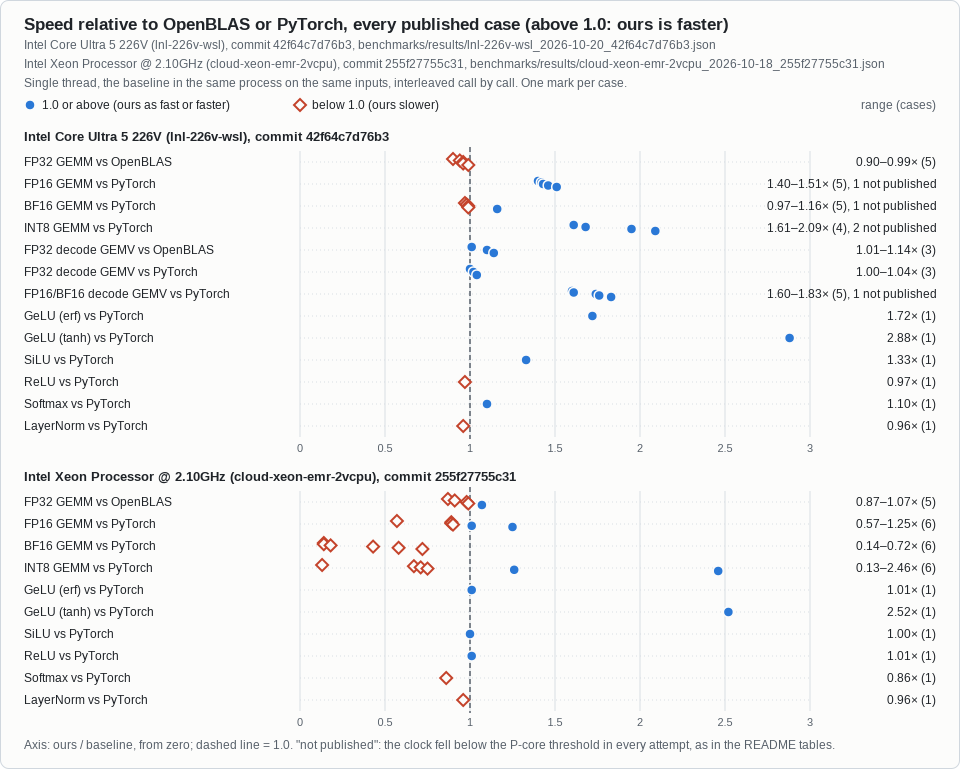
On the laptop most cases are level with or faster than the baseline, but OpenBLAS stays ahead on FP32 GEMM (0.90–0.99×) and PyTorch slightly ahead on BF16 GEMM from 256³ up, ReLU and LayerNorm (0.96–0.99×). The large losses are on the Emerald Rapids VM, where PyTorch is far ahead on BF16 GEMM (0.14–0.72×) and on INT8 GEMM from 512³ up and for one row (0.13–0.75×).
Install
pip install simd-ml-kernels
python -m simd_ml_kernels selftest   # every kernel vs a float64 reference; exits 1 on failure
Wheels exist for CPython 3.9–3.13 on Linux x86-64 (manylinux_2_28) and macOS
arm64 (scalar kernels only); anywhere else pip builds from source, which needs
a C++17 compiler. From a clone: pip install .. Details:
docs/setup.md.
import numpy as np, simd_ml_kernels as sk
x = np.random.randn(1, 4096).astype(np.float16)      # one token's activations
W = np.random.randn(11008, 4096).astype(np.float16)  # weights [out, in], as torch.nn.Linear stores them
y = sk.silu(sk.sgemm_f16(x, W, trans_b=True))        # decode GEMV in float32 (W read in place), then SiLU
print(sk.detected_isa())                             # kernel table in use: 'avx512', 'avx2' or 'scalar'
The full Python API, with each function's error bound, is in docs/api/python_api.md.
Kernels
Instruction sets dispatch can select. The table (scalar, AVX2 or AVX-512) is chosen from CPUID and XGETBV. A cell is a body that table can run.
| Kernel | scalar | AVX2 | AVX-512 | AVX-VNNI | AVX512-VNNI | BF16-dot |
|---|---|---|---|---|---|---|
| FP32 GEMM | yes | 6×16 | 12×32 | — | — | — |
| FP16 GEMM | yes | yes | 12×32 | — | — | — |
| BF16 GEMM | yes | yes | 12×32 | — | — | opt-in |
| Decode GEMV | yes | yes | yes | — | — | — |
| INT8 GEMM | yes | convert | — | yes | yes | — |
| Q8_0 GEMV | yes | pmadd | — | yes | yes | — |
| Q4_0 GEMV | yes | pmadd | — | yes | yes | — |
| GeLU, ReLU, SiLU, softmax, LayerNorm | yes | yes | — | — | — | — |
| Mark | Means |
|---|---|
| yes | that body |
| — | no such body |
| 6×16, 12×32 | packed tile. A small AVX-512 product uses the AVX2 direct kernel |
| convert | INT8 widened to FP32, then the FP32 kernel (no AVX-VNNI) |
| pmadd | vpmaddubsw for Q8_0 and Q4_0 (no VNNI) |
| opt-in | vdpbf16ps: SIMD_ML_BF16_DOT=1, AVX512-BF16, not trans_b, packed shape, one thread. Execution is not confirmed in CI (docs/VALIDATION.md) |
Decode GEMV is trans_b, at most 8 rows, with its own AVX-512 loop (no BF16-dot). quantize_q8_0 and quantize_q4_0 are scalar. Any x86-64 CPU runs the extension; other architectures run the scalar kernels only.
Where a path actually runs. CI does not use SDE (docs/setup.md). isa_units checks object files, not VNNI or BF16-dot execution. What ran on a real CPU before 0.4.0, and what did not, is in docs/VALIDATION.md.
| Path | CI | SDE |
|---|---|---|
| scalar | every job | -nhm |
| AVX2 | runner has AVX2, FMA and F16C | -hsw |
| AVX-512 | only if that runner has AVX-512F/DQ/BW/VL | -skx, -spr |
| AVX-VNNI, AVX512-VNNI, BF16-dot | only if that runner's CPUID reports the feature | -spr |
Where each kernel lives and how it works
| Kernel | Implementation | Notes |
|---|---|---|
| GEMM (SGEMM) | gemm/avx2_gemm_packed.cpp, gemm/avx512_gemm_packed.cpp |
6×16 AVX2 (12 accumulators) and 12×32 AVX-512 (24 accumulators) kernels; unpacked for small products, Goto/BLIS 5 loops with block sizes from CPUID leaf 4 otherwise; trans_a/trans_b handled in packing |
FP16 / BF16 GEMM (sgemm_f16, sgemm_bf16) |
same files; gemm/avx512bf16_gemm.cpp |
Inputs converted to FP32 once while packing, then the FP32 kernels; FP32 accumulation and output; vdpbf16ps path opt-in (SIMD_ML_BF16_DOT=1; slower than conversion where measured) |
Decode GEMV (x @ W.T: sgemm / sgemm_f16 / sgemm_bf16 with trans_b=True, ≤ 8 rows) |
same files (dot_rows) |
W [N, K] read in place, 4 (FP32) or 8 (FP16/BF16) rows at a time, 16-bit weights converted in registers; bound by memory bandwidth, reported as GB/s and % of the measured read stream and STREAM triad |
INT8 GEMM (sgemm_u8s8) |
gemm/avxvnni_gemm.cpp, gemm/avx512vnni_gemm.cpp, gemm/int8_rows.hpp |
uint8 × int8 with per-column scales, FP32 output; vpdpbusd (AVX-VNNI, AVX512_VNNI), exact int32 sums per K block; FP32 conversion path without VNNI; one row with trans_b reads B in place |
Q8_0 decode GEMV (quantize_q8_0, gemv_q8_0) |
quant/q8_0_scalar.cpp, quant/q8_0_rows.hpp |
Weights in ggml's block_q8_0 (byte-identical; 34 bytes per 32), x quantized to Q8 once per call; exact integer block dots (vpdpbusd with ggml's sign trick, vpmaddubsw without VNNI), FP32 sums; 8 rows read in place, next rows prefetched |
Q4_0 decode GEMV (quantize_q4_0, gemv_q4_0) |
quant/q4_0_scalar.cpp, quant/q4_0_rows.hpp |
Weights in ggml's block_q4_0 (byte-identical; 18 bytes per 32), x quantized to Q8 once per call; two rows per register, nibbles as vpdpbusd's unsigned operand with −8·Σx as its start (no sign trick), FP32 sums; 8 rows read in place, next rows prefetched |
| GeLU | intrinsic_gelu.cpp |
Exact (erf, rational approximation) by default or tanh formula (approximate="tanh"), as in PyTorch; max abs error ≤ 2e-6 |
| ReLU | activations/relu_avx2.cpp |
_mm256_max_ps, exact |
| SiLU | activations/silu_avx2.cpp |
x / (1 + exp(-x)); error ≤ 1e-35 + 1e-6·|ref| for every finite x |
| Softmax | activations/softmax_avx2.cpp |
Numerically stable (max-subtraction) |
| LayerNorm | activations/layer_norm_avx2.cpp |
Two-pass statistics (float lanes, flushed to double), then normalize; optional γ/β; error ≤ 1e-5 + 1e-4·|ref| for |mean| ≤ 30·std |
Where it loses
Known Honest Limitations: where it loses or has not been measured (the full table, with planned fixes, is in docs/ROADMAP.md):
- One row times a 4096×4096 INT8 matrix on the cloud VM: 0.13× PyTorch
(
255f27755c31, before the row path). On the laptop it was 1.36× once the row path landed (290b91baad26) and is 1.61× in the newest laptop run (42f64c7d76b3). - On the Emerald Rapids VM (
255f27755c31): BF16 GEMM at 0.14–0.72× PyTorch, whose rate implies AMX tiles, which this library does not use; INT8 GEMM at 0.67–0.75× PyTorch from N = 512 up; FP32 GEMM at 87% of OpenBLAS at N = 2048. - LayerNorm at 0.96× and ReLU at 0.97× PyTorch on the laptop (
42f64c7d76b3). - FP16/BF16 GEMM on AVX2 saves memory but is no faster than FP32 on compute-bound shapes (AVX2 has no 16-bit FMA).
- Single-threaded by default: OpenMP (GEMM and decode GEMV) is a build
option. GEMV scaling is measured only on the laptop's 4 P-cores under
WSL2 (
38cd710929a3), where 4 cores read 2.4–3.0× one core's bandwidth; at 4 threads the smallest Llama-3.2-1B matrix in Q8_0 (512×2048) is level with ggml. The INT8 GEMM has no threaded path. - AVX-512 is measured only on a cloud VM whose clock and neighbours are not controlled; the AVX-512 GEMV is not measured.
How a call reaches a kernel
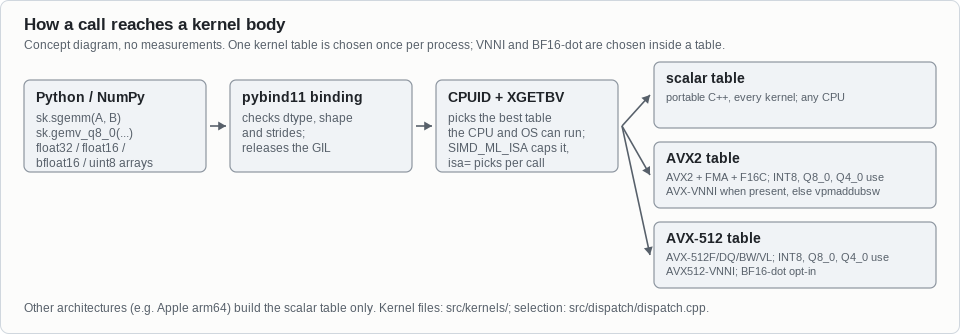
The table is chosen once per process from what the CPU and OS support;
SIMD_ML_ISA=scalar|avx2 caps it and isa= picks one per call. Design notes:
docs/DESIGN.md.
Performance
Generated from committed JSON (benchmarks/results/) by
benchmarks/make_tables.py: one pinned core, one thread unless stated, the
baseline in the same process on the same inputs, interleaved call by call. The
GHz column is the core clock measured during the case; cases where it fell
below the P-core threshold are not shown. Protocol, terms (read roof, Q8_0,
Q4_0, …), the summary by run and every run with interquartile ranges:
docs/BENCHMARKS.md.
Llama-3.2-1B end to end: tokens/s, time per token, perplexity
examples/llama/
is a Python loop, not a runtime. It generates text with meta-llama/Llama-3.2-1B
from these kernels and NumPy. Accuracy is tests/test_llama.py only. It needs
the gated weights (SIMD_ML_LLAMA_DIR) and is not run in CI; it last passed
locally on 2026-11-21 for 0.4.0
(docs/VALIDATION.md).
| Check | Scope |
|---|---|
| Weights | meta-llama/Llama-3.2-1B safetensors, FP32 |
| Reference | transformers 5.20.2, PyTorch 2.14.1 CPU, SDPA |
| Prompts | 5 |
| Logits | first 8 positions, |err| ≤ 1e-4 + 1e-5·|ref| |
| Tokens | 64 greedy tokens, identical |
Speed is one machine, median of 3.
| Scope | |
|---|---|
| Machine | Intel Core Ultra 5 226V, WSL2, P-cores |
| Weights | llama.cpp's own GGUF files |
| Ours | the Python loop above |
| Baseline | llama.cpp v0.7.0 llama-bench, CPU-only Release, GGML_NATIVE=ON, GGML_OPENMP=ON, GGML_CPU_REPACK=ON |
lnl-226v-wsl, 2026-10-21, commit f4a501dd2db4
Source: Intel(R) Core(TM) Ultra 5 226V, P-cores 0-3 (taskset -c 0-3), CPUs [0, 1, 2, 3]; meta-llama/Llama-3.2-1B from llama.cpp's own GGUF files (--pure), the same bytes on both sides; llama.cpp v0.7.0 (620d2225cc43), CPU-only Release, GGML_NATIVE=ON, GGML_OPENMP=ON, GGML_CPU_REPACK=ON; Python 3.12.3, GNU 13.3.0; 2026-10-21T02:31:26+00:00; benchmarks/results/lnl-226v-wsl_2026-10-21_f4a501dd2db4_llama.json.
Tokens/s, greedy decode of 128 tokens after a 32-token prompt. Ours: the examples/llama/ loop, Python over our GEMVs, median of 3 runs. llama.cpp: llama-bench -p 0 -n 128, average, at a depth of 32 KV entries like ours. × = ours / llama.cpp: above 1, ours is faster. † = clock below 3.0 GHz on some thread.
| Weights | Threads | Ours tok/s | llama.cpp tok/s (depth 32) | Ours / llama.cpp |
|---|---|---|---|---|
| F32 | 1 | 6.1 | 5.1 | 1.20× |
| F32 | 2 | 10.8 | 8.8 | 1.23× |
| F32 | 4 | 15.2 | 14.3 | 1.06× |
| Q8_0 | 1 | 21.5 | 13.7 | 1.58× |
| Q8_0 | 2 | 35.6 | 21.1 | 1.69× |
| Q8_0 | 4 | 45.9 | 35.5 | 1.29× |
| Q4_0 | 1 | 34.1 | 26.7 | 1.28× |
| Q4_0 | 2 | 54.1 | 47.9 | 1.13× |
| Q4_0 | 4 | 73.8 | 72.1 | 1.02× |
Where our time goes (one extra profiled run per row; ms per decode token)
| Weights | Threads | GEMVs | Attention | Norms, RoPE, SiLU | Other (Python/NumPy glue) | Total (profiled) |
|---|---|---|---|---|---|---|
| F32 | 1 | 157.89 ms (97%) | 1.35 ms (1%) | 2.83 ms (2%) | 0.33 ms (0%) | 162.41 ms |
| F32 | 2 | 92.64 ms (96%) | 1.32 ms (1%) | 2.65 ms (3%) | 0.30 ms (0%) | 96.91 ms |
| F32 | 4 | 62.10 ms (94%) | 1.37 ms (2%) | 2.54 ms (4%) | 0.30 ms (0%) | 66.31 ms |
| Q8_0 | 1 | 43.44 ms (92%) | 1.25 ms (3%) | 2.22 ms (5%) | 0.27 ms (1%) | 47.18 ms |
| Q8_0 | 2 | 25.47 ms (89%) | 1.22 ms (4%) | 1.85 ms (6%) | 0.22 ms (1%) | 28.76 ms |
| Q8_0 | 4 | 18.51 ms (85%) | 1.31 ms (6%) | 1.75 ms (8%) | 0.21 ms (1%) | 21.78 ms |
| Q4_0 | 1 | 26.94 ms (90%) | 1.12 ms (4%) | 1.55 ms (5%) | 0.20 ms (1%) | 29.81 ms |
| Q4_0 | 2 | 17.22 ms (85%) | 1.18 ms (6%) | 1.59 ms (8%) | 0.21 ms (1%) | 20.21 ms |
| Q4_0 | 4 | 10.91 ms (80%) | 1.17 ms (9%) | 1.37 ms (10%) | 0.19 ms (1%) | 13.64 ms |
Perplexity on examples/llama/data/alice_ch1-2.txt (5742 tokens; llama-perplexity's method: chunks of 512, second half scored), ours and llama-perplexity -c 512 on the same GGUFs
| Weights | Ours PPL | Δ vs our F32 | llama.cpp PPL | Δ vs llama.cpp F32 | Ours − llama.cpp |
|---|---|---|---|---|---|
| F32 | 5.9625 | — | 5.9623 ± 0.2275 | — | +0.0002 |
| Q8_0 | 5.9830 | +0.0205 | 5.9782 ± 0.2281 | +0.0159 | +0.0048 |
| Q4_0 | 8.8892 | +2.9267 | 8.8716 ± 0.3637 | +2.9093 | +0.0176 |
Single-thread tables: GEMM, FP16/BF16/INT8 GEMM, decode GEMV, Q8_0, Q4_0, activations
lnl-226v-wsl, 2026-10-20, commit 42f64c7d76b3
Source: Intel(R) Core(TM) Ultra 5 226V, WSL2 vCPU 2 (P-core by measured clock, see protocol); Python 3.12.3, GNU 13.3.0, commit 42f64c7d76b3; baselines: NumPy 2.5.4 with scipy-openblas 0.3.34.106.0, PyTorch 2.14.1+cpu; 30 interleaved reps after 5 warm-up; 2026-10-20T02:58:46+00:00; benchmarks/results/lnl-226v-wsl_2026-10-20_42f64c7d76b3.json.
FP32 GEMM, square, single thread
| N | simd-ml-kernels GFLOP/s | OpenBLAS GFLOP/s | % of OpenBLAS | core GHz median (min–max) |
|---|---|---|---|---|
| 128 | 97.1 | 103.8 | 94% | 4.14 (3.74–4.37) |
| 256 | 104.0 | 115.9 | 90% | 4.27 (4.00–4.43) |
| 512 | 116.5 | 121.1 | 96% | 4.41 (3.63–4.43) |
| 1024 | 117.6 | 119.1 | 99% | 4.15 (3.87–4.42) |
| 2048 | 114.0 | 118.7 | 96% | 4.16 (4.02–4.43) |
FP16 / BF16-input GEMM, FP32 accumulation and output, single thread (PyTorch: torch.matmul on float16 / bfloat16 tensors, which returns float16 / bfloat16)
| input | M×N×K | simd-ml-kernels GFLOP/s | our FP32 GFLOP/s | % of FP32 | PyTorch GFLOP/s | ours / PyTorch | core GHz median (min–max) |
|---|---|---|---|---|---|---|---|
| FP16 | 128×128×128 | 89.4 | 95.2 | 94% | 59.1 | 1.51× | 4.33 (3.69–4.39) |
| FP16 | 256×256×256 | 109.7 | 116.5 | 94% | 78.6 | 1.40× | 4.22 (3.66–4.44) |
| FP16 | 512×512×512 | 113.5 | 119.7 | 95% | 79.5 | 1.43× | 4.34 (3.69–4.43) |
| FP16 | 1024×1024×1024 | 112.9 | 113.0 | 100% | 79.6 | 1.42× | 4.28 (3.76–4.43) |
| FP16 | 2048×2048×2048 | 113.7 | 112.8 | 101% | 78.1 | 1.46× | 4.19 (3.94–4.42) |
| BF16 | 128×128×128 | 100.7 | 101.3 | 99% | 86.4 | 1.16× | 3.96 (3.75–4.38) |
| BF16 | 256×256×256 | 112.2 | 115.8 | 97% | 113.2 | 0.99× | 4.19 (4.04–4.42) |
| BF16 | 512×512×512 | 117.0 | 118.7 | 99% | 119.2 | 0.98× | 4.14 (3.92–4.43) |
| BF16 | 1024×1024×1024 | 113.2 | 114.7 | 99% | 116.5 | 0.97× | 4.09 (3.79–4.42) |
| BF16 | 2048×2048×2048 | 113.6 | 112.7 | 101% | 115.0 | 0.99× | 4.20 (3.97–4.42) |
Not shown: FP16 1×4096×4096 (median 4.12, min 3.39 GHz, 3 attempts), BF16 1×4096×4096 (median 4.21, min 2.85 GHz, 3 attempts). A clock sample stayed below the 3.6 GHz P-core threshold (--min-ghz) in every attempt, so these numbers are not published; they remain in the JSON. |
INT8 GEMM (uint8 × per-channel int8, FP32 output), x·Wᵀ, single thread, path avx_vnni (PyTorch: torch.ops.quantized.linear, prepacked weights, which returns requantized uint8)
| M×N×K | simd-ml-kernels GOP/s | × our FP32 | FP32-conversion path GOP/s | × our FP32 | PyTorch GOP/s | ours / PyTorch | core GHz median (min–max) |
|---|---|---|---|---|---|---|---|
| 256×256×256 | 381.5 | 3.26× | 116.1 | 0.99× | 182.9 | 2.09× | 4.19 (3.77–4.39) |
| 512×512×512 | 398.3 | 3.58× | 109.2 | 0.98× | 204.2 | 1.95× | 4.03 (3.77–4.18) |
| 2048×2048×2048 | 407.7 | 3.64× | 111.8 | 1.00× | 242.2 | 1.68× | 4.33 (3.63–4.44) |
| 1×4096×4096 | 60.0 | 3.61× | 65.8 | 3.96× | 37.3 | 1.61× | 4.30 (3.76–4.39) |
Not shown: 128×128×128 (median 4.22, min 2.49 GHz, 3 attempts), 1024×1024×1024 (median 4.07, min 3.60 GHz, 3 attempts). A clock sample stayed below the 3.6 GHz P-core threshold (--min-ghz) in every attempt, so these numbers are not published; they remain in the JSON. |
Decode GEMV y = x·Wᵀ (one row x, W [N, K] as torch.nn.Linear stores it), FP32 output, single thread; read roof: the read stream timed in each case, interleaved with it; STREAM triad of the run: single-core read stream 32.2 GB/s, STREAM triad 29.0 GB/s (all-core: read not measured, triad not measured). GB/s counts the weights, x and y. (PyTorch: F.linear on the same weights in their dtype, which returns that dtype; OpenBLAS: NumPy's matrix-vector product, FP32 only)
| weights | M×N×K | simd-ml-kernels µs | GB/s | % of read roof | % of triad | PyTorch GB/s | ours / PyTorch | OpenBLAS sgemv GB/s | ours / OpenBLAS | core GHz median (min–max) |
|---|---|---|---|---|---|---|---|---|---|---|
| FP32 | 1×2048×8192 | 1989 | 33.8 | 93% | 117% | 33.2 | 1.02× | 30.7 | 1.10× | 4.40 (3.69–4.44) |
| FP32 | 1×4096×4096 | 1998 | 33.6 | 96% | 116% | 32.3 | 1.04× | 33.3 | 1.01× | 4.20 (3.99–4.39) |
| FP32 | 1×4096×11008 | 5252 | 34.4 | 96% | 119% | 34.5 | 1.00× | 30.0 | 1.14× | 4.09 (3.74–4.27) |
| FP16 | 1×2048×8192 | 1101 | 30.5 | 86% | 105% | 17.6 | 1.74× | — | — | 4.22 (3.96–4.43) |
| FP16 | 1×4096×4096 | 1097 | 30.6 | 85% | 106% | 19.1 | 1.60× | — | — | 4.17 (3.96–4.37) |
| FP16 | 1×4096×11008 | 2872 | 31.4 | 95% | 108% | 17.8 | 1.76× | — | — | 4.15 (3.95–4.40) |
| BF16 | 1×4096×4096 | 1178 | 28.5 | 82% | 98% | 17.7 | 1.61× | — | — | 4.33 (4.12–4.41) |
| BF16 | 1×4096×11008 | 2928 | 30.8 | 87% | 106% | 16.9 | 1.83× | — | — | 4.13 (3.65–4.33) |
Not shown: BF16 1×2048×8192 (median 4.09, min 3.39 GHz, 3 attempts). A clock sample stayed below the 3.6 GHz P-core threshold (--min-ghz) in every attempt, so these numbers are not published; they remain in the JSON. |
Q8_0 decode GEMV (gemv_q8_0: ggml block_q8_0 weights, 34 bytes per 32, x quantized to Q8 inside), path avx_vnni, single thread; GB/s counts the weights, x and y; × columns: time of that GEMV / ours, in the same interleaved case. PyTorch: FP32 F.linear on the dequantized weights, not a quantized kernel. ggml: llama.cpp v0.7.0 (620d222), test-backend-ops perf MUL_MAT q8_0 × f32, one thread (OMP_THREAD_LIMIT=1, GGML_OPENMP=ON, GGML_NATIVE=ON), median of 3 runs of its own mean over ≥ 1 s on the same weights (not interleaved).
| M×N×K | simd-ml-kernels µs | GB/s | % of read roof | × our FP32 GEMV | × our BF16 GEMV | PyTorch FP32 µs | ours / PyTorch | ggml µs (own timing) | ggml GB/s | ggml % of roof | ours / ggml | core GHz median (min–max) |
|---|---|---|---|---|---|---|---|---|---|---|---|---|
| 1×2048×8192 | 588 | 30.4 | 85% | 3.45× | 1.90× | 2084 | 3.55× | 909 | 19.6 | 55% | 1.55× | 4.25 (3.82–4.41) |
| 1×4096×4096 | 564 | 31.6 | 89% | 3.59× | 2.09× | 2140 | 3.79× | 923 | 19.3 | 55% | 1.64× | 4.22 (4.10–4.44) |
| 1×4096×11008 | 1726 | 27.8 | 81% | 3.24× | 1.75× | 5355 | 3.10× | 2802 | 17.1 | 50% | 1.62× | 4.19 (4.02–4.40) |
Q4_0 decode GEMV (gemv_q4_0: ggml block_q4_0 weights, 18 bytes per 32, x quantized to Q8 inside), path avx_vnni, single thread; GB/s counts the weights, x and y; × columns: time of that GEMV / ours, in the same interleaved case (our Q8_0 GEMV on the Q8_0 blocks of the same W). PyTorch: FP32 F.linear on the dequantized weights, not a quantized kernel. ggml: llama.cpp v0.7.0 (620d222), test-backend-ops perf MUL_MAT q4_0 × f32, one thread (OMP_THREAD_LIMIT=1, GGML_OPENMP=ON, GGML_NATIVE=ON), median of 3 runs of its own mean over ≥ 1 s on the same weights (not interleaved).
| M×N×K | simd-ml-kernels µs | GB/s | % of read roof | × our Q8_0 GEMV | × our FP32 GEMV | PyTorch FP32 µs | ours / PyTorch | ggml µs (own timing) | ggml GB/s | ggml % of roof | ours / ggml | core GHz median (min–max) |
|---|---|---|---|---|---|---|---|---|---|---|---|---|
| 1×2048×8192 | 397 | 23.9 | 68% | 1.38× | 5.12× | 2040 | 5.14× | 628 | 15.1 | 43% | 1.58× | 4.25 (4.08–4.44) |
| 1×4096×4096 | 383 | 24.7 | 70% | 1.45× | 5.40× | 2136 | 5.58× | 610 | 15.5 | 44% | 1.59× | 4.29 (3.94–4.41) |
| 1×4096×11008 | 890 | 28.6 | 83% | 1.67× | 6.05× | 5361 | 6.03× | 1948 | 13.0 | 38% | 2.19× | 4.29 (3.90–4.40) |
Activations and normalization, out-of-place, single thread
| kernel | shape | simd-ml-kernels Gelem/s | elem/cycle | PyTorch Gelem/s | ours / PyTorch | core GHz median (min–max) |
|---|---|---|---|---|---|---|
gelu_exact |
1048576 | 2.777 | 0.669 | 1.611 | 1.72× | 4.15 (3.74–4.39) |
gelu_tanh |
1048576 | 1.514 | 0.376 | 0.526 | 2.88× | 4.03 (3.73–4.42) |
silu |
1048576 | 2.619 | 0.622 | 1.973 | 1.33× | 4.21 (3.77–4.42) |
relu |
1048576 | 4.304 | 1.010 | 4.430 | 0.97× | 4.26 (3.76–4.40) |
softmax |
1024×1024 | 1.504 | 0.351 | 1.365 | 1.10× | 4.28 (3.83–4.42) |
layer_norm |
1024×1024 | 3.980 | 0.965 | 4.128 | 0.96× | 4.13 (3.72–4.38) |
cloud-xeon-emr-2vcpu, 2026-10-18, commit 255f27755c31
Source: Intel(R) Xeon(R) Processor @ 2.10GHz, vCPU 1 (KVM guest, 2 vCPU; host core not visible); Python 3.13.16, GNU 13.3.0, commit 255f27755c31; baselines: NumPy 2.5.4 with scipy-openblas 0.3.34.106.0, PyTorch 2.14.1+cu130; 30 interleaved reps after 5 warm-up; 2026-10-18T12:03:45+00:00; benchmarks/results/cloud-xeon-emr-2vcpu_2026-10-18_255f27755c31.json.
FP32 GEMM, square, single thread
| N | simd-ml-kernels GFLOP/s | OpenBLAS GFLOP/s | % of OpenBLAS | core GHz median (min–max) |
|---|---|---|---|---|
| 128 | 95.4 | 89.6 | 107% | 3.08 (2.90–3.22) |
| 256 | 111.0 | 112.6 | 99% | 3.11 (2.93–3.24) |
| 512 | 105.6 | 108.3 | 98% | 3.03 (1.13–3.20) |
| 1024 | 101.7 | 111.8 | 91% | 3.29 (2.82–3.59) |
| 2048 | 108.1 | 124.8 | 87% | 3.18 (3.08–3.68) |
FP16 / BF16-input GEMM, FP32 accumulation and output, single thread (PyTorch: torch.matmul on float16 / bfloat16 tensors, which returns float16 / bfloat16)
| input | M×N×K | simd-ml-kernels GFLOP/s | our FP32 GFLOP/s | % of FP32 | PyTorch GFLOP/s | ours / PyTorch | core GHz median (min–max) |
|---|---|---|---|---|---|---|---|
| FP16 | 128×128×128 | 86.3 | 94.9 | 91% | 69.0 | 1.25× | 3.15 (3.00–3.22) |
| FP16 | 256×256×256 | 96.5 | 104.1 | 93% | 95.2 | 1.01× | 3.17 (2.90–3.22) |
| FP16 | 512×512×512 | 110.8 | 109.6 | 101% | 123.3 | 0.90× | 3.18 (2.96–3.20) |
| FP16 | 1024×1024×1024 | 114.9 | 114.9 | 100% | 128.6 | 0.89× | 3.17 (3.02–3.22) |
| FP16 | 2048×2048×2048 | 104.7 | 104.9 | 100% | 117.4 | 0.89× | 3.05 (2.88–3.38) |
| FP16 | 1×4096×4096 | 2.7 | 1.7 | 153% | 4.7 | 0.57× | 3.17 (3.05–3.33) |
| BF16 | 128×128×128 | 100.2 | 99.9 | 100% | 139.1 | 0.72× | 3.06 (2.84–3.20) |
| BF16 | 256×256×256 | 97.8 | 95.2 | 103% | 225.0 | 0.43× | 3.11 (2.93–3.17) |
| BF16 | 512×512×512 | 115.0 | 110.3 | 104% | 640.5 | 0.18× | 3.13 (3.06–3.21) |
| BF16 | 1024×1024×1024 | 112.9 | 113.9 | 99% | 805.2 | 0.14× | 3.18 (3.01–3.44) |
| BF16 | 2048×2048×2048 | 108.7 | 109.0 | 100% | 771.3 | 0.14× | 3.21 (2.87–3.91) |
| BF16 | 1×4096×4096 | 2.3 | 1.7 | 137% | 4.0 | 0.58× | 3.59 (2.97–3.97) |
INT8 GEMM (uint8 × per-channel int8, FP32 output), x·Wᵀ, single thread, path avx512_vnni (PyTorch: torch.ops.quantized.linear, prepacked weights, which returns requantized uint8)
| M×N×K | simd-ml-kernels GOP/s | × our FP32 | FP32-conversion path GOP/s | × our FP32 | PyTorch GOP/s | ours / PyTorch | core GHz median (min–max) |
|---|---|---|---|---|---|---|---|
| 128×128×128 | 114.2 | 1.55× | 73.1 | 0.99× | 46.4 | 2.46× | 3.14 (3.00–3.87) |
| 256×256×256 | 198.6 | 1.99× | 78.5 | 0.79× | 157.8 | 1.26× | 3.22 (3.15–3.31) |
| 512×512×512 | 249.4 | 2.32× | 80.7 | 0.75× | 350.1 | 0.71× | 3.23 (3.17–3.37) |
| 1024×1024×1024 | 229.5 | 2.69× | 66.0 | 0.77× | 306.4 | 0.75× | 3.11 (2.85–3.32) |
| 2048×2048×2048 | 291.9 | 2.83× | 69.9 | 0.68× | 435.2 | 0.67× | 3.17 (2.75–4.01) |
| 1×4096×4096 | 2.7 | 0.38× | 4.1 | 0.57× | 20.1 | 0.13× | 3.32 (3.19–3.38) |
Activations and normalization, out-of-place, single thread
| kernel | shape | simd-ml-kernels Gelem/s | elem/cycle | PyTorch Gelem/s | ours / PyTorch | core GHz median (min–max) |
|---|---|---|---|---|---|---|
gelu_exact |
1048576 | 1.983 | 0.585 | 1.971 | 1.01× | 3.39 (3.15–3.45) |
gelu_tanh |
1048576 | 1.156 | 0.339 | 0.460 | 2.52× | 3.41 (3.30–3.50) |
silu |
1048576 | 1.712 | 0.542 | 1.704 | 1.00× | 3.16 (2.95–3.20) |
relu |
1048576 | 2.725 | 0.865 | 2.704 | 1.01× | 3.15 (3.00–3.21) |
softmax |
1024×1024 | 1.084 | 0.336 | 1.260 | 0.86× | 3.22 (3.15–3.26) |
layer_norm |
1024×1024 | 2.099 | 0.663 | 2.180 | 0.96× | 3.16 (3.04–3.30) |
Threaded decode GEMV (OpenMP build, 1/2/4 threads)
OpenMP builds only (-DSIMD_ML_OPENMP=ON, off by default). The process runs
on the laptop's 4 P-cores (taskset -c 0-3, the 4 low-power E-cores excluded);
ours, PyTorch and ggml use the same thread count, and every percentage is of
the read roof measured at that thread count in the same case.
lnl-226v-wsl, 2026-10-20, commit 38cd710929a3, 1/2/4 threads
Source: Intel(R) Core(TM) Ultra 5 226V, WSL2 vCPUs 0-3 (the 4 P-cores; the 4 LP E-cores excluded), 1/2/4 threads; Python 3.12.3, GNU 13.3.0, commit 38cd710929a3; baselines: NumPy 2.5.4 with scipy-openblas 0.3.34.106.0, PyTorch 2.14.1+cpu; 30 interleaved reps after 5 warm-up; 2026-10-20T08:58:42+00:00; benchmarks/results/lnl-226v-wsl_2026-10-20_38cd710929a3_threads.json; CPUs [0, 1, 2, 3].
Q8_0 / Q4_0 decode GEMV at 1–4 threads, path avx_vnni. GB/s counts the weights, x and y; % of the read roof measured at the same thread count in the same case; scaling = GB/s at N threads / (N × GB/s at 1 thread); ours with weights rotated past the caches, and on the same weights every call (as ggml runs). ggml: llama.cpp v0.7.0 (620d222), test-backend-ops perf MUL_MAT q8_0 or q4_0 × f32, the same thread count (OMP_THREAD_LIMIT = threads, GGML_OPENMP=ON, GGML_NATIVE=ON), median of 3 runs of its own mean over ≥ 1 s on the same weights (not interleaved).
| format | N×K (Llama-3.2-1B) | threads | simd-ml-kernels µs | GB/s | % of read roof | scaling | same weights µs | ggml µs (own timing) | ggml % of roof | ours / ggml (same weights) | ours / ggml (rotated) | core GHz median (min–max) |
|---|---|---|---|---|---|---|---|---|---|---|---|---|
| Q8_0 | 512×2048 (k_proj, v_proj) | 1 | 42 | 26.9 | 78% | 100% | 30 | 30 | 110% | 0.98× | 0.71× | 4.48 (4.00–4.58) |
| Q8_0 | 512×2048 (k_proj, v_proj) | 2 | 24 | 47.2 | 71% | 88% | 17 | 18 | 95% | 1.07× | 0.75× | 4.26 (4.04–4.50) |
| Q8_0 | 512×2048 (k_proj, v_proj) | 4 | 18 | 61.4 | 68% | 57% | 12 | 11 | 110% | 0.97× | 0.62× | 3.56 (3.13–3.65) |
| Q8_0 | 2048×2048 (q_proj, o_proj) | 1 | 150 | 29.7 | 81% | 100% | 109 | 128 | 95% | 1.18× | 0.85× | 4.23 (3.95–4.57) |
| Q8_0 | 2048×2048 (q_proj, o_proj) | 2 | 85 | 52.4 | 80% | 88% | 53 | 73 | 93% | 1.38× | 0.86× | 4.11 (3.67–4.52) |
| Q8_0 | 2048×2048 (q_proj, o_proj) | 4 | 60 | 74.8 | 79% | 63% | 36 | 45 | 107% | 1.23× | 0.75× | 3.57 (3.16–3.66) |
| Q8_0 | 2048×8192 (down_proj) | 1 | 504 | 35.4 | 93% | 100% | 474 | 877 | 54% | 1.85× | 1.74× | 4.50 (3.93–4.90) |
| Q8_0 | 2048×8192 (down_proj) | 2 | 317 | 56.3 | 87% | 79% | 277 | 446 | 62% | 1.61× | 1.41× | 4.29 (3.61–4.54) |
| Q8_0 | 2048×8192 (down_proj) | 4 | 237 | 75.3 | 81% | 53% | 194 | 278 | 69% | 1.43× | 1.17× | 3.60 (3.14–3.65) |
| Q8_0 | 4096×4096 | 1 | 539 | 33.1 | 91% | 100% | 490 | 809 | 61% | 1.65× | 1.50× | 4.24 (3.73–4.48) |
| Q8_0 | 4096×4096 | 2 | 314 | 56.9 | 90% | 86% | 260 | 438 | 65% | 1.68× | 1.39× | 4.17 (3.53–4.52) |
| Q8_0 | 4096×4096 | 4 | 233 | 76.6 | 81% | 58% | 175 | 283 | 66% | 1.61× | 1.21× | 3.64 (3.27–3.66) |
| Q8_0 | 8192×2048 (gate_proj, up_proj) | 1 | 551 | 32.4 | 89% | 100% | 487 | 833 | 59% | 1.71× | 1.51× | 4.42 (3.96–4.58) |
| Q8_0 | 8192×2048 (gate_proj, up_proj) | 2 | 325 | 55.0 | 88% | 85% | 268 | 469 | 61% | 1.75× | 1.44× | 4.35 (3.89–4.57) |
| Q8_0 | 8192×2048 (gate_proj, up_proj) | 4 | 232 | 77.1 | 86% | 59% | 179 | 299 | 66% | 1.67× | 1.29× | 3.56 (3.34–3.67) |
| Q8_0 | 4096×11008 | 1 | 1445 | 33.2 | 91% | 100% | 1422 | 2766 | 48% | 1.94× | 1.91× | 4.43 (3.95–4.51) |
| Q8_0 | 4096×11008 | 2 | 848 | 56.5 | 87% | 85% | 801 | 1511 | 49% | 1.89× | 1.78× | 4.20 (3.57–4.51) |
| Q8_0 | 4096×11008 | 4 | 611 | 78.5 | 83% | 59% | 546 | 911 | 56% | 1.67× | 1.49× | 3.52 (3.06–3.66) |
| Q8_0 | 128256×2048 (lm_head) | 1 | 8037 | 34.8 | 100% | 100% | 8171 | 15579 | 52% | 1.91× | 1.94× | 4.34 (3.95–4.55) |
| Q8_0 | 128256×2048 (lm_head) | 2 | 4710 | 59.4 | 99% | 85% | 4683 | 9754 | 48% | 2.08× | 2.07× | 4.08 (3.53–4.55) |
| Q8_0 | 128256×2048 (lm_head) | 4 | 3234 | 86.4 | 95% | 62% | 3191 | 5819 | 53% | 1.82× | 1.80× | 3.49 (3.31–3.66) |
| Q4_0 | 512×2048 (k_proj, v_proj) | 1 | 29 | 21.0 | 57% | 100% | 22 | 31 | 52% | 1.42× | 1.10× | 4.39 (3.48–4.58) |
| Q4_0 | 512×2048 (k_proj, v_proj) | 2 | 17 | 35.1 | 54% | 83% | 13 | 18 | 50% | 1.43× | 1.08× | 4.32 (3.46–4.52) |
| Q4_0 | 512×2048 (k_proj, v_proj) | 4 | 12 | 48.0 | 50% | 57% | 10 | 12 | 53% | 1.22× | 0.94× | 3.60 (3.23–3.66) |
| Q4_0 | 2048×2048 (q_proj, o_proj) | 1 | 90 | 26.4 | 72% | 100% | 71 | 126 | 52% | 1.77× | 1.39× | 4.13 (3.68–4.56) |
| Q4_0 | 2048×2048 (q_proj, o_proj) | 2 | 56 | 42.4 | 64% | 80% | 38 | 72 | 50% | 1.89× | 1.28× | 4.24 (3.84–4.54) |
| Q4_0 | 2048×2048 (q_proj, o_proj) | 4 | 37 | 64.6 | 70% | 61% | 26 | 43 | 60% | 1.62× | 1.16× | 3.54 (3.18–3.67) |
| Q4_0 | 2048×8192 (down_proj) | 1 | 335 | 28.3 | 78% | 100% | 302 | 593 | 44% | 1.96× | 1.77× | 4.10 (3.54–4.52) |
| Q4_0 | 2048×8192 (down_proj) | 2 | 184 | 51.4 | 84% | 91% | 158 | 311 | 50% | 1.97× | 1.69× | 4.09 (3.72–4.49) |
| Q4_0 | 2048×8192 (down_proj) | 4 | 148 | 63.8 | 69% | 56% | 102 | 187 | 55% | 1.84× | 1.26× | 3.53 (3.14–3.66) |
| Q4_0 | 4096×4096 | 1 | 332 | 28.5 | 78% | 100% | 294 | 553 | 47% | 1.88× | 1.66× | 4.53 (3.72–4.56) |
| Q4_0 | 4096×4096 | 2 | 207 | 45.8 | 71% | 80% | 159 | 298 | 50% | 1.87× | 1.44× | 4.15 (3.79–4.47) |
| Q4_0 | 4096×4096 | 4 | 148 | 64.2 | 68% | 56% | 102 | 187 | 53% | 1.83× | 1.27× | 3.54 (3.01–3.66) |
| Q4_0 | 8192×2048 (gate_proj, up_proj) | 1 | 348 | 27.3 | 76% | 100% | 294 | 555 | 48% | 1.89× | 1.60× | 4.29 (3.87–4.57) |
| Q4_0 | 8192×2048 (gate_proj, up_proj) | 2 | 202 | 47.0 | 75% | 86% | 158 | 318 | 47% | 2.01× | 1.58× | 4.37 (3.80–4.54) |
| Q4_0 | 8192×2048 (gate_proj, up_proj) | 4 | 140 | 67.7 | 71% | 62% | 101 | 188 | 53% | 1.87× | 1.35× | 3.46 (3.07–3.62) |
| Q4_0 | 4096×11008 | 1 | 882 | 28.8 | 84% | 100% | 843 | 2002 | 37% | 2.37× | 2.27× | 4.25 (3.50–4.58) |
| Q4_0 | 4096×11008 | 2 | 492 | 51.7 | 81% | 90% | 466 | 996 | 40% | 2.14× | 2.03× | 3.99 (3.45–4.40) |
| Q4_0 | 4096×11008 | 4 | 338 | 75.3 | 79% | 65% | 264 | 587 | 45% | 2.22× | 1.74× | 3.50 (3.15–3.65) |
| Q4_0 | 128256×2048 (lm_head) | 1 | 5393 | 27.5 | 77% | 100% | 5468 | 9889 | 42% | 1.81× | 1.83× | 4.05 (3.25–4.48) |
| Q4_0 | 128256×2048 (lm_head) | 2 | 2942 | 50.4 | 82% | 92% | 2947 | 6442 | 37% | 2.19× | 2.19× | 4.33 (4.14–4.51) |
| Q4_0 | 128256×2048 (lm_head) | 4 | 1999 | 74.2 | 88% | 67% | 1934 | 3707 | 47% | 1.92× | 1.85× | 3.49 (3.05–3.62) |
Per-token GEMV time, Llama-3.2-1B (config.json of meta-llama/Llama-3.2-1B (sha256 bfb5d39c327ee5c3, tie_word_embeddings True); 16 layers × (2 q/o + 2 k/v + 2 gate/up + 1 down) + lm_head, every matrix in the format shown; ours with rotated weights, ggml on the same weights every run; GEMVs only, not a tokens/s figure)
- Q8_0, 1 thread: ours 39.88 ms, ggml 61.33 ms (1.54×)
- Q8_0, 2 threads: ours 23.67 ms, ggml 34.82 ms (1.47×)
- Q8_0, 4 threads: ours 16.95 ms, ggml 21.62 ms (1.28×)
- Q4_0, 1 thread: ours 25.68 ms, ggml 42.16 ms (1.64×)
- Q4_0, 2 threads: ours 14.69 ms, ggml 24.50 ms (1.67×)
- Q4_0, 4 threads: ours 10.43 ms, ggml 14.48 ms (1.39×)
FP32 / FP16 / BF16 decode GEMV (x·Wᵀ, W [N, K]), same roof and scaling; PyTorch: F.linear at torch.set_num_threads(N), timed alone after ours (two OpenMP runtimes would spin against each other), FP32 and BF16.
| weights | N×K | threads | simd-ml-kernels µs | GB/s | % of read roof | scaling | PyTorch GB/s | ours / PyTorch | core GHz median (min–max) |
|---|---|---|---|---|---|---|---|---|---|
| FP32 | 2048×8192 | 1 | 2147 | 31.3 | 92% | 100% | 32.2 | 0.97× | 4.00 (3.14–4.45) |
| FP32 | 2048×8192 | 2 | 1126 | 59.6 | 93% | 95% | 56.0 | 1.07× | 4.14 (3.61–4.42) |
| FP32 | 2048×8192 | 4 | 822 | 81.7 | 85% | 65% | 81.1 | 1.01× | 3.48 (3.12–3.64) |
| FP32 | 4096×4096 | 1 | 1986 | 33.8 | 96% | 100% | 33.4 | 1.01× | 4.42 (3.66–4.54) |
| FP32 | 4096×4096 | 2 | 1153 | 58.2 | 89% | 86% | 58.4 | 1.00× | 4.28 (3.83–4.54) |
| FP32 | 4096×4096 | 4 | 816 | 82.3 | 91% | 61% | 82.6 | 1.00× | 3.59 (3.24–3.67) |
| FP32 | 4096×11008 | 1 | 5153 | 35.0 | 101% | 100% | 33.8 | 1.03× | 4.29 (3.73–4.59) |
| FP32 | 4096×11008 | 2 | 3060 | 59.0 | 93% | 84% | 58.3 | 1.01× | 4.18 (3.50–4.55) |
| FP32 | 4096×11008 | 4 | 2106 | 85.7 | 89% | 61% | 84.6 | 1.01× | 3.57 (3.17–3.66) |
| FP16 | 2048×8192 | 1 | 1110 | 30.2 | 83% | 100% | — | — | 4.28 (3.97–4.51) |
| FP16 | 2048×8192 | 2 | 657 | 51.1 | 80% | 84% | — | — | 4.17 (3.67–4.47) |
| FP16 | 2048×8192 | 4 | 457 | 73.4 | 77% | 61% | — | — | 3.58 (3.16–3.66) |
| FP16 | 4096×4096 | 1 | 1067 | 31.5 | 87% | 100% | — | — | 4.50 (3.94–4.58) |
| FP16 | 4096×4096 | 2 | 647 | 51.9 | 85% | 82% | — | — | 3.79 (3.37–4.53) |
| FP16 | 4096×4096 | 4 | 445 | 75.5 | 83% | 60% | — | — | 3.50 (3.24–3.65) |
| FP16 | 4096×11008 | 1 | 2617 | 34.5 | 96% | 100% | — | — | 4.26 (3.71–4.55) |
| FP16 | 4096×11008 | 2 | 1588 | 56.8 | 85% | 82% | — | — | 4.25 (3.78–4.47) |
| FP16 | 4096×11008 | 4 | 1113 | 81.1 | 84% | 59% | — | — | 3.59 (3.01–3.66) |
| BF16 | 2048×8192 | 1 | 1118 | 30.0 | 86% | 100% | 18.8 | 1.60× | 4.46 (3.95–4.88) |
| BF16 | 2048×8192 | 2 | 609 | 55.2 | 80% | 92% | 33.5 | 1.65× | 4.53 (4.08–4.82) |
| BF16 | 2048×8192 | 4 | 424 | 79.2 | 75% | 66% | 53.3 | 1.48× | 3.81 (3.18–3.94) |
| BF16 | 4096×4096 | 1 | 1096 | 30.6 | 85% | 100% | 17.4 | 1.76× | 4.14 (3.93–4.53) |
| BF16 | 4096×4096 | 2 | 649 | 51.7 | 81% | 84% | 31.8 | 1.62× | 4.12 (3.56–4.49) |
| BF16 | 4096×4096 | 4 | 446 | 75.3 | 79% | 61% | 49.8 | 1.51× | 3.63 (3.24–3.66) |
| BF16 | 4096×11008 | 1 | 2559 | 35.3 | 98% | 100% | 18.0 | 1.96× | 4.53 (3.78–4.56) |
| BF16 | 4096×11008 | 2 | 1691 | 53.4 | 91% | 76% | 33.6 | 1.59× | 3.78 (3.33–4.52) |
| BF16 | 4096×11008 | 4 | 1112 | 81.1 | 83% | 58% | 53.1 | 1.53× | 3.54 (3.22–3.65) |
Run it on your hardware:
export OPENBLAS_NUM_THREADS=1 OMP_NUM_THREADS=1 MKL_NUM_THREADS=1
taskset -c 2 python -m simd_ml_kernels bench
Build, test, contribute
pip install .                                   # from a clone: the package with the _core extension
python -m pytest tests                          # float64 references; PyTorch cross-checks if torch is installed
cmake -S . -B build -DCMAKE_BUILD_TYPE=Release && cmake --build build && ctest --test-dir build
Requirements (GCC ≥ 12 or Clang ≥ 15, CMake ≥ 3.22, pybind11 ≥ 2.11), CMake
options, Docker and Intel SDE are in
docs/setup.md.
Every pull request builds with GCC 12/13 and Clang 15 and runs the C++ and
Python tests, selftest, stubtest, the examples and an ASan + UBSan build
(docs/DESIGN.md §8).
Issues, pull requests and benchmark results from other hardware are welcome:
run python -m simd_ml_kernels bench --json with the protocol in
docs/BENCHMARKS.md
and open a PR with the JSON. Start with
AGENTS.md (commands, repository
map, the checklist for adding a kernel) and
CONTRIBUTING.md.
Links
- docs/DESIGN.md: how each kernel works and why
- docs/BENCHMARKS.md: protocol, terms and every run
- docs/VALIDATION.md: which paths ran on real hardware for 0.4.0
- docs/ROADMAP.md: history, planned work, limitations
- docs/setup.md: prerequisites, CMake options, Intel SDE, Docker
- CHANGELOG.md
- Preprint: IntrinsicML: Transparent Hand-Vectorized SIMD Microkernels for ML Workloads. It describes the earlier AVX2 kernels; current scope and results are in this README.
Naming. One name everywhere: repository and PyPI distribution simd-ml-kernels,
import simd_ml_kernels. The project was previously called IntrinsicML (the
preprint title), the repository SIMD-Microkernels-for-ML-Workloads (GitHub
redirects old links), and the import simd_kernels, which still works but
emits a DeprecationWarning and will be removed in 0.5.0.
Citation
@misc{myet2026intrinsicml,
  title  = {{IntrinsicML}: Transparent Hand-Vectorized {SIMD} Microkernels
            for Machine Learning Workloads},
  author = {Myet, Min Htet},
  year   = {2026},
  url    = {https://zenodo.org/records/20616502}
}
License
Apache 2.0 — see LICENSE.
1 maintainer

Metadata
1 maintainer
Release files for simd-ml-kernels 0.4.0
For a detailed explanation of source distributions (sdists) and built distributions (wheels), please see the package formats documentation.
Source distribution (sdist)
| File | Size | Uploaded | Provenance | Actions |
|---|---|---|---|---|
| simd_ml_kernels-0.4.0.tar.gz | 567.8 kB | With provenance | Details for simd_ml_kernels-0.4.0.tar.gz |
Built distributions (wheels)
Total release size: 3.6 MB
Release files / simd_ml_kernels-0.4.0.tar.gz
| Download URL | simd_ml_kernels-0.4.0.tar.gz |
|---|---|
| Size | 567.8 kB |
| Tags | Source |
|
SHA-256 checksum How to use checksums |
f3d9ef7730590f3fbc9d4c298c0634be3feef83431c18e47a4d010cd70b8d63f
|
|
BLAKE2b-256 checksum How to use checksums |
229d5f2a62fbb61a01c08a6d422c8b5897f7780284918d73fa5a4f65854ead79
|
| Upload date | |
|
Uploaded using Trusted Publishing? What is trusted publishing? |
Yes |
| Uploaded via |
twine/7.0.0 CPython/3.13.16
|
Provenance
Provenance describes where a file came from. On PyPI, provenance is shared via attestations, which provide a verifiable record of the build or publishing details. View details, limitations and caveats.


PyPI Publish Attestation
PyPI verified that this artifact, at this checksum, originated from the publisher listed below.
Signed by GitHub Actions, verified by PyPI on Nov 21, 2026.
Transparency logRelease files / simd_ml_kernels-0.4.0-cp313-cp313-manylinux_2_27_x86_64.manylinux_2_28_x86_64.whl
| Download URL | simd_ml_kernels-0.4.0-cp313-cp313-manylinux_2_27_x86_64.manylinux_2_28_x86_64.whl |
|---|---|
| Size | 409.2 kB |
| Tags | CPython 3.13 Linux glibc 2.27+ x86-64 Linux glibc 2.28+ x86-64 |
|
SHA-256 checksum How to use checksums |
915daab2105bfbe1ae8ea8d1eb397b3e57da836fc5d8a37028ebe98d897125a4
|
|
BLAKE2b-256 checksum How to use checksums |
9b94e9d0f97b0327b167e61c9080079c59dc304b9204a07fbc3879cde8f10329
|
| Upload date | |
|
Uploaded using Trusted Publishing? What is trusted publishing? |
Yes |
| Uploaded via |
twine/7.0.0 CPython/3.13.16
|
Provenance
Provenance describes where a file came from. On PyPI, provenance is shared via attestations, which provide a verifiable record of the build or publishing details. View details, limitations and caveats.
PyPI Publish Attestation
PyPI verified that this artifact, at this checksum, originated from the publisher listed below.
Signed by GitHub Actions, verified by PyPI on Nov 21, 2026.
Transparency logRelease files / simd_ml_kernels-0.4.0-cp313-cp313-macosx_11_0_arm64.whl
| Download URL | simd_ml_kernels-0.4.0-cp313-cp313-macosx_11_0_arm64.whl |
|---|---|
| Size | 205.1 kB |
| Tags | CPython 3.13 macOS 11.0+ ARM64 |
|
SHA-256 checksum How to use checksums |
595cc9b4e55941f1040a89b2cd7b34c378b600f73f426e19d6654e6f706234a3
|
|
BLAKE2b-256 checksum How to use checksums |
6b69d5a77b5de1376ad3809a256754d313637b97ad53d0a0492c981d874ee488
|
| Upload date | |
|
Uploaded using Trusted Publishing? What is trusted publishing? |
Yes |
| Uploaded via |
twine/7.0.0 CPython/3.13.16
|
Provenance
Provenance describes where a file came from. On PyPI, provenance is shared via attestations, which provide a verifiable record of the build or publishing details. View details, limitations and caveats.
PyPI Publish Attestation
PyPI verified that this artifact, at this checksum, originated from the publisher listed below.
Signed by GitHub Actions, verified by PyPI on Nov 21, 2026.
Transparency logRelease files / simd_ml_kernels-0.4.0-cp312-cp312-manylinux_2_27_x86_64.manylinux_2_28_x86_64.whl
| Download URL | simd_ml_kernels-0.4.0-cp312-cp312-manylinux_2_27_x86_64.manylinux_2_28_x86_64.whl |
|---|---|
| Size | 409.2 kB |
| Tags | CPython 3.12 Linux glibc 2.27+ x86-64 Linux glibc 2.28+ x86-64 |
|
SHA-256 checksum How to use checksums |
ea87bbacdca04f815a702c7b02a8d256a6a47d26575f791ee07d6384ae6e6cd0
|
|
BLAKE2b-256 checksum How to use checksums |
a048443215486938626d197d96406a57759da856bbc3170e753a5e93e8869f97
|
| Upload date | |
|
Uploaded using Trusted Publishing? What is trusted publishing? |
Yes |
| Uploaded via |
twine/7.0.0 CPython/3.13.16
|
Provenance
Provenance describes where a file came from. On PyPI, provenance is shared via attestations, which provide a verifiable record of the build or publishing details. View details, limitations and caveats.
PyPI Publish Attestation
PyPI verified that this artifact, at this checksum, originated from the publisher listed below.
Signed by GitHub Actions, verified by PyPI on Nov 21, 2026.
Transparency logRelease files / simd_ml_kernels-0.4.0-cp312-cp312-macosx_11_0_arm64.whl
| Download URL | simd_ml_kernels-0.4.0-cp312-cp312-macosx_11_0_arm64.whl |
|---|---|
| Size | 205.1 kB |
| Tags | CPython 3.12 macOS 11.0+ ARM64 |
|
SHA-256 checksum How to use checksums |
bc52c726c53649152651bd4192ab64b52b7868a7fa123ad5790135df0858f418
|
|
BLAKE2b-256 checksum How to use checksums |
597786b862abd15a59bf40aa7656a3d1af516be66803f8d3a2cb76c43bca92c7
|
| Upload date | |
|
Uploaded using Trusted Publishing? What is trusted publishing? |
Yes |
| Uploaded via |
twine/7.0.0 CPython/3.13.16
|
Provenance
Provenance describes where a file came from. On PyPI, provenance is shared via attestations, which provide a verifiable record of the build or publishing details. View details, limitations and caveats.
PyPI Publish Attestation
PyPI verified that this artifact, at this checksum, originated from the publisher listed below.
Signed by GitHub Actions, verified by PyPI on Nov 21, 2026.
Transparency logRelease files / simd_ml_kernels-0.4.0-cp311-cp311-manylinux_2_27_x86_64.manylinux_2_28_x86_64.whl
| Download URL | simd_ml_kernels-0.4.0-cp311-cp311-manylinux_2_27_x86_64.manylinux_2_28_x86_64.whl |
|---|---|
| Size | 409.2 kB |
| Tags | CPython 3.11 Linux glibc 2.27+ x86-64 Linux glibc 2.28+ x86-64 |
|
SHA-256 checksum How to use checksums |
0326ed9abb8cd990863971a53997e2eb91088c6e63a5a87e2601ea17862011fc
|
|
BLAKE2b-256 checksum How to use checksums |
fc3461bdedd860ca2c48051de2984407fbf7d5d9931982dc3e31e0abb0d90cb8
|
| Upload date | |
|
Uploaded using Trusted Publishing? What is trusted publishing? |
Yes |
| Uploaded via |
twine/7.0.0 CPython/3.13.16
|
Provenance
Provenance describes where a file came from. On PyPI, provenance is shared via attestations, which provide a verifiable record of the build or publishing details. View details, limitations and caveats.
PyPI Publish Attestation
PyPI verified that this artifact, at this checksum, originated from the publisher listed below.
Signed by GitHub Actions, verified by PyPI on Nov 21, 2026.
Transparency logRelease files / simd_ml_kernels-0.4.0-cp311-cp311-macosx_11_0_arm64.whl
| Download URL | simd_ml_kernels-0.4.0-cp311-cp311-macosx_11_0_arm64.whl |
|---|---|
| Size | 202.7 kB |
| Tags | CPython 3.11 macOS 11.0+ ARM64 |
|
SHA-256 checksum How to use checksums |
a590a73310b57f75de15c8582702c1987367f08c8e2852fc5377a3939b6000ed
|
|
BLAKE2b-256 checksum How to use checksums |
cc552f6db328d8d8e1e0aff068c5179730665d27e7bfb157256d9a6bcdafbd32
|
| Upload date | |
|
Uploaded using Trusted Publishing? What is trusted publishing? |
Yes |
| Uploaded via |
twine/7.0.0 CPython/3.13.16
|
Provenance
Provenance describes where a file came from. On PyPI, provenance is shared via attestations, which provide a verifiable record of the build or publishing details. View details, limitations and caveats.
PyPI Publish Attestation
PyPI verified that this artifact, at this checksum, originated from the publisher listed below.
Signed by GitHub Actions, verified by PyPI on Nov 21, 2026.
Transparency logRelease files / simd_ml_kernels-0.4.0-cp310-cp310-manylinux_2_27_x86_64.manylinux_2_28_x86_64.whl
| Download URL | simd_ml_kernels-0.4.0-cp310-cp310-manylinux_2_27_x86_64.manylinux_2_28_x86_64.whl |
|---|---|
| Size | 408.4 kB |
| Tags | CPython 3.10 Linux glibc 2.27+ x86-64 Linux glibc 2.28+ x86-64 |
|
SHA-256 checksum How to use checksums |
bddb5a93fb72980ef2d37d4256548c692a007108d2d04809cd5bb4a6403dfbae
|
|
BLAKE2b-256 checksum How to use checksums |
15dd0fb508c3e2557bb4099c8f7fe30b064383e6820bd44958702763cef0de7c
|
| Upload date | |
|
Uploaded using Trusted Publishing? What is trusted publishing? |
Yes |
| Uploaded via |
twine/7.0.0 CPython/3.13.16
|
Provenance
Provenance describes where a file came from. On PyPI, provenance is shared via attestations, which provide a verifiable record of the build or publishing details. View details, limitations and caveats.
PyPI Publish Attestation
PyPI verified that this artifact, at this checksum, originated from the publisher listed below.
Signed by GitHub Actions, verified by PyPI on Nov 21, 2026.
Transparency logRelease files / simd_ml_kernels-0.4.0-cp310-cp310-macosx_11_0_arm64.whl
| Download URL | simd_ml_kernels-0.4.0-cp310-cp310-macosx_11_0_arm64.whl |
|---|---|
| Size | 201.7 kB |
| Tags | CPython 3.10 macOS 11.0+ ARM64 |
|
SHA-256 checksum How to use checksums |
0401b6d0f2dcc3d6842481a6e047087edfc68d1f44dc550a0aaca32c6b3bb91e
|
|
BLAKE2b-256 checksum How to use checksums |
1238d0c93865121297e867d99fb7c22fe1919018fefe46da3accba16884ee2ad
|
| Upload date | |
|
Uploaded using Trusted Publishing? What is trusted publishing? |
Yes |
| Uploaded via |
twine/7.0.0 CPython/3.13.16
|
Provenance
Provenance describes where a file came from. On PyPI, provenance is shared via attestations, which provide a verifiable record of the build or publishing details. View details, limitations and caveats.
PyPI Publish Attestation
PyPI verified that this artifact, at this checksum, originated from the publisher listed below.
Signed by GitHub Actions, verified by PyPI on Nov 21, 2026.
Transparency logRelease files / simd_ml_kernels-0.4.0-cp39-cp39-manylinux_2_27_x86_64.manylinux_2_28_x86_64.whl
| Download URL | simd_ml_kernels-0.4.0-cp39-cp39-manylinux_2_27_x86_64.manylinux_2_28_x86_64.whl |
|---|---|
| Size | 409.0 kB |
| Tags | CPython 3.9 Linux glibc 2.27+ x86-64 Linux glibc 2.28+ x86-64 |
|
SHA-256 checksum How to use checksums |
9ee804c74fe4a5b8a5f28e19df8e71ea8ec0a6ffce92618c52e112067ef594f8
|
|
BLAKE2b-256 checksum How to use checksums |
f012a4d400e17aa0012d22775619bcdbc74d642c1bcbd869dda17b01dc2d5722
|
| Upload date | |
|
Uploaded using Trusted Publishing? What is trusted publishing? |
Yes |
| Uploaded via |
twine/7.0.0 CPython/3.13.16
|
Provenance
Provenance describes where a file came from. On PyPI, provenance is shared via attestations, which provide a verifiable record of the build or publishing details. View details, limitations and caveats.
PyPI Publish Attestation
PyPI verified that this artifact, at this checksum, originated from the publisher listed below.
Signed by GitHub Actions, verified by PyPI on Nov 21, 2026.
Transparency logRelease files / simd_ml_kernels-0.4.0-cp39-cp39-macosx_11_0_arm64.whl
| Download URL | simd_ml_kernels-0.4.0-cp39-cp39-macosx_11_0_arm64.whl |
|---|---|
| Size | 201.8 kB |
| Tags | CPython 3.9 macOS 11.0+ ARM64 |
|
SHA-256 checksum How to use checksums |
3dce00147a45f7499301d305242a483ead257a34f8461764ac7e16bcf47fe844
|
|
BLAKE2b-256 checksum How to use checksums |
bba3b137dd44d1a03456cc0a4f2fcee5fbe7b20746284a5032c8b13dd1c032df
|
| Upload date | |
|
Uploaded using Trusted Publishing? What is trusted publishing? |
Yes |
| Uploaded via |
twine/7.0.0 CPython/3.13.16
|
Provenance
Provenance describes where a file came from. On PyPI, provenance is shared via attestations, which provide a verifiable record of the build or publishing details. View details, limitations and caveats.
PyPI Publish Attestation
PyPI verified that this artifact, at this checksum, originated from the publisher listed below.
Signed by GitHub Actions, verified by PyPI on Nov 21, 2026.
Transparency logSecurity for simd-ml-kernels 0.4.0
Provenance
Provenance describes where a file came from. On PyPI, provenance is shared via attestations, which provide a verifiable record of the build or publishing details. View details, limitations and caveats.
Full provenance
All 11 files in this release have been uploaded with provenance metadata.
Attestation for simd_ml_kernels-0.4.0.tar.gz
PyPI Publish Attestation
PyPI verified that this artifact, at this checksum, originated from the publisher listed below.
Signed by GitHub Actions, verified by PyPI on Nov 21, 2026.
Transparency logA note on package security
PyPI is a repository for distributing packages, not a service for auditing them. While third-party security researchers and our staff do their best to detect and remove malicious packages, PyPI cannot guarantee the quality, security or suitability of any given package.
To learn more about protecting yourself from malicious actors, visit our package security documentation.














