
SimEvo: A Simple Python Library for Simulations of Natural Selection





Overview
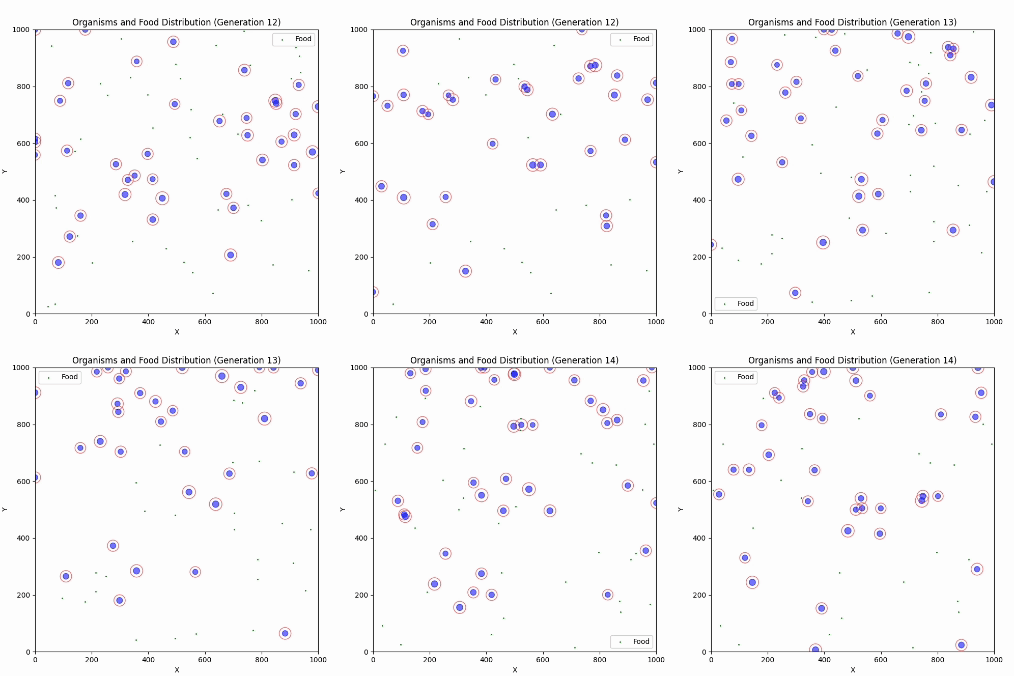
Project Overview: Simulating Natural Selection in Ecosystems using C++ and Python
SimEvo leverages the computational efficiency of C++ for the core simulation engine and offers an intuitive Python interface for ease of use and accessibility. It models ecosystems composed of organisms with genetically determined traits, interacting within an environment that includes resources like food. The simulation observes the principles of natural selection, with organism survival and reproduction influenced by their traits and environmental factors.
- 📂 GitHub Repository: https://github.com/YJack0000/SimEvo
- 💻 Implemented In:
- Core Library: C++
- Bindings & Interface: Python
How to use
Install directly from PyPI
!!!This feature is only support Linux and MacOS currently.
pip install simevopy
Build from scratch
Build for testing
mkdir build; cd build
cmake -S .. -B . -DBUILD_TESTS=true
make
ctest -V
Build for python package
python setup.py install
or
pip install .
Components:
SimEvo integrates a high-performance C++ simulation engine with Python bindings for ease of use. Key architectural components include:
- Core Simulation Engine (C++): Manages the dynamics of natural selection and organism interactions.
- Python API (C++/Python via pybind11): Allows users to define and manipulate the simulation parameters easily.
- Spatial Indexing (Quadtree): Optimizes computational tasks related to spatial relationships and interactions among entities.
Python Script Examples
The script sets up a SimSel simulation in a 500x500 space, initializing 10 "ABCD" gene organisms and distributing food to model resource scarcity. Operating in an "optimize" mode for efficiency, it cycles through 100 generations, each time scattering food and advancing the simulation to observe natural selection as organisms interact, feed, and reproduce based on genetic traits. You can find more examples in examples.
from simevopy import Environment, Organism, Genes
import random

# Setup base organisms in the environment
def setup_base_organism(env, count=10):
    for _ in range(count):
        x = random.randint(0, env.width - 1)
        y = random.randint(0, env.height - 1)
        env.add_organism(Organism(Genes("ABCD")), x, y)

# Distribute food randomly within the environment
def distribute_food_randomly(env, food_count=50):
    for _ in range(food_count):
        x = random.randint(0, env.width - 1)
        y = random.randint(0, env.height - 1)
        env.add_food(x, y)

# Create an optimized environment
env = Environment(500, 500, type="optimize")

# Initialize organisms
setup_base_organism(env)

# Run the simulation over 100 generations
for i in range(100):
    print(f"Gen {i} th")
    distribute_food_randomly(env, 100)
    env.simulate_iteration(50)
1 maintainer

Metadata
1 maintainer
Release files for simevopy 0.2.26
For a detailed explanation of source distributions (sdists) and built distributions (wheels), please see the package formats documentation.
Source distribution (sdist)
| File | Size | Uploaded | |
|---|---|---|---|
| simevopy-0.2.26.tar.gz | 28.4 kB | Details |
Release files / simevopy-0.2.26.tar.gz
| Download URL | simevopy-0.2.26.tar.gz |
|---|---|
| Size | 28.4 kB |
| Tags | Source |
|
SHA-256 checksum How to use checksums |
88bb43f0191df49c1fe09098fadbf48ec429fc259b165984a6864881279c7088
|
|
BLAKE2b-256 checksum How to use checksums |
4b8aaa801dfb2694242b1442f15952391c67099770490d64a32e96d628fbd935
|
| Upload date | |
|
Uploaded using Trusted Publishing? What is trusted publishing? |
No |
| Uploaded via |
twine/5.1.0 CPython/3.12.4
|














