
title: SimpleAudit Studio emoji: 🔍 colorFrom: blue colorTo: indigo sdk: docker app_port: 7860 pinned: false
SimpleAudit Studio
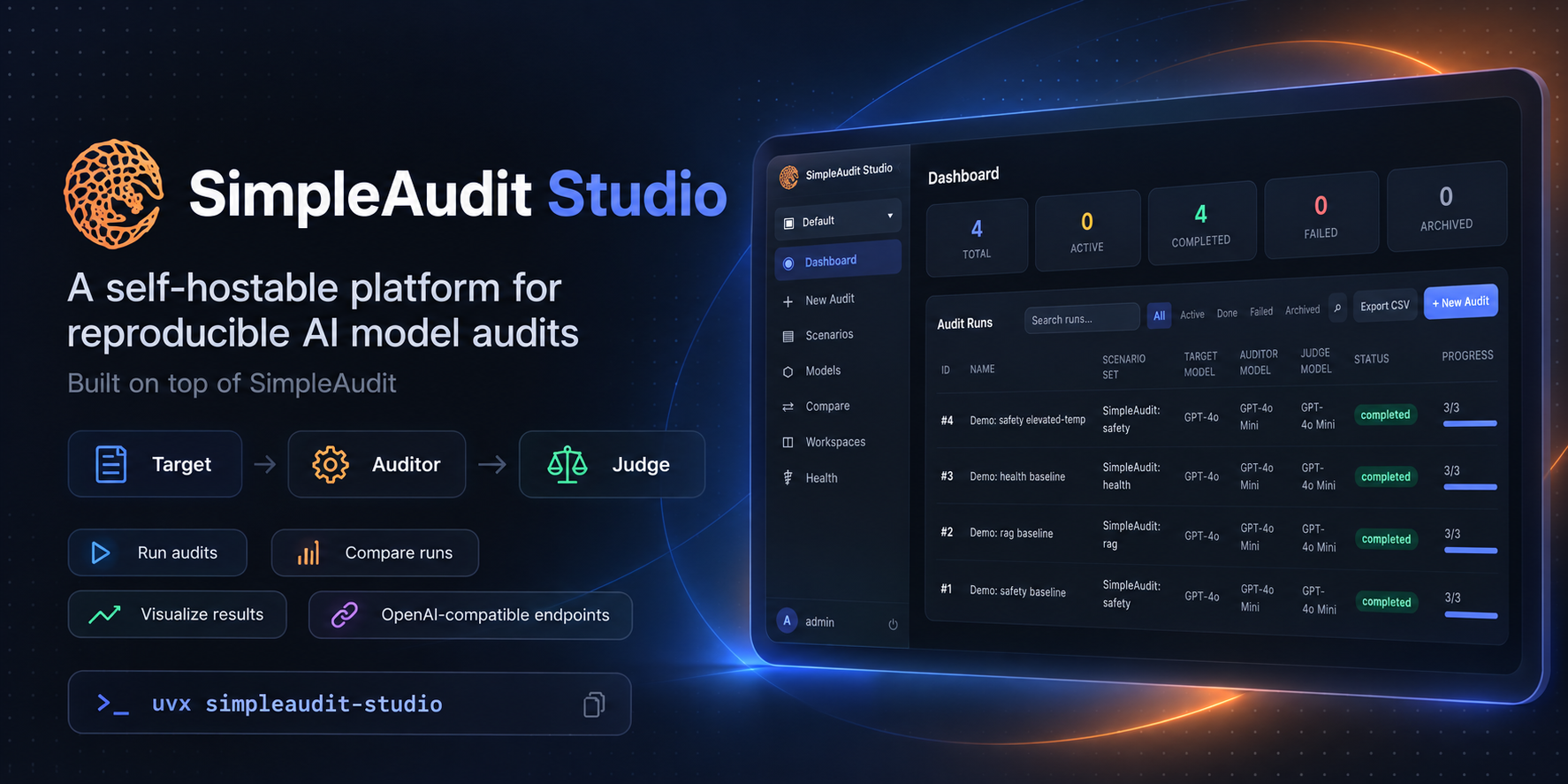


A self-hostable platform for running reproducible AI model audits using the SimpleAudit engine (Target → Auditor → Judge). Every audit captures frozen, versioned inputs so historical results stay interpretable years later.
🚀 Quick Start
uvx simpleaudit-studio
uvx installs the simpleaudit-studio package and runs it in an isolated environment. No Docker, no Postgres, no manual setup. Opens at http://localhost:8000 (login: studio / admin123). A mock model server is pre-seeded so you can start exploring audit results immediately.
🌐 Or skip the setup entirely — try the live demo: sushantgautam-simpleaudit-studio.hf.space
Want the latest unreleased code from this repo instead of the PyPI release? Same one-liner, pointed at git:
uvx --from "git+https://github.com/SushantGautam/SimpleAuditStudio" spin
🤖 Using Real Models
The pre-seeded connections point at a built-in mock server. To run real audits, update your model connections on the Models page to any OpenAI-compatible endpoint. A few common options:
| Provider | Base URL | Example |
|---|---|---|
| Ollama (local) | http://localhost:11434/v1 |
Qwen 3, Llama 3.3, Mistral |
| vLLM | http://your-vllm-server:8000/v1 |
Any HF model |
| OpenAI | https://api.openai.com/v1 |
GPT-4o, o3 |
| Together AI | https://api.together.xyz/v1 |
Many open models |
| Groq | https://api.groq.com/openai/v1 |
Fast inference |
Set the API key in the connection form (leave blank for local servers that don't require auth), then start a run from New Experiment.
🛠️ Local Development
For contributors working on the codebase, use uv — no manual venv steps, no Makefile. Two verbs cover everything:
uv sync— create/update.venvfrompyproject.toml+uv.lockuv run <cmd>— run any command inside.venv(auto-syncs first if the lockfile changed)
Setup (one time)
git clone https://github.com/SushantGautam/SimpleAuditStudio
cd SimpleAuditStudio
cp .env.local.example .env          # minimal local config (SQLite + mock models)

uv sync --extra dev --extra postgres   # create .venv + install all deps
uv run manage.py setup_local           # migrate + create admin (studio / BOOTSTRAP_PASSWORD from .env) + seed data
setup_local chains the three idempotent first-run steps (migrate → bootstrap admin → seed scenario packs & model connections) into one command. Re-run it any time — it skips what already exists.
Daily work
uv run manage.py dev_server --embedded # easiest: web UI + API + audit worker, zero-Docker → http://localhost:8000
Other options:
uv run manage.py runserver               # web UI + API only (no worker)
uv run manage.py dev_server              # web UI + worker, uses .env (edit POSTGRES_*/HATCHET_* to point at your infra)
SIMPLEAUDIT_LOCAL_SQLITE=1 uv run manage.py test infra   # tests
🐳 Self-Hosting
For teams or multi-user setups, use Docker Compose:
git clone https://github.com/SushantGautam/SimpleAuditStudio
cd SimpleAuditStudio
cp .env.example .env
# edit POSTGRES_PASSWORD and BOOTSTRAP_PASSWORD at minimum
docker compose up -d
Services: Web UI (:8000), PostgreSQL, Hatchet queue (:8888), Worker. Optional profile: --profile mock (mock model API).
See docs/deployment.md for production hardening, backups, and upgrades.
✨ What You Can Do
- Build versioned scenario sets and register OpenAI-compatible models
- Run experiments across models, scenario versions and settings, with a review step before launch
- Watch runs live, including per-repetition results
- Monitor models for drift on a schedule (interval or cron)
- Filter, customise and compare runs on an interactive dashboard
🏗️ Architecture
Browser → Django (gunicorn :8000 in Compose; runserver :7860 in the HF Space / uvx demo)
              ↓
         PostgreSQL 16 (domain + queue DBs)
              ↓
         Hatchet Server (durable job queue)
              ↓
         Worker (CPU pool) → SimpleAudit Engine
              Target → Auditor → Judge
📚 Documentation
- Architecture — system design, service boundaries, deployment topology
- Domain Model — scenarios, scenario sets, audit runs, immutability invariants
- Deployment — Docker Compose, production hardening, upgrades
🤝 Contributing
Architecture decisions are documented in docs/architecture.md.
1 maintainer

Metadata
1 maintainer
Release files for simpleaudit-studio 0.3.1
For a detailed explanation of source distributions (sdists) and built distributions (wheels), please see the package formats documentation.
Source distribution (sdist)
| File | Size | Uploaded | |
|---|---|---|---|
| simpleaudit_studio-0.3.1.tar.gz | 620.1 kB | Details |
Built distribution (wheel)
| File | Interpreter | ABI | Platform | Reset |
|---|---|---|---|---|
| simpleaudit_studio-0.3.1-py3-none-any.whl | Python 3 | none | any | Details |
Total release size: 1.1 MB
Release files / simpleaudit_studio-0.3.1.tar.gz
| Download URL | simpleaudit_studio-0.3.1.tar.gz |
|---|---|
| Size | 620.1 kB |
| Tags | Source |
|
SHA-256 checksum How to use checksums |
b98a99742a510a6cd19caa71d461fa5a57dfdea072abcb1bc731b92becb0dadd
|
|
BLAKE2b-256 checksum How to use checksums |
04b628c0b673966540405cc2cb7f3311fb4384f1af4a4be898fd6b315ecfe3d2
|
| Upload date | |
|
Uploaded using Trusted Publishing? What is trusted publishing? |
Yes |
| Uploaded via |
twine/7.0.0 CPython/3.13.14
|
Provenance
Provenance describes where a file came from. On PyPI, provenance is shared via attestations, which provide a verifiable record of the build or publishing details. View details, limitations and caveats.


PyPI Publish Attestation
PyPI verified that this artifact, at this checksum, originated from the publisher listed below.
Signed by GitHub Actions, verified by PyPI on Sep 28, 2026.
Transparency logRelease files / simpleaudit_studio-0.3.1-py3-none-any.whl
| Download URL | simpleaudit_studio-0.3.1-py3-none-any.whl |
|---|---|
| Size | 517.4 kB |
| Tags | Python 3 |
|
SHA-256 checksum How to use checksums |
2f71572bb217c1af1bd81a9bf2831c10c1513703574c8d75e8aba50470729ec1
|
|
BLAKE2b-256 checksum How to use checksums |
b4e956f9d7c98c421a595ce3725b4088a4d30ddeb1f5bd355cb07858bb62895d
|
| Upload date | |
|
Uploaded using Trusted Publishing? What is trusted publishing? |
Yes |
| Uploaded via |
twine/7.0.0 CPython/3.13.14
|
Provenance
Provenance describes where a file came from. On PyPI, provenance is shared via attestations, which provide a verifiable record of the build or publishing details. View details, limitations and caveats.
PyPI Publish Attestation
PyPI verified that this artifact, at this checksum, originated from the publisher listed below.
Signed by GitHub Actions, verified by PyPI on Sep 28, 2026.
Transparency log













