
Tuple-Space + Yool safe-speed runtime kernel: lazy 1,000,000+ subagent batch_spawn, adaptive lane concurrency, and a dependency-free OpenAI-compatible provider client for real subagents on DeepSeek / MiMo / OpenRouter / local LLMs.

Project description
simplicio-prompt
Tuple-space runtime for real subagent fan-out, consensus, cache-aware prompts, and cost-aware AI execution.
Commands stay in English so they can be copied exactly.


English | Português | Español | 日本語 | 한국어 | 简体中文 | Italiano | Français | Русский | Polski | हिन्दी | العربية | עברית | Bahasa Melayu | Bahasa Indonesia

The short version
Tuple-space runtime for real subagent fan-out, consensus, cache-aware prompts, and cost-aware AI execution.
Project DNA
simplicio-prompt is the contract layer: fan-out, consensus, routing discipline, and repeatable prompt behavior for agents that need more than a clever single response. The old README held the runtime vocabulary and benchmark context; the new structure now brings that depth back instead of flattening it into marketing copy.
The new first screen is the doorway; the restored guide below is the workshop. This README should help a stranger understand the promise quickly and still give an operator enough depth to run, validate, and extend the project.
Quick Start
pip install -U simplicio-prompt
simplicio-subagents --help
npm install simplicio-prompt
What it does
- Separates task contract from execution strategy.
- Runs fan-out profiles from quick to 600-lane max breadth.
- Writes reusable JSON/Markdown evidence reports for orchestrators.
- Keeps the kernel dependency-free for Python runtime usage.
- Ships
simplicio-edit, a token-free deterministic file editor: an LLM emits a JSON edit script and this CLI applies it without any model calls (see the section below).
Why this README is built to earn attention
- clear first-screen promise
- language links before installation
- badges and a visual hero for fast trust
- copy-ready quick start
- proof before long reference material
- star history for social proof
How it works
flowchart LR
  mapper["simplicio-mapper
repo context"] --> current["simplicio-prompt
this project"]
  prompt["simplicio-prompt
reasoning runtime"] --> current
  current --> evidence["validated evidence
tests, docs, screenshots"]
  current --> sprint["simplicio-sprint
delivery loop"]
Proof and validation
- The package is dual-published to PyPI and npm.
- The fan-out runtime is used by Simplicio CLI and SendSprint planning paths.
- Changelog documents local Ollama defaults and real-stack evidence routing.
Simplicio ecosystem
- simplicio-mapper supplies repo context before interpretation.
- simplicio-cli executes focused code tasks with verification.
- simplicio-prompt provides fan-out and consensus runtime patterns.
- simplicio-sprint turns cards into draft PR delivery loops.
Documentation standard
- YOOL_TUPLE_HAMT.md
- CONTRIBUTING.md
- SECURITY.md
- CODE_OF_CONDUCT.md
- docs/runtime-contracts.md — machine-readable
prompt/output schemas + local-agent status/escalation protocol for
supervisory runtimes (manifest in
contracts/manifest.json) - docs/readme-globalization-standard.md
Original Field Guide
The section below restores the project-specific README material that existed before the globalization pass. Keep this substance when refreshing the top-level narrative: add polish, do not erase operational memory.
simplicio-prompt
Capability-addressing pattern: yool (atomic action) wrapped in tuples (addressable envelopes) over an HAMT (Hash Array Mapped Trie) registry, coordinated through a tuple-space with content-addressable receipts.
This repo is the canonical spec. Vendor it into any project that wants the pattern.
What's new in 1.13
More features, more reach, and a tighter runtime:
- Now on PyPI —
pip install simplicio-promptships the dependency-free Python kernel and asimplicio-subagentsconsole command, alongside the existing npm package. - Real subagents on any model / provider — DeepSeek, MiMo, OpenRouter, or a
free local LLM (Ollama / vLLM / LM Studio) all run through the same
--provider/--modelflags. The defaultstandardfan-out is 200 subagents;--fanout-profile maxselects 600 for max-breadth parallel audits, and explicit--subagents Nstill wins. - Reusable evidence artifacts —
--report-dirwrites JSON/Markdown summaries for single runs and NDJSON/Markdown summaries for batch orchestrators, including status, counts, tokens, cost, samples, and errors. - Safer wide fan-out defaults — runs with 64+ subagents auto-enable
deterministic diversified personas unless
--no-auto-diversifyis passed. - First-class observability —
PromptFanoutadapters plus per-lane token/cost accounting, circuit-breaker state, and cache stats in every snapshot. - Always-on invocation — a
UserPromptSubmithook routes every message through the runtime with no trigger keyword, now including a Gemini CLI target. - One-command test suite —
npm testruns the Node CLI/hook/cache/target tests plus the full Python kernel suite in a single pass.
Scope — where simplicio-prompt actually wins
simplicio-prompt is a runtime for fan-out, not a wrapper that makes
single LLM calls more accurate. Be honest about the evidence before picking
this up:
- Single-call code generation — the ONE-SHOT template adds runtime
framing on top of a normal prompt. Across 4 models × 12 cases × 3 sides
the bench shows parity or marginal regression vs sending the task
through
simplicio-clidirectly. If your use case is "one model, one prompt, one artifact", use cli alone — sp adds overhead with no measurable lift. - Fan-out with consensus aggregation — this is where sp earns its
keep. On the same bench,
cli + sprunning N=200 subagents with modal-vote onqwen-coder-next-instructscored 12/12 PHPUnit green — the only configuration that did so. Modal-vote on smaller MoE models can collapse to uniq=1 when prompts are bit-identical; that's the bottleneck the v1.11 diverse-prompt and v1.12 behavior- consensus phases attack.
The two products are composable, not alternatives:
| Layer | Project | Answer |
|---|---|---|
| WHAT the task is | simplicio-cli |
role / stack / goal / target / testable criteria / constraints / output shape (6-layer contract) |
| HOW the agent operates | simplicio-prompt (this repo) |
orchestration, fan-out, real subagents, safe-speed runtime |
For code tasks, send the contract through cli and let sp handle fan-out when N>1 makes sense.
Real-stack evidence requests
When the task asks for Playwright/browser proof of web screens connected to a
real API and PostgreSQL/local database, simplicio-prompt treats it as
analysis-first work. The runtime contract now points agents to load mapper
artifacts, route through simplicio-dev-cli or simplicio-sprint, start the
real services, collect focused Playwright screenshots/traces/network evidence,
and close with exact validation commands plus pushed commits.
Two physically separate templates
So the BATCH content never enters the model's context in single-artifact tasks:
| Template | File | When |
|---|---|---|
| ONE-SHOT (default) | prompts/agent-runtime-execution-prompt.md |
Single deliverable per request: file edit, diff, snippet, answer, classification. Lean persona, no tuple-space framing in the body. |
| BATCH (opt-in) | prompts/agent-runtime-batch.md |
Orchestrated fan-out: parallel audits, item-parallel work, 200+ real subagents, brainstorm at scale. Tuple-space primitives, batch_spawn, LaneWorkerPool, real subagent invocation via simplicio-subagents. |
Opt-in paths to BATCH:
- Set
YOOL_TUPLE_FULL_RUNTIME=1— the Claude Code hook switches to the BATCH directive. - Run
npx simplicio-prompt --batch/--batch --rawto print the BATCH template. - Run
npx simplicio-prompt --batch tasks.jsonl --fanout-profile max --jsonto process many SendSprint items with one runtime/provider boot and emit one NDJSON result per task; add--report-dir reports/batchto persist review artifacts. - Import
getBatchPrompt()/getBatchPromptSection()from the npm API, or use thesimplicio-prompt/batch-promptpackage export. - Have your coding agent invoke
simplicio-subagentsvia shell when the task is genuinely fan-out (the BATCH template includes this protocol).
Highlight: 1,000,000+ subagents, zero enumeration
simplicio-promptscales to 1,000,000+ subagents in a single task without enumerating them, without spawning a million processes, and without melting your provider quota.
It does this with batch_spawn(depth, branching, compression_threshold) — a
lazy hierarchical fan-out over a Hilbert-indexed tuple graph. The kernel stores
virtual-agent counts and content-addressable receipts instead of a flat
list of agents, so the cost of representing the work is logarithmic, not
linear.
depth=4, branching=32⇒ 1,048,576 subagents materialized only when a tuple is actually visited.2,833.75xfaster scale representation than a flat instruction flow (V2 benchmark).26.93xfaster active execution than naive sequential fan-out.compress_token+prune_idlekeep inactive subagents as auditable tokens, so a million-subagent task still fits in a small working set.LaneWorkerPoolenforces bounded per-lane concurrency (YOOL_TUPLE_LANE_CONCURRENCY=32,YOOL_TUPLE_MAX_LANE_CONCURRENCY=64), so a million-subagent graph never turns into a million concurrent calls.- Provider safety stays intact: receipt/input cache, jittered backoff, circuit breakers, and small-task batching apply at the million-subagent scale exactly as they do at one.
- Observability is first-class: snapshots include per-lane token/cost usage, circuit breaker state, cache stats, and lane worker success/failure metrics.
The output shape stays auditable at any scale:
[Tuple Space Snapshot]
[Active Agents/Subagents]      ← materialized, small
[Total Agents/Subagents]       ← virtual, up to 1,000,000+
[Proximo Yool a executar]
[Resultado parcial]
See prompts/agent-runtime-execution-prompt.md
and kernel/yool_tuple_kernel.py for the
canonical batch_spawn contract.
Real subagents — any model, any provider
Point
simplicio-promptat any OpenAI-compatible provider and one task fans out across 200 real subagents by default — actual LLM calls, not placeholders, through the same safe-speed runtime. The provider doesn't matter: DeepSeek, MiMo, OpenRouter (any model it gateways), a free local LLM (Ollama / vLLM / LM Studio), or any custom endpoint all work through the same--provider/--modelflags.Use
--fanout-profile quickfor tight budgets, the default--fanout-profile standardfor normal fan-out, and--fanout-profile maxfor max-breadth: large parallel audits, item-parallel work where N items >= 200, or running the live-bench scenario below. Explicit--subagents Noverrides the profile.Verified live on OpenRouter (
deepseek/deepseek-chat) with the max-breadth setting: 600/600 subagents, 0 failures, ~103s, ≈$0.045 at illustrative pricing on a single task. Change--subagentsto run any count.
batch_spawn represents subagents virtually. To make them real, the kernel
ships a dependency-free, OpenAI-compatible provider client and a fan-out runtime
that drains N materialized subagent tuples through LaneWorkerPool — so every
real call inherits the same guardrails (bounded per-lane concurrency, the
receipt/input cache that de-duplicates identical prompts, jittered backoff, and a
provider circuit breaker).
kernel/providers.py—LLMProvider+ presets fordeepseek,mimo,local/ollama, and a generic OpenAI-compatible config, with per-call token usage and cost accounting.kernel/subagent_runtime.py—SubagentRuntimefans a task across N real subagents and aggregates results, tokens, and cost.
Run real subagents on DeepSeek. Default fan-out is 200 via the
standard profile; opt in to --fanout-profile max for 600-subagent
max-breadth runs.
export DEEPSEEK_API_KEY=sk-...

# default 200 subagents
python kernel/subagent_runtime.py --provider deepseek \
  --task "Brainstorm edge cases and tests for a distributed rate limiter"

# opt-in: max-breadth fan-out for large parallel audits
python kernel/subagent_runtime.py --provider deepseek --fanout-profile max \
  --task "Audit these 600 functions in parallel"

# offline cost projection / demo — no key, no network:
python kernel/subagent_runtime.py --provider deepseek --fanout-profile max \
  --task "..." --dry-run --report-dir reports/fanout

# other providers (default 200 subagents)
python kernel/subagent_runtime.py --provider mimo  --task "..."
python kernel/subagent_runtime.py --provider local --subagents 50 --task "..."   # Ollama
For orchestrators that already have many task prompts, use JSONL batch mode. Each input line is one object:
{"task_id":"WS-101","prompt":"Audit this change","system":"You are a reviewer"}
simplicio-prompt --batch tasks.jsonl --fanout-profile max --dry-run --json \
  --report-dir reports/batch > out.ndjson
For the Python runtime CLI directly, use the non-overloaded alias:
simplicio-subagents --batch-file tasks.jsonl --fanout-profile max --dry-run \
  --json --report-dir reports/batch > out.ndjson
Each output line is { "task_id": "...", "status": "ok", "result": ... } or
{ "task_id": "...", "status": "error", "error": "..." }. A malformed line or
single task error does not stop the rest of the batch.
Or programmatically:
from kernel.providers import resolve_provider_config, LLMProvider
from kernel.subagent_runtime import SubagentRuntime

provider = LLMProvider(resolve_provider_config("deepseek"))
# CLI profiles resolve to an explicit API count; standard is 200.
report = SubagentRuntime(provider).run("Audit this module", subagents=200)
print(report.format_summary())   # completed/failed, tokens, total cost in USD
Provider configuration
| Preset | Default base URL | API key env | Notes |
|---|---|---|---|
deepseek |
https://api.deepseek.com/v1 |
DEEPSEEK_API_KEY |
cheap cloud, OpenAI-compatible |
mimo |
https://api.mimo.ai/v1 |
MIMO_API_KEY |
set MIMO_BASE_URL to your endpoint |
openrouter |
https://openrouter.ai/api/v1 |
OPENROUTER_API_KEY |
OpenAI-compatible gateway; set --model (e.g. deepseek/deepseek-chat) |
local / ollama |
http://localhost:11434/v1 |
none | free/offline, defaults to openbmb/minicpm5:latest |
| (any other id) | SIMPLICIO_LLM_BASE_URL |
SIMPLICIO_LLM_API_KEY |
generic OpenAI-compatible |
Per-provider env overrides (example for DeepSeek): DEEPSEEK_BASE_URL,
DEEPSEEK_MODEL, DEEPSEEK_PROMPT_COST_PER_MTOK,
DEEPSEEK_COMPLETION_COST_PER_MTOK. Cost defaults are illustrative — set the
*_COST_PER_MTOK vars to your live contract pricing (e.g. 0.003) so the
reported cost_usd matches your bill.
Behavior consensus (Phase 2) — oracle-driven modal-vote
kernel/aggregator.py::BehaviorConsensus replaces
naive string modal-vote with oracle-driven consensus: each candidate is
run through your test runner (PHPUnit, pytest, jest, regex — anything that
returns a {test_name: bool} profile) and the winner is the candidate
whose pass/fail profile aligns best with the rest of the pool on the tests
the majority also passes. If any candidate passes every observed test,
that one wins outright.
from kernel.aggregator import BehaviorConsensus

def oracle(code: str) -> dict[str, bool]:
    return {
        "unit:rejects_admin": "admin" in code and "deny" in code,
        "unit:allows_member": "member" in code,
        "regex:no_eval":      "eval(" not in code,
    }

candidates = [r.text for r in report.results if r.ok]   # fan-out output
result = BehaviorConsensus.pick(candidates, oracle)

print(result.index)            # winning candidate index
print(result.passed_tests)     # tests it passes
print(result.broken_tests)     # tests it still breaks
print(result.consensus_score)  # how aligned its profile is with majority
print(result.coverage)         # fraction of total tests it passes
This is the mechanism behind the headline 12/12 PHPUnit result on
qwen-coder-next-instruct — modal-vote alone collapses to uniq=1 on MoE
models when the prompts are bit-identical; an oracle breaks that tie by
voting on behavior, not on strings.
Adversarial pairs (Phase 3) — arena selection
kernel/arena.py::AdversarialPairs runs M implementer
attempts and M senior-reviewer critiques in parallel, then picks the
attempt with the highest critic score and zero violations. Optional
oracle integration applies the Phase 2 selector to the surviving
candidates for a double gate (review-passed + behavior-correct).
from kernel.providers import resolve_provider_config, LLMProvider
from kernel.arena import AdversarialPairs

generator = LLMProvider(resolve_provider_config("deepseek"))
critic    = LLMProvider(resolve_provider_config("openrouter"))

arena  = AdversarialPairs(M=100, max_workers=32)
report = arena.run(
    task="repair the role guard in App\\Auth\\Router",
    generator_provider=generator,
    critic_provider=critic,
    # optional double-gate via Phase 2:
    # oracle_fn=lambda code: {"unit": "admin" in code, ...},
)

winner = report.winner             # ArenaAttempt | None
print(report.winner_index)
print(winner.text if winner else "no clean winner")
for review in report.reviews:
    print(review.score, review.violations)
It is API-only by design: the ONE-SHOT default fan-out path stays intact, so production wins from arena only when callers opt in.
Acknowledgement
Special thanks to Jesse Daniel Brown, PhD, my mentor, a California, USA native and author of 100+ scientific articles. His humanitarian and educational perspective on programming, AI, and scientific work helped reinforce the mission behind this repository: practical agent systems that increase human capability through safer, more auditable automation.
V2 safe-speed infographics
English

Portuguese Brazil

Infographic Explanation
The infographics compare a loose prompt flow against the simplicio-prompt V2
safe-speed runtime. The left side shows the old failure modes: flat agent lists,
sequential work, repeated provider calls, no cache, fixed concurrency, retry
storms, large LLM context, and weak audit trails.
The right side shows the V2 path: tuple-space routing, lazy batch_spawn,
adaptive LaneWorkerPool, receipt/input cache, small-task batching, circuit
breakers, backoff with jitter, context compression, local yool routing, and
speculative execution only for idempotent work. The practical result is faster
delivery through avoided repeat work and safer provider behavior, not through
unbounded calls.
Measured V2 benchmark highlights:
- Scale representation:
2,833.75xfaster than a normal instruction flow. - Active execution:
26.93xfaster than normal sequential execution. - Cache:
4xfewer provider calls, a75%reduction. - Batching:
32xfewer small-task calls, a96.88%reduction. - Circuit breaker:
64xfewer failure attempts, a98.44%reduction. - Token economy:
76.32%estimated savings through context compression.
Quick read
YOOL_TUPLE_HAMT.md- full spec with diagrams, algorithms, examples, guardrails.kernel/yool_tuple_kernel.py- reference Python kernel with lazybatch_spawn,compress_token, hookwall, indexed tuple-space scans, and lane worker fan-out.prompts/agent-runtime-execution-prompt.md- ready prompt for Claude, Codex, Hermes, and other coding agents.examples/- runnable minimal implementations (Python, Node).guardrails/- CPU throttle + disk GC reference implementations.adopters.md- projects that vendor this spec.
Install via npm
The repo ships as an npm package and as a multi-IDE plugin. Use it without cloning:
# print the full prompt
npx simplicio-prompt

# print only the `## Prompt` body (no surrounding markdown)
npx simplicio-prompt --raw

# install as a plugin for one (or many) coding agents
npx simplicio-prompt --target claude-code     # → CLAUDE.md
npx simplicio-prompt --target codex           # → AGENTS.md
npx simplicio-prompt --target hermes          # → AGENTS.md
npx simplicio-prompt --target opencode        # → AGENTS.md  (alias: openclaw)
npx simplicio-prompt --target cursor          # → .cursor/rules/*.mdc + .cursorrules
npx simplicio-prompt --target copilot         # → .github/copilot-instructions.md
npx simplicio-prompt --target cline           # → .clinerules/simplicio-prompt.md
npx simplicio-prompt --target aider           # → CONVENTIONS.md
npx simplicio-prompt --target gemini          # → GEMINI.md
npx simplicio-prompt --install-all            # → every target above

# inspect / discover
npx simplicio-prompt --list-targets
Or add it as a dependency and consume it programmatically:
npm install simplicio-prompt
import {
  getPrompt,
  getPromptSection,
  getPromptPath,
  getTargets,
  findTarget,
} from "simplicio-prompt";

const fullMarkdown = getPrompt();        // entire prompt file
const promptOnly   = getPromptSection(); // just the `## Prompt` body
const filePath     = getPromptPath();    // absolute path on disk
const targets      = getTargets();       // multi-IDE plugin target registry
const cursor       = findTarget("cursor");
Every install wraps the prompt in <!-- simplicio-prompt:start --> /
<!-- simplicio-prompt:end --> markers so reinstalling updates the block in
place instead of duplicating it. The Cursor .mdc rule and any new directory
(.cursor/rules/, .github/, .clinerules/) are created automatically.
simplicio-edit — token-free deterministic file editing
The npm package also ships a second binary, simplicio-edit, which applies
a JSON edit script to files with zero LLM calls — instant, free, and
reproducible. An LLM (or a script, or you) emits a small JSON patch
describing what to change; the CLI applies it. Full operation reference
in docs/json-file-editor.md.
# apply an edit script
npx simplicio-edit edits.json

# preview changes without writing
npx simplicio-edit edits.json --dry-run

# read script from stdin, emit machine-readable report
cat edits.json | npx simplicio-edit - --json
Script shape (version: 1):
{
  "version": 1,
  "edits": [
    { "file": "src/app.ts", "ops": [
        { "op": "replace", "find": "TODO", "value": "DONE" },
        { "op": "insertAfter", "find": "// hooks", "value": "useDebounce();" }
    ] },
    { "file": "src/new.ts", "create": true, "content": "export {};\n" },
    { "file": "src/old.ts", "delete": true }
  ]
}
Supported text ops: replace, regexReplace, insertAfter, insertBefore,
insertAtLine, deleteLine, deleteMatching, append, prepend. Exit
codes: 0 success, 1 edit/validation error, 2 usage error.
Programmatic API via the dedicated export:
import {
  applyEditScript,
  applyOps,
  parseEditScript,
  EditError,
} from "simplicio-prompt/json-file-editor";

const report = applyEditScript(scriptObjectOrString, {
  dryRun: false,        // true to compute changes without writing
  cwd: process.cwd(),   // resolve relative file paths against this
});
// report.results is [{ file, action, changed, ops? }] where:
//   action  = "create" | "overwrite" | "edit" | "delete"
//   changed = boolean (false on a no-op edit)
//   ops     = per-op applied list (only on action === "edit")
applyOps(text, ops) is the lower-level helper that operates on a single
string (no filesystem access) and returns the edited text — useful for
unit tests or when you want to drive the script-runner yourself.
Install via PyPI (Python)
The reference kernel ships as a dependency-free Python package, so you can run real subagents on any OpenAI-compatible provider without cloning the repo:
pip install simplicio-prompt
from kernel.providers import resolve_provider_config, LLMProvider
from kernel.subagent_runtime import SubagentRuntime
from kernel.yool_tuple_kernel import build_default_space

# 1,000,000+ subagents represented lazily, materialized only when visited
space, root = build_default_space()
receipt = space.batch_spawn(root, "codex_worker", depth=4, branching=32)
print(receipt.virtual_agents)  # 1048576

# real subagents on any provider (DeepSeek / MiMo / OpenRouter / local)
provider = LLMProvider(resolve_provider_config("deepseek"))
# CLI profiles resolve to an explicit API count; standard is 200.
report = SubagentRuntime(provider).run("audit this module", subagents=200)
print(report.format_summary())  # completed/failed, tokens, total cost in USD
The install also exposes a console entry point for offline cost projection and live fan-out:
# default fan-out (200 subagents) — offline cost projection, no API key
simplicio-subagents --provider deepseek --task "..." --dry-run \
  --report-dir reports/fanout

# max-breadth fan-out (opt-in) for large parallel audits
simplicio-subagents --provider deepseek --fanout-profile max --task "..." \
  --dry-run --report-dir reports/fanout
Optional Rust acceleration (PyO3)
For hot paths (prompt section extraction, multi-needle pattern scan, and
guardrail validation) the repo ships an optional native extension
written in Rust with PyO3 bindings. The default pip install simplicio-prompt
remains pure-Python and dependency-free; the native extension is opt-in.
Build and install the extension locally:
pip install maturin
cd rust && maturin develop --release
That produces _simplicio_native in the current Python environment.
kernel/utils/accel.py transparently picks it up on the next import:
from kernel.utils import accel

accel.backend_name()                              # "native" (or "python" w/o the wheel)
accel.extract_prompt_section(text)                # native if available, identical output
accel.find_patterns(text, ["needle-a", "needle-b"])
accel.validate_guardrails(["rule-a", "rule-b"], text)
The native path is parity-tested against the pure-Python fallback
(tests/test_accel.py) so the output is identical byte-for-byte; pick
whichever your install has. Measured speedups on local builds:
extract / ONESHOT (~75 lines)             ~3.0x
extract / BATCH   (~280 lines)            ~3.1x
extract / 5KB body                        ~7.0x
find_patterns / 4 needles in 5KB          ~2.2x
validate_guardrails / 6 rules in 5KB      ~7.4x
(50k iterations each, Rust 1.94, CPython 3.11.) Run
python benchmarks/accel_benchmark.py to reproduce locally.
The native wheel is not published to PyPI yet — that requires a
manylinux/macOS/Windows wheel matrix in CI. For now cd rust && maturin develop is the canonical install path.
Multi-IDE plugin matrix
| Target id | IDE / agent | Files written |
|---|---|---|
claude-code |
Anthropic Claude Code | CLAUDE.md |
codex |
OpenAI Codex CLI | AGENTS.md |
hermes |
Nous Research Hermes | AGENTS.md |
opencode (alias openclaw) |
OpenCode / OpenClaw | AGENTS.md |
cursor |
Cursor IDE | .cursor/rules/simplicio-prompt.mdc, .cursorrules |
copilot (alias github-copilot) |
GitHub Copilot | .github/copilot-instructions.md |
cline |
Cline (VS Code) | .clinerules/simplicio-prompt.md |
aider |
Aider | CONVENTIONS.md |
gemini (alias gemini-cli) |
Google Gemini CLI | GEMINI.md |
Auto-invocation per agent
The runtime is meant to be always-on — every user message is treated as the task and routed through the runtime, with no trigger keyword. How that invocation is wired depends on the agent:
| Agent | Invocation mechanism | Always-on? |
|---|---|---|
| Claude Code | UserPromptSubmit hook (plugins/claude-code/hooks/) injects the runtime contract on every prompt; plus a simplicio-runtime skill and slash commands |
yes, programmatic |
| Codex / Hermes / OpenCode | AGENTS.md loaded as standing instructions |
yes (context file) |
| Cursor | .cursor/rules/*.mdc with alwaysApply: true |
yes (always-apply rule) |
| GitHub Copilot | .github/copilot-instructions.md |
yes (context file) |
| Cline | .clinerules/simplicio-prompt.md |
yes (context file) |
| Aider | CONVENTIONS.md |
yes (context file) |
| Gemini CLI | GEMINI.md loaded every turn |
yes (context file) |
A true prompt-submit hook (inject-on-every-prompt with programmatic stand-down) exists only in Claude Code. For the other agents, the always-applied context file is the invocation — it is read on every turn, so the contract is always present. All of them honor in-message stand-down phrases ("stop", "cancel", "exit runtime", "ignore simplicio").
Claude Code plugin
plugins/claude-code/ is a full Claude Code plugin: drop it into
~/.claude/plugins/simplicio-prompt/ (or your project's .claude/plugins/) to
get an always-on hook, three slash commands, and a runtime skill:
UserPromptSubmithook (hooks/hooks.json→hooks/user-prompt-submit.mjs) — injects the runtime contract (hooks/runtime-directive.md) on every prompt, unless the prompt is an explicit stand-down. This is the always-on invocation./simplicio <task>— run the next task through the Tuple-Space + Yool runtime./simplicio-install <target>— install the runtime contract into the current repo (claude-code,codex,cursor,copilot,gemini,all, …)./simplicio-status on|off|<field>:on— toggle the opt-in status output.simplicio-runtimeskill — auto-activates in repos that vendor the spec.
Legacy --install
The original single-file installer still works for backwards compatibility:
npx simplicio-prompt --install CLAUDE.md
npx simplicio-prompt --install AGENTS.md
npx simplicio-prompt --install .cursorrules
Integration adapter
For orchestration repos that want the runtime without copying tuple boilerplate, use the Python adapter:
from examples.python.prompt_fanout import PromptFanout

fanout = PromptFanout(repo="my-service", authority="simplicio-sprint")
root, receipt = fanout.spawn_task(
    "review checkout edge cases",
    mapper_context={"target": "src/checkout.ts"},
    depth=2,
    branching=8,
)
fanout.record_tokens("analysis", prompt_tokens=1200, completion_tokens=300, cost_usd=0.02)
print(receipt.virtual_agents)
print(fanout.snapshot()["token_usage"])
simplicio-dev-cli can use the same adapter for internal verification
reasoning when it already has structured mapper context.
How to use the prompt
Use simplicio-prompt as a canonical execution prompt for coding agents such as
Claude, Codex, Hermes, Cursor, Cline, or any assistant that can read repository
instructions.
- Run
npx simplicio-prompt --install CLAUDE.md(or paste the## Promptsection fromprompts/agent-runtime-execution-prompt.mdintoAGENTS.md,CLAUDE.md,.cursorrules, or a custom system prompt). - In the target repository, just ask for work in your own words. You do not
need to start the message with
Implement— any user input (a sentence, a bug description, a code snippet, a one-word request) is treated as the taskXand routed through the same runtime. The only opt-outs are explicit stand-down phrases like "stop", "cancel", "exit runtime". - The agent will read the canonical files listed in the prompt, decompose the
task into a Hilbert-indexed tuple graph, create a root tuple, route active
work through tuple-space primitives, and use
LaneWorkerPoolplus the V2 safe-speed controls. - Status output is opt-in (default: silent). Enable with
YOOL_TUPLE_STATUS=true(orstatus_output=trueruntime flag). When on, the agent returns this shape:
[Tuple Space Snapshot]
[Active Agents/Subagents]
[Total Agents/Subagents]
[Next Yool to Execute]
[Partial Result]
Per-field toggles (default false): YOOL_TUPLE_STATUS_SNAPSHOT,
YOOL_TUPLE_STATUS_ACTIVE, YOOL_TUPLE_STATUS_TOTAL,
YOOL_TUPLE_STATUS_NEXT, YOOL_TUPLE_STATUS_PARTIAL.
For high-throughput local runs, set the runtime environment variables before starting the agent or scripts:
$env:YOOL_TUPLE_LANE_CONCURRENCY="32"
$env:YOOL_TUPLE_MAX_LANE_CONCURRENCY="64"
$env:YOOL_TUPLE_CPU_QUOTA_PCT="95"
$env:YOOL_TUPLE_QUEUE_MAXSIZE="8192"
$env:YOOL_TUPLE_COMPRESSION_THRESHOLD="1024"
$env:YOOL_TUPLE_CACHE_MAX_ENTRIES="16384"
$env:YOOL_TUPLE_CACHE_TTL_S="3600"
$env:YOOL_TUPLE_API_MAX_RETRIES="3"
$env:YOOL_TUPLE_API_BACKOFF_BASE_MS="100"
$env:YOOL_TUPLE_API_BACKOFF_MAX_MS="5000"
$env:YOOL_TUPLE_CIRCUIT_FAILURE_THRESHOLD="5"
$env:YOOL_TUPLE_CIRCUIT_COOLDOWN_S="30"
$env:YOOL_TUPLE_BATCH_SMALL_TASK_SIZE="32"
$env:YOOL_TUPLE_CONTEXT_COMPRESSION_CHARS="6000"
Run the reference kernel and tests:
python kernel/yool_tuple_kernel.py
python -m unittest discover -s tests -p "test_*.py"
V2 benchmark report
The V2 report is the main evidence for the safe-speed runtime. Read it before adopting the prompt in another project:
What the V2 report shows:
2,833.75xfaster scale representation than normal instruction flow.26.93xfaster active execution than normal sequential execution.4xfewer repeated provider calls through receipt/input cache.32xfewer small-task calls through batching.64xfewer provider failure attempts through circuit breakers.76.32%estimated token savings through context compression.
The key point: V2 speeds up by avoiding repeated work and controlling provider pressure. It does not depend on unsafe infinite calls, unbounded concurrency, or retry storms.
High-throughput runtime defaults
The reference kernel is tuned for speed while keeping host guardrails explicit:
| Env var | Default | Purpose |
|---|---|---|
YOOL_TUPLE_LANE_CONCURRENCY / YOOL_LANE_CONCURRENCY |
32 |
Preferred workers per lane. |
YOOL_TUPLE_MAX_LANE_CONCURRENCY / YOOL_MAX_LANE_CONCURRENCY |
64 |
Ceiling for workers per lane. |
YOOL_TUPLE_CPU_QUOTA_PCT / YOOL_CPU_QUOTA_PCT |
95 |
Default per-yool CPU budget. |
YOOL_TUPLE_QUEUE_MAXSIZE / YOOL_QUEUE_MAXSIZE |
8192 |
Lane queue scan cap. |
YOOL_TUPLE_COMPRESSION_THRESHOLD / YOOL_COMPRESSION_THRESHOLD |
1024 |
Active materialized agents before pruning. |
YOOL_TUPLE_CACHE_MAX_ENTRIES / YOOL_CACHE_MAX_ENTRIES |
16384 |
Receipt/input-hash cache size. |
YOOL_TUPLE_CACHE_TTL_S / YOOL_CACHE_TTL_S |
3600 |
Cache TTL in seconds. |
YOOL_TUPLE_API_MAX_RETRIES / YOOL_API_MAX_RETRIES |
3 |
Retry budget for transient API/LLM failures. |
YOOL_TUPLE_API_BACKOFF_BASE_MS / YOOL_API_BACKOFF_BASE_MS |
100 |
Initial jittered backoff delay. |
YOOL_TUPLE_API_BACKOFF_MAX_MS / YOOL_API_BACKOFF_MAX_MS |
5000 |
Backoff ceiling. |
YOOL_TUPLE_CIRCUIT_FAILURE_THRESHOLD / YOOL_CIRCUIT_FAILURE_THRESHOLD |
5 |
Failures before opening provider breaker. |
YOOL_TUPLE_CIRCUIT_COOLDOWN_S / YOOL_CIRCUIT_COOLDOWN_S |
30 |
Provider cooldown after breaker opens. |
YOOL_TUPLE_BATCH_SMALL_TASK_SIZE / YOOL_BATCH_SMALL_TASK_SIZE |
32 |
Default small-task batch size. |
YOOL_TUPLE_CONTEXT_COMPRESSION_CHARS / YOOL_CONTEXT_COMPRESSION_CHARS |
6000 |
Large LLM context compression threshold. |
Safe speedups now live in the kernel, not only in the prompt: receipt/input
cache, adaptive lane concurrency, jittered backoff, provider circuit breakers,
small-task batching, prompt/context compression, local yool routing, and
speculative execution only for tuples marked idempotent=True.
Run the reference kernel and tests:
python kernel/yool_tuple_kernel.py
python -m unittest discover -s tests -p "test_*.py"
Benchmark reports:
Why a separate repo
The pattern is cross-project. SendSprint, llm-project-mapper, future agents - all consume the same spec. One source of truth, vendored on demand.
License
MIT © Wesley Simplicio. See LICENSE.
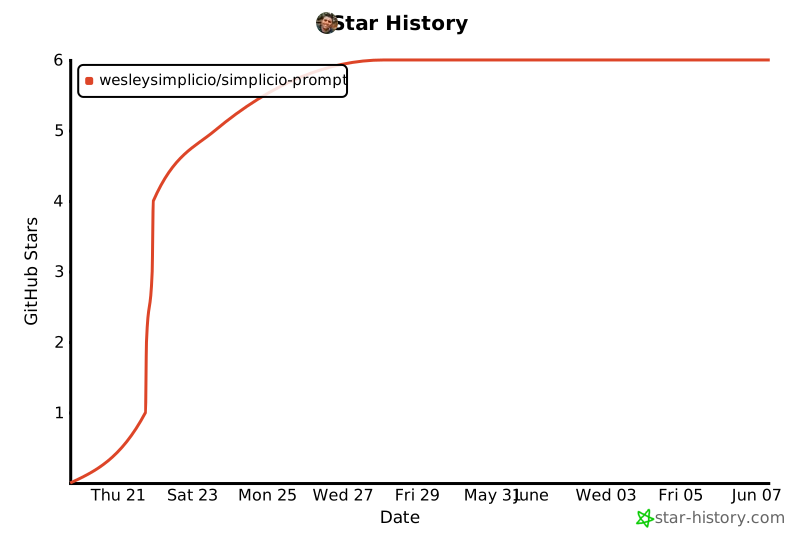
Star History
License
MIT. See LICENSE.
Release history Release notifications | RSS feed


Download files
Download the file for your platform. If you're not sure which to choose, learn more about installing packages.
Source Distribution
Built Distribution
Filter files by name, interpreter, ABI, and platform.
If you're not sure about the file name format, learn more about wheel file names.
Copy a direct link to the current filters
File details
Details for the file simplicio_prompt-1.14.0.tar.gz.
File metadata
- Download URL: simplicio_prompt-1.14.0.tar.gz
- Upload date:
- Size: 111.3 kB
- Tags: Source
- Uploaded using Trusted Publishing? No
- Uploaded via: twine/6.2.0 CPython/3.11.15
File hashes
| Algorithm | Hash digest | |
|---|---|---|
| SHA256 |
ea57586546ca4f5dd256dfd10e7675a75a3b3151dfc2af946551f8aa558b41c8
|
|
| MD5 |
919ad173c186d41e6836e290b212870e
|
|
| BLAKE2b-256 |
0fbbee286c0d40577cd1f38037968926650d1c4fc9a5af0f872bb3e6e1850272
|
File details
Details for the file simplicio_prompt-1.14.0-py3-none-any.whl.
File metadata
- Download URL: simplicio_prompt-1.14.0-py3-none-any.whl
- Upload date:
- Size: 68.3 kB
- Tags: Python 3
- Uploaded using Trusted Publishing? No
- Uploaded via: twine/6.2.0 CPython/3.11.15
File hashes
| Algorithm | Hash digest | |
|---|---|---|
| SHA256 |
f4c38d8bc1c49b3002e6c033fe0eaa38e2238155bd94b73e2675f3fd6c8a6dd8
|
|
| MD5 |
980b6ae7b50bec8948328f6016979303
|
|
| BLAKE2b-256 |
170f78a68edaa7cb7b277e2eba6a1fe8b04c7874010ad8b91c8ec232540c2ba6
|






