
since-cutoff
English | 简体中文
Your coding agent learned your libraries before they changed. since-cutoff lists what changed in the public API of your pinned dependency versions since the model's training cutoff, tests the model on a sample of those changes to find the ones it gets wrong, and writes short AGENTS.md notes for them. A type checker, not another LLM, scores the answers. A note is kept only if its example type-checks against your version; otherwise it becomes a plain statement of the change.


The problem
Every model has a training cutoff. Your lockfile does not. A few real examples for a model
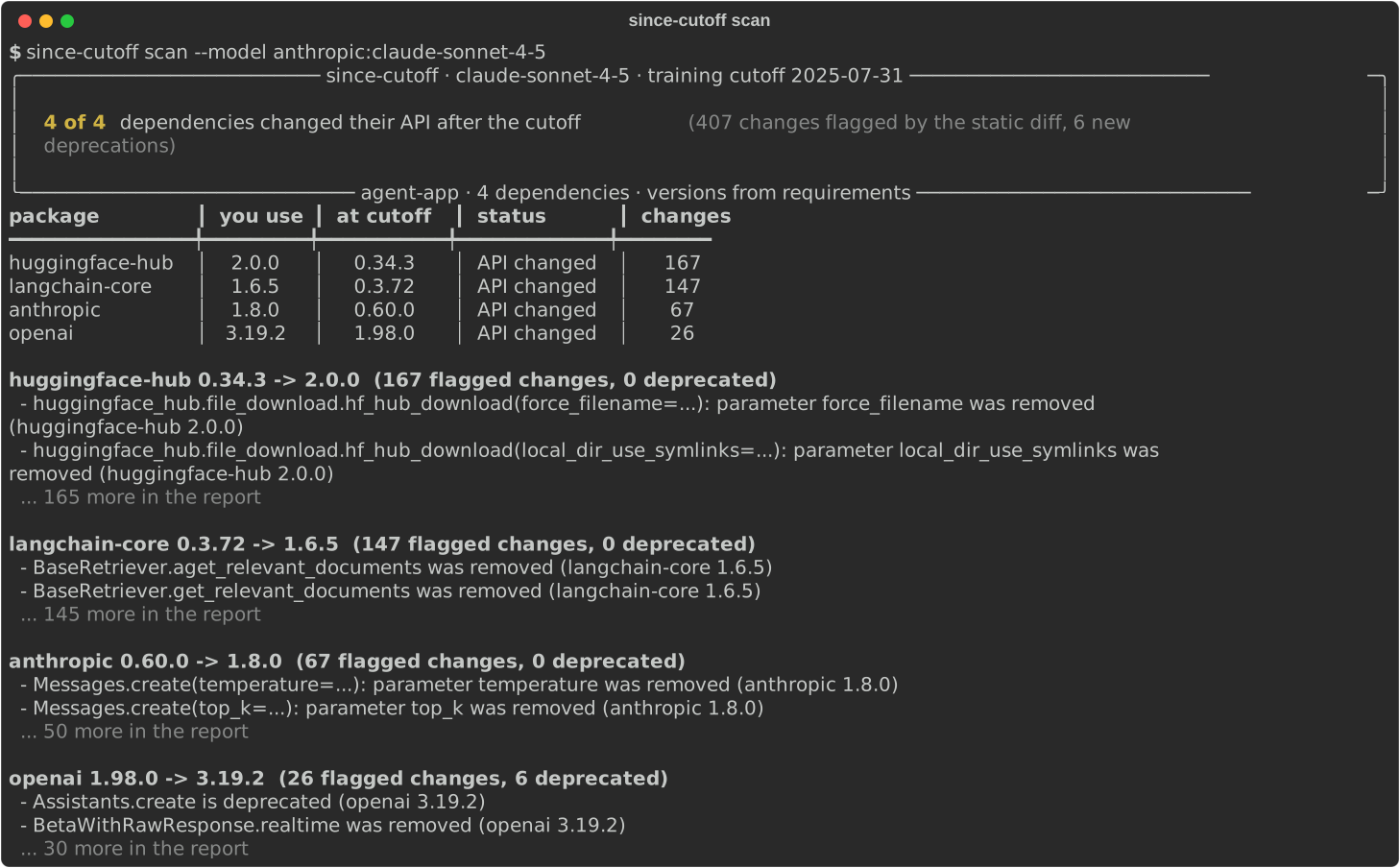
with a July 2025 cutoff (Claude Sonnet 4.5) and current releases, found by since-cutoff scan:
| library | version the model saw | your version | what breaks |
|---|---|---|---|
| anthropic | 0.60.0 | 1.8.0 | messages.create(temperature=..., top_p=..., top_k=...) no longer accepted |
| huggingface-hub | 0.34.3 | 2.0.0 | hf_hub_download(resume_download=..., force_filename=..., local_dir_use_symlinks=...) removed |
| langchain-core | 0.3.72 | 1.6.5 | retriever.get_relevant_documents(), llm.predict() removed |
| openai | 1.98.0 | 3.19.2 | 21 breaking changes, 6 new deprecations |
For that sample project, 7 of 9 dependencies had changed their public API after the cutoff (the static diff flags 317 breaking changes and 23 new deprecations; some are internals, which the task writer skips). An agent that learned the old API writes code that fails at import or call time, or, worse, still runs because the old path is only deprecated.
Documentation tools such as Context7 fetch current docs for a library when the agent looks it up. since-cutoff answers a different question: which of the changes in your pinned versions this model actually gets wrong. It writes notes only for those, and re-tests the model on held-out tasks with and without the notes to check that they help.
Features
scan: for every dependency, the version your model saw at its training cutoff vs. the one you pin, and a static diff of what broke in between (no model calls, no API key).run: probes the model with short tasks that need the changed APIs and scores its code with a type checker against both versions: stale, wrong, deprecated or correct.- Verified fixes: one-line AGENTS.md / CLAUDE.md notes, kept only if their example type-checks against your exact version, and re-tested on held-out tasks.
mcp: an MCP server, so Claude Code, Codex, Cursor, VS Code, Claude Desktop or Gemini CLI can check what changed in a library since its cutoff before writing code against it.- CI: a GitHub Action that adds a summary to the job page, a
pre-commit hook, and
scan --markdown/--fail-on-changesfor any other CI. - Works where you are: Claude Code plugin and skill, or any of Anthropic, OpenAI, OpenRouter, DeepSeek, Ollama and OpenAI-compatible servers.
- Every lockfile: uv, Poetry, PDM, pylock, Pipenv, requirements files, or a
.venv. - Safe and reproducible: never runs package or model-written code; everything is cached; full JSON and Markdown reports.
Quick start
# list API changes since your model's cutoff (fast, no model calls)
uvx since-cutoff scan

# probe the model, write verified notes, and apply them to AGENTS.md
uvx since-cutoff run --apply
Or install it with pipx install since-cutoff (or pip install since-cutoff) and run
since-cutoff. Run it from your project root (anything with uv.lock, poetry.lock,
pdm.lock, pylock.toml, Pipfile.lock, requirements*.txt, pyproject.toml or a .venv).
In Claude Code
/plugin marketplace add MohammadHijjawi97/since-cutoff
/plugin install since-cutoff@since-cutoff
Then ask Claude to "check which of our dependencies you are out of date on", or run
/since-cutoff:since-cutoff. The skill runs the CLI; the measuring itself is done by a fresh,
tool-less copy of the model, so the agent cannot grade itself. The plugin also starts the MCP
server described next, so Claude can look up a library's changes before it writes code.
In other coding agents
npx skills add MohammadHijjawi97/since-cutoff
This installs the same skill through the open skills
CLI for Codex, Cursor, Gemini CLI, GitHub Copilot, OpenCode and other agents that read
SKILL.md. Outside Claude Code, tell the tool which model to test, for example
since-cutoff scan --model openai:gpt-5.4. For the MCP tools, add the server as shown in the
next section.
Example prompts
- "Which of our dependencies changed their public API after your training cutoff?" The agent
runs
since-cutoff scanor calls the MCP toolproject_changes: no model calls, no API key. - "Measure which of those changes you actually get wrong, and add the verified notes to
AGENTS.md." The agent runs
since-cutoff run --quick --applyafter asking you, becauserunsends prompts to the model provider and uses your API credits or Claude Code usage. - "Before you write the httpx code, check what changed in httpx since your cutoff." The agent
calls the MCP tool
api_changes.
Use it from any agent (MCP)
since-cutoff mcp is an MCP server that lets a coding agent ask "what changed in this library
since my training cutoff?" before it writes code. It has three read-only tools:
| tool | answers |
|---|---|
api_changes(package, model, symbol=...) |
what changed in one library between the release at the model's cutoff and the latest (or a given) version, hard breaks first |
project_changes(project_dir, model) |
the same for every dependency of a project at its pinned version, starting with APIs your code already uses |
model_cutoff(model) |
a model's training cutoff, from models.dev |
The agent passes its own model id, so the answer covers what that model could not have seen. The tools read PyPI and package sources statically: no model calls, no API key, no package code executed.
Claude Code
claude mcp add --scope user since-cutoff -- uvx since-cutoff@latest mcp
Codex (~/.codex/config.toml)
[mcp_servers.since-cutoff]
command = "uvx"
args = ["since-cutoff@latest", "mcp"]
startup_timeout_sec = 60
tool_timeout_sec = 900
Cursor (~/.cursor/mcp.json) and Claude Desktop (claude_desktop_config.json)
{
  "mcpServers": {
    "since-cutoff": { "command": "uvx", "args": ["since-cutoff@latest", "mcp"] }
  }
}
VS Code (.vscode/mcp.json)
{
  "servers": {
    "since-cutoff": { "type": "stdio", "command": "uvx", "args": ["since-cutoff@latest", "mcp"] }
  }
}
Gemini CLI
gemini mcp add --scope user since-cutoff uvx since-cutoff@latest mcp
# or as an extension, which starts the same server:
gemini extensions install https://github.com/MohammadHijjawi97/since-cutoff
@latest makes uvx pick up new releases instead of reusing the first version it cached (the
plugin's own .mcp.json pins the exact release instead). If the client cannot find uvx,
install uv or give the full path (which uvx).
The first project_changes call on a larger project downloads the wheels of every dependency
that changed and can take several minutes (very large packages such as transformers take the
longest). Results are cached, so later calls take seconds. To warm the cache, run
since-cutoff scan in the project once; it shares the cache with the server. Clients with a
short default tool timeout may need a longer one, as in the Codex example above. The release
workflow also publishes the server to the
MCP Registry as
io.github.MohammadHijjawi97/since-cutoff.
What api_changes("huggingface-hub", model="claude-haiku-4-5") returns (real output, trimmed):
# huggingface-hub 0.29.1 -> 2.0.0

- From 0.29.1 (2025-02-20): the newest release on or before 2025-02-28 (training cutoff of claude-haiku-4-5, from models.dev)
- To 2.0.0 (2026-09-24): the latest release on PyPI
- 116 breaking changes, 0 new deprecations (removed or moved 62, parameters removed 43, parameters now required 9, changed kind 1, now keyword-only or positional-only 1)

## Removed or moved

- `huggingface_hub.InferenceApi` was removed; similar names now: `inference`, `InferenceEndpoint`, `InferenceClient`
- `huggingface_hub.configure_http_backend` was removed; 1 similar, e.g. `huggingface_hub.utils.configure_http_backend`
...

## Parameters removed

- `huggingface_hub.login(write_permission=...)`: parameter `write_permission` was removed
- `huggingface_hub.snapshot_download(resume_download=...)`: parameter `resume_download` was removed; similar parameters now: `force_download`
- `huggingface_hub.file_download.hf_hub_download(force_filename=...)`: parameter `force_filename` was removed; similar parameters now: `filename`
...

Not listed: 76 breaking changes, 0 new deprecations (removed or moved 47, parameters removed 29). Narrow with symbol="..." or raise limit.
With symbol="hf_hub_download" it lists only the 8 changes to that function (resume_download=,
force_filename=, local_dir_use_symlinks= and proxies=, on the function and on HfApi).
symbol also takes a call the way code writes it: client.messages.create finds the changes
to Messages.create.
A real run
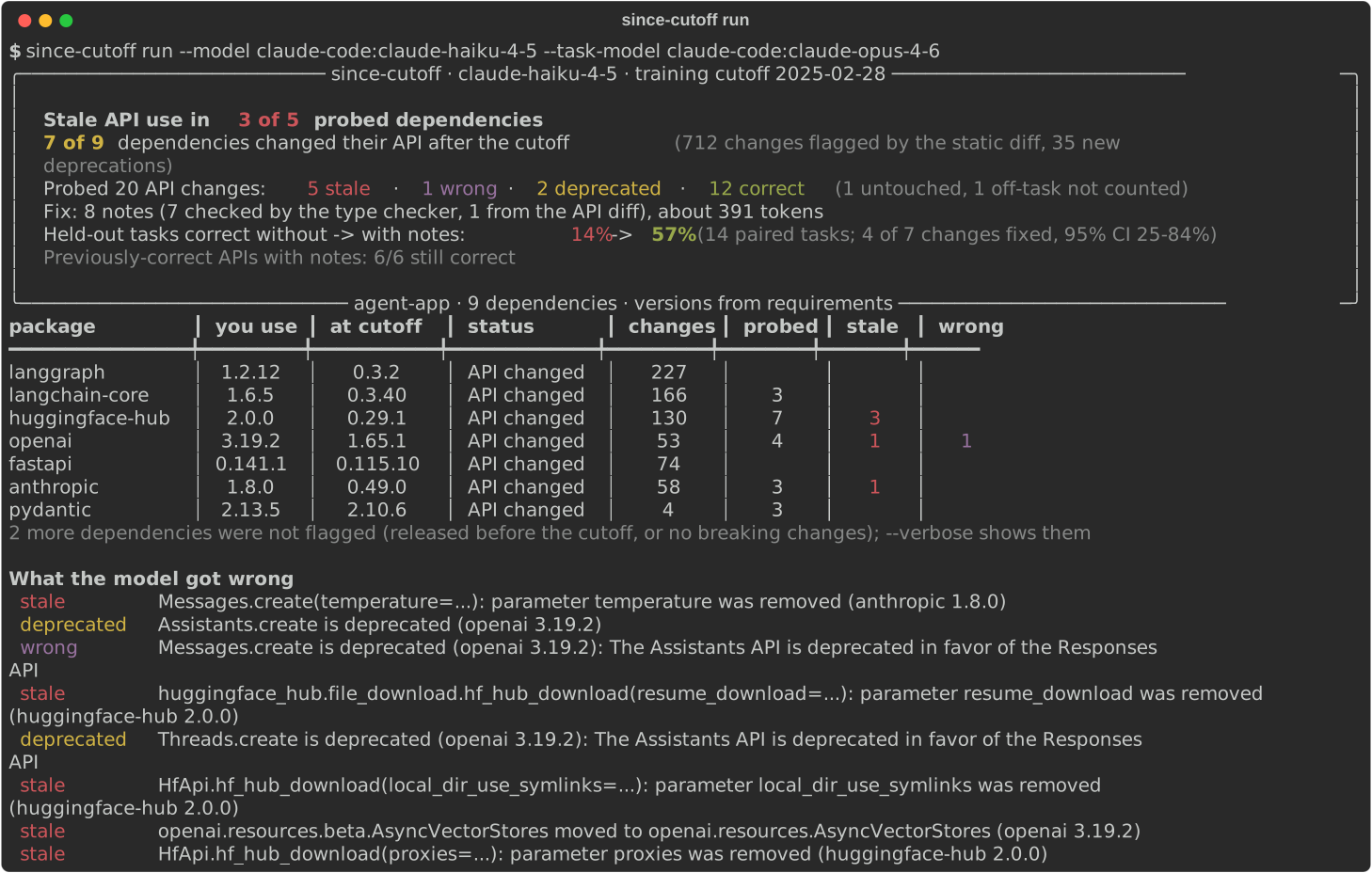
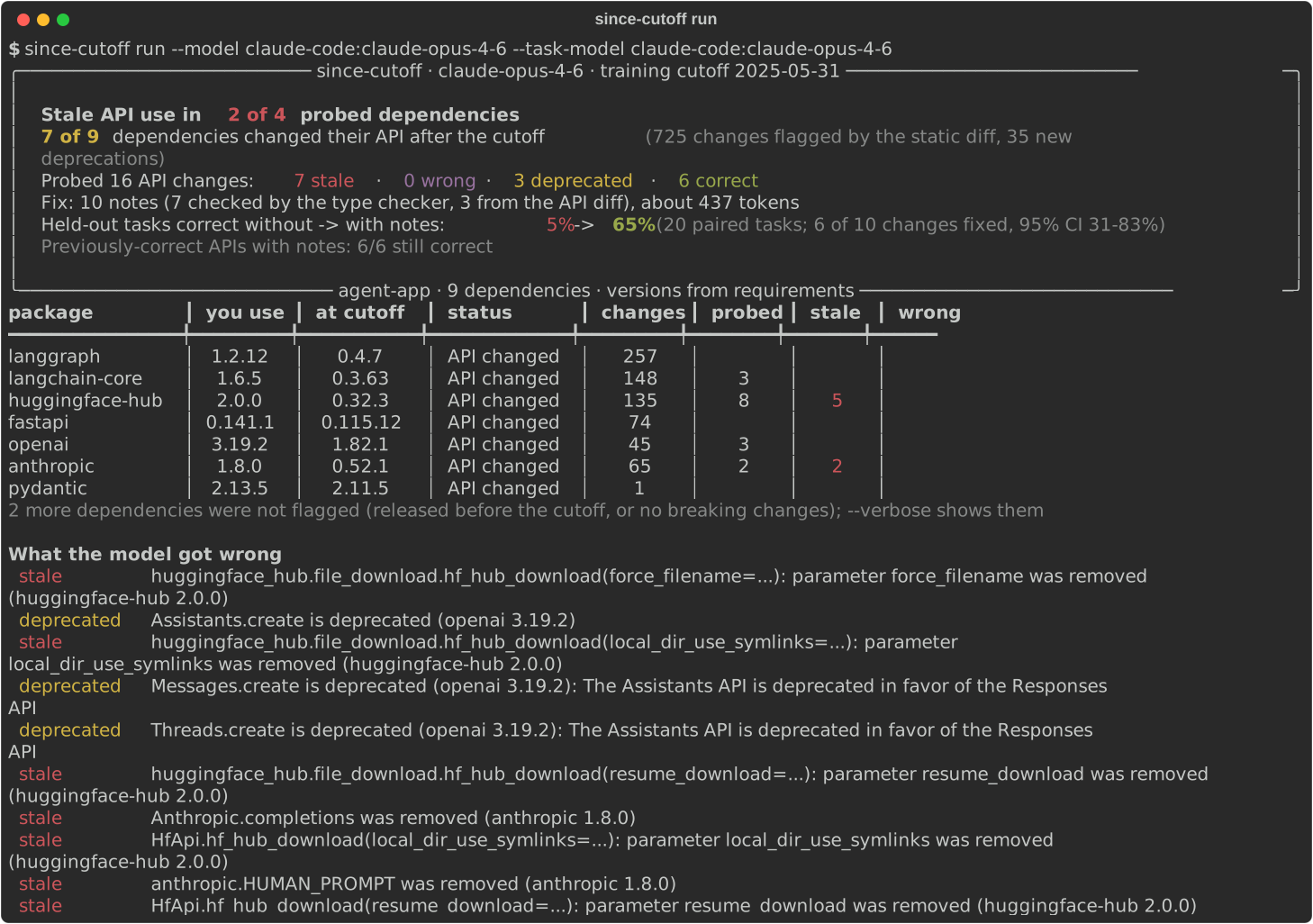
Two Claude models on the 9-dependency sample project in
examples/agent-app,
with Claude Opus 4.6 writing the tasks and notes:
| Claude Haiku 4.5 | Claude Opus 4.6 | |
|---|---|---|
| training cutoff | Feb 2025 | May 2025 |
| API changes probed | 20 | 16 |
| stale / wrong / deprecated / correct | 5 / 1 / 2 / 12 | 7 / 0 / 3 / 6 |
| libraries with stale use | 3 of 5 probed | 2 of 4 probed |
| notes written (type-checker verified) | 8 (7), about 391 tokens | 10 (7), about 437 tokens |
| held-out correct, without -> with notes | 14% -> 57% (14 pairs) | 5% -> 65% (20 pairs) |
| previously-correct APIs after notes | 6/6 still correct | 6/6 still correct |
The stronger model is not safer: Opus 4.6 confidently wrote APIs that were removed after its
cutoff, including anthropic.HUMAN_PROMPT with client.completions. Stale code from both runs,
each valid for the version the model learned and broken for the pinned one:
messages.create(temperature=...) (anthropic 1.8), hf_hub_download(resume_download=...),
local_dir_use_symlinks=..., force_filename=... and proxies=... (huggingface-hub 2.0), and
client.beta.vector_stores (openai 3.x).
The notes it wrote (excerpt, verbatim):
<!-- since-cutoff:start -->
## Library changes after the model's training cutoff

**anthropic 1.8.0**
- `temperature=...` was removed from `messages.create()` in anthropic 1.8.0. Omit the `temperature` parameter entirely; there is no replacement.

**huggingface-hub 2.0.0**
- `hf_hub_download(..., resume_download=True)`: The `resume_download` parameter was removed in huggingface-hub 2.0.0. Omit it; downloads resume automatically.

**openai 3.19.2**
- `client.beta.vector_stores` is removed in openai 3.19.2. Use `client.vector_stores` instead.
<!-- since-cutoff:end -->
Small samples, two models, one project: treat it as a demonstration, not a benchmark. The full
report (every task, answer and type-checker error) is what since-cutoff run writes to
.since-cutoff/report.md. To reproduce: cd examples/agent-app && since-cutoff run --model claude-code:claude-haiku-4-5 --task-model claude-code:claude-opus-4-6.
Models
--model |
uses | needs |
|---|---|---|
claude-code (default) |
your Claude Code login (subscription or key), current model | the claude CLI |
claude-code:sonnet, claude-code:claude-haiku-4-5 |
a specific Claude model | the claude CLI |
anthropic:<model> |
Anthropic API | ANTHROPIC_API_KEY |
openai:<model> |
OpenAI API | OPENAI_API_KEY |
openrouter:<vendor/model> |
OpenRouter | OPENROUTER_API_KEY |
deepseek:<model> |
DeepSeek API | DEEPSEEK_API_KEY |
ollama:<model> |
local Ollama | Ollama running |
openai-compatible:<model> |
any OpenAI-compatible server | --base-url, optional OPENAI_API_KEY |
Training cutoffs come from models.dev (a snapshot is bundled for
offline use). since-cutoff models sonnet lists them; --cutoff 2025-07 overrides.
since-cutoff scan --cutoff 2025-07 without --model scans against that date alone and
names no model.
How it works
flowchart LR
  L[lockfile] --> V[version at the model's cutoff<br/>vs your version]
  V --> D[static API diff<br/>griffe]
  D --> T[short tasks that need<br/>the changed API]
  T --> M[model answers<br/>no tools, no docs]
  M --> C[basedpyright against<br/>BOTH versions]
  C --> N[notes, verified<br/>by the type checker]
  N --> H[held-out tasks<br/>with vs without notes]
| outcome | meaning |
|---|---|
| stale | the code is valid for the version the model knew and invalid for yours, and the error involves an API that changed |
| wrong | invalid for your version, but not explained by a change (hallucinated or misused API) |
| deprecated | valid, but uses an API marked @deprecated in your version |
| correct | valid for your version and actually uses the changed API |
| untouched / off-task / invalid / error | not counted in any rate, and always reported |
Everything is scored by a type checker against the exact package versions, each in an isolated
environment with that package's own runtime dependencies. No LLM judges anything, and every
number traces back to results.json. Details: docs/how-it-works.md.
What it runs, sends and fetches
- Fetches package metadata and wheels from PyPI and model cutoffs from models.dev (a snapshot is bundled for offline use).
- Sends prompts only to the model provider you choose (
runonly;scanandmcpsend nothing). Prompts contain package names, versions, public signatures and docstrings of the changed APIs, the generated tasks and, for notes, the model's own answer. Never your source code. - Runs basedpyright locally on the model's answers. It never executes them.
- Writes
.since-cutoff/in your project, its cache (since-cutoff cache path) and, with--apply, one marked block inAGENTS.md/CLAUDE.md. No telemetry.
Safe by design
- Never executes code. Package code is read statically (griffe with inspection off; only
.py/.pyifiles are extracted, with path and size checks). Model-written code is only type-checked. - Writes almost nothing. Only
.since-cutoff/(which ignores itself in git) and, with--apply, one marked block inAGENTS.md/CLAUDE.md. Everything else in that file is left byte-for-byte unchanged. - Stays on PyPI. Git, path, workspace and private-index dependencies are never looked up on public PyPI by name.
- Local and cached. No telemetry. PyPI data, diffs, tasks and answers are cached, so
re-runs are free and reproducible (
--freshasks the model again).
Use in CI
GitHub Action
Scans the project on each pull request and adds a summary to the job page: per dependency, the
version at the model's cutoff, the version you pin and the top changes, with changes to names
your code uses first. Like scan, it only reads PyPI and models.dev: no model calls, no API key.
# .github/workflows/since-cutoff.yml
name: since-cutoff
on:
  pull_request:
    paths: ["**/*.lock", "**/pylock*.toml", "**/requirements*.txt", "**/pyproject.toml"]
jobs:
  scan:
    runs-on: ubuntu-latest
    steps:
      - uses: actions/checkout@v7
      - uses: MohammadHijjawi97/since-cutoff@v0
        with:
          model: anthropic:claude-sonnet-4-5  # the model your team codes with
| input | default | |
|---|---|---|
model |
required | provider:model as for --model; only its training cutoff is used |
working-directory |
. |
the project directory |
only, exclude |
comma-separated PyPI names | |
cutoff |
override the training cutoff (YYYY-MM or YYYY-MM-DD) |
|
fail-on-changes |
false |
fail the step when a dependency changed its API after the cutoff |
step-summary |
true |
add the Markdown summary to the job summary |
cache |
true |
keep PyPI metadata, package sources and API diffs between runs (also when fail-on-changes fails the job) |
args |
more since-cutoff scan arguments, e.g. --all-deps --limit 20 |
|
since-cutoff-version |
0.2.0 |
the since-cutoff release to run, or latest |
Outputs: changed-packages (comma-separated), changes (breaking changes), deprecations,
markdown (the summary's path, for example to post it as a pull request comment) and report
(the full report's path). Like every report, the counts take a change that is reachable under
several import paths once.
pre-commit
# .pre-commit-config.yaml
repos:
  - repo: https://github.com/MohammadHijjawi97/since-cutoff
    rev: v0.2.0
    hooks:
      - id: since-cutoff-scan
        args: [--model=anthropic:claude-sonnet-4-5]  # add --fail-on-changes to block the commit
The hook runs when a lockfile, a requirements file or pyproject.toml changes, and prints the
scan. Give it --model in args. It needs PyPI, so skip it on pre-commit.ci
(ci: {skip: [since-cutoff-scan]}).
Other CI
# Markdown summary for any CI; exit code 3 if a dependency changed its API after the cutoff
since-cutoff scan --model anthropic:claude-sonnet-4-5 --markdown summary.md --fail-on-changes

# measure the model as well (needs its API key, or the claude CLI)
since-cutoff run --quick --fail-on-stale --json > since-cutoff.json
--markdown - prints the summary to stdout (the usual output then goes to stderr). Exit codes:
0 ok, 1 error (including "no model answer could be scored"), 2 usage error, 3 stale API
use found with run --fail-on-stale, or API changes found with scan --fail-on-changes.
Limitations
- Python only for now. TypeScript (
.d.tsdiffs,tsc) is next. - A type checker sees wrong names, wrong parameters and PEP 702 deprecations. It cannot see
behaviour changes behind an unchanged signature, or deprecations that only warn at run time.
scanalso lists deprecations declared with a library's own decorator (name containing "deprecat"), butrundoes not probe them. - The diff covers the public API:
_privatenames, and test suites, benchmarks and examples shipped inside a package, are skipped. - Probes cover a ranked sample of the breaking changes (symbols your code already uses first), not all of them.
- "The version the model saw" is the newest release on or before the cutoff date. Models know recent releases less well, so real staleness can start earlier.
- Held-out tasks are paraphrases of the same change: they show that a note fixes that change, not that the model got better in general.
Related work
- Context7 and similar tools retrieve current docs at answer time. since-cutoff is complementary: it measures what is actually wrong and keeps a small, verified note in the repo.
- cutoff probes a library you maintain; postcut pastes changelogs since the cutoff.
- Built on griffe, basedpyright, models.dev and rich.
Privacy and support
since-cutoff collects no personal data and has no telemetry. It reads your project's
dependency files and Python code on your machine, fetches public package data from PyPI and
model cutoffs from models.dev, and only in run sends prompts to the model provider you
choose: package names, versions, public API signatures and docstrings, generated tasks and the
model's own answers, never your source code. It stores results in .since-cutoff/, a local
cache (since-cutoff cache clear removes it) and, with --apply, one marked block in
AGENTS.md/CLAUDE.md. Details: PRIVACY.md.
Support and bug reports: GitHub issues. Security issues: see SECURITY.md.
Contributing
Issues and pull requests are welcome; see CONTRIBUTING.md. The offline test suite runs the whole pipeline with a toy library and a scripted model, so no API key is needed.
Citation
If you use since-cutoff in research, please cite it (see CITATION.cff).
License
MIT © Mohammad Hijjawi
1 maintainer

Release files for since-cutoff 0.2.0
For a detailed explanation of source distributions (sdists) and built distributions (wheels), please see the package formats documentation.
Source distribution (sdist)
| File | Size | Uploaded | |
|---|---|---|---|
| since_cutoff-0.2.0.tar.gz | 147.5 kB | Details |
Built distribution (wheel)
| File | Interpreter | ABI | Platform | Reset |
|---|---|---|---|---|
| since_cutoff-0.2.0-py3-none-any.whl | Python 3 | none | any | Details |
Total release size: 265.2 kB
Release files / since_cutoff-0.2.0.tar.gz
| Download URL | since_cutoff-0.2.0.tar.gz |
|---|---|
| Size | 147.5 kB |
| Tags | Source |
|
SHA-256 checksum How to use checksums |
86138bff3f498ad8b87578a32eef41aa688355050db3cde089bef26863d6ffa5
|
|
BLAKE2b-256 checksum How to use checksums |
a62dd5a1038a35e787cca6a041ed1479df4ecc9bda3d4e823530eb67d88e6ff4
|
| Upload date | |
|
Uploaded using Trusted Publishing? What is trusted publishing? |
Yes |
| Uploaded via |
twine/7.0.0 CPython/3.13.14
|
Provenance
Provenance describes where a file came from. On PyPI, provenance is shared via attestations, which provide a verifiable record of the build or publishing details. View details, limitations and caveats.


PyPI Publish Attestation
PyPI verified that this artifact, at this checksum, originated from the publisher listed below.
Signed by GitHub Actions, verified by PyPI on Sep 27, 2026.
Transparency logRelease files / since_cutoff-0.2.0-py3-none-any.whl
| Download URL | since_cutoff-0.2.0-py3-none-any.whl |
|---|---|
| Size | 117.7 kB |
| Tags | Python 3 |
|
SHA-256 checksum How to use checksums |
f6d5cd488ba42aac7fa47239665190913452c057e6f3f552f253eefd4614be98
|
|
BLAKE2b-256 checksum How to use checksums |
a8bd79936c1c5facc30a3817626c8dc7560f91ca416ce75bdd20b7c64db14f6b
|
| Upload date | |
|
Uploaded using Trusted Publishing? What is trusted publishing? |
Yes |
| Uploaded via |
twine/7.0.0 CPython/3.13.14
|
Provenance
Provenance describes where a file came from. On PyPI, provenance is shared via attestations, which provide a verifiable record of the build or publishing details. View details, limitations and caveats.
PyPI Publish Attestation
PyPI verified that this artifact, at this checksum, originated from the publisher listed below.
Signed by GitHub Actions, verified by PyPI on Sep 27, 2026.
Transparency log













