
The sinupy Package
The sinupy package makes it convenient to analyze the characteristic sinusoidal waves propagating in various kinds of medium. Typical waves in plasma have been given in the code to demonstrate how the package works and other users are free to follow the steps to research on their medium or charcteristic waves of interest.
Wave Equation
The electromagnetic wave equation is the theoretical basics of our formula derivation. The following formulas reveal what we call as the tensor coefficient matrix $T$
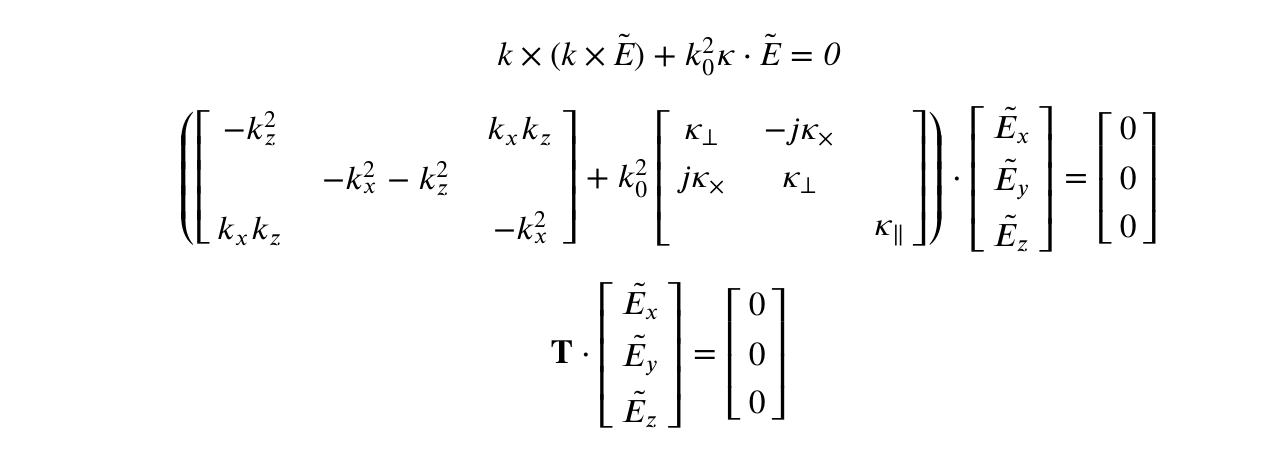
You can acquire the sympy.Array representation of the above (tensor) matrix coefficients by the WaveEq class' coeff_matrix() method. For the relevant variable, you can get them by attribute e.g., wave_eq.wave.k[1] means the wave's $k_y$ component of $\vec{k}$ vector.
Example Snapshots
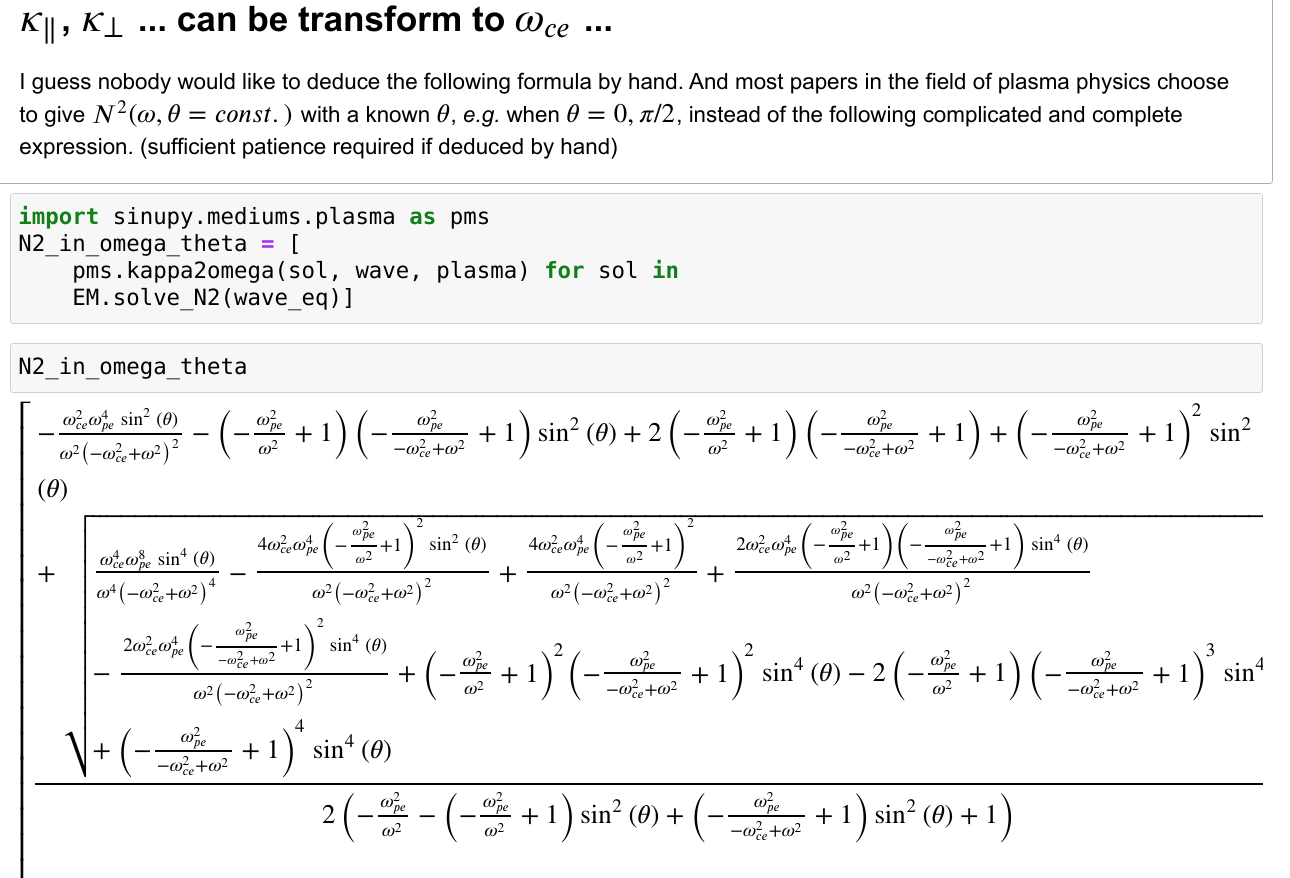
How the refraction index $N$ changes with $\omega$ and $\theta$
$\omega-\vec{k}$ Diagram
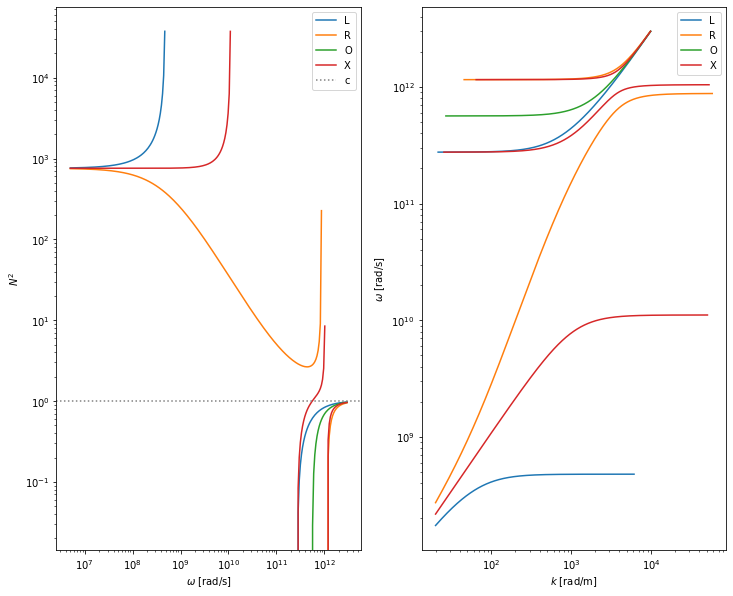
Refer to the sinupy/nb/dispersion_relation.ipynb for more info.
The Famous CMA Diagram in Plasma Physics
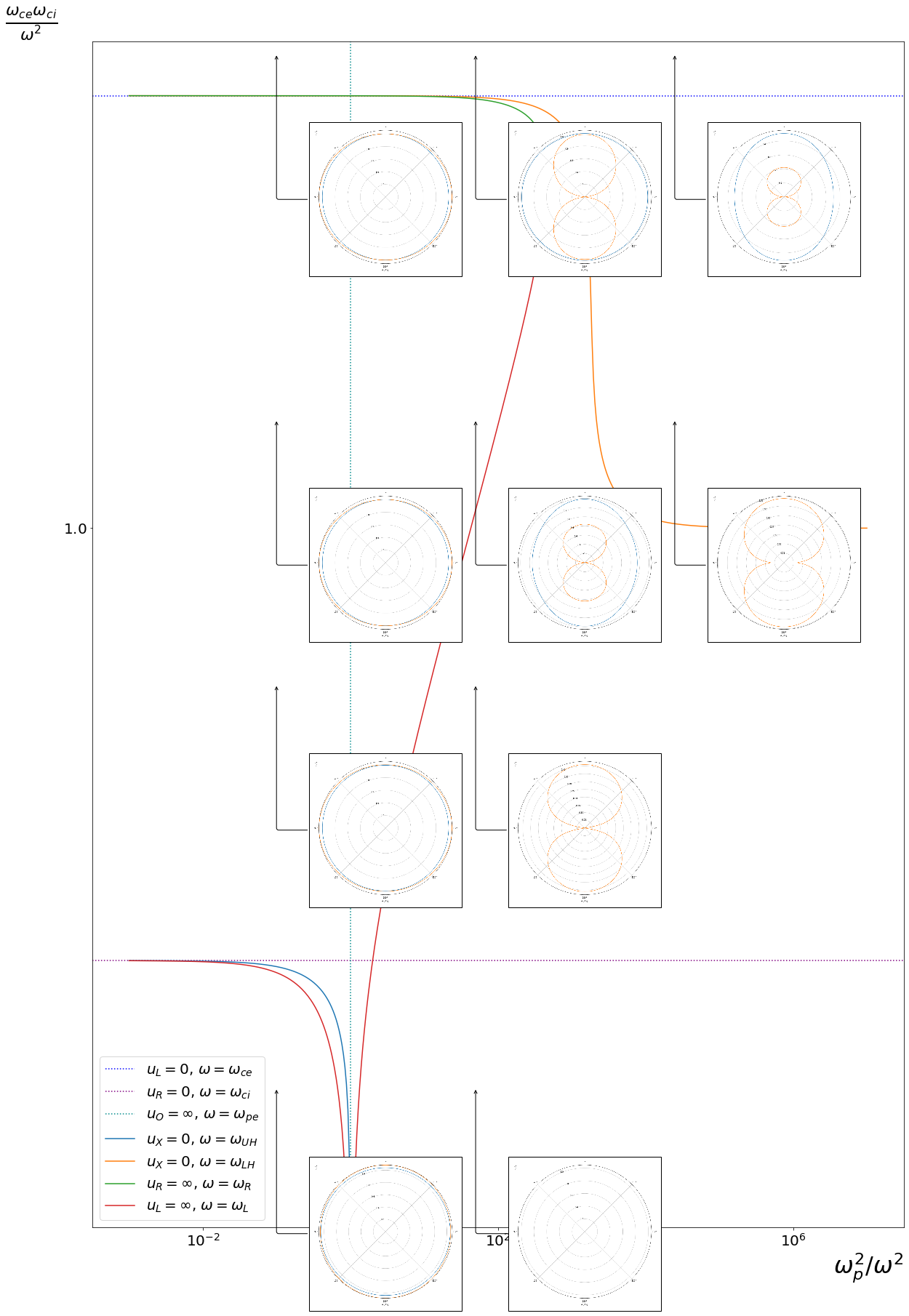
Refer to the sinupy/nb/CMA.ipynb for more info.
Usage Tips
-
Unstable APIs
The APIs are not stable now, please contact Wenyin Wei (wenyin.wei.ww@gmail.com) for face-to-face communication to save your time. Though unstable, they are easy to understand, if the user is familiar with Python enough, he or she can easily recognize the techniques and tricks the package uses.
The jupyter notebooks in the
sinupy/nbfolder are complete and self-contained to allow the newcoming users to understand how the code works. -
Consider the users of this package are scientists who spend a lot of time on the decution of physical formulas, the attributes in any classes in sinupy are intentionally set public without leading underscores
_. -
Sympy Variable Name Crash
The variable name crash is very dangerous in sinupy so we carefully choose our sympy name to avoid they happen to be the same. For example, we do not expect the computer get confused between the static magnetic field attribute
BinMagnetizedPlasmaand the dynamic fieldBinElectroMagneticWave, of which the definitions are as:# ElectroMagneticWave B_x, B_y, B_z = _symbols('B_x_{varidx}, B_y_{varidx}, B_z_{varidx}'.format(varidx=self.varidx), complex=True) self.B = _Array([B_x, B_y, B_z]) # MagnetizedPlasma B_x, B_y, B_z = _symbols('B_x, B_y, B_z') self.B = _Array([B_x, B_y, B_z])
For sinupy,
varidxis a class attribute to help distinguish various physical quantities, which defaults to be a string with nothing ''. Therefore, users do not need to worry, whenvaridxdefaults to be '', about thatB_x_crashes withB_x, because sympy recognize them as different symbols due to the trailing underscore_.For other variables that may coincide, users should be careful when they define their own variables. The probability to name crashes is not that big if the user defines long enough names.
-
What if I really want to replace a pre-existing variable name in sinupy?
In most of cases, the pre-existing variable names would not cause big troubles, because the symbols would not interwine in one formula. However, when the user wants to cancel some pre-existing variables because they occupy some names that are very concise and meaningful, they can choose to inherit the class where the variable attribute is defined and override the constructor. We try to make sinupy as open as posisble to extension and the python inheritance hierarchy helps a lot. Using a custom class generally works well in sinupy.
Goal
- Be a standard formula deduction in sinusoidal analysis.
- Extend to general curvilinear coordinate system with the help of einsteinpy.
- Multi-wave coupling relation and their respective growth rate.
1 maintainer

Metadata
1 maintainer
Release files for sinupy 0.1.1
For a detailed explanation of source distributions (sdists) and built distributions (wheels), please see the package formats documentation.
Source distribution (sdist)
| File | Size | Uploaded | |
|---|---|---|---|
| sinupy-0.1.1.tar.gz | 11.8 kB | Details |
Built distribution (wheel)
| File | Interpreter | ABI | Platform | Reset |
|---|---|---|---|---|
| sinupy-0.1.1-py3-none-any.whl | Python 3 | none | any | Details |
Total release size: 28.7 kB
Release files / sinupy-0.1.1.tar.gz
| Download URL | sinupy-0.1.1.tar.gz |
|---|---|
| Size | 11.8 kB |
| Tags | Source |
|
SHA-256 checksum How to use checksums |
f8ce593846acea604ef360808788f8d429e36a4f28271a316b71509852ded0ef
|
|
BLAKE2b-256 checksum How to use checksums |
2801b6d34ae3f686335820a398d96f3843dd5d1a95bcd212efcd951ffbf282dd
|
| Upload date | |
|
Uploaded using Trusted Publishing? What is trusted publishing? |
No |
| Uploaded via |
twine/3.4.1 importlib_metadata/4.0.1 pkginfo/1.7.0 requests/2.25.1 requests-toolbelt/0.9.1 tqdm/4.60.0 CPython/3.6.9
|
Release files / sinupy-0.1.1-py3-none-any.whl
| Download URL | sinupy-0.1.1-py3-none-any.whl |
|---|---|
| Size | 16.8 kB |
| Tags | Python 3 |
|
SHA-256 checksum How to use checksums |
a06ef1dea049003df78570261431b8593f5a0c9f1be2af9f7d06bc884acb5802
|
|
BLAKE2b-256 checksum How to use checksums |
1ee7d8079ba519748632422e960d871e26fc01ad2f3d1ec6453f5b5e14c69314
|
| Upload date | |
|
Uploaded using Trusted Publishing? What is trusted publishing? |
No |
| Uploaded via |
twine/3.4.1 importlib_metadata/4.0.1 pkginfo/1.7.0 requests/2.25.1 requests-toolbelt/0.9.1 tqdm/4.60.0 CPython/3.6.9
|














