

Site your state, derive the wire.
situ lets a Python developer write a reactive web UI as one component — real HTML on top, Python signals and handlers below — and declare, per piece of state, where it lives. A real Python→JS compiler reads that declaration and emits a small, app-specific client island; the client/server boundary stays explicit and is enforced at compile time. You author no client JavaScript, and you can read every line the compiler ships.
It is for Python developers who want a reactive web UI and would keep the whole app in Python. A hypermedia library (htmx, Datastar) hands you a mechanism — swap HTML on an event, wire the targets yourself; situ gives you a structure for the whole UI layer:
- State has a place. Declare where each signal lives (
Local/Url/Server/Synced) and its transport is derived — a live search, a selection, an open dialog, a database command, a shareable URL — no fetch, target, or SSE wire by hand, and the boundary is compile-checked (a client read ofServerstate is aCompileError). - No client JavaScript, no build step. Real HTML and Python; the compiler emits the
island — no bundler, no
node_modules, no separate front-end to deploy — and you can read every line it ships (a few kilobytes, no framework runtime underneath). - A composition model. Components with props, events, slots, per-placement state, and scoped CSS; the compiler folds a whole tree of them into one island at zero runtime cost.
- A component kit (work in progress).
situ_uiprovides typed, HTML-first widgets — Dialog, Tabs, Combobox, DataGrid, Menu — invoked from your templates, so common UI (a dialog, a searchable select, a data grid) ships with the framework. - A meta-framework on top. For CRUD screens, declui turns a typed model into a form, list, tracker, or create/edit screen — sensible type→widget defaults plus a MetaUI-style rule cascade — no component written at all.
- One component, either framework. Litestar (the reference) or Flask, unchanged; the Litestar imports are lazy, so the Flask path pulls in no Litestar.
situ is a young, alpha library extracted from a research programme; the compiler accepts a bounded dialect of Python and fails closed on anything outside it. See Status and the known limits.
The one idea: site each piece of state
Every signal declares its site, and the transport follows from that — you never write a fetch, a target, or an SSE wire.
| Site | Where it lives | What the compiler derives |
|---|---|---|
Local[T] |
the browser | compiled to JS — zero network |
Url[T] |
the query string | a shareable link the server re-renders |
Server[Facade] |
the database | a POST command that re-renders one region |
Synced[T] |
(reserved) | a local-first replica — design stage |
The boundary is a compile-time invariant: a client read of Server-sited state is a
CompileError, so database-backed state cannot reach the browser by accident.
Install
pip install situ                   # the compiler + the Litestar mount
pip install "situ[flask]"          # + the Flask (WSGI) adapter
pip install "situ[sqlalchemy]"     # + the SQLAlchemy/Dishka session helpers
pip install "situ[model-adapters]" # + attrs/msgspec/pydantic model sources for declui
Requires Python 3.12+.
Sixty seconds of situ
A component is two sibling files sharing a stem, so each gets native editor tooling.
counter.py — the signals and handlers:
from situ import Local

count: Local[int] = 0  # client state — compiled to JS, no network


def bump() -> None:
    global count          # names the local signal this handler writes
    count = count + 1
counter.html — real HTML with shorthand reactive attributes:
<div data-region>
  <button @click="bump">+1</button>
  <strong :text="count"></strong>
</div>
app.py — the controller is one mount call plus the wiring:
from pathlib import Path

import situ
from litestar import Litestar
from litestar.plugins.jinja import JinjaTemplateEngine
from litestar.static_files import create_static_files_router
from litestar.template.config import TemplateConfig
from situ import mount_static_component

HERE = Path(__file__).parent

app = Litestar(
    route_handlers=[
        mount_static_component(
            path="/counter",
            stem=HERE / "counter",       # counter.py + counter.html
            template="page.html",        # situ ships a minimal default
            meta={"name": "Counter"},
        ),
        # serve the runtime shim the generated island loads from /static/_rt.js
        create_static_files_router(path="/static", directories=[situ.static_dir()]),
    ],
    template_config=TemplateConfig(
        directory=situ.templates_dir(), engine=JinjaTemplateEngine
    ),
)
litestar --app app:app run # then open http://localhost:8000/counter
Two rules the runtime enforces: every reactive element lives inside <header> or the single <div data-region> (the two roots where binders are wired), and data-region is the first attribute on that <div>.
When state needs the database
Declare the site, and the seam follows:
search: Local[str] = ""       # live search — compiled to JS, zero network
filter: Url[str] = "all"      # a shareable link the server re-renders
issues: Server[IssuesFacade]  # the store: a facade in handlers, rows in the template


async def close(id):          # `await` makes this a server command:
    await issues.set_status(id, "closed")   # → POST /cmd/close/{id} → region re-render
A handler containing await becomes a POST command; every other handler compiles to
client JS. The Server components guide walks the wiring, and the tutorial builds a complete issue tracker this way in six parts — live search, filters, selection, commands, a create dialog — with zero hand-written JavaScript and a generated island of ~7 KB.
Or generate the UI from a model: declui
For CRUD-shaped screens, skip the component too. declui turns a typed model into a working form, list, master-detail, server-backed tracker, or create/edit form — at compile time, onto the same seam:
@dataclass
class Sample:
    title: str                                              # str  → text input
    shirt: Annotated[Shirt, Field()] = Shirt.medium         # Enum → <select>
    price: Annotated[Decimal, Field()] = Decimal("10.50")   # Decimal → decimal input
    need_by: Annotated[date | None, Field()] = None         # date → date picker

app = Litestar(route_handlers=[mount_model(path="/sample", screen=Screen(model=Sample)), ...])
Conditional predicates (editable="rating > 50") compile to client binders; @action
methods become gated command buttons that can carry a label and navigate on success;
screens=("create",) / ("edit",) generate write forms whose submit calls the facade
(facade.create(**fields)), gated by required= / valid=; and Screen(rules=...) —
the MetaUI app sheet — sets presentation by selector across fields and per screen. Models
may be dataclasses, attrs, msgspec, Pydantic, or SQLAlchemy. In the capstone example, an
8-line Screen stands in for the 311 lines of hand-written components in the equivalent
demo.
declui documentation →
Litestar or Flask
The mount has a portable core (situ.mount.core — dispatch, render, the
command/region/feed/window protocol, no framework imported) with thin adapters over it:
- Litestar (the reference):
mount_component/mount_static_component/mount_tree, with per-request DI via Dishka. - Flask (WSGI):
situ.mount.flask.mount_flaskreturns an ordinaryBlueprint; a plainresolve=lambda: storecallable replaces the DI container, and the request path imports zero Litestar. Seeexamples/flask/.
Documentation
Full documentation lives in docs/ (a Zensical site —
make docs-serve to browse it locally at http://localhost:8000):
- Quickstart — the counter, explained.
- Tutorial — build an issue tracker in six parts; every listing compiles and is browser-verified.
- Concepts — sites & the seam, handlers & commands, the compiled dialect, composition, the wire protocol.
- Cheat sheet — the whole authoring surface on one page; plus the full binder, API, and error references.
- situ vs. … — React, Vue, Svelte, htmx, Datastar, LiveView, Eliom and the research lineage.
- For AI coding assistants:
llms.txt(index) andllms-full.txt— a single-file, self-contained reference with verified samples and the rules an agent must follow.
Demos & examples
Everything documented runs, and everything that runs is browser-verified (the e2e suite fails on any console error):
uv run litestar --app demos.app:app run       # 17 demos behind one gallery
uv run uvicorn examples.declui.app:app        # the declui example tour (create/edit, rules, …)
uv run --with flask flask --app examples/flask/app.py run   # the Flask adapter
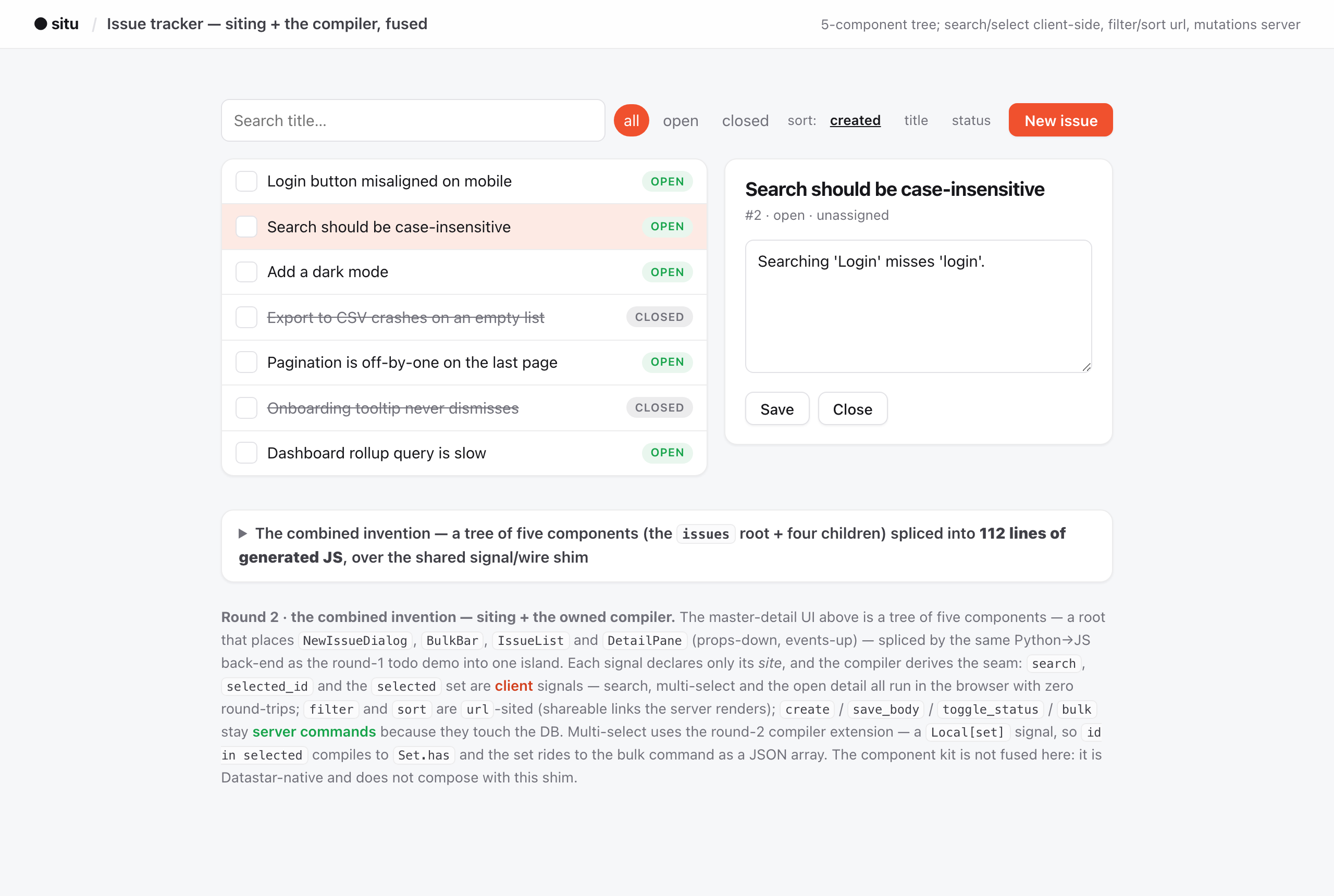
The flagship (/issues, above) is a five-component master-detail tracker whose entire
client is a 117-line generated island; across all thirty shipped apps the islands
measure 6–13 KB over a ~540-line shared shim. Each demo page shows its own source, its
signal→transport table, and the island it serves.
What's in the box
situ.compiler— the Python→JS compiler (parse_front_end,load_front_end,compile_app,splice_tree) and the site markers. Pure standard library.situ.mount— the framework-neutral mount core plus the Litestar route factories and the FlaskBlueprintadapter. Litestar bindings load lazily.situ.declui— the model→UI generator (Field,Screen,Rule,zones,action,mount_model) — forms, lists, trackers, create/edit write forms, and the rule cascade.situ_ui— a component kit: 24 components (Dialog, Combobox, DataGrid, Menu, …), aui-*CSS class contract, interactions compiled from Python.situ.siting— theSignal/Signals/Sitecontract;situ.infra— Jinja string rendering and, behind[sqlalchemy], an async engine + Dishka session provider.python -m situ.check— static component-tree resolution for your lint loop.
Status
Alpha. The compiler accepts a bounded dialect of Python and rejects the rest with a clear error; it does not relocate database I/O to the client.
The dialect is specified as a table of typing rules, and every rule is checked against
CPython — situ runs a differential oracle that generates expressions over operand type pairs,
evaluates them in CPython and in node, and compares. A construct with no rule cannot be
emitted at all, and the lowerer has no guards, because an ill-typed program cannot reach it.
The oracle found 1323 divergences in a compiler that passed its whole test suite; the
disagreement baseline is now empty — across every expression it generates, as a value and
as a condition, situ agrees with CPython or refuses to compile. Knowing the types also lets the
compiler accept more: k in d, xs[-1], 'ab' * 3 and n % m were all rejected by the
untyped emitter and are now correct. Synced is a reserved site — the
design names it, and the implementation is future work. Dishka is required only by the
Litestar mount_component; the Flask adapter takes a plain callable. The full list of
limits is in Status & roadmap.
License
Apache 2.0 © Stefane Fermigie & Abilian SAS
1 maintainer

Download files
Download the file for your platform. If you're not sure which to choose, learn more about installing packages.
Source Distribution
Built Distribution
Filter files by name, interpreter, ABI, and platform.
If you're not sure about the file name format, learn more about wheel file names.
Copy a direct link to the current filters
File details
Details for the file situ-0.3.2.tar.gz.
File metadata
- Download URL: situ-0.3.2.tar.gz
- Upload date:
- Size: 270.1 kB
- Tags: Source
- Uploaded using Trusted Publishing? No
- Uploaded via:
uv/0.11.16 {"installer":{"name":"uv","version":"0.11.16","subcommand":["publish"]},"python":null,"implementation":{"name":null,"version":null},"distro":{"name":"macOS","version":null,"id":null,"libc":null},"system":{"name":null,"release":null},"cpu":null,"openssl_version":null,"setuptools_version":null,"rustc_version":null,"ci":null}
File hashes
| Algorithm | Hash digest | |
|---|---|---|
| SHA256 |
219e6e5e5290b88e498cfd8202dcbe9174bb868aca29736237114b1074773560
|
|
| MD5 |
89b11dfed301493b10ad061e3aa28562
|
|
| BLAKE2b-256 |
2afa6d71e6b39bf93e9f85cc8ee2864efe449b7a8ece12e4ce4a9ed53f42483c
|
File details
Details for the file situ-0.3.2-py3-none-any.whl.
File metadata
- Download URL: situ-0.3.2-py3-none-any.whl
- Upload date:
- Size: 320.4 kB
- Tags: Python 3
- Uploaded using Trusted Publishing? No
- Uploaded via:
uv/0.11.16 {"installer":{"name":"uv","version":"0.11.16","subcommand":["publish"]},"python":null,"implementation":{"name":null,"version":null},"distro":{"name":"macOS","version":null,"id":null,"libc":null},"system":{"name":null,"release":null},"cpu":null,"openssl_version":null,"setuptools_version":null,"rustc_version":null,"ci":null}
File hashes
| Algorithm | Hash digest | |
|---|---|---|
| SHA256 |
1da26ea0068b66594c7289b49cc8772dc27844ef3496f6de30a9b846195e9881
|
|
| MD5 |
14135f000a47e76f37a61f43d3610919
|
|
| BLAKE2b-256 |
8bdeba73ebfd245e768108ef87585624802a37b8572bb5b4539ae43ecbeef7ff
|







