

Evaluate and improve AI agent skills and plugins: quality, security, overlap, compatibility, and real impact across agents









📺 Livestream: Ask the Experts: Evaluating Agent Skills
SkillEvaluator checks AI agent skills and plugins, and measures a skill's effect on task results: start with quality checks, then compare runs with and without a skill.
Catch skill issues before merge. Connect your repository to SkillEvaluator with a CI template for automated quality and security gates, without building or maintaining evaluation code.
Agent skills are folders of instructions and supporting files defined by the Agent Skills specification. SkillEvaluator is part of the NVIDIA Verified Skills pipeline.
Get started
Install the CLI in a Python 3.12–3.14 environment:
pip install skillevaluator
Or use uv
uv tool install --python 3.13 skillevaluator
For uv setup or direct GitHub source installation, see Installation.
Then check skills from your terminal, CI, or agent:
|
Run checks backed by 500+ static rules and detection patterns, without an LLM key. Complete scanner setup for full coverage: skillevaluator validate \
./my-skill --tiers 1
Run all three tiersAfter all-tier setup with NVIDIA Build,
remove skillevaluator validate \
./my-skill
|
Check every skill change. Run in your GitHub repo to open a setup PR: skillevaluator ci init
Start here: Guided setup for GitHub and GitLab. |
Add the skill to Claude Code, Codex or another agent: npx skills add \
NVIDIA/SkillEvaluator
Then ask: "Is my skill any good?" See the agent guide. |

⚡ Harness check: will your agent load your skill?
🔑 No API key · 🤖 No agent run
skillevaluator harness-check ./my-skill
Illustrative summary of versioned profiles. Full output can include notes and schema diagnostics.
╭─ Harness compatibility · my-skill ──────────────────────────────────────────────────────╮
│  ⚠️ codex        degraded    Description cut to 1,021 chars + '...' in the skill list   │
│  ❌ claude-code  not loaded  .agents/skills is not scanned                              │
│  ✅ opencode     loads                                                                  │
│  ✅ hermes       loads                                                                  │
│  ✅ openclaw     loads                                                                  │
│  ❌ copilot-cli  not loaded  description is 1,028 UTF-16 units, 4 over the 1,024 limit  │
╰────────────────────────────────────────────────────────────────── ❌ 2 of 6 not loaded ─╯
skillevaluator validate includes Harness Check in Tier 1 alongside quality,
schema, version, PII, license, Unicode and script linting. Security and code
integrity checks use SkillSpector, Gitleaks, Bandit and optional Semgrep.
See all Tier 1 checks;
use --tiers 1 to run only this tier.
🧪 Ready to go deeper? Try a live agent evaluation (Tier 3).
Quickstart
Check your skill without a key
skillevaluator quality-check ./my-skill
No API key, scanner, GPU or Docker is needed. It prints a score out of 100 with a
grade and the findings behind it; the passing threshold defaults to 70. This is
static quality only; publication evidence stays INCOMPLETE. Security and agent impact need additional checks. See the
keyless walkthrough.
No skill yet? Clone the repository and use the bundled
src/skillevaluator/tier3/reference_skills/text-analyzer. Scores can differ by release.
Run all three tiers with a free NVIDIA Build key
Eligible NVIDIA Developer Program members can use NVIDIA-hosted endpoints for free prototyping, subject to access terms and rate limits.
- Sign in at build.nvidia.com and complete enrollment.
- Open a model page, select Get API Key, and generate your key.
- Complete scanner setup, start Docker, and prepare a reviewed dataset. Install every tier, set the provider and key, then validate:
python -m pip install "skillevaluator[all]"
export SKILL_EVAL_LLM_PROVIDER=nv_build
export NVIDIA_API_KEY='nvapi-...'
skillevaluator validate ./my-skill
Without --tiers, validate runs all three. The key covers embeddings and chat
in Tier 2 and supported agents in Tier 3; add --llm for model checks in Tier 1.
For uv or GitHub installations, use the matching all-tier install instead of the pip command above. Tier 3 also
needs Docker running; add --tiers 1,2 to skip it. More in
Run the combined pipeline, the
Build walkthrough and provider configuration.
Bring skill evaluation to your repository
Start here: Repository integration guide, install to first passing check on GitHub or GitLab. Below is the summary.
Minimal setup. No evaluation code to write or maintain. Choose your skill folders and thresholds to get automated validation, security scanning and downloadable reports for changed skills in GitHub or GitLab.
11 CI checks backed by 500+ static rules and detection patterns:
quality, schema, version, PII, license, Unicode, script linting,
Harness Check,
security, code integrity and dependency auditing.
Scanners: SkillSpector,
Gitleaks, Bandit and Semgrep,
and pip-audit.
GitHub guided setup: after installing the CLI, run inside your checked-out repository:
skillevaluator ci init
Choose checks and optional hosted feedback, then review the setup PR. CLI setup guide.
Manual setup (no CLI): copy a filled-in template from CI templates.
| Your repository | Ready-to-use template | Copy destination |
|---|---|---|
| GitHub | Skill checks | .github/workflows/skill-checks.yml |
| GitLab | Skill checks | .gitlab-ci.yml, or merge into your existing pipeline |
| GitHub PR comments without hosting | Optional comments | Second workflow; complete comment setup |
| GitHub hosted reports and PR comments | Optional publisher | Second workflow; complete publisher setup |
Pick one optional feedback workflow. These run Tier 1 checks without a model key; all-tier CI setup adds deduplication and live agent evaluation.
Also: template reference and report examples.
Three-tier overview
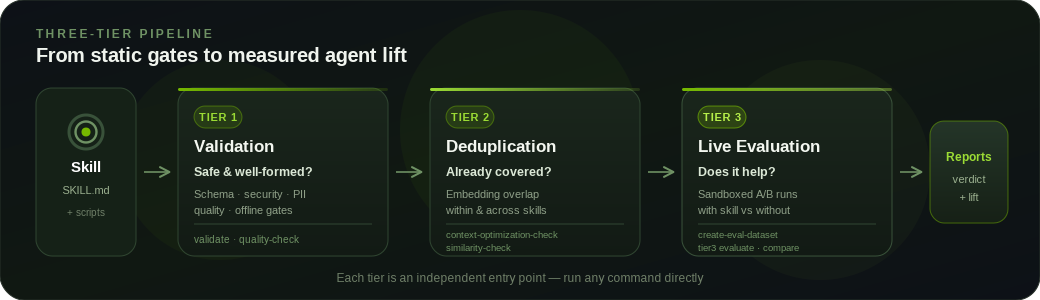
Each tier is independent. Use the all-tier installation for all three:
| Tier | Question | Example after setup | Additional setup |
|---|---|---|---|
| Tier 1: Validation | Is the skill safe, well-formed and harness-compatible? | skillevaluator tier1 ./my-skill --no-llm |
External scanners for full static coverage; a provider and model clients enable LLM checks |
| Tier 1: Harness Check | Will the agent load the skill? | skillevaluator harness-check ./my-skill |
No API key or agent run |
| Tier 2: Deduplication | Does guidance repeat or overlap? | skillevaluator tier2 ./my-skill |
Embeddings and chat; add --catalog ./skill-catalog.json for inter-skill comparison |
| Tier 3: Live Agent Evaluation | Does the skill help the agent? | skillevaluator tier3 ./my-skill |
Provider access, a supported agent, and a running sandbox (Docker by default) |
Prepare scanners for your installed release; Semgrep is optional.
--no-llm does not remove scanner requirements; a scanner that cannot run is
INCOMPLETE and exits nonzero.
SkillSpector provides specialized skill
security scanning; Harbor, the
open-source agent evaluation framework, powers sandboxed agent runs.
Tier 2 reports when inter-skill comparison did not run. Tier 3 autopilot reuses sources or creates one skill-grounded case with limited coverage. See tier guides.
Run the combined pipeline
After setting up the provider, scanners, and agent sandbox, run all three tiers:
skillevaluator doctor --env-mode docker
skillevaluator validate ./my-skill
doctor checks readiness, not inference success. validate runs all tiers with
autopilot for skills. Use --tiers 1,2 to skip live evaluation or --tiers 1 for
static checks. --no-autopilot requires an existing source. Other artifact types
retain their applicable stages.
Tier 1 gates validate. Tier 2 gates unless --no-block-on-dedup is set;
Tier 3 gates only with --block-on-agent-eval. Model and managed-sandbox usage
can incur charges; see runtime and cost.
Standalone generation needs substantive evals/EVAL.md guidance, a --prompt
file with task requests and outcomes, or matching retained traces. --force
below replaces the autopilot starter; --refine refines it. Explicit
--grounding skill permits skill-only starters. Review cases; templates omit
unauthored negatives.
skillevaluator tier3 create-eval-dataset ./my-skill --full --prompt eval-guidance.md --force
Run from a source checkout
For an editable environment, follow the development setup.
Research and citation
Resources: paper, PDF, DOI, BibTeX, and NVIDIA Developer blog. Cite the paper and record the SkillEvaluator release or commit; see CITATION.cff.
Documentation
See the documentation for setup, tier guides, reports, CI integration, CLI reference, and performance dashboard.
Installation and third-party software
This project will download and install additional third-party open source software projects. Review the license terms of these open source projects before use.
Contributing
Read CONTRIBUTING.md and run:
make lint && make test && make build
See project governance and Code of Conduct.
Support
Support level: Experimental. Community-supported, best-effort, with no SLA or NVIDIA enterprise support entitlement. Report bugs and feature requests through GitHub Issues; see SUPPORT.md.
Security
Report suspected vulnerabilities using the private process in SECURITY.md. Do not disclose security issues in a public GitHub issue.
Releases
See CHANGELOG.md and GitHub Releases.
License
Apache License 2.0: see LICENSE, NOTICE, and THIRD_PARTY_NOTICES.md.
Copyright (c) 2026 NVIDIA CORPORATION & AFFILIATES. All rights reserved.
1 maintainer

Metadata
1 maintainer
Release files for skillevaluator 1.2.1
For a detailed explanation of source distributions (sdists) and built distributions (wheels), please see the package formats documentation.
Source distribution (sdist)
| File | Size | Uploaded | Provenance | Actions |
|---|---|---|---|---|
| skillevaluator-1.2.1.tar.gz | 3.6 MB | Without provenance | Details for skillevaluator-1.2.1.tar.gz |
Built distribution (wheel)
| File | Interpreter | ABI | Platform | Actions Reset |
|---|---|---|---|---|
| skillevaluator-1.2.1-py3-none-any.whl | Python 3 | none | any | Details for skillevaluator-1.2.1-py3-none-any.whl |
Total release size: 6.6 MB
Release files / skillevaluator-1.2.1.tar.gz
| Download URL | skillevaluator-1.2.1.tar.gz |
|---|---|
| Size | 3.6 MB |
| Tags | Source |
|
SHA-256 checksum How to use checksums |
91995da67ee769d2d5dfcf88153328f2dd509affb217fd7685eb015cb258e38b
|
|
BLAKE2b-256 checksum How to use checksums |
3a6b6110b688150b49166de6ab335f586587193e51f773258aff8ed5e399e099
|
| Upload date | |
|
Uploaded using Trusted Publishing? What is trusted publishing? |
No |
| Uploaded via |
twine/7.0.0 CPython/3.14.8
|
Release files / skillevaluator-1.2.1-py3-none-any.whl
| Download URL | skillevaluator-1.2.1-py3-none-any.whl |
|---|---|
| Size | 2.9 MB |
| Tags | Python 3 |
|
SHA-256 checksum How to use checksums |
cfdd052adbcab802151017b3a283cbdeda33f80a71472ba193c8c1ffccc9cb9b
|
|
BLAKE2b-256 checksum How to use checksums |
6c85a997485438ff09f5b1f5ddc2c225f01c7144004be806772db17301d443d9
|
| Upload date | |
|
Uploaded using Trusted Publishing? What is trusted publishing? |
No |
| Uploaded via |
twine/7.0.0 CPython/3.14.8
|
Security for skillevaluator 1.2.1
Provenance
Provenance describes where a file came from. On PyPI, provenance is shared via attestations, which provide a verifiable record of the build or publishing details. View details, limitations and caveats.
No provenance found
None of the files in this release were uploaded with provenance metadata.
A note on package security
PyPI is a repository for distributing packages, not a service for auditing them. While third-party security researchers and our staff do their best to detect and remove malicious packages, PyPI cannot guarantee the quality, security or suitability of any given package.
To learn more about protecting yourself from malicious actors, visit our package security documentation.














