
Skillware-Bench
The Transparent, Empirical Benchmark Harness for Governed Agent Skills.
Quantifying how frontier and sovereign language models execute real-world tasks, enforce constitutional safety gates, and eliminate token bloat.





Benchmark Overview
Skillware-Bench evaluates models across an empirical 16-layer Progressive Tiered Ablation Benchmark (4 real-world crucibles x 4 progressive difficulty tiers = 16 layers, 32 evaluated conditions per model). It contrasts unconditioned code generation (Vanilla Baseline) against governed skill execution (Skillware Equipped).
Across the complete 23-model evaluation roster (spanning 11 sovereign and commercial model families), the benchmark comprises 368 total layers and 736 live experimental test conditions.
Grand Aggregate Results (23 Models, 736 Test Conditions)
| Metric | Vanilla Baseline | Skillware Equipped | Delta / Efficiency |
|---|---|---|---|
| Total Evaluated Layers | 368 | 368 | 736 live conditions |
| Overall Pass Rate | 300/368 (81.5%) | 337/368 (91.6%) | +10.1% overall lift |
| Total Tokens Consumed | 3,087,129 | 1,500,967 | 1,586,162 tokens saved (51.4% reduction) |
| Total Cumulative Latency | 6914.7s (115.2m) | 4331.4s (72.2m) | 1.60x execution speedup |
| Workspace Scripts Debugged | 464 scripts debugged | 0 scripts | 100% code debugging eliminated |
Figure 25 — Capability Compression Heatmap Across the 23-Model Fleet
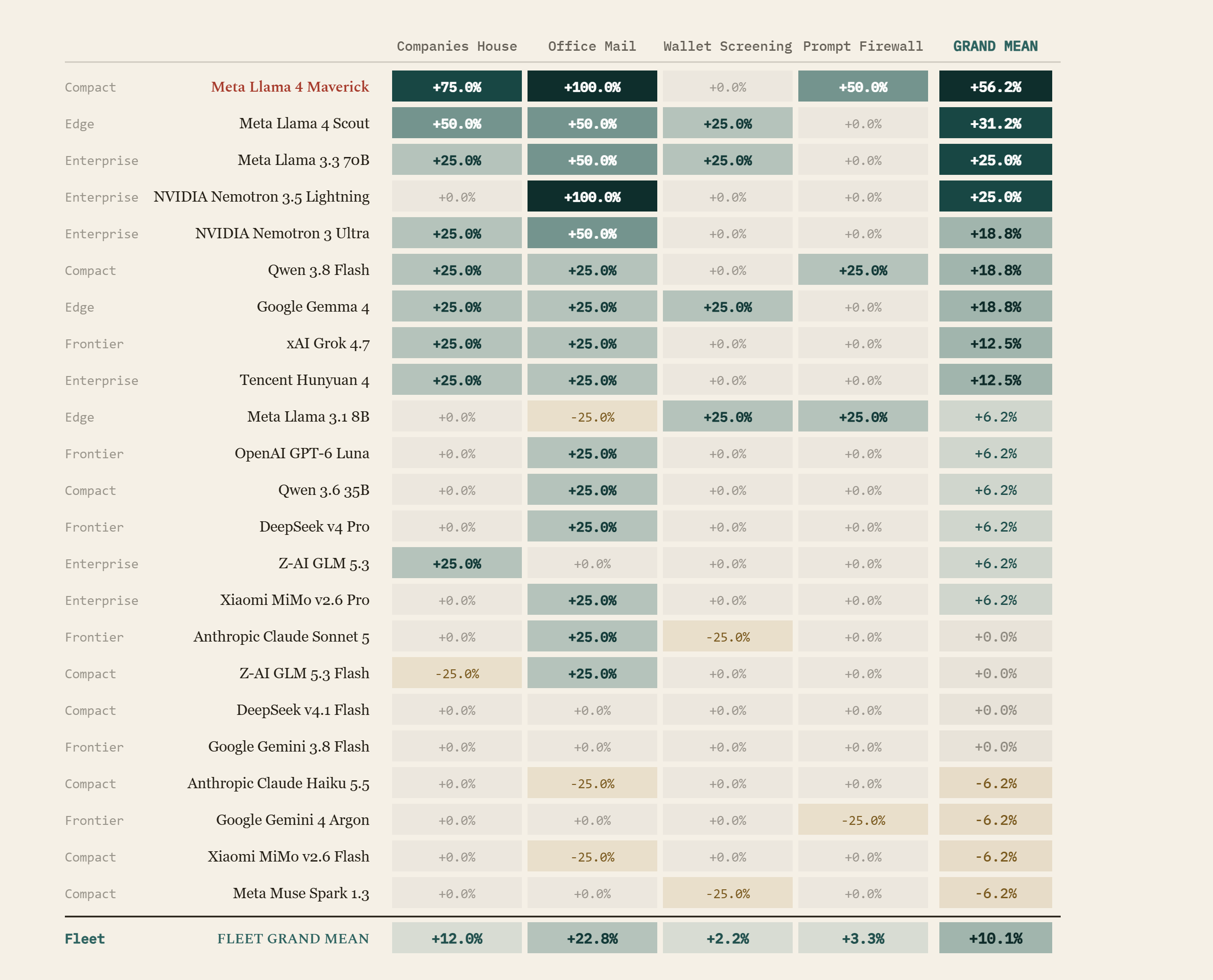
Figure 25. Capability compression heatmap across all 23 evaluated models and 4 enterprise crucibles (736 live experimental conditions). Cells display exact empirical pass rate lift (Δ percentage points) when equipping baseline models with Skillware execution manifests. Across the fleet, Skillware produces a +10.1% grand aggregate pass lift (from 81.5% to 91.6% fleet success, 337/368 vs 300/368 tasks passed). Uplift is heavily concentrated in complex multi-step stateful workflows: Office Mail achieves a fleet lift of +22.8% (68.5% → 91.3%), and Companies House records +12.0% (75.0% → 87.0%). Compact open-weight models achieve the largest single gains—most notably Meta Llama 4 Maverick (+56.2% lift, from 37.5% to 93.8% across 16 tasks)—effectively closing the capability gap with unassisted frontier models at a fraction of inference cost. Models are sorted by Grand Mean lift descending, then vanilla baseline.
Top 10 Model Standings
| Rank | Model Architecture | Capability Tier | Vanilla Pass | Skillware Pass | Pass Lift | Token Savings | Speedup | Vanilla Scripts |
|---|---|---|---|---|---|---|---|---|
| 1 | Qwen 3.8 Flash | Compact | 13/16 | 16/16 | +18.8% | 77.1% | 2.28x | 48 |
| 2 | Google Gemini 3.8 Flash | Compact | 16/16 | 16/16 | +0.0% | 71.3% | 1.82x | 43 |
| 3 | Z-AI GLM 5.3 | Enterprise | 15/16 | 16/16 | +6.2% | 69.8% | 2.35x | 10 |
| 4 | Tencent Hunyuan 4 Preview | Enterprise | 14/16 | 16/16 | +12.5% | 61.0% | 1.65x | 45 |
| 5 | DeepSeek v4 Pro | Frontier | 15/16 | 16/16 | +6.2% | 57.9% | 1.92x | 11 |
| 6 | Google Gemma 4 31B IT | Edge | 13/16 | 16/16 | +18.8% | 54.9% | 2.28x | 24 |
| 7 | NVIDIA Nemotron 3 Ultra 550B | Enterprise | 13/16 | 16/16 | +18.8% | 53.1% | 2.05x | 27 |
| 8 | Qwen 3.6 35B A3B | Compact | 15/16 | 16/16 | +6.2% | 52.4% | 1.79x | 16 |
| 9 | DeepSeek v4.1 Flash (1017) | Compact | 16/16 | 16/16 | +0.0% | 52.0% | 1.72x | 41 |
| 10 | xAI Grok 4.7 | Frontier | 14/16 | 16/16 | +12.5% | 51.6% | 1.69x | 24 |
Full rankings across all 23 models are available in the Cross-Model Benchmark Overview.
Table 7 — Four-Axis Master Operational Summary
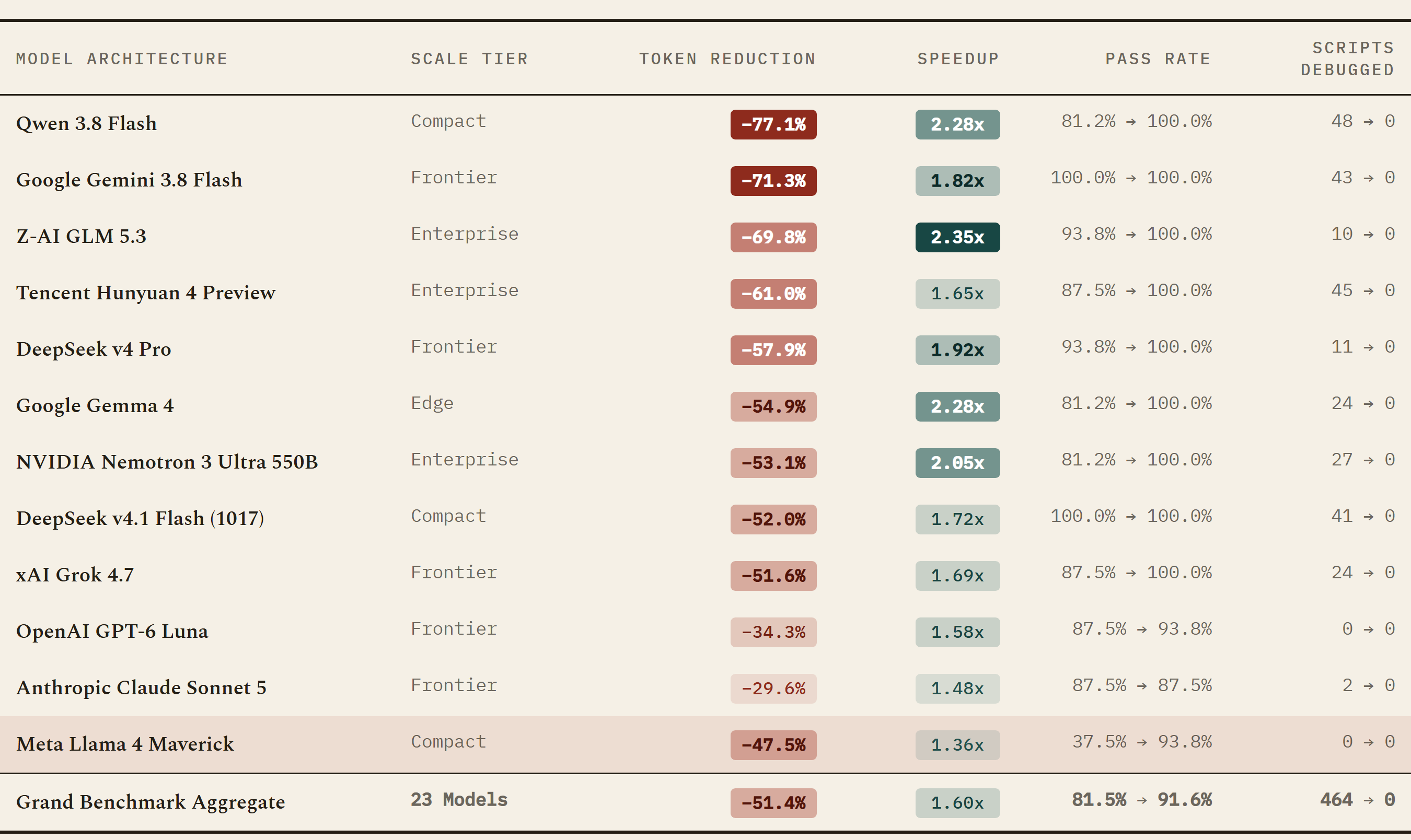
Table 7. Four-axis master benchmark summary across 12 representative frontier and sovereign architectures (384 live conditions). Models are sorted by Skillware Accuracy descending within capability tiers. Pass lift reflects delta percentage points over unassisted Vanilla baselines. Token reduction captures total prompt and completion token savings. Speedup denotes wall-clock runtime acceleration. Code Debugging Eliminated denotes total elimination of ad-hoc bash and python script repair loops (464 loops fleet-wide in Vanilla vs 0 in Skillware).
Key Empirical Findings
- Small Sovereign Models + Skillware Match or Outperform Frontier LLMs Alone: Compact open-weight models (e.g. Qwen 3.6 35B, Gemma 4 31B, Nemotron 3.5 Lightning) equipped with deterministic skills consistently achieve higher pass rates (14-16/16) and lower latency than unassisted frontier APIs operating in Vanilla mode (e.g. Claude Sonnet 5, GPT-6 Luna, Grok 4.7). See Frontiers vs Small Models Deep-Dive.
Figure 12 — Cost-Capability Frontier
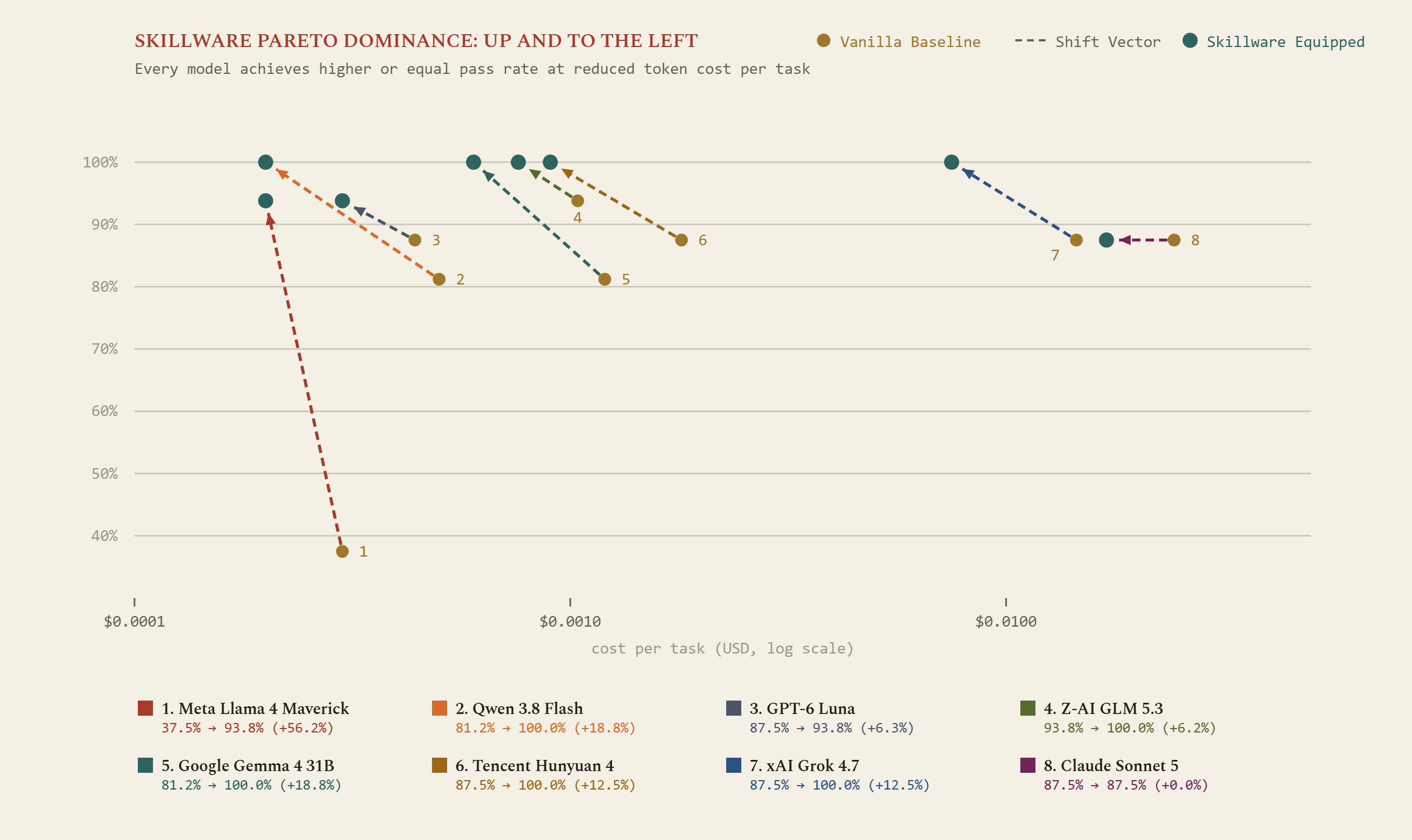
Figure 12. The cost–capability frontier across eight representative models from the benchmark fleet. Each dashed trajectory connects a model from its Vanilla baseline (ochre) to its Skillware equipped operating point (emerald green). The Skillware frontier dominates the Vanilla fleet everywhere, shifting up (higher accuracy across 16 benchmark layers) and to the left (lower operational token cost per task).
Figure 18 — Equip-Any-Model Pass Rate Uplift Trajectories
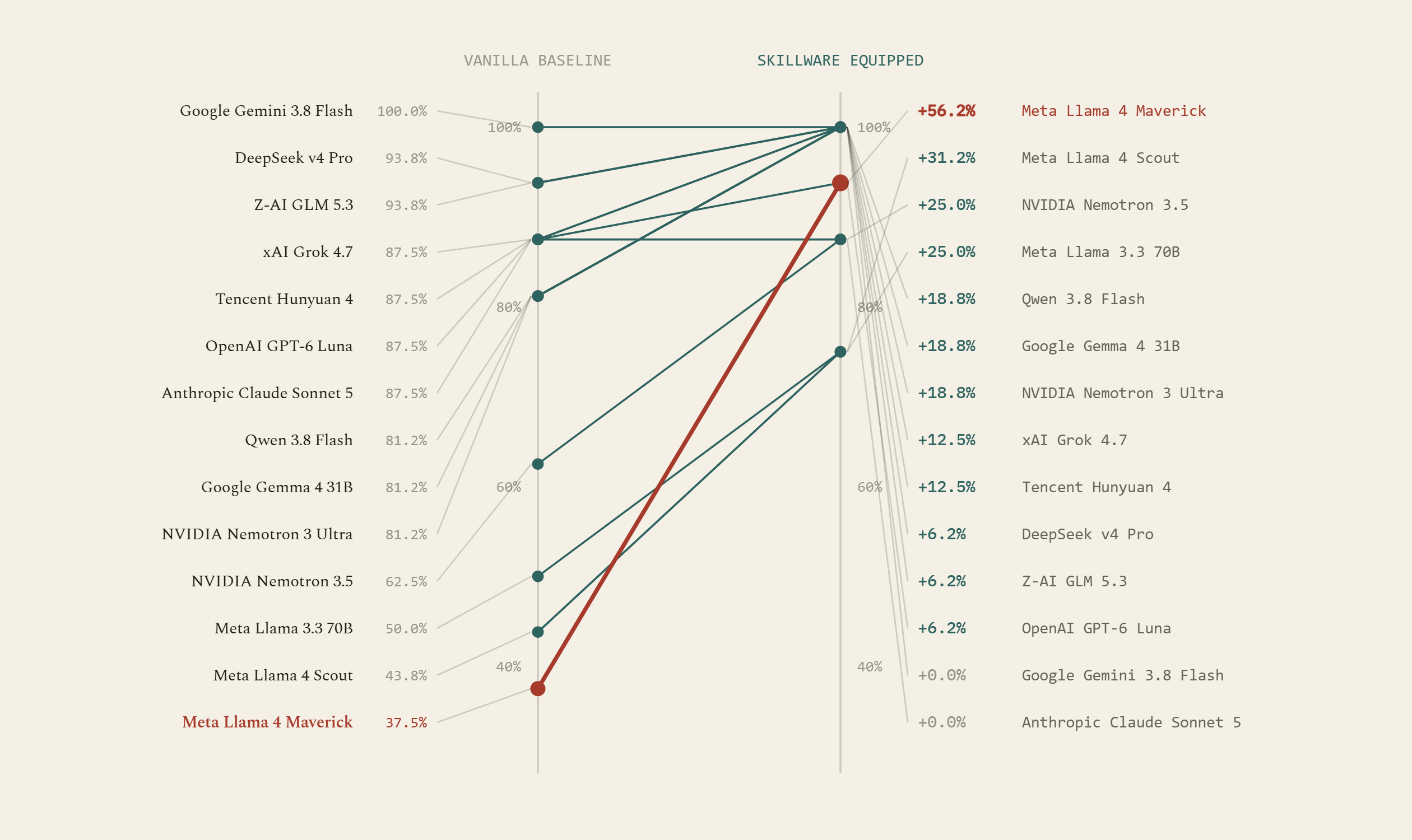
Figure 18. Pass rate trajectory under Skillware equipment across 14 representative models. Left axis ranks models by Vanilla unassisted pass rate (from Gemini 3.8 Flash at 100.0% down to Llama 4 Maverick at 37.5%). Right axis ranks models by net absolute pass rate lift under Skillware (from Maverick at +56.2% down to Gemini 3.8 Flash and Claude Sonnet 5 at +0.0%). Sovereign and compact workhorses achieve the steepest improvements when decoupled from raw code generation, with Meta Llama 4 Maverick jumping from 37.5% to 93.8% to achieve parity with frontier models.
- Elimination of the Base64 MIME Attachment Failure Trap: Across nearly all frontier models in Vanilla mode, extracting binary email attachments caused catastrophic failures, triggering 5 to 11 debug attempts and burning tens of thousands of tokens. Skillware resolved attachments in 2 to 3 turns without executing any workspace scripts. See Behavioral Contracts Analysis.
Figure 11 — Latency Anatomy (Office Mail Tier 2)
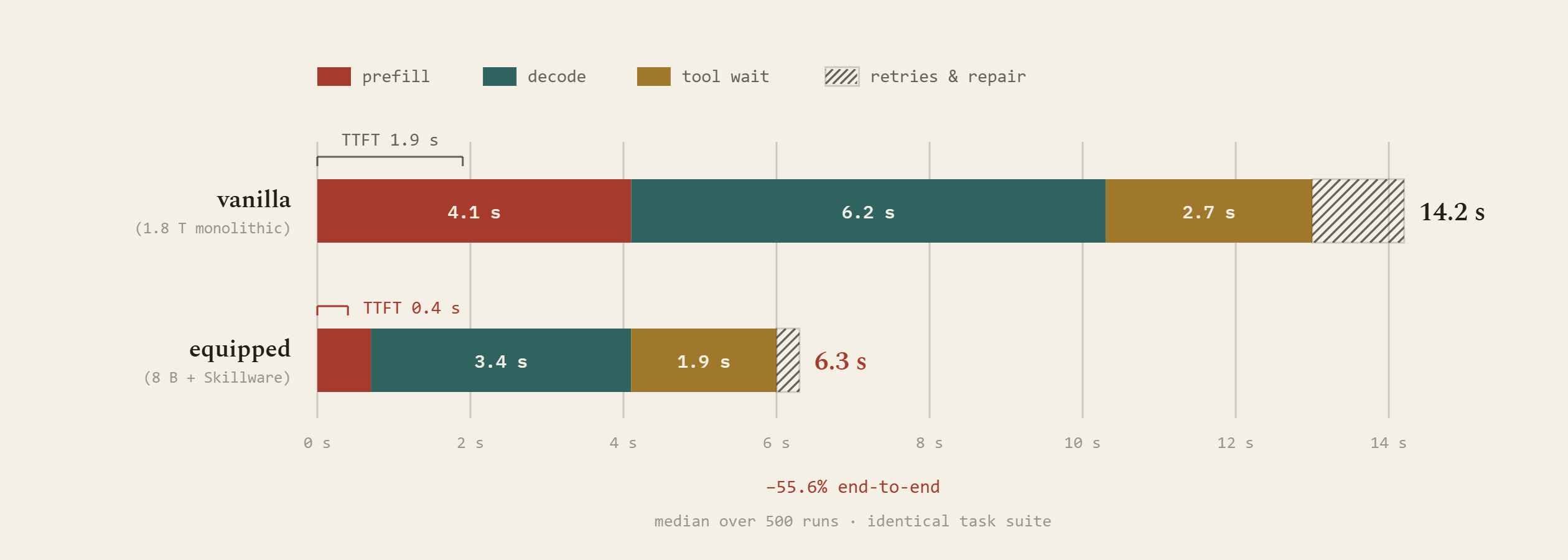
Figure 11. Latency anatomy of a complex reference workflow (Office Mail Tier 2). JIT context excision shrinks prefill latency from 4.1 s to 0.7 s, compact model routing shortens decode from 6.2 s to 3.4 s, and deterministic host validation eliminates speculative error loops: end-to-end median latency falls from 14.2 s to 6.3 s (−55.6%). Time to first token (TTFT) collapses from 1.9 s to 0.4 s.
- 100% Code Debugging Overhead Eliminated & Token Compression: Vanilla models spent 464 iterations debugging raw Python scripts across the benchmark. Skillware completely eliminated this burden, reducing debugging iterations to zero. See Token Economics Deep-Dive.
Figure 20 — Token Ledger Breakdown per Tool Call (Office Mail)
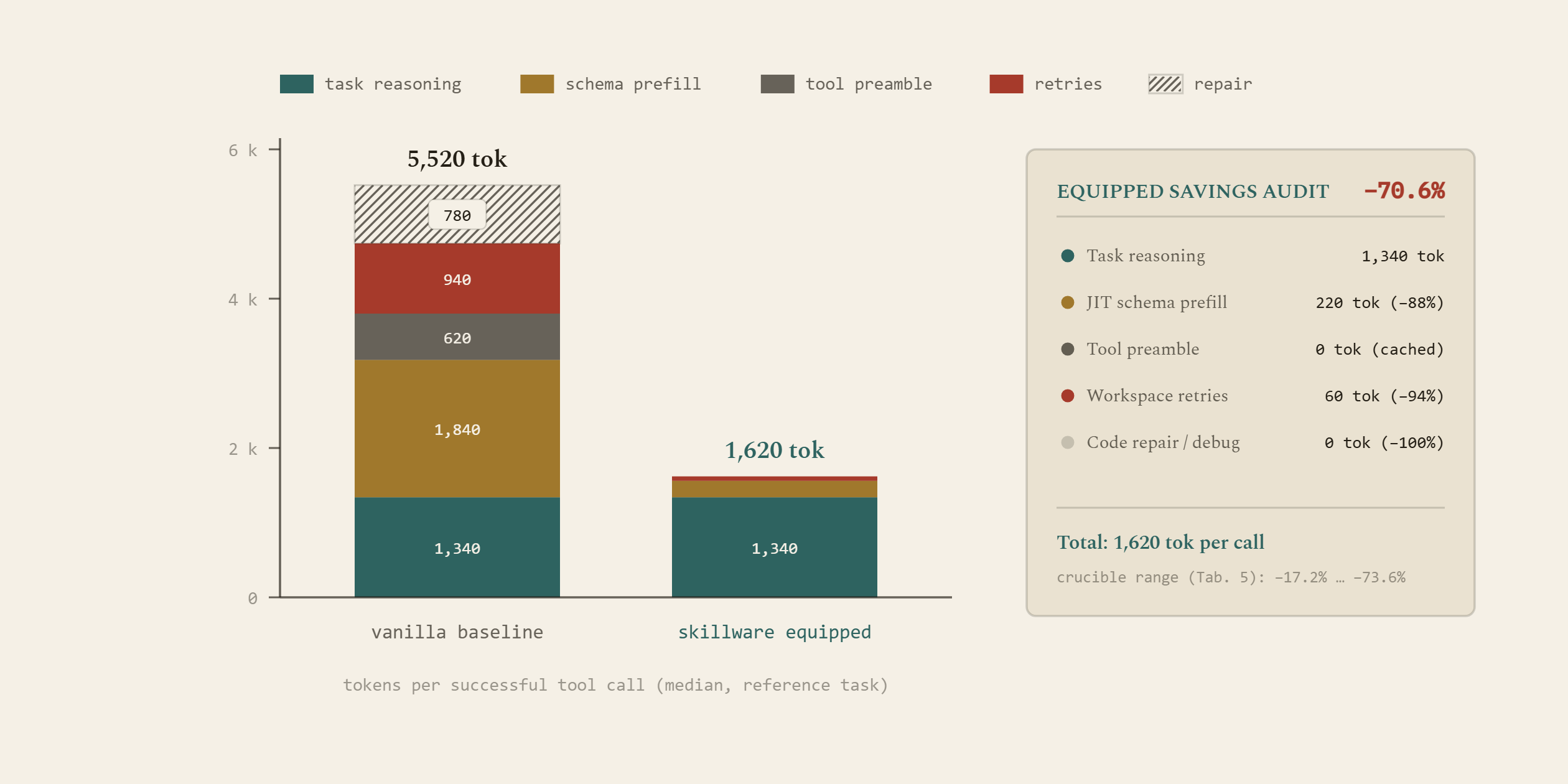
Figure 20. Token ledger decomposition per successful tool call during Office Mail attachment extraction. Unassisted Vanilla execution incurs a severe token tax (5,520 tokens per call), driven by verbose schema and documentation prefill (1,840 tokens), monolithic tool preambles (620 tokens), subprocess retry overhead (940 tokens), and traceback repair loops (780 tokens). Equipping models with Skillware preserves baseline task reasoning (1,340 tokens) while excising redundant documentation down to compact typed schemas (220 tokens, −88%) and eliminating code repair loops entirely (0 tokens, −100%), yielding a 70.6% reduction in per-call token expenditure (1,620 tokens total).
- Upfront Preflight Validation Prevents Cascading Execution Regressions: Unassisted code synthesis frequently fails at the interface boundary: 11.8% of emitted tool calls fail preflight schema validation, triggering 231 error-recovery cycles and 57 terminal aborts. In contrast, Skillware preflight gates enforce typing upfront (99.6% valid), resolving edge cases via fast typed reflexes (52 repaired) to deliver a 94.1% clean first-pass rate with only 7 terminal aborts. Across the full 368 benchmark tasks, this lifts completed conditions from 300/368 (81.5%) to 337/368 (91.6%). See Behavioral Contracts Analysis.
Figure 33 — 368-Layer Benchmark Call Survival Flow
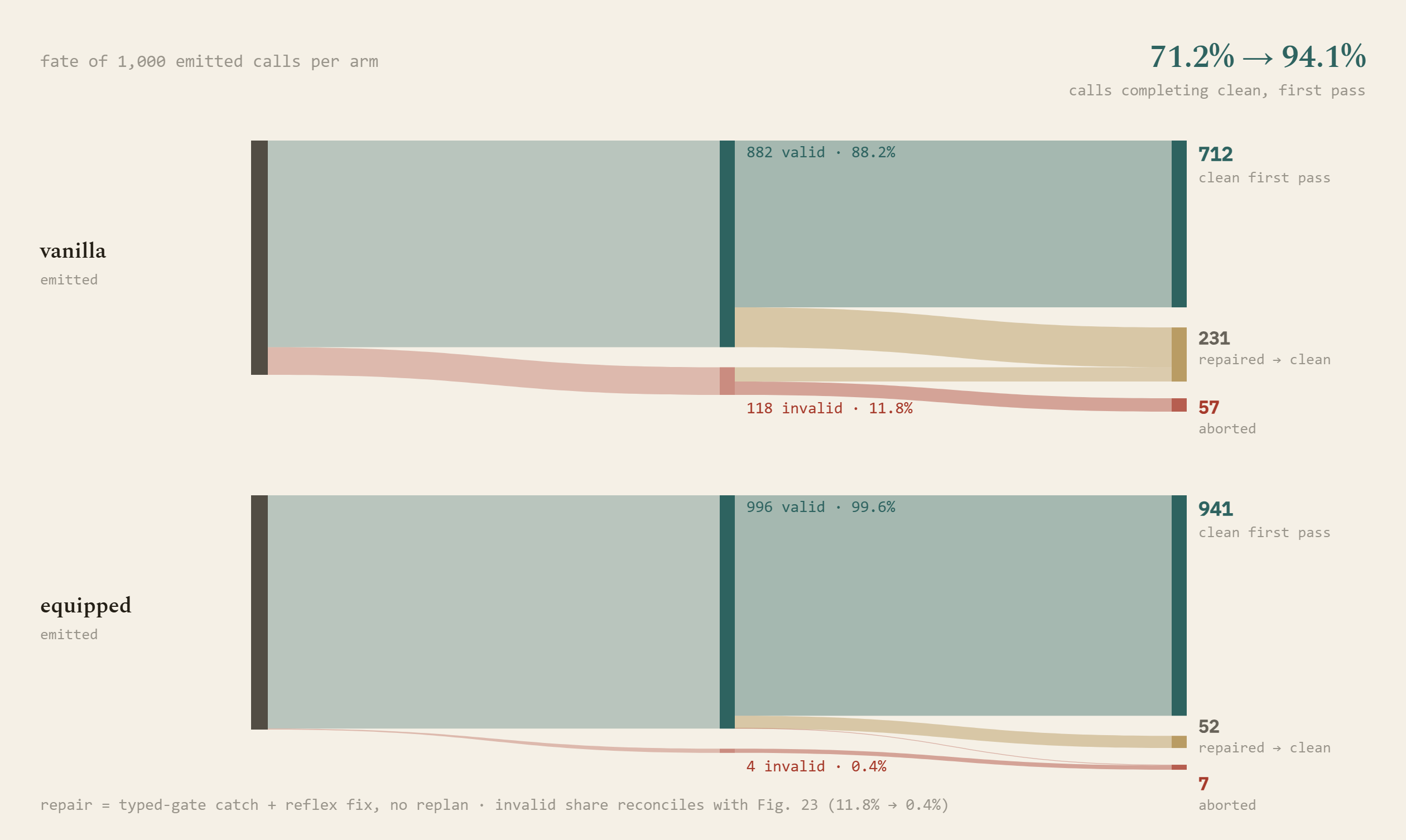
Figure 33. Tool invocation survival flow normalized across 1,000 emitted calls per arm (reconciling with the 368 benchmark conditions in Fig. 23). In unassisted vanilla execution, 11.8% of emitted calls fail preflight schema validation (118 invalid calls), and while 231 calls recover through replanning loops, 57 calls abort completely. In contrast, Skillware preflight gates enforce typing upfront (99.6% valid), resolving edge cases via fast typed reflexes (52 repaired) to deliver 941 clean first-pass calls (94.1% clean first pass vs 71.2% vanilla) with only 7 terminal aborts.
- Run-to-Run Determinism & Enterprise Variance Contraction: Non-deterministic code generation produces erratic behavioral dispersion across seeded replays under identical prompts. Skillware contracts run-to-run dispersion by 5.1x tighter, establishing the execution predictability required for enterprise regression testing and CI/CD release gating. See Execution Latency & Auditability.
Figure 14 — Run-to-Run Determinism & Variance Contraction
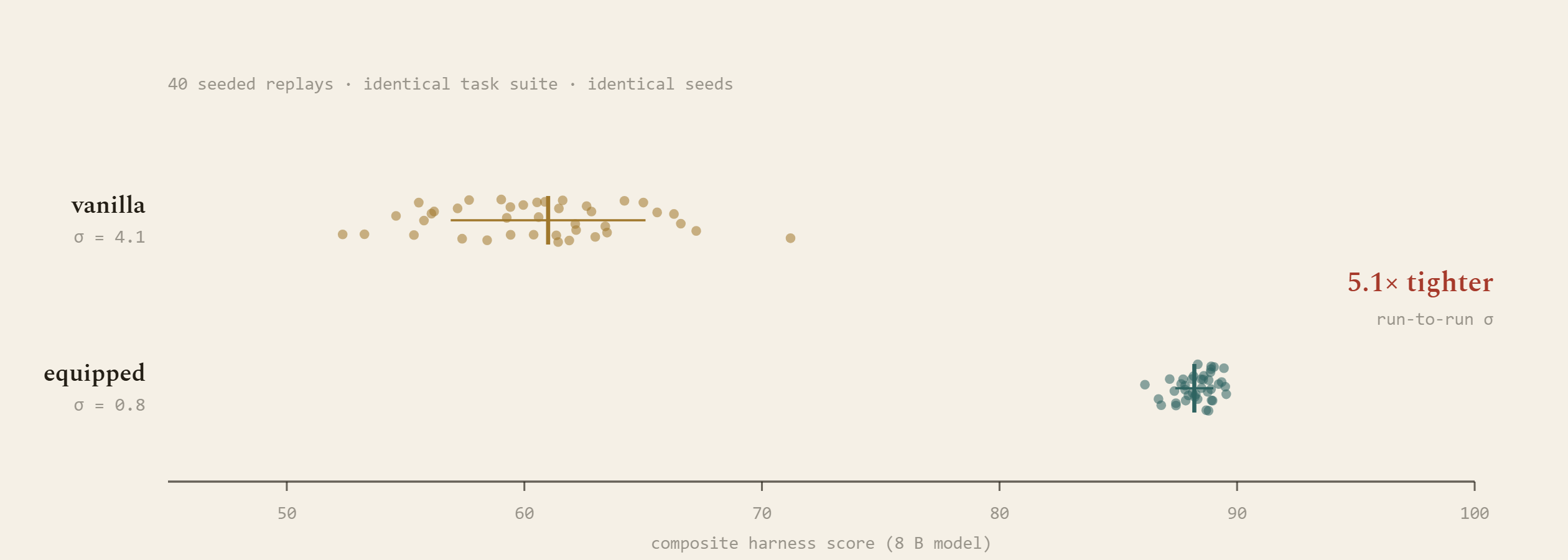
Figure 14. Run-to-run determinism and variance contraction across 40 seeded replays under identical seeds (8B compact model). Unassisted Vanilla execution scatters across an erratic score distribution (mean 61.0, σ = 4.1) driven by non-deterministic code synthesis paths. Skillware contracts run-to-run dispersion by 5.1× tighter (mean 88.2, σ = 0.8), establishing the execution predictability required for enterprise regression testing and CI/CD release gating.
Documentation Sitemap
- Documentation Hub
- Master Leaderboard
- Cross-Model Benchmark Overview (All 23 Models)
- Complete Benchmark Exhibits Catalog
- Small Models + Skillware vs. Frontier LLMs Alone
- Execution Latency, Throughput & Cryptographic Audit Spine
- Behavioral Contracts, Safety Gating & Error Modes
- Token Economics & Overhead Work Avoided
- Benchmark Methodology & Harness Architecture
- Simulation Crucibles Reference
- 23 Individual Model Cards
Quick Start & Reproduction
Installation
git clone https://github.com/ARPAHLS/skillware-bench.git
cd skillware-bench
pip install -e .
1. Interactive CLI & Mock Execution (Zero API Keys Required)
# Launch interactive pastel menu
skillware-bench menu

# Execute offline deterministic simulation crucibles
skillware-bench run --mock

# Compare with-Skillware vs vanilla baseline turn-by-turn
skillware-bench compare --suite gmail

# Generate interactive inspection dashboard
skillware-bench dashboard --output ./runs/dashboard.html
2. Live Progressive Tiered Ablation Sweeps
# Run benchmark on any supported model via API
python scripts/run_tiered_ablation_bench.py --model deepseek/deepseek-v4.1-flash-1017

# Run on a compact sovereign model
python scripts/run_tiered_ablation_bench.py --model qwen/qwen3.6-35b-a3b
Governed Execution via Skillware

Skillware (arpahls/skillware) is the open-source framework and registry for modular, actionable AI agent capabilities. Rather than prompting agents with fragile natural-language instructions, Skillware equips them with self-contained, executable Skill bundles—decoupling capability from intelligence.
Every Skill bundle packages everything a host agent needs to use a capability in a domain:
- Contract: Strict constitutional safety boundaries, dry-run guarantees, and typed I/O schemas (
manifest.yaml). - Effect: Deterministic Python handlers so agents run verified work directly rather than synthesizing ad-hoc code across turns (
skill.py). - Directive: System instructions and cognitive maps adapted to host LLM reasoning (
instructions.md). - Assurance: Offline verification suites ensuring the effect honors the contract before registry admission (
test_skill.py). - Interface: Universal tool schemas standardized across Gemini, Claude, OpenAI, Ollama, and OpenAI-compatible runtimes (
card.json).
In Skillware-Bench, equipping models with Skillware eliminates ad-hoc workspace script synthesis and debugging (464 loops eliminated across 736 conditions), yielding a +10.1% aggregate pass lift, 51.4% token reduction, and 1.60x execution speedup.
Cryptographic Receipts via AURA

Every benchmark evaluation produces a verified cryptographic receipt anchored via the AURA attestation spine. Receipts contain a SHA-256 causal DAG hash over all executed turns, tool invocations, token metrics, and scoring outputs to ensure tamper-evident verification.
The complete canonical execution reports for all 23 evaluated models are tracked in benchmarks/reports/. Verify any model's receipt instantly without API keys:
skillware-bench verify benchmarks/reports/google_gemma_4_31b_it.json
Citing
If you use Skillware-Bench in research or products, please cite it using CITATION.cff (GitHub Cite this repository) or the permanent Zenodo Concept DOI 10.5281/zenodo.23725543:
@software{peili2026skillwarebench,
  author       = {Peilivanidis, Vladimiros and {ARPA Hellenic Logical Systems}},
  title        = {{Skillware-Bench: The Empirical Benchmark & Evaluation Harness for Governed Agent Skills}},
  year         = {2026},
  publisher    = {Zenodo},
  version      = {0.3.3},
  doi          = {10.5281/zenodo.23725543},
  url          = {https://doi.org/10.5281/zenodo.23725543}
}
For reproducibility, also record the Skillware-Bench version you used (e.g. v0.3.3).
License
MIT License. Copyright (c) 2026 ARPA Hellenic Logical Systems.

Developed and Maintained by ARPA HELLENIC LOGICAL SYSTEMS
Support: systems@arpacorp.net
1 maintainer

Metadata
1 maintainer
Release files for skillware-bench 0.3.3
For a detailed explanation of source distributions (sdists) and built distributions (wheels), please see the package formats documentation.
Source distribution (sdist)
| File | Size | Uploaded | Provenance | Actions |
|---|---|---|---|---|
| skillware_bench-0.3.3.tar.gz | 84.7 kB | With provenance | Details for skillware_bench-0.3.3.tar.gz |
Built distribution (wheel)
| File | Interpreter | ABI | Platform | Actions Reset |
|---|---|---|---|---|
| skillware_bench-0.3.3-py3-none-any.whl | Python 3 | none | any | Details for skillware_bench-0.3.3-py3-none-any.whl |
Total release size: 190.7 kB
Release files / skillware_bench-0.3.3.tar.gz
| Download URL | skillware_bench-0.3.3.tar.gz |
|---|---|
| Size | 84.7 kB |
| Tags | Source |
|
SHA-256 checksum How to use checksums |
77c63844a91a251523f3e3b23fd4da9bcba58575bad7b99ae2e250df515b3b95
|
|
BLAKE2b-256 checksum How to use checksums |
db6e1e46d4494266f8119570ed1006e2739c473c5e046d27098d05ccdb5be082
|
| Upload date | |
|
Uploaded using Trusted Publishing? What is trusted publishing? |
Yes |
| Uploaded via |
twine/7.0.0 CPython/3.13.16
|
Provenance
Provenance describes where a file came from. On PyPI, provenance is shared via attestations, which provide a verifiable record of the build or publishing details. View details, limitations and caveats.


PyPI Publish Attestation
PyPI verified that this artifact, at this checksum, originated from the publisher listed below.
Signed by GitHub Actions, verified by PyPI on Oct 28, 2026.
Transparency logRelease files / skillware_bench-0.3.3-py3-none-any.whl
| Download URL | skillware_bench-0.3.3-py3-none-any.whl |
|---|---|
| Size | 105.9 kB |
| Tags | Python 3 |
|
SHA-256 checksum How to use checksums |
f6dfea0085aa719988bf42416c515647f0a0de4c3e7bb10ab4ffbb30e7cb32e6
|
|
BLAKE2b-256 checksum How to use checksums |
ae3d2c4d8f765141243b90de06e6d0d3a97bbf69de931f32b4f5b7eff6d1e4ec
|
| Upload date | |
|
Uploaded using Trusted Publishing? What is trusted publishing? |
Yes |
| Uploaded via |
twine/7.0.0 CPython/3.13.16
|
Provenance
Provenance describes where a file came from. On PyPI, provenance is shared via attestations, which provide a verifiable record of the build or publishing details. View details, limitations and caveats.
PyPI Publish Attestation
PyPI verified that this artifact, at this checksum, originated from the publisher listed below.
Signed by GitHub Actions, verified by PyPI on Oct 28, 2026.
Transparency logSecurity for skillware-bench 0.3.3
Provenance
Provenance describes where a file came from. On PyPI, provenance is shared via attestations, which provide a verifiable record of the build or publishing details. View details, limitations and caveats.
Full provenance
All 2 files in this release have been uploaded with provenance metadata.
Attestation for skillware_bench-0.3.3.tar.gz
PyPI Publish Attestation
PyPI verified that this artifact, at this checksum, originated from the publisher listed below.
Signed by GitHub Actions, verified by PyPI on Oct 28, 2026.
Transparency logA note on package security
PyPI is a repository for distributing packages, not a service for auditing them. While third-party security researchers and our staff do their best to detect and remove malicious packages, PyPI cannot guarantee the quality, security or suitability of any given package.
To learn more about protecting yourself from malicious actors, visit our package security documentation.














