

Scikit-learn Smithy
Scikit-learn smithy is a tool that helps you to forge scikit-learn compatible estimator with ease.
WebUI | Documentation | Repository | Issue Tracker
How can you use it?
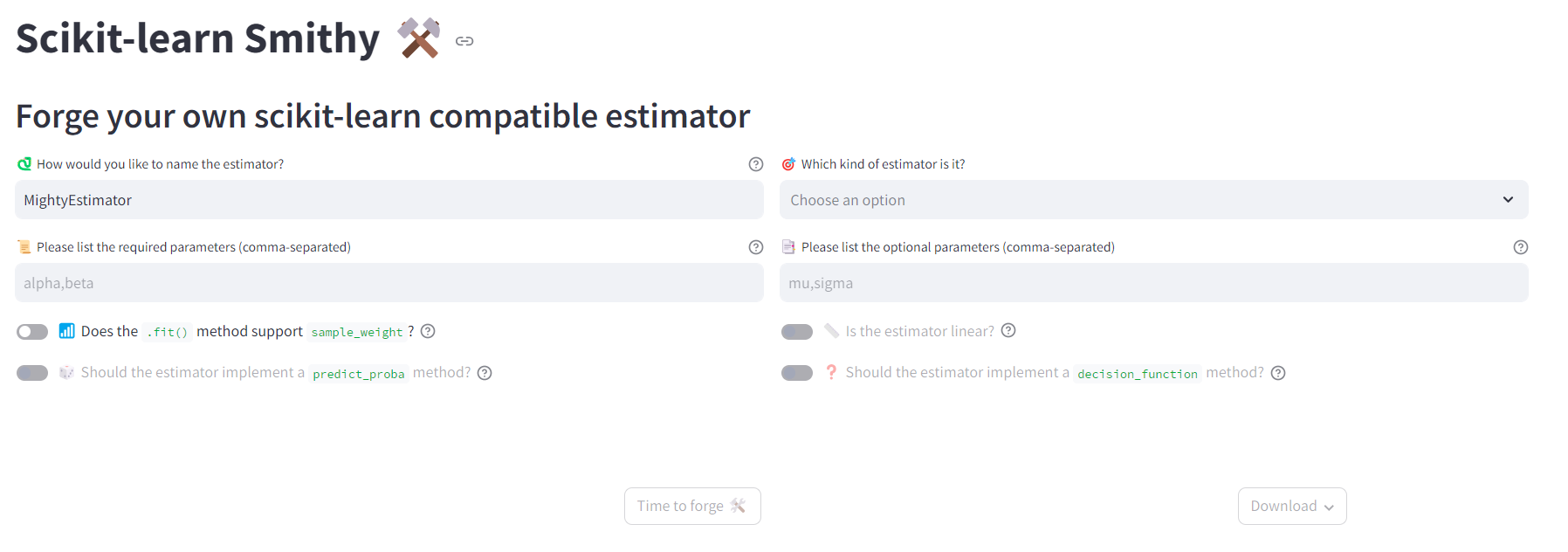
✅ Directly from the browser via a Web UI.
- Available at sklearn-smithy.streamlit.app
- It requires no installation.
- Powered by streamlit
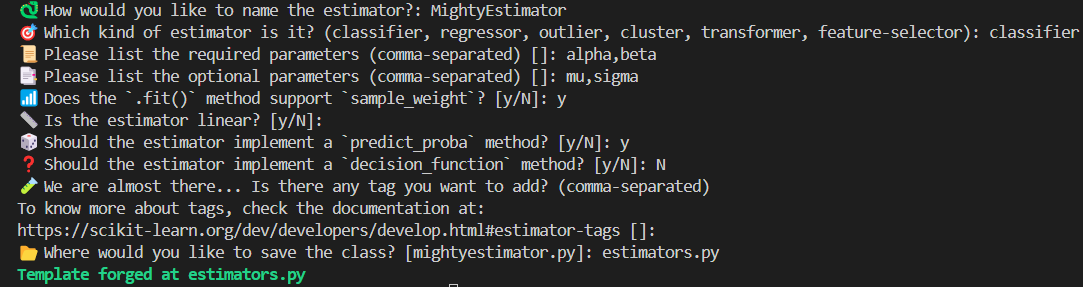
✅ As a CLI (command line interface) in the terminal.
- Available via the
smith forgecommand. - It requires installation:
python -m pip install sklearn-smithy - Powered by typer.
✅ As a TUI (terminal user interface) in the terminal.
- Available via the
smith forge-tuicommand. - It requires installing extra dependencies:
python -m pip install "sklearn-smithy[textual]" - Powered by textual.
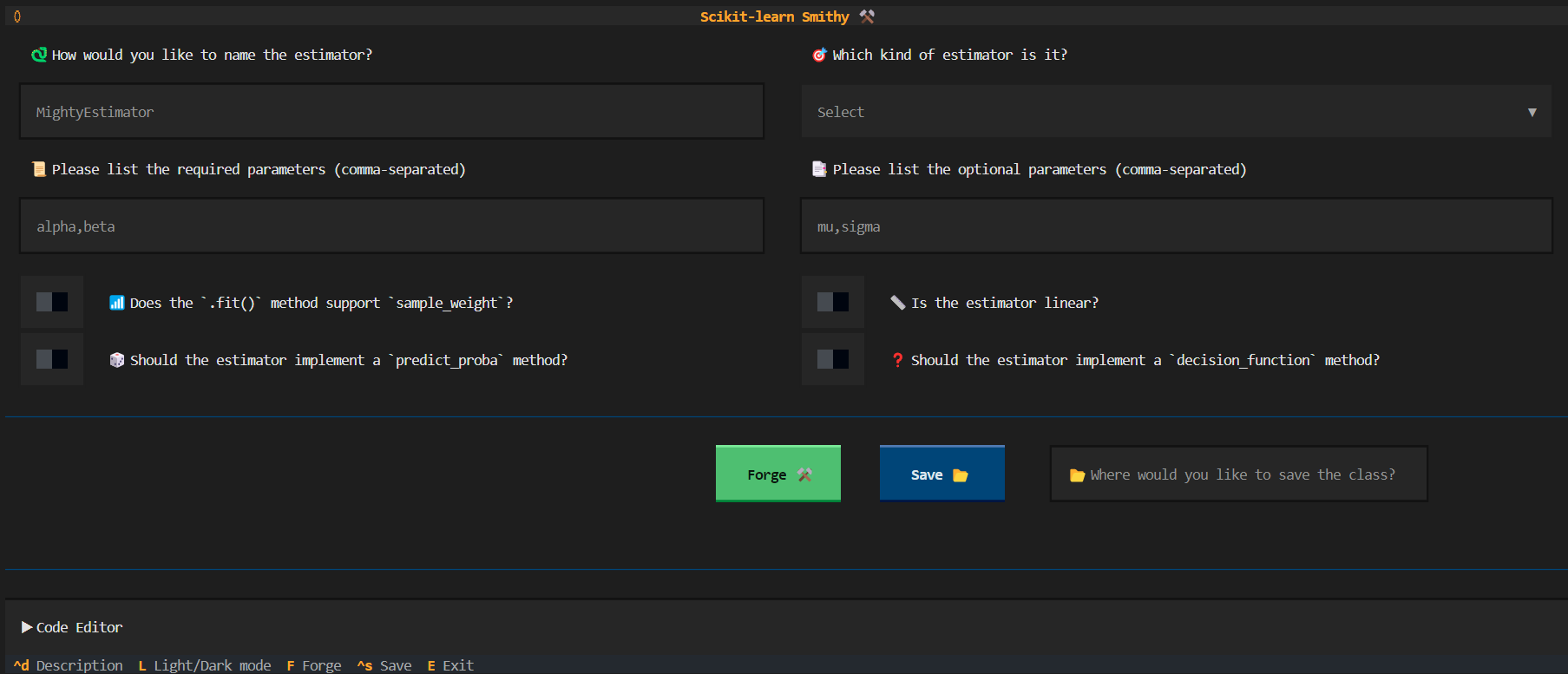
All these tools will prompt a series of questions regarding the estimator you want to create, and then it will generate the boilerplate code for you.
Why ❓
Writing scikit-learn compatible estimators might be harder than expected.
While everyone knows about the fit and predict, there are other behaviours, methods and attributes that
scikit-learn might be expecting from your estimator depending on:
- The type of estimator you're writing.
- The signature of the estimator.
- The signature of the
.fit(...)method.
Scikit-learn Smithy to the rescue: this tool aims to help you crafting your own estimator by asking a few questions about it, and then generating the boilerplate code.
In this way you will be able to fully focus on the core implementation logic, and not on nitty-gritty details of the scikit-learn API.
Sanity check
Once the core logic is implemented, the estimator should be ready to test against the somewhat official
parametrize_with_checks
pytest compatible decorator:
from sklearn.utils.estimator_checks import parametrize_with_checks

@parametrize_with_checks([
    YourAwesomeRegressor,
    MoreAwesomeClassifier,
    EvenMoreAwesomeTransformer,
])
def test_sklearn_compatible_estimator(estimator, check):
    check(estimator)
and it should be compatible with scikit-learn Pipeline, GridSearchCV, etc.
Official guide
Scikit-learn documentation on how to develop estimators.
Supported estimators
The following types of scikit-learn estimator are supported:
- ✅ Classifier
- ✅ Regressor
- ✅ Outlier Detector
- ✅ Clusterer
- ✅ Transformer
- ✅ Feature Selector
- 🚧 Meta Estimator
Installation
sklearn-smithy is available on pypi, so you can install it directly from there:
python -m pip install sklearn-smithy
Remark: The minimum Python version required is 3.10.
This will make the smith command available in your terminal, and you should be able to run the following:
smith version
sklearn-smithy=...
Extra dependencies
To run the TUI, you need to install the textual dependency as well:
python -m pip install "sklearn-smithy[textual]"
User guide 📚
Please refer to the dedicated user guide documentation section.
Origin story
The idea for this tool originated from scikit-lego #660, which I cannot better explain than quoting the PR description itself:
So the story goes as the following:
- The CI/CD fails for scikit-learn==1.5rc1 because of a change in the
check_estimatorinternals- In the scikit-learn issue I got a better picture of how to run test for compatible components
- In particular, rolling your own estimator suggests to use
parametrize_with_checks, and of course I thought "that is a great idea to avoid dealing manually with each test"- Say no more, I enter a rabbit hole to refactor all our tests - which would be fine
- Except that these tests failures helped me figure out a few missing parts in the codebase
1 maintainer

Metadata
1 maintainer
Release files for sklearn-smithy 0.2.0
For a detailed explanation of source distributions (sdists) and built distributions (wheels), please see the package formats documentation.
Source distribution (sdist)
| File | Size | Uploaded | |
|---|---|---|---|
| sklearn_smithy-0.2.0.tar.gz | 18.9 kB | Details |
Built distribution (wheel)
| File | Interpreter | ABI | Platform | Reset |
|---|---|---|---|---|
| sklearn_smithy-0.2.0-py3-none-any.whl | Python 3 | none | any | Details |
Total release size: 43.4 kB
Release files / sklearn_smithy-0.2.0.tar.gz
| Download URL | sklearn_smithy-0.2.0.tar.gz |
|---|---|
| Size | 18.9 kB |
| Tags | Source |
|
SHA-256 checksum How to use checksums |
aa61505872cfd40ffe8695d711688a2b9d8c5cc7762241f92567f0e187575d07
|
|
BLAKE2b-256 checksum How to use checksums |
4ff600e9fca8e50fe7b5c279790d2bd020c2f172b41b7f504ec70efc9eda18ce
|
| Upload date | |
|
Uploaded using Trusted Publishing? What is trusted publishing? |
No |
| Uploaded via |
python-httpx/0.27.0
|
Release files / sklearn_smithy-0.2.0-py3-none-any.whl
| Download URL | sklearn_smithy-0.2.0-py3-none-any.whl |
|---|---|
| Size | 24.5 kB |
| Tags | Python 3 |
|
SHA-256 checksum How to use checksums |
1769f7c128d0c43f6143a5ced01cc7298ba943d3fcb13953c14f94e91910ca98
|
|
BLAKE2b-256 checksum How to use checksums |
f4920b8d6b01fbb639b16560c18506cd1b66c6f168972d34bc614ca7b9cfbd16
|
| Upload date | |
|
Uploaded using Trusted Publishing? What is trusted publishing? |
No |
| Uploaded via |
python-httpx/0.27.0
|














