
Welcome to sktime

A unified interface for machine learning with time series
🚀 Version 1.3.0 out now! Check out the release notes here.
sktime is a library for time series analysis in Python. It provides a unified interface for multiple time series learning tasks. Currently, this includes forecasting, time series classification, clustering, anomaly/changepoint detection, and other tasks. It comes with time series algorithms and scikit-learn compatible tools to build, tune, and validate time series models.
| Documentation · Tutorials · Release Notes | |
|---|---|
| Open Source |   |
| Tutorials |   |
| Community |   |
| CI/CD |    |
| Code |     |
| Downloads |    |
| Citation |  |
📚 Documentation
| Documentation | |
|---|---|
| ⭐ Tutorials | New to sktime? Here's everything you need to know! |
| 📋 Binder Notebooks | Example notebooks to play with in your browser. |
| 👩💻 Examples | How to use sktime and its features. |
| ✂️ Extension Templates | How to build your own estimator using sktime's API. |
| 🎛️ API Reference | The detailed reference for sktime's API. |
| 📺 Video Tutorial | Our video tutorial from 2021 PyData Global. |
| 🛠️ Changelog | Changes and version history. |
| 🌳 Roadmap | sktime's software and community development plan. |
| 📝 Related Software | A list of related software. |
💬 Where to ask questions
Questions and feedback are extremely welcome! We strongly believe in the value of sharing help publicly, as it allows a wider audience to benefit from it.
| Type | Platforms |
|---|---|
| 🐛 Bug Reports | GitHub Issue Tracker |
| ✨ Feature Requests & Ideas | GitHub Issue Tracker |
| 👩💻 Usage Questions | GitHub Discussions · Stack Overflow |
| 💬 General Discussion | GitHub Discussions |
| 🏭 Contribution & Development | dev-chat channel · Discord |
| 🌐 Meet-ups and collaboration sessions | Discord - Fridays 13 UTC, dev/meet-ups channel |
💫 Features
Our objective is to enhance the interoperability and usability of the time series analysis ecosystem in its entirety. sktime provides a unified interface for distinct but related time series learning tasks. It features dedicated time series algorithms and tools for composite model building, such as pipelining, ensembling, tuning, and reduction, empowering users to apply algorithms designed for one task to another.
sktime also provides interfaces to related libraries, for example scikit-learn, statsmodels, tsfresh, PyOD, and fbprophet, among others.
| Module | Status | Links |
|---|---|---|
| Forecasting | stable | Tutorial · API Reference · Extension Template |
| Time Series Classification | stable | Tutorial · API Reference · Extension Template |
| Time Series Regression | stable | API Reference |
| Transformations | stable | Tutorial · API Reference · Extension Template |
| Detection tasks | maturing | Extension Template |
| Parameter fitting | maturing | API Reference · Extension Template |
| Time Series Clustering | maturing | API Reference · Extension Template |
| Time Series Distances/Kernels | maturing | Tutorial · API Reference · Extension Template |
| Time Series Alignment | experimental | API Reference · Extension Template |
| Time Series Splitters | maturing | Extension Template |
| Distributions and simulation | experimental |
⏳ Install sktime
For troubleshooting and detailed installation instructions, see the documentation.
- Operating system: macOS X · Linux · Windows 8.1 or higher
- Python version: Python 3.11, 3.12, 3.13, 3.14, and 3.15 (only 64-bit)
- Package managers: pip · conda (via
conda-forge)
pip
Using pip, sktime releases are available as source packages and binary wheels. Available wheels are listed here.
pip install sktime
or, with maximum dependencies,
pip install sktime[all_extras]
For curated sets of soft dependencies for specific learning tasks:
pip install sktime[forecasting]  # for selected forecasting dependencies
pip install sktime[forecasting,transformations]  # forecasters and transformers
or similar. Valid sets are:
forecastingtransformationsclassificationregressionclusteringparam_estnetworksdetectionalignment
Cave: in general, not all soft dependencies for a learning task are installed, only a curated selection.
conda
You can also install sktime from conda via the conda-forge channel.
The feedstock including the build recipe and configuration is maintained
in this conda-forge repository.
conda install -c conda-forge sktime
or, with maximum dependencies,
conda install -c conda-forge sktime-all-extras
(as conda does not support dependency sets,
flexible choice of soft dependencies is unavailable via conda)
⚡ Quickstart
Forecasting
from sktime.datasets import load_airline
from sktime.forecasting.base import ForecastingHorizon
from sktime.forecasting.theta import ThetaForecaster
from sktime.split import temporal_train_test_split
from sktime.performance_metrics.forecasting import mean_absolute_percentage_error

y = load_airline()
y_train, y_test = temporal_train_test_split(y)
fh = ForecastingHorizon(y_test.index, is_relative=False)
forecaster = ThetaForecaster(sp=12)  # monthly seasonal periodicity
forecaster.fit(y_train)
y_pred = forecaster.predict(fh)
mean_absolute_percentage_error(y_test, y_pred)
>>> 0.08661467738190656
Time Series Classification
from sktime.classification.interval_based import TimeSeriesForestClassifier
from sktime.datasets import load_arrow_head
from sklearn.model_selection import train_test_split
from sklearn.metrics import accuracy_score

X, y = load_arrow_head()
X_train, X_test, y_train, y_test = train_test_split(X, y)
classifier = TimeSeriesForestClassifier()
classifier.fit(X_train, y_train)
y_pred = classifier.predict(X_test)
accuracy_score(y_test, y_pred)
>>> 0.8679245283018868
👋 How to get involved
There are many ways to join the sktime community. We follow the all-contributors specification: all kinds of contributions are welcome - not just code.
| Documentation | |
|---|---|
| 💝 Contribute | How to contribute to sktime. |
| 🎒 Mentoring | New to open source? Apply to our mentoring program! |
| 📅 Meetings | Join our discussions, tutorials, workshops, and sprints! |
| 👩🔧 Developer Guides | How to further develop sktime's code base. |
| 🚧 Enhancement Proposals | Design a new feature for sktime. |
| 🏅 Contributors | A list of all contributors. |
| 🙋 Roles | An overview of our core community roles. |
| 💸 Donate | Fund sktime maintenance and development. |
| 🏛️ Governance | How and by whom decisions are made in sktime's community. |
🏆 Hall of fame
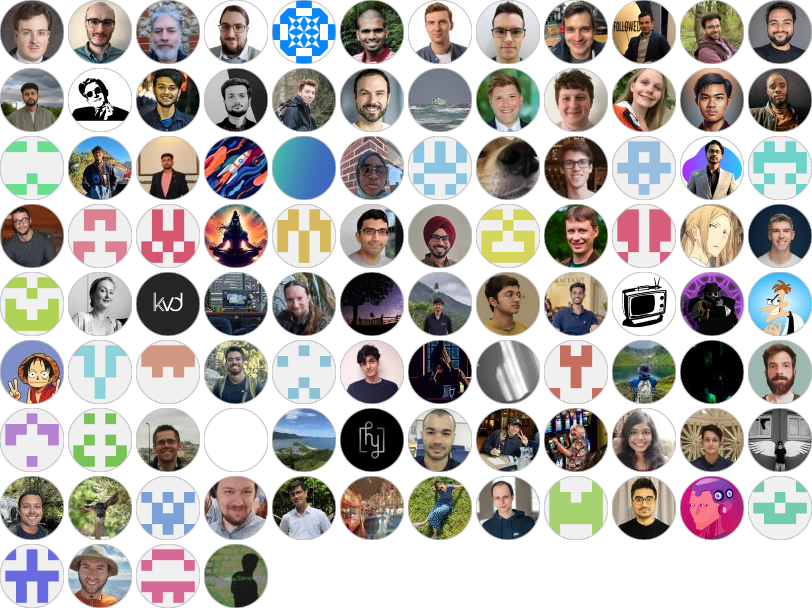
Thanks to all our community for all your wonderful contributions, PRs, issues, ideas.
💡 Project vision
- By the community, for the community -- developed by a friendly and collaborative community.
- The right tool for the right task -- helping users to diagnose their learning problem and suitable scientific model types.
- Embedded in state-of-art ecosystems and provider of interoperable interfaces -- interoperable with scikit-learn, statsmodels, tsfresh, and other community favorites.
- Rich model composition and reduction functionality -- build tuning and feature extraction pipelines, solve forecasting tasks with scikit-learn regressors.
- Clean, descriptive specification syntax -- based on modern object-oriented design principles for data science.
- Fair model assessment and benchmarking -- build your models, inspect your models, check your models, and avoid pitfalls.
- Easily extensible -- easy extension templates to add your own algorithms compatible with sktime's API.


Release files for sktime 1.3.0
For a detailed explanation of source distributions (sdists) and built distributions (wheels), please see the package formats documentation.
Source distribution (sdist)
| File | Size | Uploaded | Provenance | Actions |
|---|---|---|---|---|
| sktime-1.3.0.tar.gz | 36.5 MB | With provenance | Details for sktime-1.3.0.tar.gz |
Built distribution (wheel)
| File | Interpreter | ABI | Platform | Actions Reset |
|---|---|---|---|---|
| sktime-1.3.0-py3-none-any.whl | Python 3 | none | any | Details for sktime-1.3.0-py3-none-any.whl |
Total release size: 44.8 MB
Release files / sktime-1.3.0.tar.gz
| Download URL | sktime-1.3.0.tar.gz |
|---|---|
| Size | 36.5 MB |
| Tags | Source |
|
SHA-256 checksum How to use checksums |
827d722492217792e0c9c79a4f6ecd15ee0194ae638c6b5f0ef69c767ebbc16f
|
|
BLAKE2b-256 checksum How to use checksums |
fe6e8a7d197cd558fcaf6299fbce6855d4d6b151f4e641ff945d26ffa8422f43
|
| Upload date | |
|
Uploaded using Trusted Publishing? What is trusted publishing? |
Yes |
| Uploaded via |
twine/7.0.0 CPython/3.13.16
|
Provenance
Provenance describes where a file came from. On PyPI, provenance is shared via attestations, which provide a verifiable record of the build or publishing details. View details, limitations and caveats.


PyPI Publish Attestation
PyPI verified that this artifact, at this checksum, originated from the publisher listed below.
Signed by GitHub Actions, verified by PyPI on Nov 8, 2026.
Transparency logRelease files / sktime-1.3.0-py3-none-any.whl
| Download URL | sktime-1.3.0-py3-none-any.whl |
|---|---|
| Size | 8.3 MB |
| Tags | Python 3 |
|
SHA-256 checksum How to use checksums |
8c760156fd0f4605307a912844fa8831a6d6e860f46075f984de20e01cecf089
|
|
BLAKE2b-256 checksum How to use checksums |
8f5ccb4525471ad26d513c3ee294a6290999b7c5f90bfd21c6f7a8249b5c52c2
|
| Upload date | |
|
Uploaded using Trusted Publishing? What is trusted publishing? |
Yes |
| Uploaded via |
twine/7.0.0 CPython/3.13.16
|
Provenance
Provenance describes where a file came from. On PyPI, provenance is shared via attestations, which provide a verifiable record of the build or publishing details. View details, limitations and caveats.
PyPI Publish Attestation
PyPI verified that this artifact, at this checksum, originated from the publisher listed below.
Signed by GitHub Actions, verified by PyPI on Nov 8, 2026.
Transparency logSecurity for sktime 1.3.0
Provenance
Provenance describes where a file came from. On PyPI, provenance is shared via attestations, which provide a verifiable record of the build or publishing details. View details, limitations and caveats.
Full provenance
Both files in this release have been uploaded with provenance metadata.
Attestation for sktime-1.3.0.tar.gz
PyPI Publish Attestation
PyPI verified that this artifact, at this checksum, originated from the publisher listed below.
Signed by GitHub Actions, verified by PyPI on Nov 8, 2026.
Transparency logA note on package security
PyPI is a repository for distributing packages, not a service for auditing them. While third-party security researchers and our staff do their best to detect and remove malicious packages, PyPI cannot guarantee the quality, security or suitability of any given package.
To learn more about protecting yourself from malicious actors, visit our package security documentation.














