
Co-create PowerPoint slide decks with AI
Verified details
These details have been verified by PyPIProject links
GitHub Statistics
Maintainers

Project description
title: SlideDeck AI emoji: 🏢 colorFrom: yellow colorTo: green sdk: streamlit sdk_version: 1.44.1 app_file: app.py pinned: false license: mit




SlideDeck AI
We spend a lot of time creating slides and organizing our thoughts for any presentation. With SlideDeck AI, co-create slide decks on any topic with Artificial Intelligence and Large Language Models. Describe your topic and let SlideDeck AI generate a PowerPoint slide deck for you—it's as simple as that!
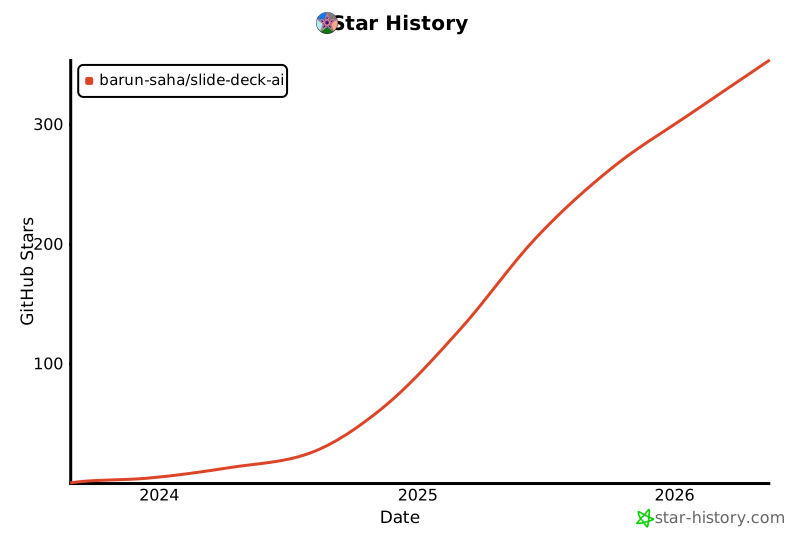
Star History
Process
SlideDeck AI works in the following way:
- Given a topic description, it uses a Large Language Model (LLM) to generate the initial content of the slides. The output is generated as structured JSON data based on a pre-defined schema.
- Next, it uses the keywords from the JSON output to search and download a few images with a certain probability.
- Subsequently, it uses the
python-pptxlibrary to generate the slides, based on the JSON data from the previous step. A user can choose from a set of pre-defined presentation templates. - At this stage onward, a user can provide additional instructions to refine the content. For example, one can ask to add another slide or modify an existing slide. A history of instructions is maintained.
- Every time SlideDeck AI generates a PowerPoint presentation, a download button is provided. Clicking on the button will download the file.
In addition, SlideDeck AI can also create a presentation based on PDF files.
Python API Usage
from slidedeckai.core import SlideDeckAI


slide_generator = SlideDeckAI(
    model='[gg]gemini-2.5-flash-lite',
    topic='Make a slide deck on AI',
    api_key='your-google-api-key',  # Or set via environment variable
)
pptx_path = slide_generator.generate()
print(f'🤖 Generated slide deck: {pptx_path}')
CLI Usage
Generate a new slide deck:
slidedeckai generate --model '[gg]gemini-2.5-flash-lite' --topic 'Make a slide deck on AI' --api-key 'your-google-api-key'
Launch the Streamlit app:
slidedeckai launch
List supported models (these are the only models supported by SlideDeck AI):
slidedeckai --list-models
Summary of the LLMs
SlideDeck AI allows the use of different LLMs from several online providers—Azure OpenAI, Google, Cohere, Together AI, and OpenRouter. Most of these service providers offer generous free usage of relevant LLMs without requiring any billing information.
Based on several experiments, SlideDeck AI generally recommends the use of Mistral NeMo, Gemini Flash, and GPT-4o to generate the slide decks.
The supported LLMs offer different styles of content generation. Use one of the following LLMs along with relevant API keys/access tokens, as appropriate, to create the content of the slide deck:
| LLM | Provider (code) | Requires API key | Characteristics |
|---|---|---|---|
| Claude Haiku 4.5 | Anthropic (an) |
Mandatory; get here | Faster, detailed |
| Gemini 2.0 Flash | Google Gemini API (gg) |
Mandatory; get here | Faster, longer content |
| Gemini 2.0 Flash Lite | Google Gemini API (gg) |
Mandatory; get here | Fastest, longer content |
| Gemini 2.5 Flash | Google Gemini API (gg) |
Mandatory; get here | Faster, longer content |
| Gemini 2.5 Flash Lite | Google Gemini API (gg) |
Mandatory; get here | Fastest, longer content |
| GPT-4.1-mini | OpenAI (oa) |
Mandatory; get here | Faster, medium content |
| GPT-4.1-nano | OpenAI (oa) |
Mandatory; get here | Faster, shorter content |
| GPT-5 | OpenAI (oa) |
Mandatory; get here | Slow, shorter content |
| GPT | Azure OpenAI (az) |
Mandatory; get here NOTE: You need to have your subscription/billing set up | Faster, longer content |
| Command R+ | Cohere (co) |
Mandatory; get here | Shorter, simpler content |
| Gemini-2.0-flash-001 | OpenRouter (or) |
Mandatory; get here | Faster, longer content |
| GPT-3.5 Turbo | OpenRouter (or) |
Mandatory; get here | Faster, longer content |
| DeepSeek-V3.1-Terminus | SambaNova (sn) |
Mandatory; get here | Fast, detailed content |
| Llama-3.3-Swallow-70B-Instruct-v0.4 | SambaNova (sn) |
Mandatory; get here | Fast, shorter |
| DeepSeek V3-0324 | Together AI (to) |
Mandatory; get here | Slower, medium-length |
| Llama 3.3 70B Instruct Turbo | Together AI (to) |
Mandatory; get here | Slower, detailed |
| Llama 3.1 8B Instruct Turbo 128K | Together AI (to) |
Mandatory; get here | Faster, shorter |
IMPORTANT: SlideDeck AI does NOT store your API keys/tokens or transmit them elsewhere. If you provide your API key, it is only used to invoke the relevant LLM to generate contents. That's it! This is an Open-Source project, so feel free to audit the code and convince yourself.
In addition, offline LLMs provided by Ollama can be used. Read below to know more.
Icons
SlideDeck AI uses a subset of icons from bootstrap-icons-1.11.3 (MIT license) in the slides. A few icons from SVG Repo (CC0, MIT, and Apache licenses) are also used.
Local Development
SlideDeck AI uses LLMs via different providers. To run this project by yourself, you need to use an appropriate API key, for example, in a .env file.
Alternatively, you can provide the access token in the app's user interface itself (UI).
Offline LLMs Using Ollama
SlideDeck AI allows the use of offline LLMs to generate the contents of the slide decks. This is typically suitable for individuals or organizations who would like to use self-hosted LLMs for privacy concerns, for example.
Offline LLMs are made available via Ollama. Therefore, a pre-requisite here is to have Ollama installed on the system and the desired LLM pulled locally. You should choose a model to use based on your hardware capacity. However, if you have no GPU, gemma3:1b can be a suitable model to run only on CPU.
In addition, the RUN_IN_OFFLINE_MODE environment variable needs to be set to True to enable the offline mode. This, for example, can be done using a .env file or from the terminal. The typical steps to use SlideDeck AI in offline mode (in a bash shell) are as follows:
# Environment initialization, especially on Debian
sudo apt update -y
sudo apt install python-is-python3 -y
sudo apt install git -y
# Change the package name based on the Python version installed: python -V
sudo apt install python3.11-venv -y

# Install Git Large File Storage (LFS)
sudo apt install git-lfs -y
git lfs install

ollama list  # View locally available LLMs
export RUN_IN_OFFLINE_MODE=True  # Enable the offline mode to use Ollama
git clone [https://github.com/barun-saha/slide-deck-ai.git](https://github.com/barun-saha/slide-deck-ai.git)
cd slide-deck-ai
git lfs pull  # Pull the PPTX template files - ESSENTIAL STEP!

python -m venv venv  # Create a virtual environment
source venv/bin/activate  # On a Linux system
pip install -r requirements.txt

streamlit run ./app.py  # Run the application
💡If you have cloned the repository locally but cannot open and view the PPTX templates, you may need to run
git lfs pullto download the template files. Without this, although content generation will work, the slide deck cannot be created.
The .env file should be created inside the slide-deck-ai directory.
The UI is similar to the online mode. However, rather than selecting an LLM from a list, one has to write the name of the Ollama model to be used in a textbox. There is no API key asked here.
The online and offline modes are mutually exclusive. So, setting RUN_IN_OFFLINE_MODE to False will make SlideDeck AI use the online LLMs (i.e., the "original mode."). By default, RUN_IN_OFFLINE_MODE is set to False.
Finally, the focus is on using offline LLMs, not going completely offline. So, Internet connectivity would still be required to fetch the images from Pexels.
Live Demo
- SlideDeck AI on Hugging Face Spaces
- Demo video of the chat interface on YouTube
- Demo video on using Azure OpenAI
Award
SlideDeck AI has won the 3rd Place in the Llama 2 Hackathon with Clarifai in 2023.
Contributors
SlideDeck AI is glad to have the following community contributions:
- Aditya: added support for page range selection for PDF files and new chat button.
- Sagar Bharatbhai Bharadia: added support for Gemini 2.5 Flash Lite and Gemini 2.5 Flash LLMs.
- Sairam Pillai: unified the project's LLM access by migrating the API calls to LiteLLM.
- Srinivasan Ragothaman: added OpenRouter support and API keys mapping from the
.envfile.
Thank you all for your contributions!

Project details
Verified details
These details have been verified by PyPIProject links
GitHub Statistics
Maintainers
Release history Release notifications | RSS feed


Download files
Download the file for your platform. If you're not sure which to choose, learn more about installing packages.
Source Distribution
Built Distribution
Filter files by name, interpreter, ABI, and platform.
If you're not sure about the file name format, learn more about wheel file names.
Copy a direct link to the current filters
File details
Details for the file slidedeckai-8.0.4.tar.gz.
File metadata
- Download URL: slidedeckai-8.0.4.tar.gz
- Upload date:
- Size: 2.8 MB
- Tags: Source
- Uploaded using Trusted Publishing? Yes
- Uploaded via: twine/6.1.0 CPython/3.13.7
File hashes
| Algorithm | Hash digest | |
|---|---|---|
| SHA256 |
7426e62590bceb9cb67f0a693bebdf81c1d233b93808be1f0329b3647cdbcb36
|
|
| MD5 |
9b4115efe35cb55036336994bf7eba4d
|
|
| BLAKE2b-256 |
81ddbe46cb5f828ecefeb2c82d89ec7611c3fc0cb7085bf85fbdc8a80e1a2a18
|
Provenance
The following attestation bundles were made for slidedeckai-8.0.4.tar.gz:
Publisher:
publish-to-pypi.yml on barun-saha/slide-deck-ai
-
Statement:
-
Statement type:
https://in-toto.io/Statement/v1 -
Predicate type:
https://docs.pypi.org/attestations/publish/v1 -
Subject name:
slidedeckai-8.0.4.tar.gz -
Subject digest:
7426e62590bceb9cb67f0a693bebdf81c1d233b93808be1f0329b3647cdbcb36 - Sigstore transparency entry: 715587414
- Sigstore integration time:
-
Permalink:
barun-saha/slide-deck-ai@2670d27bf091c71a36eaf1a93f8fda5b562e843a -
Branch / Tag:
refs/tags/v8.0.4 - Owner: https://github.com/barun-saha
-
Access:
public
-
Token Issuer:
https://token.actions.githubusercontent.com -
Runner Environment:
github-hosted -
Publication workflow:
publish-to-pypi.yml@2670d27bf091c71a36eaf1a93f8fda5b562e843a -
Trigger Event:
push
-
Statement type:
File details
Details for the file slidedeckai-8.0.4-py3-none-any.whl.
File metadata
- Download URL: slidedeckai-8.0.4-py3-none-any.whl
- Upload date:
- Size: 2.9 MB
- Tags: Python 3
- Uploaded using Trusted Publishing? Yes
- Uploaded via: twine/6.1.0 CPython/3.13.7
File hashes
| Algorithm | Hash digest | |
|---|---|---|
| SHA256 |
1428f59962c790c54b22c0820e8e325ef4fb94ea85c9bec1f81f1e365146b203
|
|
| MD5 |
29401b94a469815831e2315fad2e8d18
|
|
| BLAKE2b-256 |
f7e5f37f932f38be9404b3dbf2292040c00ebedb67e97084afa95d0913325f62
|
Provenance
The following attestation bundles were made for slidedeckai-8.0.4-py3-none-any.whl:
Publisher:
publish-to-pypi.yml on barun-saha/slide-deck-ai
-
Statement:
-
Statement type:
https://in-toto.io/Statement/v1 -
Predicate type:
https://docs.pypi.org/attestations/publish/v1 -
Subject name:
slidedeckai-8.0.4-py3-none-any.whl -
Subject digest:
1428f59962c790c54b22c0820e8e325ef4fb94ea85c9bec1f81f1e365146b203 - Sigstore transparency entry: 715587416
- Sigstore integration time:
-
Permalink:
barun-saha/slide-deck-ai@2670d27bf091c71a36eaf1a93f8fda5b562e843a -
Branch / Tag:
refs/tags/v8.0.4 - Owner: https://github.com/barun-saha
-
Access:
public
-
Token Issuer:
https://token.actions.githubusercontent.com -
Runner Environment:
github-hosted -
Publication workflow:
publish-to-pypi.yml@2670d27bf091c71a36eaf1a93f8fda5b562e843a -
Trigger Event:
push
-
Statement type:






