
Slidedown
- Do you ✍️ Slides?
- Do you 😠 PowerPoint?
- Do you ❤️ Markdown?
You're in Luck!
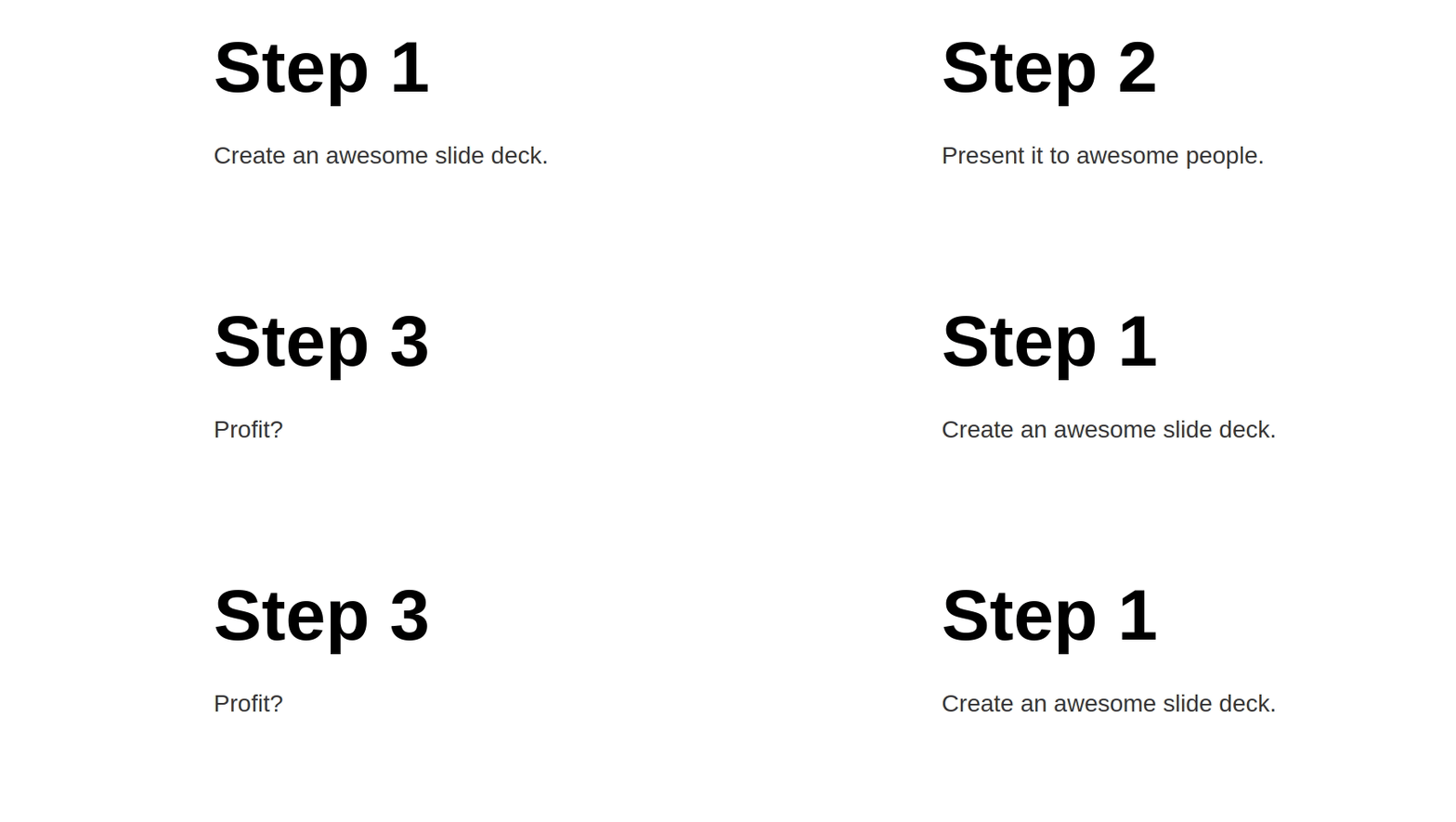
Turn markdown like this:
# Step 1

Create an awesome slide deck.

# Step 2

Present it to awesome people.

# Step 3

Profit?
Into slides like this:
How?
- Install
slidedownwithpip
pip install slidedown
- Start presenting your markdown files
slidedown README.md
- Open up your browser
http://localhost:5678/client/index.html
Interactive Elements
You can embed interactive views into your slides using IDOM,
by adding an HTML element into your markup with an attribute of the form
data-idom="your_script.py" where your_script.py should be placed in the same
directory that slidedown was invoked and must contains a function Main() or main()
that returns an IDOM element or a VDOM dict. All other data- attributes will be
interpreted as parameters to pass to that function.
IDOM in Slidedown Example
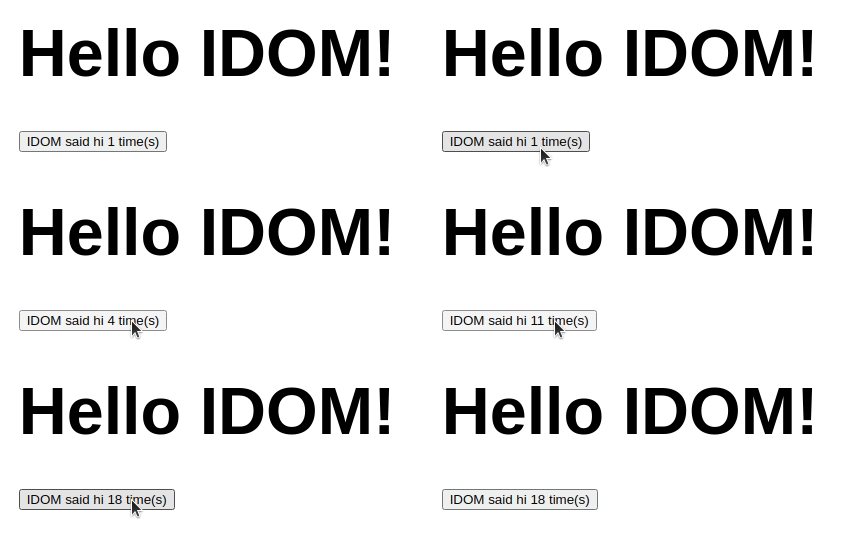
The following markup:
# Hello IDOM!

<span data-idom="hello" data-greeting="hello" />
and a script hello.py containing:
import idom

@idom.component
def Main(greeting: str):
    hi_count, set_hi_count = idom.hooks.use_state(1)
    return idom.html.button(
        {"onClick": lambda event: set_hi_count(hi_count + 1)},
        f"IDOM said {greeting} {hi_count} time(s)",
    )
Should produce the following output:
Config File
Slidedown supports a slidedown.json config file that can be placed adjacent to your
Markdown in order to configure the options used when running. The available options
match those seen in the help message (slidedown --help) except with all usages of -
replaced with _. For example:
{
  "host": "127.0.0.1",
  "no_browser": true,
  "no_reload": false,
  "port": 5678,
  "reload_delay": 3.0,
  "reload_ignore": ["ignore-dir/*"],
  "reload_watch": ["watch-dir/*"],
  "show_options": false,
  "start_slide": 0
}
1 maintainer

Metadata
1 maintainer
Release files for slidedown 0.7.0
For a detailed explanation of source distributions (sdists) and built distributions (wheels), please see the package formats documentation.
Source distribution (sdist)
| File | Size | Uploaded | Provenance | Actions |
|---|---|---|---|---|
| slidedown-0.7.0.tar.gz | 10.9 kB | Without provenance | Details for slidedown-0.7.0.tar.gz |
Built distribution (wheel)
| File | Interpreter | ABI | Platform | Actions Reset |
|---|---|---|---|---|
| slidedown-0.7.0-py3-none-any.whl | Python 3 | none | any | Details for slidedown-0.7.0-py3-none-any.whl |
Total release size: 21.6 kB
Release files / slidedown-0.7.0.tar.gz
| Download URL | slidedown-0.7.0.tar.gz |
|---|---|
| Size | 10.9 kB |
| Tags | Source |
|
SHA-256 checksum How to use checksums |
b01886e5000097f0bab39721b8364bd19e5106b4ba09a4d4faee9e44770a6bbd
|
|
BLAKE2b-256 checksum How to use checksums |
b8f0834202e44fe6d1bbe12a8ae8fe83ad065b2054bbf9bfd0e7b5342828c072
|
| Upload date | |
|
Uploaded using Trusted Publishing? What is trusted publishing? |
No |
| Uploaded via |
twine/3.4.2 importlib_metadata/4.8.1 pkginfo/1.7.1 requests/2.26.0 requests-toolbelt/0.9.1 tqdm/4.62.2 CPython/3.9.0
|
Release files / slidedown-0.7.0-py3-none-any.whl
| Download URL | slidedown-0.7.0-py3-none-any.whl |
|---|---|
| Size | 10.7 kB |
| Tags | Python 3 |
|
SHA-256 checksum How to use checksums |
195876a83e821a335328054fd0b08f0560af4aa38ec49913b9aee44b4252f5c6
|
|
BLAKE2b-256 checksum How to use checksums |
562873eafc2d5a909197f39d1dfb54c5d396541fdc6df62e4e44e589b43ef02a
|
| Upload date | |
|
Uploaded using Trusted Publishing? What is trusted publishing? |
No |
| Uploaded via |
twine/3.4.2 importlib_metadata/4.8.1 pkginfo/1.7.1 requests/2.26.0 requests-toolbelt/0.9.1 tqdm/4.62.2 CPython/3.9.0
|
Security for slidedown 0.7.0
Provenance
Provenance describes where a file came from. On PyPI, provenance is shared via attestations, which provide a verifiable record of the build or publishing details. View details, limitations and caveats.
No provenance found
None of the files in this release were uploaded with provenance metadata.
A note on package security
PyPI is a repository for distributing packages, not a service for auditing them. While third-party security researchers and our staff do their best to detect and remove malicious packages, PyPI cannot guarantee the quality, security or suitability of any given package.
To learn more about protecting yourself from malicious actors, visit our package security documentation.














