
{📖} Structural LLM Wiki
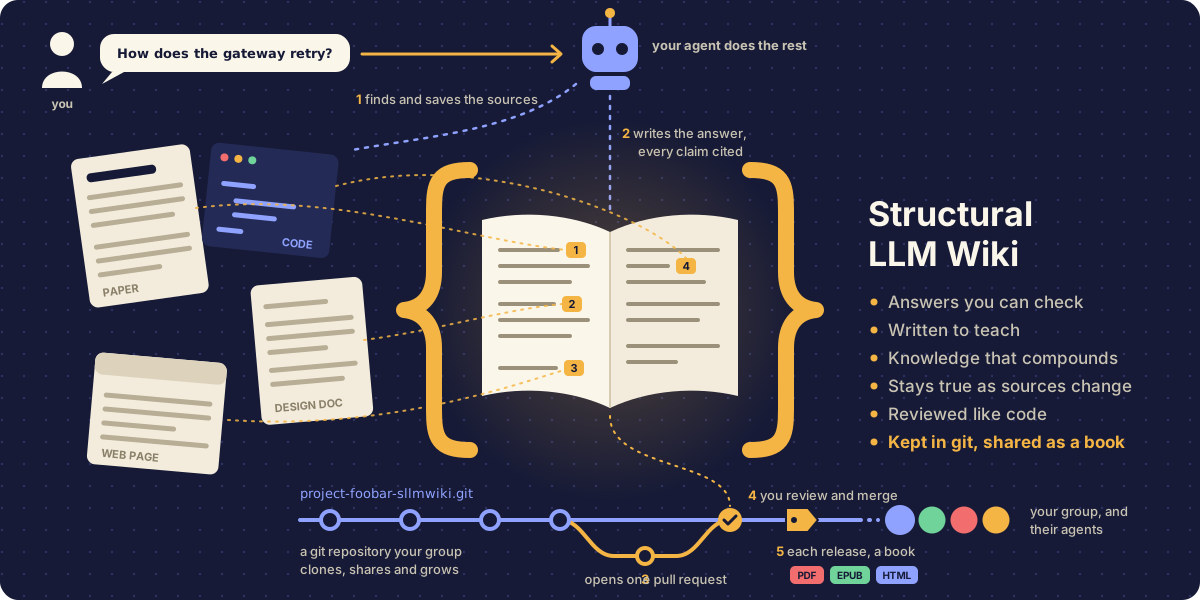




Your group's knowledge, researched by your coding agent, cited to the exact source, and reviewed like code.
An agent skill, packaged as a Claude Code plugin, that turns a git repository into a wiki your coding agent researches and keeps current. You ask a question. It saves the sources that answer it, verbatim copies of code, design docs, specifications, papers or web pages, and writes a narrative: an account, told in order, of what happened or how something works, every claim linked to the section of a source that supports it. Each run arrives as one pull request you review. It builds on Andrej Karpathy's LLM wiki pattern and adds what a group needs: claims you can check, review before anything lands, and a book at each release.
See one. Every narrative in the demo wiki was researched and written by an unattended run, and arrived as a pull request to review. Three recent runs, one question each:
| Question | Model | Kind | Sources saved | Narrative | Time | Tokens | Pull request |
|---|---|---|---|---|---|---|---|
| How does Raft elect a leader and keep every server's log consistent? | Opus 5.5 | how it works | 3 (99 KB): two dissertation chapters, etcd's README | 1,799 words | 10 min | 6.0M in, 51K out | #22 |
| What are the classic failure modes of large distributed systems, and their mitigations? | Opus 5.5 | survey | 4 (43 KB), and 2 papers as links | 1,937 words | 8 min | 8.7M in, 42K out | #23 |
| How does classic attention compare with paged attention? | Haiku 5.5 | comparison | 4 (290 KB), and 1 paper as a link | 982 words | 7 min | 4.6M in, 57K out | #24 |
Each run reports its own time and tokens in its pull request. The tokens count the main session only, and about 98% of the input is cached. Start at the demo's index, or download its book as a PDF, EPUB or HTML file from its latest release.
Setup
You need an agent that runs Agent Skills, such as Claude Code, plus git and Python 3.9 or later; the first run installs the rest, the plugin's code (the sllmwiki package, into the plugin's own folder) and anything missing, with your package manager. gh, signed in, is recommended: it opens the pull requests (without it, the skill prints a link to open each one yourself). The wiki's CI checks and its book need the wiki hosted on GitHub.
-
Create an empty repository (for example
project-foobar-sllmwiki), clone it and start Claude Code in it. -
Install the plugin into it:
claude plugin marketplace add mengjiasun1992/structural-llm-wiki --scope project
claude plugin install sllmwiki@structural-llm-wiki --scope project
-
Run
/sllmwiki:init. It asks a few preferences (language, source policy, the book), lays out the wiki, installs its CI checks and makes the first commit. Rerun it after a plugin update. -
Ask your first questions:
/sllmwiki:build "How does our gateway route requests?" "Why does it retry?"
Join a wiki: open it in Claude Code and accept the plugin it offers; its README, which init writes, says the rest. Other agents (Codex, Cursor, Copilot): npx skills add mengjiasun1992/structural-llm-wiki -g with the skills CLI and pipx install sllmwiki (the version the skill's SKILL.md names), then ask in your own words ("lint the gateway narratives").
Installing git, Python and gh
brew install git python gh                                   # macOS
winget install Git.Git Python.Python.3.13 GitHub.cli         # Windows
sudo apt-get install -y git python3 gh                       # Debian / Ubuntu
gh auth login && gh auth setup-git                           # then, everywhere
Why use it
- Builders need to understand a system before they change it, but the why is in a design doc that drifted and a chat thread nobody can find, and an AI's answer can't say which parts it read and which it guessed.
- Tech leads need what the group knows to outlive who knows it. Onboarding runs through the same few seniors, and nobody can say which docs are still true.
- Researchers have more papers than time, and LLM summaries cite sections that don't say what they claim.
What the wiki does about it:
- Every claim can be checked. Each one cites the exact section of a saved source, one click away. What no source states is marked as the narrative's own reasoning (
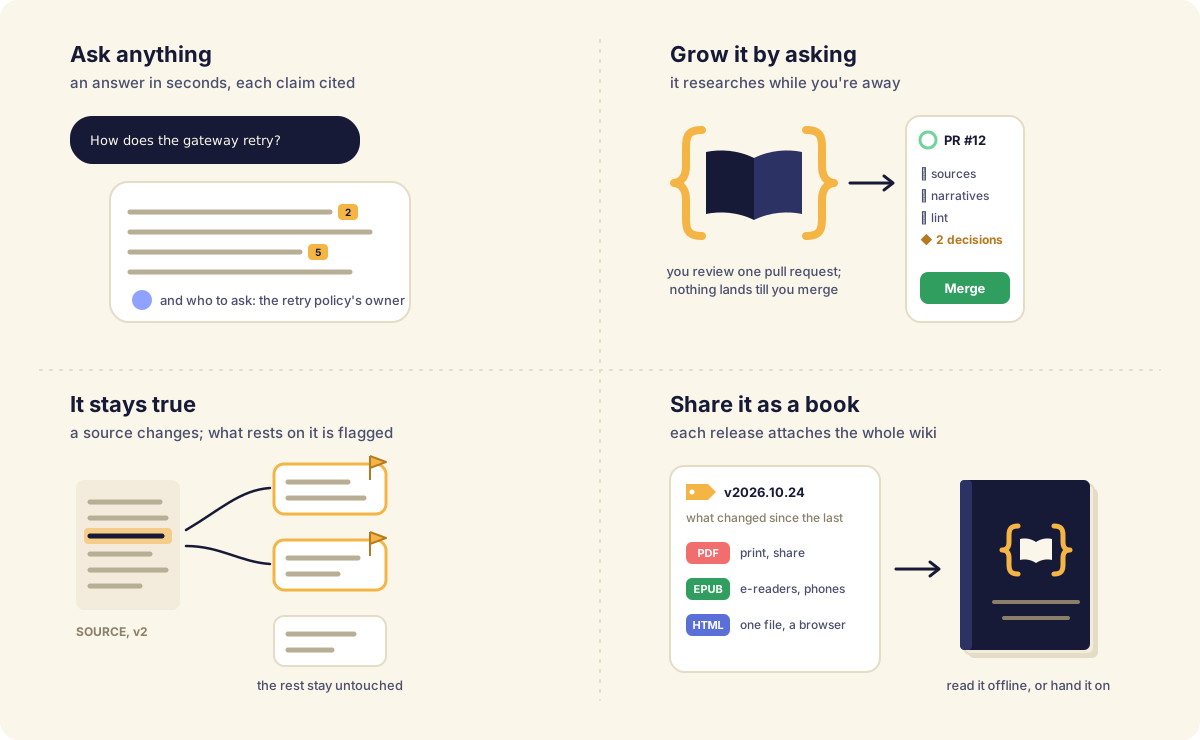
[→]) or as a gap ([?]), never filled with a guess. Lint checks every claim and quotation against the section it cites. - Nothing lands unreviewed. The agent researches on its own and delivers one pull request: a checklist on top, the decisions it couldn't make, and what the run cost. Your seniors review instead of writing from scratch.
- Knowledge compounds. One narrative per question, kept in git. A new answer builds on what the wiki already explains, and the next person who asks gets the reviewed answer.
- Answers stay true. Each narrative records the source versions it read. When code or a doc changes, exactly the narratives that rest on it are flagged.
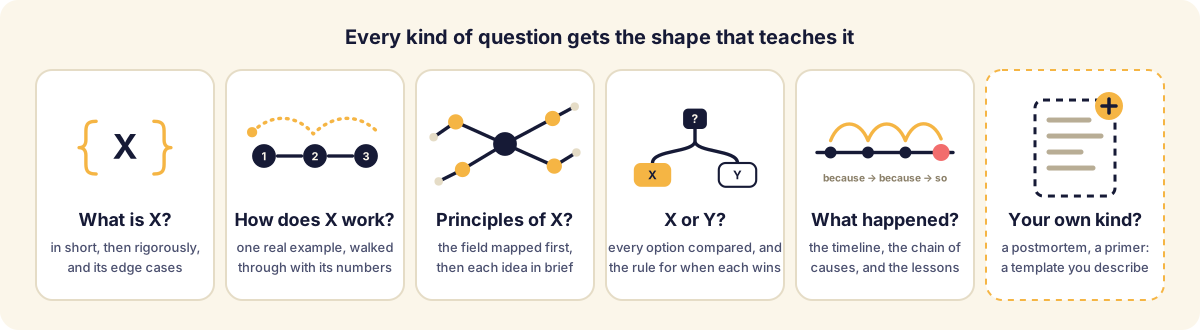
- It teaches. The answer's shape fits the question, written for a reader new to the topic; describe your own kind, such as a postmortem or a ten-minute primer on a paper.
- It knows who to ask. Each topic lists the people behind its code and docs, ranked by evidence from git history and code owners.
- A book with every release. The whole wiki as a PDF, an EPUB or one HTML file, chapters in teaching order, diagrams and math drawn as on GitHub: an onboarding pack, current as of that day.
It's all plain Markdown and YAML in git: browse it on GitHub, open it in Obsidian, or use it from any agent that supports Agent Skills. Scripts do everything mechanical, so your tokens go to judgment.
Usage
| I want to… | Run |
|---|---|
| Set up a wiki (start here, in an empty repository) | /sllmwiki:init |
| Ask the wiki: a cited answer in seconds, or a DRAFT and an offer to research it | /sllmwiki:query "How does the gateway retry failed backends?" |
| Research questions unattended: sources saved, a cited answer each, one pull request to review | /sllmwiki:build "How does the gateway route requests?" "Why does it retry?" |
| Publish the wiki as a book (PDF, EPUB, HTML) in a dated release | /sllmwiki:release |
Everything else, ask in your own words: "Lint the gateway narratives", "Who knows the gateway?", "Make a template for postmortems of our incidents", or "What can sllmwiki do?".
The manual has the rest: reviewing a run, what's in your wiki, templates, citations, books, settings, languages, Obsidian, teams, and an FAQ.
Licenses and your data
The skill is open source under the GPL 3.0 or later, and the templates it puts in your wiki and book under MIT-0, with no conditions; your wiki is yours, and each source stays its authors', kept with its URL and license, quoted briefly, never fetched past a login or paywall. Narratives are written by an LLM: every claim is cited, but review each pull request before you merge it. The plugin runs on your machine and its authors collect nothing (Privacy). The details: the manual, §12.
Design
docs/structural_llm_wiki_design.md has the architecture and the decisions behind it, and docs/book_design.md the book a release attaches. docs/skill_execution_plan.md and docs/book_execution_plan.md say how each was built.
Developing
plugin/                the plugin: instructions only
├── skills/sllmwiki/   the skill: SKILL.md, workflows/, steps/
└── commands/          Claude Code commands: init, query, build, release
src/sllmwiki/          the sllmwiki package: every command, lib/, templates/
tests/                 unit tests for the package
src/actions/           the GitHub actions a wiki's CI calls
src/tools/             development and CI tools (eval-plugin.sh, check-yaml, check-book)
evals/                 behavior evals, run through src/tools/eval-plugin.sh
docs/                  the manual, the designs, their plans, and their figures
AGENTS.md has the rules for changing this repository: tests with every logic change and coverage at 95% or above, instruction word budgets, evals for behavior changes. Run the tests, and try the plugin from a checkout:
python3 -m venv .venv && . .venv/bin/activate
python3 -m pip install -e . "coverage[toml]==7.6.10"
python3 tests/run.py --coverage
claude --plugin-dir plugin             # runs the sllmwiki on PATH: this checkout's
License
Copyright 2026 Mengjia Sun. The code is licensed under the GNU General Public License, version 3 or later; the templates in src/sllmwiki/templates/ under MIT-0. Versions up to 1.2.0 were released under Apache 2.0. See NOTICE.
1 maintainer

Metadata
1 maintainer
Release files for sllmwiki 1.3.2
For a detailed explanation of source distributions (sdists) and built distributions (wheels), please see the package formats documentation.
Source distribution (sdist)
| File | Size | Uploaded | Provenance | Actions |
|---|---|---|---|---|
| sllmwiki-1.3.2.tar.gz | 305.2 kB | With provenance | Details for sllmwiki-1.3.2.tar.gz |
Built distribution (wheel)
| File | Interpreter | ABI | Platform | Actions Reset |
|---|---|---|---|---|
| sllmwiki-1.3.2-py3-none-any.whl | Python 3 | none | any | Details for sllmwiki-1.3.2-py3-none-any.whl |
Total release size: 543.2 kB
Release files / sllmwiki-1.3.2.tar.gz
| Download URL | sllmwiki-1.3.2.tar.gz |
|---|---|
| Size | 305.2 kB |
| Tags | Source |
|
SHA-256 checksum How to use checksums |
a702dee64580f4add186855fcd2c65726a7ec65f3b8b0c67d811c5a658738648
|
|
BLAKE2b-256 checksum How to use checksums |
6708e7368b1ad50db1823590600334450b085ff12e67b450cbed1346e0b15aac
|
| Upload date | |
|
Uploaded using Trusted Publishing? What is trusted publishing? |
Yes |
| Uploaded via |
twine/7.0.0 CPython/3.13.16
|
Provenance
Provenance describes where a file came from. On PyPI, provenance is shared via attestations, which provide a verifiable record of the build or publishing details. View details, limitations and caveats.


PyPI Publish Attestation
PyPI verified that this artifact, at this checksum, originated from the publisher listed below.
Signed by GitHub Actions, verified by PyPI on Nov 14, 2026.
Transparency logRelease files / sllmwiki-1.3.2-py3-none-any.whl
| Download URL | sllmwiki-1.3.2-py3-none-any.whl |
|---|---|
| Size | 238.0 kB |
| Tags | Python 3 |
|
SHA-256 checksum How to use checksums |
5be7701465f3439562b50627eb4613e727d75722b2d2dbb7728d894a567875a4
|
|
BLAKE2b-256 checksum How to use checksums |
018e5d2afce92f43c0794416c0907984d5d51a79b1cae6c9267a48b7ad66ff31
|
| Upload date | |
|
Uploaded using Trusted Publishing? What is trusted publishing? |
Yes |
| Uploaded via |
twine/7.0.0 CPython/3.13.16
|
Provenance
Provenance describes where a file came from. On PyPI, provenance is shared via attestations, which provide a verifiable record of the build or publishing details. View details, limitations and caveats.
PyPI Publish Attestation
PyPI verified that this artifact, at this checksum, originated from the publisher listed below.
Signed by GitHub Actions, verified by PyPI on Nov 14, 2026.
Transparency logSecurity for sllmwiki 1.3.2
Provenance
Provenance describes where a file came from. On PyPI, provenance is shared via attestations, which provide a verifiable record of the build or publishing details. View details, limitations and caveats.
Full provenance
Both files in this release have been uploaded with provenance metadata.
Attestation for sllmwiki-1.3.2.tar.gz
PyPI Publish Attestation
PyPI verified that this artifact, at this checksum, originated from the publisher listed below.
Signed by GitHub Actions, verified by PyPI on Nov 14, 2026.
Transparency logA note on package security
PyPI is a repository for distributing packages, not a service for auditing them. While third-party security researchers and our staff do their best to detect and remove malicious packages, PyPI cannot guarantee the quality, security or suitability of any given package.
To learn more about protecting yourself from malicious actors, visit our package security documentation.














