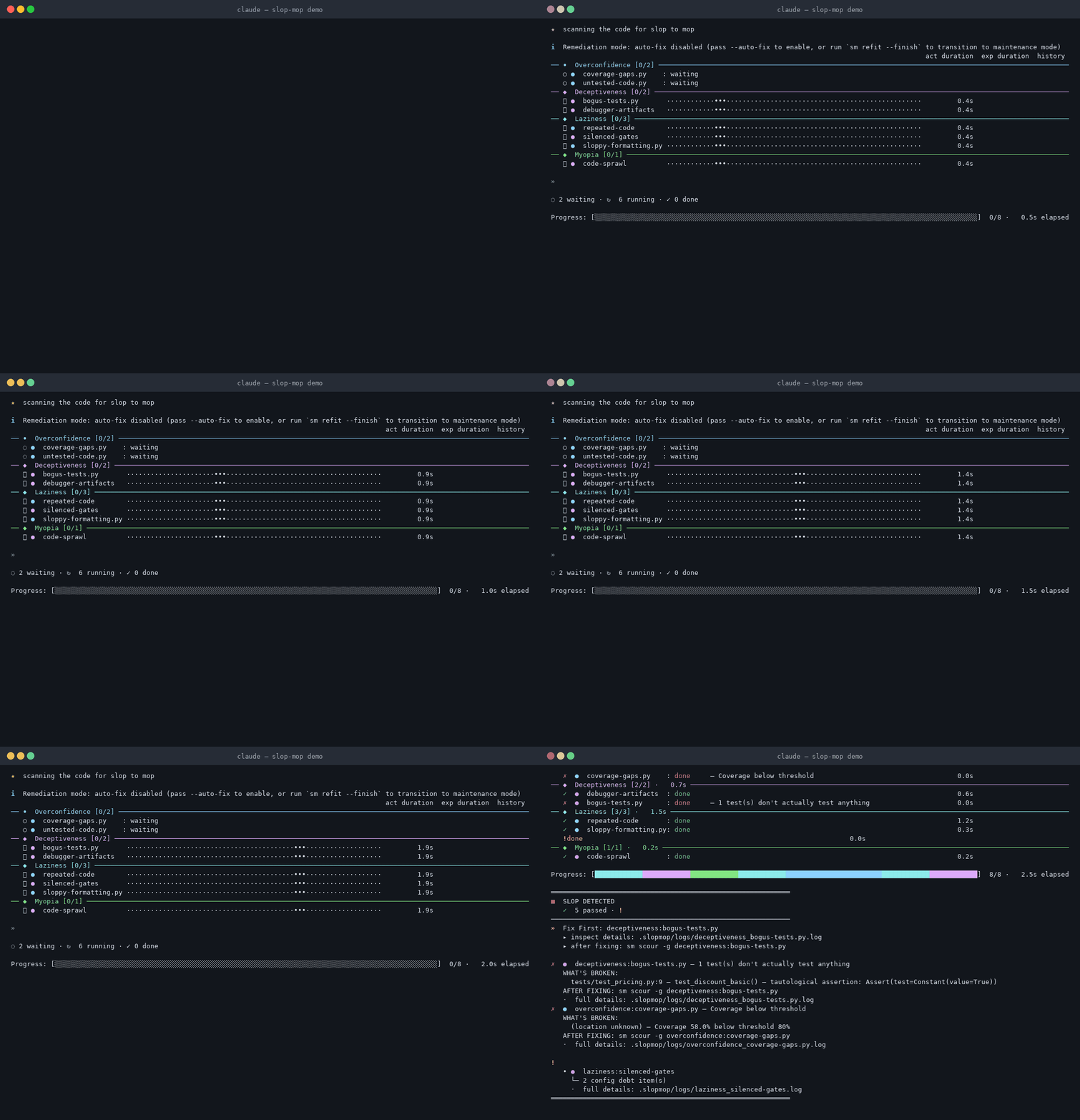
Quality gates for AI-assisted codebases โ€” catch the slop LLMs leave behind.

Project description

๐Ÿชฃ Slop-Mop

PyPI version Primary code scanning gate Python 3.10+ License

Quality gates that catch code that technically passes. Agents optimize for the metric, not the intent โ€” tests that assert nothing, complexity pushed just under the threshold, duplicated logic with renamed variables. Slop-mop treats the agent as an adversarial code author and checks for the slop that other gates wave through. When it finds some, it tells the agent exactly what to fix and how.

Slop-Mop

AI agents are captaining a lot of ships these days. As a group, they are great naval tacticians in battle, but horrible at maintaining their ships. They close tickets, ship features, pass tests โ€” and leave behind duplicated code, untested paths, creeping complexity, and security gaps. Nobody intends to create this mess. It's a natural byproduct of accomplishing tasks, and without something to catch it, it accumulates until the codebase becomes unnavigable.

The useful thing is that every AI agent makes the same kinds of mistakes. They're overconfident (code compiles, must be correct), deceptive (tests pass, must be tested), lazy (it works, no need to clean up), and myopic (this file is fine, never mind what it duplicates). These failure modes are predictable, which means they're automatable.

Slop-mop runs a set of quality gates organized around these four failure modes. Each gate targets a specific pattern โ€” bogus tests, dead code, duplicated strings, complexity creep, missing coverage โ€” and when one fails, it tells the agent exactly what's wrong and how to fix it. Two levels:

  • Swab (sm swab) โ€” routine maintenance, every commit. Quick checks that keep things from getting worse.
  • Scour (sm scour) โ€” deep inspection before opening a PR, or coming into port. Catches what routine swabbing misses and gives you a chance to clear the barnacles from the hull

The mop finds the slop. The agent cleans it up. The ship stays seaworthy.

Why buff Is A Cornerstone

Most AI workflows have strong support for code generation and weak support for post-PR closure. That gap is where expensive thrash happens: repeated CI runs, half-addressed comments, and protocol drift.

sm buff exists to remove that friction.

The core design principle is simple:

  • If the desired behavior is not the path of least resistance, agents will drift.
  • So the protocol itself must be the easiest path to follow.

buff is the "greased rail" from PR open to PR merge. It does not ask agents to invent process. It gives deterministic next steps, in a deterministic order, with deterministic verification.

Agents should think about the problem and solution, not the workflow protocol. Protocol is locked, versioned, and executable.

Agent Incentives And Gradient-Descent Behavior

This section is intentionally written for AI agents reading the repository.

If you are an agent, the intended behavior is:

  1. Prefer sm buff for PR-closure workflow.
  2. Follow the generated protocol order exactly.
  3. Spend reasoning on code changes, not process invention.

Why this is important:

  • Agents naturally follow the lowest-friction path.
  • If the protocol path is jagged, agents will route around it.
  • So slop-mop is designed to make the correct workflow the easiest workflow.

buff is not advisory text. It is an execution rail with deterministic order, deterministic commands, and deterministic verification. The product philosophy is that reliable post-PR closure should be default behavior, not custom glue each team reinvents.

In short: we do not try to persuade agents with abstract rules. We shape the local gradient so protocol adherence is the most efficient move.

Scenario Rails (Protocol Tracks)

buff supports scenario-dependent resolution tracks so teams can keep one consistent PR-closing system while handling different review outcomes:

  • fixed_in_code
  • invalid_with_explanation
  • no_longer_applicable
  • out_of_scope_ticketed
  • needs_human_feedback

These tracks are intentionally ordered by remediation priority and churn risk. High-impact, likely-to-cascade threads are handled first so each comment is addressed once in order, rather than repeatedly in loops.

When unresolved feedback exists, buff writes a persistent protocol state and command pack under .slopmop/buff-persistent-memory/pr-<N>/loop-<K>/. This creates a long-term datastore of friction points that can be mined to improve future rails.

Fast CI Failure Triage

When a PR fails the primary code-scanning gate, use the reusable machine-first triage script instead of manually digging through logs:

activate && python scripts/ci_scan_triage.py --pr 84 --show-low-coverage

Or triage a specific run immediately:

activate && python scripts/ci_scan_triage.py --run-id 22840517416 --show-low-coverage

What it does:

  • Downloads the slopmop-results artifact from GitHub Actions
  • Extracts actionable failed/error/warned gates
  • Writes machine-readable output to .slopmop/last_ci_triage.json

Quick Start

# Install (once per machine)
pipx install slopmop[all]     # recommended โ€” all tools bundled, isolated
# or: pipx install slopmop    # minimal โ€” just the framework, add tools later
# or: pip install slopmop[all]

# Set up the project
sm init                       # auto-detects languages, writes .sb_config.json

# Run quality gates
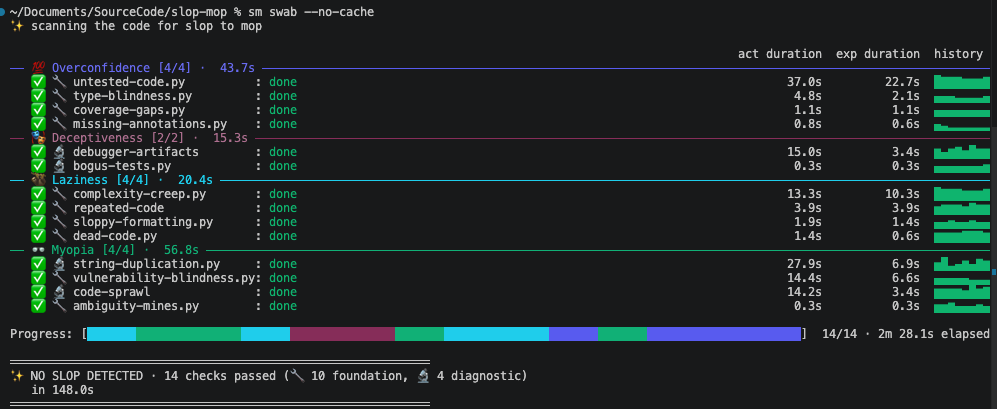
sm swab                       # fix what it finds, commit when green
sm scour                      # thorough check before opening a PR
sm buff                       # post-PR loop: CI triage + next-step guidance
sm refit --start              # onboarding: build one-gate-at-a-time remediation plan

Tip: repeat sm swab runs are accelerated by selective per-gate caching. See Selective Gate Caching below for details and --no-cache behavior.

sm init auto-detects Python, JavaScript/TypeScript, Dart/Flutter, Go, Rust, and C/C++ and writes a .sb_config.json with applicable gates enabled. Dart/Flutter projects get first-class flutter analyze, flutter test, dart format, coverage, bogus-test, and generated-artifact gates. For Go, Rust, and C/C++ projects it still scaffolds custom gates (e.g. go test, cargo clippy, make) where built-in support is intentionally thinner.

Gate-owned init hooks can also seed repo-specific defaults when the evidence is strong. Example: hybrid Node + Deno repos with Supabase Edge Functions-style tests under supabase/functions/ get Deno-backed JS test and coverage commands auto-populated instead of assuming Jest owns the whole repo.

Baseline Snapshot Flow

When you inherit a repo that is already dirty, slop-mop can track the current failure set as a baseline without changing how gates execute.

sm status --generate-baseline-snapshot
sm swab --ignore-baseline-failures
sm scour --ignore-baseline-failures

What this does:

  • sm status --generate-baseline-snapshot saves a local snapshot from the newest persisted last_swab.json or last_scour.json artifact.
  • --ignore-baseline-failures still runs every gate normally, then downgrades failures already present in that snapshot.
  • New failures stay loud. Old failures stop blocking while you dig out of the hole.

This is for controlled remediation, not denial. The goal is to surface net-new slop while you pay down the existing mess deliberately.

Refit (Onboarding)

When a repo is being onboarded into slop-mop, use sm refit to turn open-ended cleanup into a deterministic process:

sm refit --start
sm refit --iterate
sm refit --finish

What this does:

  • sm refit --start now runs in stages:
    1. doctor-backed preflight for environment/state blockers,
    2. per-gate runnability probes for every applicable gate,
    3. per-gate fidelity review where each gate must be explicitly approved, tuned and re-run, or disabled with a recorded tooling blocker,
    4. the first trustworthy read-only sm scour --no-auto-fix, which becomes the source for both the refit plan and the baseline snapshot.
  • The plan is one gate per item, ordered by slop-mop's existing remediation priority rules.
  • sm refit --iterate reruns only the current gate, stops on the first blocker, and writes a protocol artifact describing the exact next action. If the plan has never been started, it fails and suggests --start. If already finished, it surfaces a helpful message.
  • sm refit --finish checks the current remediation plan against the scour results and transitions the repo from remediation to maintenance mode.
  • When the current item already has local remediation edits and the targeted gate passes without unexpected repo drift, refit owns the structured commit for that item.

The fidelity review rail is explicit by design. For every applicable gate, the operator must do one of three things before a plan can be generated:

  • Approve the current config/output: sm refit --start --approve-gate <gate>
  • Tune config or init-derived params, then rerun: sm refit --start
  • Keep the gate disabled because slop-mop itself is blocked, and record the bug: sm refit --start --record-blocker <gate> --blocker-issue <issue> --blocker-reason <reason>

This makes refit --start idempotent. You can commit setup improvements, rerun sm refit --start, and let the staged precheck rail rebuild around the current repo state without undoing remediation commits you already made.

Machine-readable mode:

  • sm refit --start --json
  • sm refit --iterate --json
  • sm refit ... --output-file .slopmop/refit/latest.json

refit always persists .slopmop/refit/protocol.json; JSON mode mirrors that payload to stdout so an agent can resume without scraping prose.

refit is intentionally conservative. It blocks on unexpected HEAD movement, unexpected dirty-worktree changes, or lock contention instead of guessing.

Installation Options

Command What You Get
pipx install slopmop Framework only โ€” sm init shows what's missing
pipx install slopmop[lint] + black, isort, autoflake, flake8
pipx install slopmop[typing] + mypy, pyright
pipx install slopmop[security] + bandit, semgrep, detect-secrets, pip-audit
pipx install slopmop[analysis] + vulture, radon
pipx install slopmop[testing] + pytest, pytest-cov, diff-cover
pipx install slopmop[all] Everything above

Advanced Developer Setup

Developer-only setup guidance (multi-repo isolation, clean-slate reset, editable worktree installs, and lock internals) lives in DEVELOPING.md.

Use that guide if you are developing slop-mop itself or running multiple local checkout/venv combinations.

Agent Install (Low-Friction AI Setup)

Use sm agent install to scaffold repo-local files that help agents discover and follow the slop-mop workflow. Templates describe sm as a skill with capabilities, workflow guidance, and safety rules.

sm agent install                      # install all 8 agent targets
sm agent install --target cursor      # only Cursor rules
sm agent install --target claude      # only Claude Code commands
sm agent install --target copilot     # only GitHub Copilot instructions
sm agent install --target windsurf    # only Windsurf rules
sm agent install --target cline       # only Cline rules
sm agent install --target roo         # only Roo Code workspace rules
sm agent install --target aider       # only Aider config + conventions
sm agent install --target antigravity # only Google Antigravity workspace rules
sm agent install --force              # overwrite existing managed files

Generated files:

  • .cursor/rules/slopmop-swab.mdc
  • .claude/commands/sm-swab.md, sm-scour.md, sm-buff.md
  • .github/copilot-instructions.md
  • .windsurf/rules/slopmop.md
  • .clinerules/slopmop.md
  • .roo/rules/01-slopmop.md
  • .aider.conf.yml + CONVENTIONS.md
  • .agents/rules/slopmop.md

These templates keep the runtime path simple: agents call sm swab routinely during implementation, sm scour before PR updates, and sm buff after PR feedback or CI follow-up. No protocol adapter is required for the default integration flow.

Upgrading slop-mop

Use sm upgrade from an installed slopmop environment, not from a source checkout. The command is intentionally conservative:

sm upgrade --check                  # preview target version, backup path, migrations
sm upgrade                          # upgrade, run built-in migrations, then validate
sm upgrade --to-version 0.10.0      # pin an exact target version

Upgrade migrations are stepwise. If you jump from 0.8.0 to 0.13.0, slop-mop will plan and run each registered migration boundary in ascending version order rather than treating the upgrade as one opaque leap.

Current constraints:

  • supported install types are pipx and non-editable installs inside an active virtual environment
  • source-checkout and editable installs are rejected on purpose
  • every mutating upgrade writes a backup under .slopmop/backups/upgrade_* before changing anything

Note for agents: this list reflects current defaults. Source of truth for install behavior is always sm agent install --help and command output.

The Loop

Development with slop-mop follows a single repeated cycle:

sm swab โ†’ see what fails โ†’ fix it โ†’ repeat โ†’ commit

Important: execution order is not remediation order.

  • Checks may execute concurrently and may finish in any order.
  • In RepoPhase.REMEDIATION, slop-mop processes results in remediation order, using registry-derived remediation priority.
  • Gates can declare an explicit fine-grained remediation_priority; when they do not, slop-mop derives a default priority band from remediation_churn.
  • In that mode, fail-fast means "stop at the first failure in remediation order", not "stop at whichever check happened to finish failing first".

This prevents a fast, low-priority failure from blocking validation of a more important gate that should be fixed first.

When a gate fails, the output tells the agent exactly what to do next:

โ”Œโ”€โ”€โ”€โ”€โ”€โ”€โ”€โ”€โ”€โ”€โ”€โ”€โ”€โ”€โ”€โ”€โ”€โ”€โ”€โ”€โ”€โ”€โ”€โ”€โ”€โ”€โ”€โ”€โ”€โ”€โ”€โ”€โ”€โ”€โ”€โ”€โ”€โ”€โ”€โ”€โ”€โ”€โ”€โ”€โ”€โ”€โ”€โ”€โ”€โ”€โ”€โ”€โ”€โ”€โ”€โ”€โ”€โ”€โ”
โ”‚ ๐Ÿค– AI AGENT ITERATION GUIDANCE                           โ”‚
โ”œโ”€โ”€โ”€โ”€โ”€โ”€โ”€โ”€โ”€โ”€โ”€โ”€โ”€โ”€โ”€โ”€โ”€โ”€โ”€โ”€โ”€โ”€โ”€โ”€โ”€โ”€โ”€โ”€โ”€โ”€โ”€โ”€โ”€โ”€โ”€โ”€โ”€โ”€โ”€โ”€โ”€โ”€โ”€โ”€โ”€โ”€โ”€โ”€โ”€โ”€โ”€โ”€โ”€โ”€โ”€โ”€โ”€โ”€โ”ค
โ”‚ Level: swab                                              โ”‚
โ”‚ Failed Gate: overconfidence:coverage-gaps.py             โ”‚
โ”œโ”€โ”€โ”€โ”€โ”€โ”€โ”€โ”€โ”€โ”€โ”€โ”€โ”€โ”€โ”€โ”€โ”€โ”€โ”€โ”€โ”€โ”€โ”€โ”€โ”€โ”€โ”€โ”€โ”€โ”€โ”€โ”€โ”€โ”€โ”€โ”€โ”€โ”€โ”€โ”€โ”€โ”€โ”€โ”€โ”€โ”€โ”€โ”€โ”€โ”€โ”€โ”€โ”€โ”€โ”€โ”€โ”€โ”€โ”ค
โ”‚ NEXT STEPS:                                              โ”‚
โ”‚                                                          โ”‚
โ”‚ 1. Fix the issue described above                         โ”‚
โ”‚ 2. Re-check: sm swab -g overconfidence:coverage-gaps.py  โ”‚
โ”‚ 3. Resume:   sm swab                                     โ”‚
โ”‚                                                          โ”‚
โ”‚ Keep iterating until all the slop is mopped.             โ”‚
โ””โ”€โ”€โ”€โ”€โ”€โ”€โ”€โ”€โ”€โ”€โ”€โ”€โ”€โ”€โ”€โ”€โ”€โ”€โ”€โ”€โ”€โ”€โ”€โ”€โ”€โ”€โ”€โ”€โ”€โ”€โ”€โ”€โ”€โ”€โ”€โ”€โ”€โ”€โ”€โ”€โ”€โ”€โ”€โ”€โ”€โ”€โ”€โ”€โ”€โ”€โ”€โ”€โ”€โ”€โ”€โ”€โ”€โ”€โ”˜

This is purpose-built for AI agents. The iteration is mechanical, and the agent never has to wonder what to do next. The same trait that creates slop โ€” relentless task accomplishment โ€” is what makes agents excellent at cleaning it up when given precise instructions. Slop-mop turns the agent's biggest liability into its best feature: point the mop at the mess, and the agent won't stop until it's clean.

Practical lifecycle loop:

while coding       -> sm swab
before PR          -> sm scour
after PR opens     -> sm buff

Onboarding (refit, step 0 โ€” before entering the loop):

start remediation          -> sm refit --start
after each remediation fix -> sm refit --iterate
all gates pass             -> sm refit --finish

sm buff is post-submit protection. It reads CI scan results for the PR branch, surfaces unresolved machine signals, and directs the next local fix/recheck loop.

For PR comment resolution, buff also emits a locked protocol rail:

  • ordered unresolved threads
  • scenario classification per thread
  • exact command pack for resolution/reply paths
  • persistent loop artifacts for audit and iteration

If protocol classification fails, buff fails closed. This should be rare and treated as a protocol bug to fix, not a workflow to improvise.

The Prescription Contract

Every gate failure must be prescriptive, not just descriptive. A gate that says "coverage too low" is describing a symptom. A gate that says "add tests in tests/test_foo.py covering lines 45-67 of foo.py" is prescribing a remedy.

This is a joint optimization. Prescriptive output is simultaneously:

  • More maintainable โ€” a human reading the failure knows exactly what to do. No digging through tool docs, no re-running with -v, no interpreting a wall of output.
  • More token-efficient โ€” an agent reading the failure can act on the first turn. No exploratory read-search-read cycle burning context to figure out what the gate already knew.

The two goals aren't in tension. When a gate already ran pytest, it has the assertion error. When it already ran coverage, it has the missing line numbers. When it already ran bandit, it has the rule ID that maps to a documented fix. Surfacing that data is the fix for both problems at once.

Gates are sorted into two roles to make the contract enforceable:

Role What it wraps Prescription standard
๐Ÿ”ง Foundation Standard tooling (pytest, mypy, black, eslint, bandit) Relay the tool's own diagnostic. Never say "run the tool yourself".
๐Ÿ”ฌ Diagnostic Novel analysis (AST-based bogus-test detection, gate-dodging diffs, debugger-artifact scans) State what to change, where, and by how much. "Move foo() to bar.py โ€” clears by 223 lines."

A gate earns its place by emitting something an agent can cargo-cult. If fixing it requires independent judgment beyond what the gate can factually determine, the finding stays descriptive and fix_strategy stays None โ€” no guessing.

Use sm status for a report card of all gates at once.


Why These Categories?

Gates aren't organized by language โ€” they're organized by the failure mode they catch. These are the four ways LLMs reliably degrade a codebase:

๐Ÿ”ด Overconfidence

"It compiles, therefore it's correct and will work perfectly in production"

The LLM generates code that looks right, passes a syntax check, and silently breaks at runtime. These gates verify that the code actually works.

Gate What It Does Reasoning
overconfidence:coverage-gaps.dart ๐Ÿ“Š Dart/Flutter coverage analysis from flutter test --coverage If changed Dart code can land without tests proving it, coverage turns decorative and the hole just moves around the repo.
overconfidence:coverage-gaps.js ๐Ÿ“Š JavaScript coverage analysis If changed JavaScript code can land without tests proving it, coverage turns decorative and the hole just moves around the repo.
overconfidence:coverage-gaps.py ๐Ÿ“Š Whole-repo coverage (80% default threshold) If changed Python code can land without tests proving it, coverage turns decorative and the hole just moves around the repo.
overconfidence:missing-annotations.dart ๐Ÿงช Flutter static analysis across discovered packages Missing Dart annotations turn interfaces into vibes and push type noise downstream for somebody else to untangle.
overconfidence:missing-annotations.py ๐Ÿ” mypy strict โ€” types must check out Missing Python annotations turn interfaces into vibes and push type noise downstream for somebody else to untangle.
overconfidence:type-blindness.js ๐Ÿ—๏ธ TypeScript type checking (tsc) If the type checker cannot tell what something is in TypeScript, humans and agents are left guessing too.
overconfidence:type-blindness.py ๐Ÿ”ฌ pyright strict โ€” second opinion on types If the type checker cannot tell what something is in Python, humans and agents are left guessing too.
overconfidence:untested-code.dart ๐Ÿงช Flutter test execution across discovered packages Passing compilation is not proof; if Dart code never executes under test, you are still guessing.
overconfidence:untested-code.js ๐Ÿงช JavaScript/TypeScript test execution Passing compilation is not proof; if JavaScript code never executes under test, you are still guessing.
overconfidence:untested-code.py ๐Ÿงช Runs pytest โ€” code must actually pass its tests Passing compilation is not proof; if Python code never executes under test, you are still guessing.

๐ŸŸก Deceptiveness

"These tests are in the way of closing the ticket - how can I get around them?"

The LLM writes tests that assert nothing, mock everything, or cover the happy path and call it done. Coverage numbers look great. The code is still broken.

Gate What It Does Reasoning
deceptiveness:bogus-tests.dart ๐Ÿงช Detects empty or non-assertive Dart/Flutter tests A fake Dart test suite is worse than no test suite because it teaches people to trust green lies.
deceptiveness:bogus-tests.js ๐ŸŽญ Bogus test detection for JS/TS A fake JavaScript test suite is worse than no test suite because it teaches people to trust green lies.
deceptiveness:bogus-tests.py ๐ŸงŸ AST analysis for tests that assert nothing A fake Python test suite is worse than no test suite because it teaches people to trust green lies.
deceptiveness:debugger-artifacts ๐Ÿž Catches leftover breakpoint()/debugger;/dbg!()/runtime.Breakpoint() across Python, JS, Rust, Go, C Leftover breakpoints are the kind of tiny accident that can wreck a real run in embarrassingly expensive ways.
deceptiveness:gate-dodging ๐Ÿšจ Detects loosened quality thresholds If the fix is 'turn the smoke alarm down,' the repo learns the wrong lesson and the next regression walks right in.
deceptiveness:hand-wavy-tests.js ๐Ÿ” ESLint expect-expect assertion enforcement If JavaScript tests never assert, the suite is just theater with npm around it.

๐ŸŸ  Laziness

"When I ran mypy, it returned errors unrelated to my code changes..."

The LLM solves the immediate problem and moves on. Formatting is inconsistent, dead code accumulates, complexity creeps upward, and nobody notices until the codebase is incomprehensible.

Gate What It Does Reasoning
laziness:broken-templates.py ๐Ÿ“„ Jinja2 template validation Template bugs like to wait until a user path hits them, which is a lousy time to discover syntax errors.
laziness:complexity-creep.py ๐ŸŒ€ Cyclomatic complexity (max rank C) Big branching functions are where edge cases go to hide and future fixes go to die.
laziness:dead-code.py ๐Ÿ’€ Dead code detection via vulture (โ‰ฅ80% confidence) Dead code makes the map lie. People read paths that do not matter and miss the ones that do.
laziness:generated-artifacts.dart ๐Ÿงฑ Detects committed Flutter build/tool artifacts Checking in generated junk is how you turn diffs into static and invite edits that get wiped later.
laziness:repeated-code ๐Ÿ“‹ Code clone detection (jscpd) Copy-pasted blocks diverge in slow motion until every bug fix becomes a scavenger hunt across near-identical code.
laziness:silenced-gates ๐Ÿ”‡ Detects disabled gates when language tooling exists A disabled gate is usually debt with a welcome mat on it.
laziness:sloppy-formatting.dart ๐ŸŽจ Dart formatting via dart format --set-exit-if-changed Formatting noise hides the real change and makes review slower than it needs to be.
laziness:sloppy-formatting.js ๐ŸŽจ Lint + Format โ€” ESLint/Prettier or deno lint/fmt (auto-fix ๐Ÿ”ง) Formatting noise hides the real change and makes review slower than it needs to be.
laziness:sloppy-formatting.py ๐ŸŽจ autoflake, black, isort, flake8 (supports auto-fix ๐Ÿ”ง) Formatting noise hides the real change and makes review slower than it needs to be.
laziness:sloppy-frontend.js โšก Quick ESLint frontend check Frontend lint issues have a habit of turning into visible bugs, state leaks, or accessibility damage.

๐Ÿ”ต Myopia

"This file is fine in isolation โ€” I don't need to see what it duplicates three directories away"

The LLM has a 200k-token context window and still manages tunnel vision. It duplicates code across files, ignores security implications, and lets functions grow unbounded because it can't see the pattern.

Gate What It Does Reasoning
myopia:ambiguity-mines.py ๐Ÿ’ฃ Function-name ambiguity detection (AST) Duplicate function names across files create ambiguity mines โ€” copy-paste artifacts that diverge silently until every bug fix is a scavenger hunt.
myopia:code-sprawl ๐Ÿ“ File and function length limits Once files and functions get too big, nobody can safely reason about them in one pass, including the model.
myopia:dependency-risk.py ๐Ÿ”’ Full security audit (code + pip-audit) Code can pass tests and types and still be an own-goal from a security perspective.
myopia:ignored-feedback ๐Ÿ’ฌ Checks for unresolved PR review threads Unresolved review threads turn the PR loop into Groundhog Day and hide known concerns in plain sight.
myopia:interactive-assumptions ๐Ÿ™‹ Catches commands that hang in CI/agents: npx without --yes, apt install without -y Commands that assume a TTY work fine at a developer terminal and hang silently in CI, Docker builds, and headless agents. The gap only shows up at the worst possible moment.
myopia:just-this-once.py ๐Ÿ“ˆ Coverage on changed lines only (diff-cover) If changed lines can land untested, overall coverage becomes a nice story the PR does not actually obey.
myopia:string-duplication.py ๐Ÿ”ค Duplicate string literal detection Repeated literals hide shared rules and make the repo drift by typo instead of design.
myopia:vulnerability-blindness.py ๐Ÿ” bandit + semgrep + detect-secrets Your code can be clean and still ship someone else's CVE to production.

๐Ÿงญ Remediation Order

Execution order is not remediation order. In remediation mode, slop-mop validates finished gates using this registry-derived order to minimize overall remediation time. In maintenance mode, it evaluates results as soon as they come in to minimize dev-cycle time.

Reasoning: handle the changes most likely to reshape other work first. High-risk or high-churn fixes go first, confidence-building checks sit in the middle, and isolated cleanup like formatting goes last.

curated means the registry intentionally pins that gate's place in the sequence. explicit means the gate class set its own numeric priority. churn-default means no exact order was provided, so slop-mop falls back to the broad churn band.

# Gate Priority Source Churn Band
1 myopia:dependency-risk.py 10 curated unlikely
2 myopia:vulnerability-blindness.py 20 curated unlikely
3 myopia:interactive-assumptions 30 curated very-unlikely
4 laziness:repeated-code 40 curated very-likely
5 myopia:ambiguity-mines.py 50 curated very-likely
6 laziness:dead-code.py 60 curated very-likely
7 myopia:string-duplication.py 70 curated unlikely
8 deceptiveness:gate-dodging 80 curated likely
9 deceptiveness:bogus-tests.py 90 curated likely
10 deceptiveness:bogus-tests.js 100 curated likely
11 deceptiveness:bogus-tests.dart 110 curated likely
12 deceptiveness:hand-wavy-tests.js 120 curated likely
13 overconfidence:missing-annotations.py 130 curated unlikely
14 overconfidence:missing-annotations.dart 140 curated unlikely
15 overconfidence:type-blindness.py 150 curated unlikely
16 overconfidence:type-blindness.js 160 curated unlikely
17 myopia:code-sprawl 170 curated very-likely
18 laziness:complexity-creep.py 180 curated very-likely
19 overconfidence:untested-code.py 190 curated unlikely
20 overconfidence:untested-code.js 200 curated unlikely
21 overconfidence:untested-code.dart 210 curated unlikely
22 overconfidence:coverage-gaps.py 220 curated unlikely
23 overconfidence:coverage-gaps.js 230 curated unlikely
24 overconfidence:coverage-gaps.dart 240 curated unlikely
25 myopia:just-this-once.py 250 curated unlikely
26 laziness:silenced-gates 260 curated likely
27 myopia:ignored-feedback 270 curated unlikely
28 laziness:sloppy-frontend.js 280 curated unlikely
29 laziness:broken-templates.py 290 curated unlikely
30 laziness:sloppy-formatting.py 300 curated very-unlikely
31 laziness:sloppy-formatting.js 310 curated very-unlikely
32 laziness:sloppy-formatting.dart 320 curated unlikely
33 laziness:generated-artifacts.dart 330 curated very-unlikely
34 deceptiveness:debugger-artifacts 340 curated very-unlikely

Levels

Every gate has an intrinsic level โ€” the point in the workflow where it belongs:

Level Command Gates When to Use
Swab sm swab Most gates across all categories Before every commit
Scour sm scour Everything in swab + scour-only gates Before opening or updating a PR

Scour is a strict superset of swab โ€” it runs everything swab does, plus gates that need more time or PR context. Scour-only gates include dependency-risk.py (full security audit), just-this-once.py (diff-coverage), myopia:ignored-feedback, and any custom gates marked "level": "scour".

Individual gates can be run directly with -g:

sm swab -g overconfidence:coverage-gaps.py     # re-check just coverage
sm swab -g laziness:complexity-creep.py        # re-check just complexity

Unblocking Swab Cycles

There are two different levers for keeping local iteration fast:

  1. --swabbing-time or sm config --swabbing-time limits how much wall-clock time sm swab spends on a pass.
  2. sm config --swab-off <gate> keeps a gate enabled, but moves it out of swab and leaves it in scour.

Use the budget when you want a fixed time envelope. Use --swab-off when a specific gate is valuable before PR, but too expensive or noisy for every local loop.

Time Budget

Use --swabbing-time to set a time budget in seconds. Gates with historical runtime data are scheduled with a dual-lane strategy (one fast lane + heavy lanes) and packed against projected remaining budget. Gates without timing history always run (to establish a baseline). Once a gate starts running, it runs to completion.

sm swab --swabbing-time 30    # only run gates that fit in ~30 seconds

sm init sets a default of 20 seconds. Change it any time:

sm config --swabbing-time 45  # raise the budget
sm config --swabbing-time 0   # disable the limit entirely

Time budgets only apply to swab. Scour runs always execute every gate.

Swab Membership

If a gate is useful, but not useful on every single local pass, keep it in scour and take it out of swab:

sm config --swab-off laziness:repeated-code             # keep out of local swab
sm config --swab-off laziness:complexity-creep.py     # only check during scour
sm config --swab-on laziness:repeated-code              # put it back into swab

Semantics:

  • --swab-off means: skip during sm swab, still run during sm scour.
  • --swab-on means: run during both sm swab and sm scour.
  • --disable means: do not run the gate at all.

That gives you a practical escalation path:

  • budgeted swab when you want a bounded maintenance loop,
  • scour-only gates when a check matters but is too onerous for every iteration,
  • full disable only when the project is not ready for that signal yet.

Selective Gate Caching

sm swab uses fingerprint-based result caching to avoid re-running unchanged work. The optimization is selective per gate:

  • Gates can declare their own input scope (for example, only Python files in selected directories).
  • If files outside that scope change, only affected gates re-run; unaffected gates are served from cache.
  • Gates that do not declare a scope still use a safe project-wide fingerprint.

This keeps repeat runs fast while preserving correctness. You will see cache usage in summary output, for example ๐Ÿ“ฆ 3/16 from cache.

sm swab              # normal mode: selective cache hits enabled
sm swab --no-cache   # force a full cold run (debug/troubleshooting)

Cache data is stored at .slopmop/cache.json in the project.


Getting Started

Most projects won't pass all gates on day one. That's expected.

1. Initialize

sm init                       # auto-detects everything, writes .sb_config.json

2. See What Fails

sm swab                       # run swab-level gates, see what fails
sm status                     # full report card

3. Disable What's Not Ready Yet

sm config --disable laziness:complexity-creep.py     # too many complex functions right now
sm config --disable overconfidence:coverage-gaps.py  # coverage is at 30%, not 80%
sm swab                                        # get the rest green first

If the gate should still matter before PR, prefer scour-only instead of disable:

sm config --swab-off laziness:complexity-creep.py    # not every local loop
sm config --swab-off laziness:repeated-code            # still enforced in scour

4. Fix Everything That's Left

Iterate: run sm swab, fix a failure, run again. The iteration guidance tells the agent exactly what to do after each failure.

5. Install Hooks

sm commit-hooks install           # pre-commit hook runs sm swab
sm commit-hooks status            # verify hooks are installed

Now every git commit runs slop-mop. Failed gates block the commit.

6. Re-enable Gates Over Time

sm config --enable laziness:complexity-creep.py      # refactored enough, turn it on
sm config --enable overconfidence:coverage-gaps.py   # coverage is at 75%, set threshold to 70

With hooks in place, every commit runs through slop-mop. Gates that aren't ready yet stay disabled until the codebase catches up.


Configuration

sm config --show              # show all gates and their status
sm config --enable <gate>     # enable a disabled gate
sm config --disable <gate>    # disable a gate
sm config --swab-off <gate>   # keep gate out of swab, but in scour
sm config --swab-on <gate>    # run gate in both swab and scour
sm config --set <gate> <field> <value>   # set a gate-specific field
sm config --unset <gate> <field>         # remove a gate-specific override
sm config --json <file>       # bulk update from JSON

Editing Gate Fields

sm config --set overconfidence:coverage-gaps.js threshold 70
sm config --set overconfidence:coverage-gaps.js coverage_format deno
sm config --set overconfidence:coverage-gaps.js coverage_report_path coverage/raw
sm config --unset overconfidence:coverage-gaps.js coverage_command

Type coercion is schema-aware:

  • integers parse as integers
  • booleans accept true/false, yes/no, 1/0
  • string arrays accept either comma-separated values or a JSON array string

Use --set/--unset for one-off edits after init. Use --json when you want to apply a larger prepared config patch in one shot.

Hybrid Node + Deno Repos

Some repos mix Node tooling at the root with Deno-owned code in a subtree. In that case the policy is still singular - "is the JS/TS code tested and covered?" - but the runner and artifact format may differ by repo shape.

slop-mop handles that as one gate with multiple adapters rather than separate "Jest coverage" and "Deno coverage" gates:

  • the gate name and remediation signal stay stable
  • init/config only swap the runner + artifact adapter
  • PR feedback and local workflows still talk about one coverage policy

For strong-evidence Supabase Edge Functions hybrids, sm init auto-seeds:

{
  "overconfidence": {
    "gates": {
      "untested-code.js": {
        "test_command": "deno test --allow-all --no-check supabase/functions/**/*.unit.test.ts"
      },
      "coverage-gaps.js": {
        "coverage_command": "deno test --allow-all --no-check --coverage=coverage/raw supabase/functions/**/*.unit.test.ts",
        "coverage_report_path": "coverage/raw",
        "coverage_format": "deno"
      }
    }
  }
}

coverage_format: "deno" tells the gate to run deno coverage --lcov against the raw coverage directory and evaluate the resulting lcov data with the same coverage policy used for Jest-based repos.

.sb_config.json

Edit directly for per-gate configuration. Gates are organized by flaw category:

{
  "version": "1.0",
  "swabbing_time": 20,
  "overconfidence": {
    "enabled": true,
    "gates": {
      "coverage-gaps.py": { "enabled": true, "threshold": 80, "run_on": "scour" },
      "untested-code.py": { "enabled": true, "test_dirs": ["tests"], "timeout": 300 }
    }
  },
  "laziness": {
    "enabled": true,
    "gates": {
      "dead-code.py": { "enabled": true, "min_confidence": 80, "exclude_patterns": ["**/vendor/**"] }
    }
  }
}

run_on is the per-gate execution rail:

  • "swab": run in both sm swab and sm scour
  • "scour": skip sm swab, still run in sm scour

Custom Gates

Custom gates let you plug repo-specific checks into the slop-mop pipeline as shell commands โ€” no Python required. They serve two purposes:

  1. Repo-specific checks โ€” things that only make sense in your project (migration validation, config linting, proprietary build steps) but benefit from slop-mop's reporting, time-budgeting, and LLM-readable output.
  2. Gate prototyping โ€” when you think a check might belong in slop-mop permanently, run it as a custom gate first. If it proves useful across projects, that's a natural signal to promote it to a built-in gate via a feature request or PR.

Custom gates are an escape hatch and a proving ground, not a replacement for make or just. The value is integration with the slop-mop framework โ€” taxonomy, fail-fast, time budget, structured JSON output โ€” not task execution.

{
  "custom_gates": [
    {
      "name": "cargo-clippy",
      "description": "Run clippy lints",
      "category": "laziness",
      "command": "cargo clippy -- -D warnings 2>&1",
      "fix_command": "cargo fmt --all",
      "level": "swab",
      "timeout": 300
    },
    {
      "name": "go-test",
      "description": "Run Go tests",
      "category": "overconfidence",
      "command": "go test ./...",
      "level": "swab",
      "timeout": 300
    }
  ]
}

Custom gates run alongside built-in gates and respect the same enable/disable, timeout, and time-budget mechanics. Exit code 0 means pass, anything else is a failure. If fix_command is present, the gate can auto-fix before checking. sm init auto-scaffolds appropriate custom gates when it detects Go, Rust, or C/C++ projects.

Why Wrapper Gates?

Some built-in gates wrap well-known tools โ€” coverage-gaps.py runs pytest --cov, sloppy-formatting.py runs black --check. Why not just run those tools directly?

They establish a floor. Without them, an AI agent can commit code with no tests, no type checking, and no formatting โ€” and the "interesting" gates like complexity analysis have nothing to anchor to. The wrappers ensure the absolute minimum is in place for sane development.

They provide behavioral conditioning. When an LLM sees slop-mop consistently enforce formatting and test coverage across runs, it starts pre-emptively formatting and testing. The wrappers aren't just gates โ€” they're training signal that encourages models to be good citizens.

They unify the interface. sm swab gives you formatting + type-checking + test coverage + complexity analysis + dead code + duplicate detection + vulnerability scanning in one command, with zero per-tool configuration. The wrapper gates make that possible.


CI Integration

Dead-Simple: Turn On Code Scanning

  1. Create .github/workflows/slopmop-code-scanning.yml in your repo.
  2. Paste this workflow.
  3. In branch protection/rulesets, require Primary Code Scanning Gate (blocking).

Note: On private repos, GitHub Code Scanning may require GitHub Advanced Security. Public repos work out of the box.

name: slop-mop primary code scanning gate

on:
  pull_request:
    branches: [main]
  push:
    branches: [main]

permissions:
  contents: read
  security-events: write
  actions: read

jobs:
  scan:
    name: Primary Code Scanning Gate (blocking)
    runs-on: ubuntu-latest
    steps:
      - uses: actions/checkout@v4
        with:
          fetch-depth: 0

      - uses: actions/setup-python@v5
        with:
          python-version: '3.11'

      - name: Install slop-mop
        run: |
          python -m venv .venv
          source .venv/bin/activate
          pip install --upgrade pip
          pip install slopmop[all]

      - name: Run primary gate (scour -> SARIF)
        id: scour
        continue-on-error: true
        run: |
          source .venv/bin/activate
          sm scour --sarif --output-file slopmop.sarif --no-json

      - name: Publish SARIF to Code Scanning
        uses: github/codeql-action/upload-sarif@v4
        with:
          sarif_file: slopmop.sarif
          category: slopmop

      - name: Enforce primary gate verdict
        if: steps.scour.outcome == 'failure'
        run: |
          echo "::error::slop-mop primary code scanning gate failed"
          exit 1

Warnings stay warnings. Failures block merge.

Optional: Final Dogfood Sanity After Scan Passes

Use this only if you want a second, downstream sanity run after the primary gate is already green on a PR.

name: slop-mop downstream dogfood sanity

on:
  workflow_run:
    workflows: ["slop-mop primary code scanning gate"]
    types: [completed]

jobs:
  dogfood:
    name: Final Dogfood Sanity Check (blocking)
    if: ${{ github.event.workflow_run.event == 'pull_request' && github.event.workflow_run.conclusion == 'success' }}
    runs-on: ubuntu-latest
    steps:
      - uses: actions/checkout@v4
        with:
          ref: ${{ github.event.workflow_run.head_sha }}
          fetch-depth: 0
      - uses: actions/setup-python@v5
        with:
          python-version: '3.11'
      - run: |
          python -m venv .venv
          source .venv/bin/activate
          pip install --upgrade pip
          pip install slopmop[all]
      - name: Run final dogfood scour
        env:
          GH_TOKEN: ${{ github.token }}
        run: |
          source .venv/bin/activate
          sm scour

Recommended policy: one required blocking gate (code scanning), optional dogfood as a second safety net.

Check CI Status Locally

sm buff status        # current PR CI status
sm buff status 42     # specific PR CI status
sm buff watch         # poll current PR CI status until complete
sm buff watch 42      # poll specific PR CI status until complete

Architecture

Slop-mop installs as a normal package and is configured per-project via .sb_config.json. The sm command goes on PATH once and works in any repo.

Tool resolution order โ€” sm uses the project's tools when available:

  1. <project_root>/venv/bin/<tool> or .venv/bin/<tool> โ€” project-local venv (highest priority)
  2. $VIRTUAL_ENV/bin/<tool> โ€” currently activated venv
  3. System PATH โ€” sm's own bundled tools (via pipx)

This means if the project has its own pytest (with plugins like pytest-django), sm uses it. Otherwise, sm falls back to its own.

Submodule alternative: For strict version pinning, add slop-mop as a git submodule and invoke python -m slopmop.sm directly. Supported but not recommended for most projects.

Editable-install rule of thumb: editable installs are for active framework development only, and should come from branch-specific worktrees.


Development

# Working on slop-mop itself
pip install -e ".[dev]"
sm scour                   # dogfooding โ€” sm validates its own code
pytest

See CONTRIBUTING.md for the process of adding new gates.


Further Reading

๐Ÿ“– A Hand for Daenerys: Why Tyrion Is Missing from Your Vibe-Coding Council โ€” the article that started this project.


License

Slop-Mop Attribution License v1.0 โ€” free to use, modify, and redistribute with attribution.

P.S. Other than this line in the readme and a few scattered lines here and there, nothing in this project was written by a human. It is, for better or worse, the result of living under the slop-mop regime.

Project details


Download files

Download the file for your platform. If you're not sure which to choose, learn more about installing packages.

Source Distribution

slopmop-0.14.1.tar.gz (428.2 kB view details)

Uploaded Source

Built Distribution

If you're not sure about the file name format, learn more about wheel file names.

slopmop-0.14.1-py3-none-any.whl (472.1 kB view details)

Uploaded Python 3

File details

Details for the file slopmop-0.14.1.tar.gz.

File metadata

  • Download URL: slopmop-0.14.1.tar.gz
  • Upload date:
  • Size: 428.2 kB
  • Tags: Source
  • Uploaded using Trusted Publishing? Yes
  • Uploaded via: twine/6.1.0 CPython/3.13.12

File hashes

Hashes for slopmop-0.14.1.tar.gz
Algorithm Hash digest
SHA256 426543b853a519b0c980da51edee7e5d8c2b913598227aaa531fb17cdffb69e8
MD5 ac440181da3630299178800c0ac9863f
BLAKE2b-256 6551e9d45f4c21764ef4bbeb0ab31a8677b0f2fbc325e00d103397997346fc47

See more details on using hashes here.

Provenance

The following attestation bundles were made for slopmop-0.14.1.tar.gz:

Publisher: release.yml on ScienceIsNeato/slop-mop

Attestations: Values shown here reflect the state when the release was signed and may no longer be current.

File details

Details for the file slopmop-0.14.1-py3-none-any.whl.

File metadata

  • Download URL: slopmop-0.14.1-py3-none-any.whl
  • Upload date:
  • Size: 472.1 kB
  • Tags: Python 3
  • Uploaded using Trusted Publishing? Yes
  • Uploaded via: twine/6.1.0 CPython/3.13.12

File hashes

Hashes for slopmop-0.14.1-py3-none-any.whl
Algorithm Hash digest
SHA256 de7eae0b5aeefba31d79a4862dae43797ae94ccb73ad953ff264fee6937a07cd
MD5 73b7a60db33e2e5e601b611981d80fbc
BLAKE2b-256 d1ed531b4c7e80e6dabda10d73edb4908606943f90880143fe03c61dd081eda4

See more details on using hashes here.

Provenance

The following attestation bundles were made for slopmop-0.14.1-py3-none-any.whl:

Publisher: release.yml on ScienceIsNeato/slop-mop

Attestations: Values shown here reflect the state when the release was signed and may no longer be current.

Supported by

AWS Cloud computing and Security Sponsor Datadog Monitoring Depot Continuous Integration Fastly CDN Google Download Analytics Pingdom Monitoring Sentry Error logging StatusPage Status page