
Heuristic linter that scores AI residue in commits and PRs 0-100 with evidence - flags craft, not authorship

Project description
slopscore



Catch the slop before it ships.
AI tools leave fingerprints — em-dashes, a rocket 🚀 emoji no human would
ever type by hand, stray Co-Authored-By: Claude trailers,
# ... rest of the code unchanged stubs, ghost import declarations,
Summary by CodeRabbit stamps. slopscore detects these AI-generated
tells by putting a number on them: every commit, push and PR scored out
of 100, every finding backed by evidence, all before it ships.
Install
pip install slopscore
Then, inside each repo you want watched:
slopscore install-hooks
That second step is the point of the tool - a score on every commit and push. Python 3.11 or newer. No other dependencies.
Plenty of tools lint AI residue in code. Nothing else scores the prose that ships with it - the commit messages and PR text where the residue lives in git history forever. It starts as a nudge; one git config turns it into a hard gate that refuses any commit or push over your threshold, and off again just as fast.
It flags craft, not authorship. slopscore never claims "this is AI" - it
points at fixable leftovers with evidence, like a linter flagging a missing
semicolon. (Style-based AI detection is unreliable and biased against
second-language writers, so it refuses to do it: 24 real pre-2020 human PRs
must score LOW forever - tests/test_holdout.py.) Everything runs locally: no
LLM, no network, no telemetry.
Who runs it
Two kinds of people, both on their own work:
- You used AI and want to ship clean. Catch the residue - a leftover trailer, a placeholder stub, unedited boilerplate - before a reviewer does. Run it on yourself via the hooks, or as a shared standard in CI (report-only for repos with outside contributors).
- You didn't use AI but fear a detector will say you did. Formal and
second-language writers get wrongly flagged constantly. Turn on the thorough
tier (
--strict) and slopscore shows your own writing through a crude detector's eyes - the em-dashes, the "delve", the scaffolding those tools latch onto - with evidence for every hit. slopscore is not intelligent, and neither are the detectors: that is the point. It shows you your attack surface before someone else's dumb tool does, so you can shrink it on your own terms. It does not believe these tells prove AI; it refuses that.
Either way the score is information, never an accusation: the verdict is the only gate, and honest human work is built to pass.
Tested against reality
Every claim above is measured, not asserted. The signals are validated against nearly 5,000 real commits and PR bodies from public GitHub history, under pre-registered rules: the metric and the pass bar are written down before the data is scored, every rejected idea is logged, and a held-out set of 24 pre-2020 human PRs is never tuned against - CI enforces that it scores LOW forever.
- 2,300+ real human commits and PR bodies (pre-2022, definitionally pre-LLM): zero false flags.
- 1,700+ commits and PR bodies carrying real AI attribution: 99.9% flagged.
- 785 disciplined, human-reviewed AI-assisted commits: all PASS. It measures residue, not authorship - AI-assisted work that someone actually edited scores like human work.
When the corpus catches the engine being wrong, the engine changes - and signals that false-fired on real humans were rejected and stay rejected.
Try it
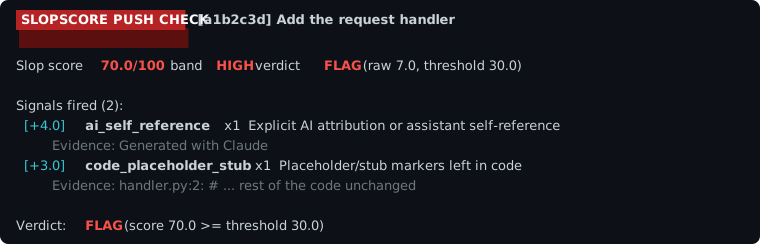
Scoring a commit on its way out - the message and the staged code, with each finding pinned to where it is:
Or score raw text from the command line:
echo "Certainly! Let's delve into a robust refactor. Generated with Claude Code." | slopscore --text -
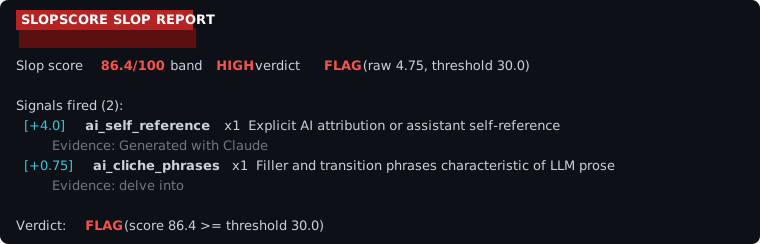
Drop the "Generated with Claude Code." sentence and it falls to 13.6, PASS -
single weak signals are normal writing; only convergence flags. (No install
needed to play: swap slopscore for uvx slopscore in any of these.)
The score is a gradient - how much AI residue is in the text, not a yes/no. A low non-zero score is light texture, not an accusation; the verdict is the only gate, and it is tuned so honest human work passes.
- Bands: LOW below 30, MEDIUM 30 to under 70, HIGH 70 and up. The verdict FLAGs at/above the threshold (default 30), so MEDIUM and HIGH both flag.
- The exit code follows the verdict:
0pass,1flag,2usage error - so it drops straight into CI or a git hook. - Evidence carries
path:linefor code; JSON input gets prose locations too (body:14,commit[2]:1).
On a terminal the report is coloured by band (green/amber/red); piped output
stays plain. --color and NO_COLOR override.
Four ways to use it
1. The CLI - check your work by hand.
# score a PR/issue described as JSON ({title, body, commits})
slopscore pr.json
# or raw text, or stdin
echo "Quick fix. Generated with Claude Code." | slopscore --text -
# scan code files too (go wide on your working tree)
slopscore --files src/*.py --json
# thorough tier: also score the opt-in signals (see "Who runs it")
slopscore --strict pr.json
2. Git hooks - score every commit and push; block them when you say so.
slopscore install-hooks
Or via the pre-commit framework:
repos:
  - repo: https://github.com/koopatroopa/slopscore
    rev: v0.1.0
    hooks:
      - id: slopscore-commit-msg
      - id: slopscore-pre-push
commit-msg scores your message plus the staged code; pre-push scores each
outgoing commit (flagged ones reported as [abc1234] Subject, clean pushes
silent). Advisory by default - they never block until you ask. The gate is
one setting, per repo, instant in both directions:
git config slopscore.block true       # gate ON: refuse commits/pushes at/above the threshold
git config slopscore.threshold 50     # move the bar (default 30)
git config slopscore.block false      # gate OFF: back to advisory
git config slopscore.strict true      # thorough tier: score the opt-in signals too
Escape hatches even with the gate on: git commit --no-verify (or push) skips
it once; SLOPSCORE_BLOCK=0 (or =1) overrides the setting for one command.
Every report's footer tells you the current state and the command to flip it.
3. Claude Code - make the agent clean up after itself.
/plugin marketplace add koopatroopa/slopscore
/plugin install slopscore@slopscore
Then restart the session once - hooks attach at session start, so the scoring begins from your next conversation.
Every git commit the agent makes gets scored; a flagged report is fed
straight back to the agent, which lays out each finding's evidence and asks
before touching anything - you decide what gets cleaned, finding by
finding. /slopscore:clean runs the full remediation loop - the agent fixes
each piece of evidence, amends, and re-scores until the commit passes, with
the deterministic linter as the gate on the rewrite. Advisory only - it
never blocks, and it works on macOS, Linux and Windows alike (the hook is
the CLI itself, no shell involved).
The plugin needs the CLI (uv tool install slopscore) - and if it is
missing, Claude is told at session start and will offer to install it for
you, then offer the git hooks so your own commits are covered too. To
remove: /plugin uninstall slopscore, then uv tool uninstall slopscore
and (if you installed the git hooks) delete the slopscore shims from
.git/hooks/.
4. CI - the same gate on every PR, two lines on either platform.
Both recipes score the PR/MR's prose (title + description) plus the diff's
added lines, report-only until you flip the gate (exit 0 pass, 1 flag).
It runs on every contributor, so it is a shared craft standard - keep it
report-only on repos with outside contributors.
GitHub (run it under pull_request, not pull_request_target - slopscore
only needs to read the diff, never repo write access or secrets):
on: pull_request
permissions:
  contents: read
# ...
- uses: actions/checkout@v4
  with: { fetch-depth: 0 }
- uses: koopatroopa/slopscore@v0   # pin to a tag
  with: { fail-on-flag: "false" }  # "true" = gate the merge
GitLab:
include:
  - remote: https://raw.githubusercontent.com/koopatroopa/slopscore/main/ci/slopscore.gitlab-ci.yml
The GitLab job ships advisory (allow_failure: true); redeclare the job to
remove that or set SLOPSCORE_THRESHOLD. Any other CI works the same way:
pip install slopscore, feed it --text and --diff, gate on the exit
code.
What it looks for
Signals that are on by default - distinctive leftovers with a very low false-positive rate:
ai_self_reference- explicit AI attribution: trailers ("Co-Authored-By: Claude"), assistant self-talk ("As an AI..."), and the stamps AI review bots leave in PR bodies ("## Summary by CodeRabbit", aider's auto-generated-PR header)ai_cliche_phrases- chatbot filler ("delve into", "it's worth noting")code_placeholder_stub- placeholder markers left in code ("// ... rest of code", "your implementation here"), reported with file and line.em_dash_density,emoji_densityandcurly_quotes- U+2014, decorative emoji and word-processor quotes are not on your keyboard; in coding artefacts they arrive via tooling. These only ever add to a score (they are excluded from the normalisation ceiling), so enabling or disabling them cannot dilute the signals above - and their combined contribution is capped, so however many fire at once they can colour a score but never flag on their own. Real Greenkeeper-era PR bodies taught us that one.
Signals that are opt-in, because humans genuinely type them:
code_undeclared_import- an import that is not in the standard library, not declared in your manifest and not a local module - possibly a package the model made up. It reads yourpyproject/requirementsand never imports or installs anything.sycophantic_openers("Certainly!", "Hope this helps!") - chat register, not commit register: across 2,500+ real AI-attributed commits and PR bodies it fired zero times, and its only corpus hits were friendly humans. Kept for scanning pasted chat output.promotional_adjectives("robust", "comprehensive"),section_scaffolding(## Overviewheaders - PR templates generate these),bold_lead_in_lists,negative_parallelism("not just X, but Y" and its TED-talk cousins),rhetorical_qa("Why? Because...") andvague_authority("studies show").
Configure it
A TOML config toggles any signal, overrides weights and sets the threshold:
threshold = 40

[signals]
emoji_density = false           # opt a default signal out
code_undeclared_import = true   # opt the import check in

[weights]
ai_self_reference = 6.0
Point each surface at it:
slopscore --config slopscore.toml --files src/*.py   # CLI
git config slopscore.config slopscore.toml           # hooks, per repo
# Action: pass `config: "slopscore.toml"` in the workflow's `with:` block
Honest about its limits
- Calibration is validated on the corpus above: humans top out at a score of 25, real attributed-AI sits at 70+, and the flag bar (30) lives in the empty gap between them. An explicit attribution trailer is a certain tell, so it scores HIGH on its own; weak signals must converge to get there.
- The corpus has an era gap by construction: the human side is pre-2022 (provably pre-LLM), the AI side is 2023+. Stated, not pretended away - a pass against modern human PR-template prose is the known next step.
- The import check resolves against your manifest; import-name vs package-name
mismatches (
yamlvsPyYAML) are only partly covered by an alias map - hence opt-in.requirements.txt-rincludes are not followed. - It is a signal, not a judge. A high score means "give this a second read", never "this is AI".
Design
The detection engine is framework-free; the CLI, git hooks and Action are thin front-ends over it. Heuristic-only by design - the value is the discipline (low false-positive, evidence-backed, craft not authorship), not a cleverer classifier.
MIT licensed.
Release history Release notifications | RSS feed


Download files
Download the file for your platform. If you're not sure which to choose, learn more about installing packages.
Source Distribution
Built Distribution
Filter files by name, interpreter, ABI, and platform.
If you're not sure about the file name format, learn more about wheel file names.
Copy a direct link to the current filters
File details
Details for the file slopscore-0.1.1.tar.gz.
File metadata
- Download URL: slopscore-0.1.1.tar.gz
- Upload date:
- Size: 59.2 kB
- Tags: Source
- Uploaded using Trusted Publishing? No
- Uploaded via: uv/0.9.3
File hashes
| Algorithm | Hash digest | |
|---|---|---|
| SHA256 |
970ef2b6acea850b08acde898e84b96042b354a7d52d56850752f387ea809d7c
|
|
| MD5 |
a82c7b859406bbbffafc20f328778d67
|
|
| BLAKE2b-256 |
3dbd3bff4be6fd2bebaf051f6ea5be65be656995b37d8726ec26e82f04912f68
|
File details
Details for the file slopscore-0.1.1-py3-none-any.whl.
File metadata
- Download URL: slopscore-0.1.1-py3-none-any.whl
- Upload date:
- Size: 35.5 kB
- Tags: Python 3
- Uploaded using Trusted Publishing? No
- Uploaded via: uv/0.9.3
File hashes
| Algorithm | Hash digest | |
|---|---|---|
| SHA256 |
0a2c2ae7f12c60ac6ae08c65cf974e8323ba83f51e427a1ee29c481915bf0f88
|
|
| MD5 |
0e10f881586c88ba9aca61b9f2101bca
|
|
| BLAKE2b-256 |
03f579ddde008cb1a3939536ead4adf944994640dfd1ec7a75974f1cfbc6639c
|






