
slowimports
Find out why your Python program is slow to start — and what to do about it.




Every Python CLI eventually gets slow to launch, and it is almost never the
code that runs. It is an import at the top of a file that is only needed on one
branch, pulling half a dependency tree in before --help can print.
python -X importtime will tell you where the milliseconds went, in nine
hundred lines of nested output. slowimports reads that, and then reads your
source, and tells you which imports you can actually move:
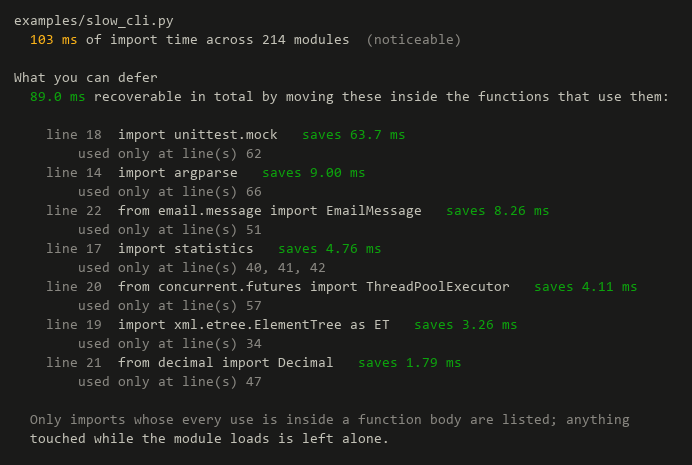
That last part is the point. Knowing unittest.mock costs 64 ms is trivia;
knowing it is only referenced inside one function, and that moving it there
recovers those 64 ms, is a change you can make in ten seconds.
Install
$ pip install slowimports
No dependencies. A tool that measures import cost has no business adding
any of its own — subprocess runs the target, ast reads the source, and
that is the whole shopping list. Python 3.9+, Linux, macOS and Windows.
Use
$ slowimports myscript.py            # a script
$ slowimports -m pytest              # a module
$ slowimports mytool                 # an installed command
$ slowimports -c 'import pandas'     # a single import
Installed commands are imported, not run
For an installed command such as pip, slowimports finds the module named by
its console_scripts entry point and imports that module under
-X importtime. It deliberately does not call the entry-point function:
that keeps profiling from performing the command's real work or other side
effects. The result covers startup imports, not wrapper overhead, argument
parsing, or work done after the entry function starts.
On Windows these commands are native .exe launchers, so their module name
cannot be read as Python source. slowimports instead reads the standard
entry-point metadata with the selected interpreter and, for versioned aliases
such as pip3.13, the launcher's bounded embedded Python wrapper. It refuses
to guess if those sources conflict, if the launcher is outside that
interpreter's Scripts directory, or if more than one installed distribution
declares the same command. If the command belongs to another environment, put
it on PATH and pass that environment's Python with --python.
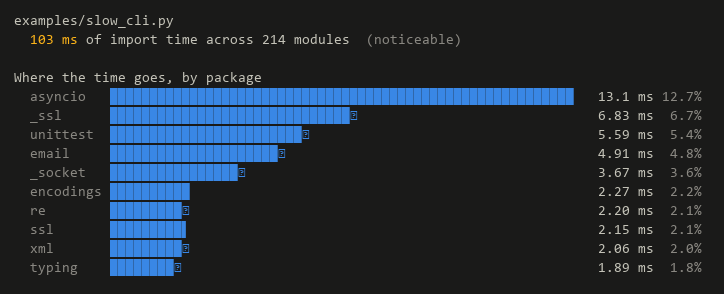
The default view groups by package, because that is the level you act on —
nobody removes numpy.linalg, they remove numpy:
examples/slow_cli.py
  103 ms of import time across 214 modules  (noticeable)

Where the time goes, by package
  asyncio   ██████████████████████████████████████████████████████   13.1 ms 12.7%
  _ssl      ████████████████████████████▏                            6.83 ms  6.7%
  unittest  ███████████████████████                                  5.59 ms  5.4%
  email     ████████████████████▎                                    4.91 ms  4.8%
  _socket   ███████████████▏                                         3.67 ms  3.6%
  encodings █████████▍                                               2.27 ms  2.2%
  re        █████████                                                2.20 ms  2.1%
  ssl       ████████▊                                                2.15 ms  2.1%
Add --advice for the analysis, --modules to rank individual modules,
--tree for an icicle chart of the import graph, or --all for everything.
How the advice works
It reads your file with ast and reports an import only when every use of
the bound name is inside a function body. Anything touched while the module is
being imported is left alone, because moving it would turn a working program
into a NameError on some path you did not test.
Disqualifying uses, all of which run at import time:
| module-level code | assignments, calls, if tests, loops |
| class bodies | they execute during import |
| decorators | @functools.cache |
| base classes | class C(enum.Enum) |
| default arguments | def f(x=json.dumps({})) |
| annotations | unless from __future__ import annotations makes them strings |
| rebinding | json = something_else later in the file |
global declarations |
the name may be reassigned |
Star imports are never reported: what from x import * binds is not knowable
without importing it, so nothing can be proven about the uses.
The analysis is deliberately one-sided. It will miss safe moves rather than suggest an unsafe one.
The saving is not the cumulative time
A module's cumulative figure counts everything it imported, and most of that
is shared. Dropping pandas does not give you back the re and enum that
five other things also need.
So the reported saving is what would actually be recovered: the total minus whatever still gets imported once that module is gone. And the headline figure for a set of imports is computed for the set, not summed — candidates that share a dependency each exclude it, so adding the individual numbers understates, while candidates that contain one another overlap, so it overstates.
Before and after
$ slowimports app.py --save before.json
# ... make the changes ...
$ slowimports app.py --compare before.json
which reports the difference, plus which packages stopped being imported and which started.
Everything else
--json |
the profile as data |
-n N |
how many rows |
--min-saving MS |
ignore advice worth less than this (default 1 ms) |
--ascii |
no block-drawing characters |
--light |
colours stepped for a light terminal |
--python PATH |
measure a different interpreter |
-- ARGS |
everything after -- goes to the target |
Colour degrades from 24-bit through 256 and 16 to none, and honours
NO_COLOR. Output is plain text when redirected, so slowimports app.py > report.txt gives you a clean file.
About the colours
The icicle chart's eight hues are a documented palette, checked by script for lightness band, chroma floor, contrast against the background, and separation under simulated protanopia and deuteranopia. Bars are deliberately a single colour: a bar's length already encodes its duration, so colouring it by duration too would spend the identity channel restating what length says. Past eight packages the tail is drawn in grey rather than given a ninth hue that would not survive the simulation.
Contributing
Bug reports and pull requests welcome — see CONTRIBUTING.md. The test suite needs nothing installed:
$ python -m unittest discover -s tests
If slowimports suggests an import that turns out not to be safe to move, that is the most valuable bug you can report. Please include the file, or the smallest version of it that still reproduces.
License
MIT — see LICENSE.
1 maintainer

Release files for slowimports 0.2.0
For a detailed explanation of source distributions (sdists) and built distributions (wheels), please see the package formats documentation.
Source distribution (sdist)
| File | Size | Uploaded | |
|---|---|---|---|
| slowimports-0.2.0.tar.gz | 36.5 kB | Details |
Built distribution (wheel)
| File | Interpreter | ABI | Platform | Reset |
|---|---|---|---|---|
| slowimports-0.2.0-py3-none-any.whl | Python 3 | none | any | Details |
Total release size: 67.9 kB
Release files / slowimports-0.2.0.tar.gz
| Download URL | slowimports-0.2.0.tar.gz |
|---|---|
| Size | 36.5 kB |
| Tags | Source |
|
SHA-256 checksum How to use checksums |
631816da164efa30e086f87f4879ae076563927182176fcb888862d365f847dd
|
|
BLAKE2b-256 checksum How to use checksums |
4aeeddad6f25fe0c407941d45d8168cc21c043b9d841051f358dfa57402b3008
|
| Upload date | |
|
Uploaded using Trusted Publishing? What is trusted publishing? |
Yes |
| Uploaded via |
twine/7.0.0 CPython/3.13.14
|
Provenance
Provenance describes where a file came from. On PyPI, provenance is shared via attestations, which provide a verifiable record of the build or publishing details. View details, limitations and caveats.


PyPI Publish Attestation
PyPI verified that this artifact, at this checksum, originated from the publisher listed below.
Signed by GitHub Actions, verified by PyPI on Aug 11, 2026.
Transparency logRelease files / slowimports-0.2.0-py3-none-any.whl
| Download URL | slowimports-0.2.0-py3-none-any.whl |
|---|---|
| Size | 31.4 kB |
| Tags | Python 3 |
|
SHA-256 checksum How to use checksums |
a1859136f6f3be0866d60ce1ed66d558300775394051857b4479d0d726d61150
|
|
BLAKE2b-256 checksum How to use checksums |
a2c60fe4894c325f22d9be8ef9bad7034c6a27947c7b4d7a56f0824b25b59484
|
| Upload date | |
|
Uploaded using Trusted Publishing? What is trusted publishing? |
Yes |
| Uploaded via |
twine/7.0.0 CPython/3.13.14
|
Provenance
Provenance describes where a file came from. On PyPI, provenance is shared via attestations, which provide a verifiable record of the build or publishing details. View details, limitations and caveats.
PyPI Publish Attestation
PyPI verified that this artifact, at this checksum, originated from the publisher listed below.
Signed by GitHub Actions, verified by PyPI on Aug 11, 2026.
Transparency log













