
Super Micro Fan Control for Linux

Project description
smfc





Super Micro fan control for Linux (home) servers.
${{\color{red}\textsf{BETA-8 pre-release. New feature: GPU zone controller feature fixed!}}}$
See discussion#68 for more details.
TL;DR
This is a systemd service running on Linux and can control fans with help of IPMI on Super Micro X10-X13 (and some X9) motherboards.
You can also run smfc in docker, see more details in Docker.md.
1. Prerequisites
- a Super Micro motherboard with ASPEED AST2400/2500/2600 chip
- Python 3.9-3.13
- Linux distribution with:
systemdandbashcoretempkernel module for Intel CPUs ork10tempkernel module for AMD CPUsdrivetempkernel module (kernel version 5.6+ required) modules for SATA HDDs/SSDs
ipmitool- optional:
smartmontoolsfor SAS/SCSI disks and standby guard feature - optional:
nvidia-smifor GPU fan controller
2. Installation and configuration
- Set up the IPMI threshold values for your fans (see this chapter for details).
- Optional: enable advanced power management features for your CPU and SATA hard disks for lower power consumption, heat generation and fan noise.
- Load kernel modules (
coretemp/k10tempanddrivetemp). - Install
smfcservice (check Installation.md for more details)`. - Edit the configuration file
/etc/smfc/smfc.confand command line options in/etc/default/smfc. - Start the
systemdservice - Check results in system log
- Leave a feedback in discussion #55
Feel free to visit Discussions and raise your questions or share your experience on this project.
Details
1. How does it work?
This service was planned for Super Micro motherboards installed in computer chassis with two independent cooling systems employing separate fans. In IPMI-terms these are called:
- CPU zone with fans: FAN1, FAN2, ...
- HD or peripheral zone with fans: FANA, FANB, ...
Please note: the fan assignment to zones is predefined in IPMI, and it cannot be changed! But smfc implements a feature, called Free zone assigment, to make the use of the fans more suitable.
In this service, a fan control logic is implemented for both zones which can:
- read the zone's temperature from Linux kernel
- calculate a new fan level based on the user-defined control function and the current temperature value of the zone
- set up the new fan level through IPMI in the zone
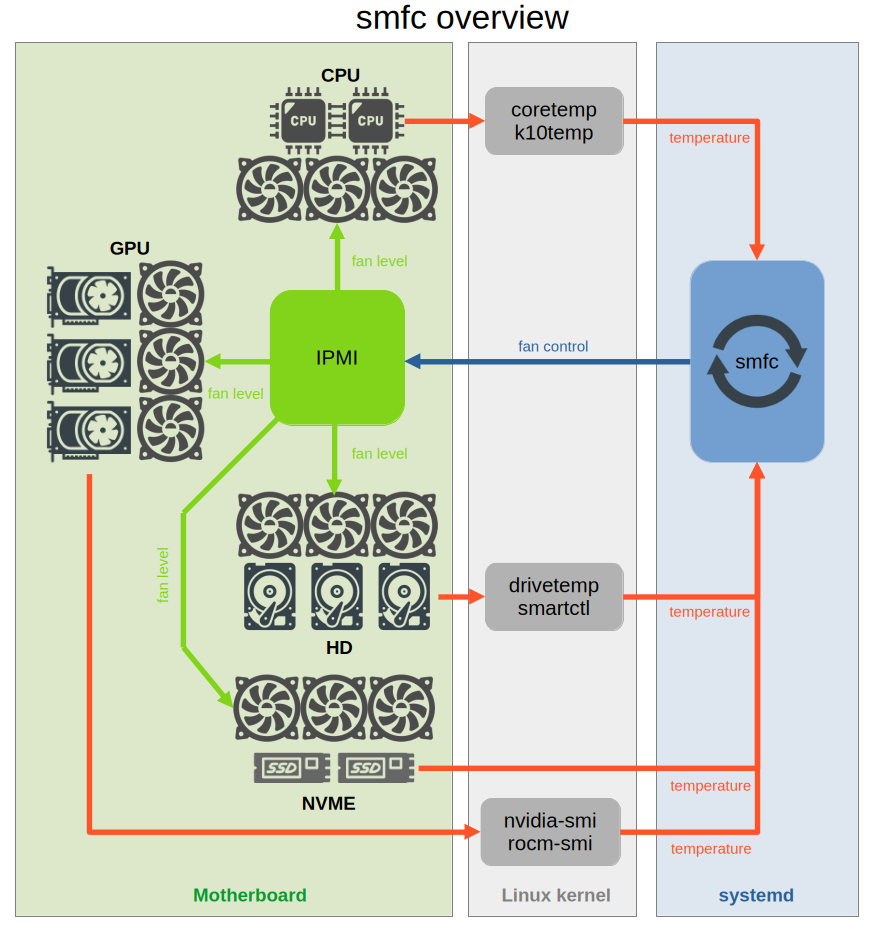
The fan control logic can be enabled and disabled independently per zone. In the zone all fans will have the same rotational speed. The user can configure different temperature calculation method (e.g. minimum, average, maximum temperatures) in case of multiple heat sources in a zone.
Please note that smfc will set all fans back to 100% speed at service termination to avoid overheating!
2. User-defined control function
The user-defined parameters (see the configuration file below for more details) create a function where a temperature interval is being mapped to a fan level interval.
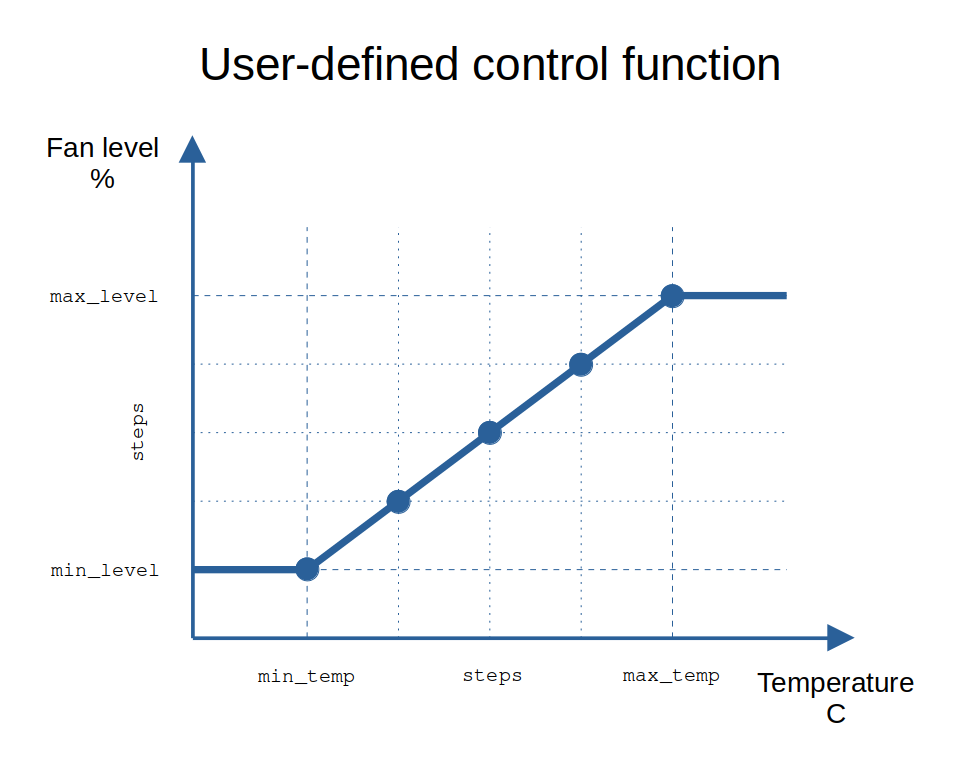
The following five parameters will define the function in both zones:
 min_temp=
 max_temp=
 min_level=
 max_level=
 steps=
With the help of this function smfc can map any new temperature measurement value to a fan level. Changing the fan rotational speed is a very slow process (i.e. it could take seconds depending on fan type and the requested amount of change), so we try to minimize these kinds of actions. Instead of setting fan rotational speed continuously we define discrete fan levels based on steps= parameter.
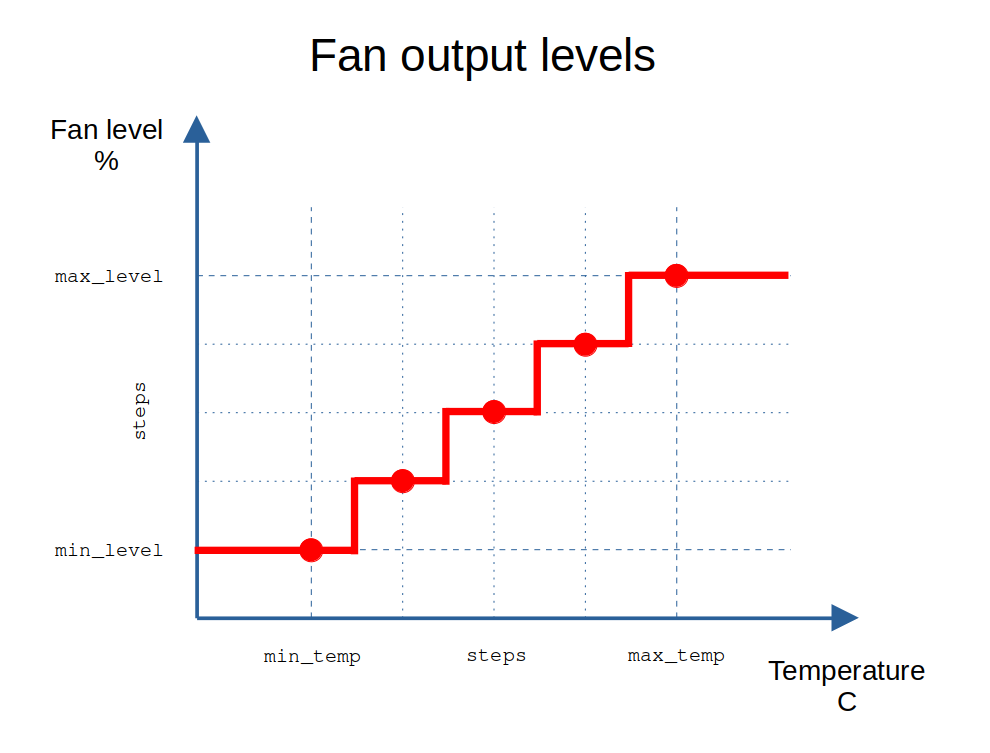
To avoid/minimize the unnecessary change of fan levels the service employs the following steps:
- When the service adjusts the fan rotational speed then it always applies a delay time defined in configuration parameter
[IPMI] fan_level_delay=in order to let the fan implement the physical change. - There is a sensitivity threshold parameter (
sensitivity=) for the fan control logic. If the temperature change is below this value, then the service will not react at all. - The configuration parameter
polling=defines the frequency of reading zone's temperature. The bigger polling time in a zone, the lower frequency of fan speed change.
3. Free zone assignment
This feature makes free IPMI zone assignment possible in smfc. In more details, smfc implemented several fan controllers:
- CPU
- HD
- GPU
where the heat source is pre-defined, but you can assign one or more IPMI zones to them. This way, a heat source (like CPU temperature) can control the fan levels:
- in any user specified IPMI zone
- multiple IPMI zones at the same time
Use ipmi_zone= parameter to specify the required IPMI zone(s) for the selected fan controller.
Here are some sample configurations for the better understanding. In the first example:
[CPU zone]
...
ipmi_zone = 0
CPU temperature will control the fan's level in IPMI 0 zone (i.e. IPMI CPU zone). In the second example:
[HD zone]
...
ipmi_zone = 0, 1, 2
HD temperature will control the fan's level in the IPMI 0, 1, 2 zones.
Typical uses-cases of this feature:
- Optimizing fan assignment/use (i.e. a specific IPMI zone with the most fan connectors on the motherboard could be used)
- Swapping zones (swapping two IPMI zones in cooling-term)
- Server motherboards with multiple IPMI zones (for example, issue#20)
(Note: till version v3.8.0, smfc had Swapped zones feature, but this new feature is a more generic successor of that one)
4. Standby guard
For HD zone an additional optional feature was implemented, called Standby guard, with the following assumptions:
- SATA hard disks are organized into a RAID array
- the RAID array will go to standby mode recurrently
This feature is monitoring the power state of SATA hard disks (with the help of the smartctl) and will put the whole array to standby mode if a few members are already stepped into that. With this feature we can avoid a situation where the array is partially in standby mode while other members are still active.
5. Hard disk compatibility
The smfc service was originally designed for SATA hard drives, but from 3.0 version it is also compatible with NVME and SAS/SCSI disks. The following table summarizes how the temperature is read for different disk types:
| Disk type | Temperature source | Kernel module | Command |
|---|---|---|---|
SATA |
Linux kernel (HWMON) | drivetemp |
- |
NVME |
Linux kernel (HWMON) | - | - |
SAS/SCSI |
smartctl |
- | smartctl |
Some additional notes:
- For
NVMESSDs no kernel driver will be loaded the kernel can handle this disk type automatically - For
SATAdisks thedrivetempkernel module should be loaded. This is the fastest way to read disk temperature, and the kernel module can report the temperature while hard disks are in sleep mode! - For
SAS/SCSIdisks thesmartctlcommand will be used to read disk temperature - If
drivetempmodule is not loaded or an HDD is not compatible withdrivetempmodule thensmfcwill usesmartctlautomatically. - Different disks types can be mixed in
hd_names=configuration parameter but the power management (standy mode) and Standby guard feature will not be supported in this case. - It is NOT RECOMMENDED to mix NVME SSD and SATA/SCSI disks in
hd_names=parameter, because they are operating in quite different temperature intervals (e.g. 30-40C vs 40-80C).
6. Super Micro compatibility
Originally this software was designed to work with Super Micro X10 and X11 motherboards with a BMC chip (i.e. ASPEED AST2400/2500) and IPMI functionality.
In case of X9 motherboards the compatibility is not guaranteed, it depends on the hardware components of the motherboard (i.e. not all X9 motherboards employ BMC chip).
The earlier X8 motherboards are NOT compatible with this software. They do not implement IPMI_FULL mode, and they cannot control fan levels how it is implemented in smfc.
X13 motherboards (with AST2600 BMC chips) seem to be compatible with smfc (see mode details in issue #33 about an X13SAE-F motherboard).
Fan control and IPMI_FULL mode are working properly. The only difference is in using thresholds, AST2600 implements only Lower Critical threshold, so setting up thresholds is different in this case.
Feel free to create a short feedback in discussion #55 on your compatibility experience.
7. IPMI fan control and sensor thresholds
On Super Micro X10-X11 motherboards IPMI uses six sensor thresholds to specify the safe and unsafe fan rotational speed intervals (these are RPM values rounded to nearest hundreds, defined for each fan separately):
Lower Non-Recoverable
Lower Critical
Lower Non-Critical
Upper Non-Critical
Upper Critical
Upper Non-Recoverable
but newer Super Micro X13 motherboards (with AST2600 BMC chip) have only one sensor threshold:
Lower Critical
Originally, this chapter was created Super Micro X10-X11 motherboards, but can be easily adopted to X13 motherboards as well (see more details in #33).
Like many other utilities (created by NAS and home server community), smfc also uses IPMI FULL mode for fan control, where all fans in the zone:
- initially configured to full speed (100%)
- then their speed can be safely configured in
[Lower Critical, Upper Critical]interval - if any fan speed oversteps either
Lower CriticalorUpper Criticalthreshold then IPMI will generate an assertion event and will set the all fan speeds back to 100% in the zone
Please also consider the fact that fans are mechanical devices, their rotational speed is not stable (it could be fluctuating). In order to avoid IPMI's assertion mechanism described here please follow the next steps:
- Per fan: check the minimum and maximum rotational speeds of your fan on its vendor website
- Per fan: configure proper IMPI sensor thresholds adjusted to the fan speed interval
- Per zone: define safe
min_level/max_levelvalues forsmfcrespecting the variance of the all fans in the IPMI zone (it could take several iterations and adjustments)
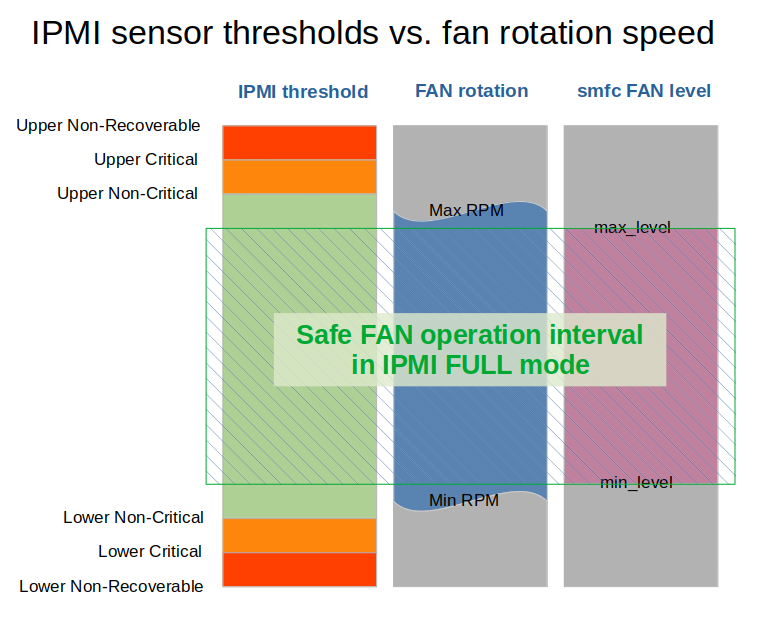
Here is a real-life example for a Noctua NF-F12 PWM fan:
Upper Non-Recoverable = 1800 rpm
Upper Critical = 1700 rpm
Upper Non-Critical = 1600 rpm
Lower Non-Critical = 200 rpm
Lower Critical = 100 rpm
Lower Non-Recoverable = 0 rpm
Max RPM = 1500 rpm
Min PRM = 300 rpm
max_level = 100 (i.e. 1500 rpm)
min_level = 35 (i.e. 500 rpm)
Notes:
-
Use the following
ipmitoolcommand to display the current IMPI sensor thresholds for fans:root@home:~# ipmitool sensor|grep FAN FAN1 | 500.000 | RPM | ok | 0.000 | 100.000 | 200.000 | 1600.000 | 1700.000 | 1800.000 FAN2 | 500.000 | RPM | ok | 0.000 | 100.000 | 200.000 | 1600.000 | 1700.000 | 1800.000 FAN3 | na | | na | na | na | na | na | na | na FAN4 | 400.000 | RPM | ok | 0.000 | 100.000 | 200.000 | 1600.000 | 1700.000 | 1800.000 FANA | 500.000 | RPM | ok | 0.000 | 100.000 | 200.000 | 1600.000 | 1700.000 | 1800.000 FANB | 500.000 | RPM | ok | 0.000 | 100.000 | 200.000 | 1600.000 | 1700.000 | 1800.000 -
Use the following
ipmitoolcommand to list assertion events:root@home:~# ipmitool sel list 1 | 10/19/2023 | 05:15:35 PM CEST | Fan #0x46 | Lower Critical going low | Asserted 2 | 10/19/2023 | 05:15:35 PM CEST | Fan #0x46 | Lower Non-recoverable going low | Asserted 3 | 10/19/2023 | 05:15:38 PM CEST | Fan #0x46 | Lower Non-recoverable going low | Deasserted 4 | 10/19/2023 | 05:15:38 PM CEST | Fan #0x46 | Lower Critical going low | Deasserted 5 | 10/19/2023 | 05:20:59 PM CEST | Fan #0x46 | Lower Critical going low | Asserted -
Use the following
ipmitoolcommands to specify all six sensor thresholds for FAN1:root@home:~# ipmitool sensor thresh FAN1 lower 0 100 200 root@home:~# ipmitool sensor thresh FAN1 upper 1600 1700 1800 -
You can also edit and run
ipmi/set_ipmi_treshold.shto configure all IPMI sensor thresholds -
If you install a new BMC firmware on your Super Micro motherboard you have to configure IPMI thresholds again
-
If you do not see fans when executing
ipmitool sensors, you may want to reset the BMC to factory default using the Web UI or usingipmitool mc reset cold -
Noctua specifies the variance of minimum and maximum fan rotational speeds (e.g. see the specification of Noctua NF-F12 PWM). For example:
Rotational speed (+/- 10%) 1500 RPM: 1350-1650 RPM intervalMin. rotational speed @ 20% PWM (+/-20%) 300 RPM: 240-360 RPM interval
Please note that LNA/ULNA cables or Y-cables can modify the rotational speed calculations here and the required IPMI sensor thresholds too.
You can read more about:
- IPMI fan control: STH Forums and TrueNAS Forums
- Change IPMI sensors thresholds: TrueNAS Forums
8. Power management
If low noise and low heat generation are important attributes of your Linux box, then you may consider the following chapters.
8.1 CPU
Most of the modern CPUs has multiple energy saving features. You can check your BIOS and enable them in order to minimize the heat generation.
Intel(R) CPUs:
- Intel(R) Speed Shift Technology
- Intel(R) SpeedStep
- C-states
- Boot performance mode
AMD(R) CPUs:
- PowerNow!
- Cool`n`quiet
- Turbo Core
With this setup the CPU will change its base frequency and power consumption dynamically based on the load.
8.2 SATA hard disks
In case of SATA hard disks, you may enable:
- advanced power management
- spin down timer
With the help of command hdparm you can enable advanced power management and specify a spin down timer (read more here):
hdparm -B 127 /dev/sda
hdparm -S 240 /dev/sda
In file /etc/hdparm.conf you can specify all parameters in a persistent way:
quiet
/dev/sda {
apm = 127
spindown_time = 240
}
/dev/sdb {
apm = 127
spindown_time = 240
}
...
Important notes:
- If you plan to spin down your hard disks or RAID array (i.e. put them to standby mode) you have to set up the configuration parameter
[HD zone] polling=minimum twice bigger as thespindown_timespecified here. - In file
/etc/hdparm.confyou must define HD names in/dev/disk/by-id/...form to avoid inconsistency.
9. Kernel modules
We need to load the following important Linux kernel modules:
coretemp: temperature report for Intel(R) CPUsk10temp: temperature report for AMD(R) CPUsdrivetemp: temperature report for SATA hard disks (available from kernel 5.6+ version)
Use /etc/modules file for persistent loading of these modules.
Here are some sample HWMON file locations for these kernel modules:
coretemp:/sys/devices/platform/coretemp.0/hwmon/hwmon*/temp1_inputk10temp:/sys/bus/pci/drivers/k10temp/0000*/hwmon/hwmon*/temp1_inputdrivetemp:/sys/class/scsi_disk/0:0:0:0/device/hwmon/hwmon*/temp1_input
Notes:
smfcis able to find the proper HWMON file automatically for Intel(R) CPUs, AMD(R) CPUs, SATA drives, or NVMe drives, but users may also specify the files manually (seehwmon_path=parameter in the config file)- Reading
drivetempmodule is the fastest way to get the temperature of the hard disks, and it can read temperature of the SATA hard disks even in standby mode, too.
10. Installation
For the installation you need a root user. Download and extract a release file or clone the git repository first.
Then use the installation script install.sh, or copy the following files manually:
| File | Installation folder | Description |
|---|---|---|
smsc.service |
/etc/systemd/system |
systemd service definition file |
smsc |
/etc/default |
service command line options |
smsc.py |
/opt/smfc |
service (python program) |
smsc.conf |
/opt/smfc |
service configuration file |
hddtemp_emu.sh |
/opt/smfc |
hddtemp emulation script (optional) |
Notes:
- any target folder can be used instead of
/opt install.shwill add all of your disks to your newsmfc.conf, please remove the unnecessary itesm
The service has the following command line options:
root@home:~/opt/smfc# ./smfc.py --help
usage: smfc.py [-h] [-c CONFIG_FILE] [-v] [-l {0,1,2,3,4}] [-o {0,1,2}]
optional arguments:
-h, --help show this help message and exit
-c CONFIG_FILE configuration file
-v show program's version number and exit
-l {0,1,2,3,4} log level: 0-NONE, 1-ERROR(default), 2-CONFIG, 3-INFO, 4-DEBUG
-o {0,1,2} log output: 0-stdout, 1-stderr, 2-syslog(default)
You may configure logging output and logging level here, and these options can be specified in /etc/default/smfcin a persistent way.
11. Configuration file
Edit /etc/smfc/smfc.conf and specify your configuration parameters here:
#
# smfc.conf (C) 2020-2025, Peter Sulyok
# smfc 4.x service configuration parameters
#
# Please read the documentation here: https://github.com/petersulyok/smfc
#
[Ipmi]
# Path for ipmitool (str, default=/usr/bin/ipmitool)
command=/usr/bin/ipmitool
# Delay time after changing IPMI fan mode (int, seconds, default=10)
fan_mode_delay=10
# Delay time after changing IPMI fan level (int, seconds, default=2)
fan_level_delay=2
# IPMI parameters for remote access (HOST is the BMC network address).
#remote_parameters=-U USERNAME -P PASSWORD -H HOST
[CPU zone]
# Fan controller enabled (bool, default=0)
enabled=1
# IPMI zone number (int, [0-7], default=0))
ipmi_zone = 0
# Calculation method for CPU temperatures (int, [0-minimum, 1-average, 2-maximum], default=1)
temp_calc=1
# Discrete steps in mapping of temperatures to fan level (int, default=6)
steps=6
# Threshold in temperature change before the fan controller reacts (float, C, default=3.0)
sensitivity=3.0
# Polling time interval for reading temperature (int, sec, default=2)
polling=2
# Minimum CPU temperature (float, C, default=30.0)
min_temp=30.0
# Maximum CPU temperature (float, C, default=60.0)
max_temp=60.0
# Minimum CPU fan level (int, %, default=35)
min_level=35
# Maximum CPU fan level (int, %, default=100)
max_level=100
[HD zone]
# Fan controller enabled (bool, default=0)
enabled=1
# IPMI zone number (int, [0-7], default=1))
ipmi_zone = 1
# Calculation of HD temperatures (int, [0-minimum, 1-average, 2-maximum], default=1)
temp_calc=1
# Discrete steps in mapping of temperatures to fan level (int, default=4)
steps=4
# Threshold in temperature change before the fan controller reacts (float, C, default=2.0)
sensitivity=2.0
# Polling interval for reading temperature (int, sec, default=10)
polling=10
# Minimum HD temperature (float, C, default=32.0)
min_temp=32.0
# Maximum HD temperature (float, C, default=46.0)
max_temp=46.0
# Minimum HD fan level (int, %, default=35)
min_level=35
# Maximum HD fan level (int, %, default=100)
max_level=100
# Names of the HDs (str multi-line list, default=)
# These names MUST BE specified in '/dev/disk/by-id/...' form!
hd_names=
# Path for 'smartctl' command (str, default=/usr/sbin/smartctl).
smartctl_path=/usr/sbin/smartctl
# Standby guard feature for RAID arrays (bool, default=0)
standby_guard_enabled=0
# 'standby guard' feature only: number of HDs already in STANDBY state before the full RAID array will be forced to it (int, default=1)
standby_hd_limit=1
Important notes:
-
[HD zone} hd_names=: This is a compulsory parameter, its value must be specified in/dev/disk/by-id/...form (the/dev/sdaform is not persistent could be changed after a reboot). -
[CPU zone] / [HD zone] min_level= / max_level=: Check the stability of your fans and adjust the fan levels based on your measurement. As it was stated earlier, IPMI can switch back to full rotational speed if fans reach specific thresholds. You can collect real data about the behavior of your fans if you edit and run scriptipmi/fan_measurement.sh. The script will set fan levels from 100% to 20% in 5% steps and results will be saved in the filefan_result.csv:root:~# cat fan_result.csv Level,FAN1,FAN2,FAN4,FANA,FANB 100,1300,1300,1200,1300,1300 95,1300,1300,1100,1200,1300 90,1200,1200,1100,1200,1200 85,1100,1100,1000,1100,1100 80,1100,1100,1000,1100,1100 75,1000,1000,900,1000,1000 70,900,900,800,1000,900 65,900,900,800,900,900 60,800,800,700,900,800 55,700,700,700,800,700 50,700,700,600,700,700 45,600,600,500,700,600 40,500,500,500,600,500 35,500,500,400,500,500 30,400,400,300,400,400 25,300,300,300,400,300 20,1300,1300,1200,1300,1300My experience is that Noctua fans in my box are running stable in the 35-100% fan level interval. An additional user experience is (see issue #12) when Noctua fans are paired with Ultra Low Noise Adapter the minimum stable fan level could go up to 45% (i.e. 35% is not stable).
-
[CPU zone] / [HD zone] hwmon_path=: This parameter is optional for Intel(R) CPUs, AMD(R) CPUs, SATA drives, and NVME drives (i.e.,smfccan automatically identify the proper file locations), but may also be specified manually for special use cases. In case of SAS/SCSI hard disks (wheredrivetempcannot be loaded) you can specifyhddtempvalue. You can use wild characters (?,*) in this parameter andsmfcwill do the path resolution automatically. -
[Ipmi] remote_parameters=: if you runsmfcin a Virtual Machine (e.g. you run TrueNAS Scale in a Proxmox VM with direct access on controller or HDDs) you would like to access IPMI remotely on your host. With this parameter your can specify IPMI remote parameters added to each IPMI calls (see issue #27). Please note that the host address here is the BMC network address (not the VM host address). -
Several sample configuration files are provided for different scenarios in folder
./src/samples. Please take a look on them, it could be a good starting point in the creation of your own configuration.
12. Automatic execution of the service
This systemd service can be started and stopped in the standard way. Do not forget to reload systemd configuration after a new installation or if you changed the service definition file:
systemctl daemon-reload
systemctl start smfc.service
systemctl stop smfc.service
systemctl restart smfc.service
systemctl status smfc.service
● smfc.service - Super Micro Fan Control
Loaded: loaded (/etc/systemd/system/smfc.service; enabled; preset: enabled)
Active: active (running) since Mon 2025-01-27 00:55:26 CET; 8h ago
Main PID: 33361 (smfc.py)
Tasks: 1 (limit: 76963)
Memory: 8.1M
CPU: 21.388s
CGroup: /system.slice/smfc.service
└─33361 /usr/bin/python3 /opt/smfc/smfc.py -c /opt/smfc/smfc.conf -l 3
Jan 27 09:10:44 nas smfc.service[33361]: CPU zone: new fan level > 48%/37.0C
Jan 27 09:10:48 nas smfc.service[33361]: CPU zone: new fan level > 35%/29.0C
Jan 27 09:10:54 nas smfc.service[33361]: CPU zone: new fan level > 48%/35.0C
If you are testing your configuration, you can start smfc.py directly in a terminal. Logging to the standard output and debug log level are useful in this case:
cd /opt
sudo smfc.py -o 0 -l 3
13. Checking result and monitoring logs
All messages will be logged to the specific output and the specific level.
With the help of command journalctl you can check logs easily. For examples:
-
listing service logs of the last two hours:
journalctl -u smfc --since "2 hours ago" -
listing service logs from the last boot:
journalctl -b -u smfc
14. FAQ
Q: My fans are spinning up and loud. What's wrong?
Most probably the rotational speed of a fan went above or below of a IPMI threshold and IPMI switched back that zone to full rotational speed. You can check the current fan rotational speeds:
ipmitool sdr
and you can also check IPMI event log and list assertion events:
root@home:~# ipmitool sel list
   1 | 10/19/2023 | 05:15:35 PM CEST | Fan #0x46 | Lower Critical going low  | Asserted
   2 | 10/19/2023 | 05:15:35 PM CEST | Fan #0x46 | Lower Non-recoverable going low  | Asserted
   3 | 10/19/2023 | 05:15:38 PM CEST | Fan #0x46 | Lower Non-recoverable going low  | Deasserted
   4 | 10/19/2023 | 05:15:38 PM CEST | Fan #0x46 | Lower Critical going low  | Deasserted
   5 | 10/19/2023 | 05:20:59 PM CEST | Fan #0x46 | Lower Critical going low  | Asserted
If the problematic fan (causing the alert) is identified then you must adjust its threshold. This process could take several adjustment cycle. Be patent :) You may read this chapter for more details.
Q: I would like to use constant fan rotational speed in one or both zones. How can I configure that?
You should configure the temperatures and levels with the same value.
min_temp=40
max_temp=40
min_level=60
max_level=60
With this setup there will be a constant 60% fan level in the specific zone. The temperature value is ignored, steps parameter is also ignored.
Q: I receive an error message "Cannot read hwmon*/temp1_input file". What is the problem?
The problem is that the specific file cannot be found in HWMON system. The potential reasons behind this issue could be:
drivetempdriver cannot support your disks (it support only SATA hard disks). In case of SAS/SCSI hard disks you can usehddtempinstead ofdrivetemp. See more details in issue #21.- Maybe you specified the
hwmon_path=parameter manually and it contains an invalid path. You can correct it.
Q: How does the author test/use this service?
The configuration is the following:
-
64 GB ECC DDR4 RAM
-
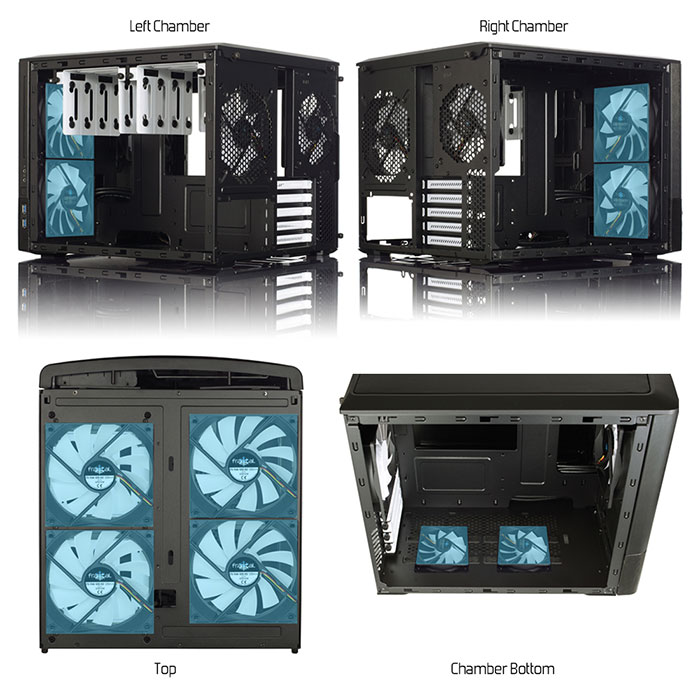
Fractal Design Node 804 case, with separate chambers for the motherboard and the hard disks:
-
Debian Linux LTS (actually bookworm with backported Linux kernel 6.5)
-
8 x WD Red 12TB (WD120EFAX) hard disks in ZFS RAID
-
3 x Noctua NF-12 PWM fans (FAN1, FAN2, FAN4) in CPU zone
-
2 x Noctua NF-12 PWM fans (FANA, FANB) in HD zone
15. References
Further readings:
Super Micro
- BMC IPMI User's Guide 1.1b (X10/X11/H11)
- BMC resources
- IPMI Utilities
- IPMICFG download
- IPMICFG User's Guide 1.15
Forums/blogs
- [STH forums] Reference Material: Supermicro X9/X10/X11 Fan Speed Control
- [TrueNAS forums] How To: Change IPMI Sensor Thresholds using ipmitool
- [TrueNAS forums] Script to control fan speed in response to hard drive temperatures
- [Pcfe's blog] Set fan thresholds on my Super Micro H11DSi-NT
Linux kernel
- [coretemp] documentation
- [drivetemp] documentation and its GitHub respository
- How to install hddtemp from a source package
Similar projects
- [GitHub] Kevin Horton's nas_fan_control
- [GitHub] Rob Urban's fork nas_fan control
- [GitHub] sretalla's fork nas_fan control
- [GitHub] Andrew Gunnerson's ipmi-fan-control
Written with StackEdit.
Release history Release notifications | RSS feed


Download files
Download the file for your platform. If you're not sure which to choose, learn more about installing packages.
Source Distribution
Built Distribution
Filter files by name, interpreter, ABI, and platform.
If you're not sure about the file name format, learn more about wheel file names.
Copy a direct link to the current filters
File details
Details for the file smfc-4.0.0b8.tar.gz.
File metadata
- Download URL: smfc-4.0.0b8.tar.gz
- Upload date:
- Size: 79.2 kB
- Tags: Source
- Uploaded using Trusted Publishing? No
- Uploaded via: twine/6.1.0 CPython/3.12.9
File hashes
| Algorithm | Hash digest | |
|---|---|---|
| SHA256 |
1c205b40f53aaac3fc82c92a9b10b800373e6f70927e8151b41b568b8cb98500
|
|
| MD5 |
32014c7635ffb2ff5a16d88d81de3fa6
|
|
| BLAKE2b-256 |
e550d1c2a49ede1b9ac2f72110ab7cbdc7283bb9fa5a98d5ba14108e0e338429
|
File details
Details for the file smfc-4.0.0b8-py3-none-any.whl.
File metadata
- Download URL: smfc-4.0.0b8-py3-none-any.whl
- Upload date:
- Size: 43.8 kB
- Tags: Python 3
- Uploaded using Trusted Publishing? No
- Uploaded via: twine/6.1.0 CPython/3.12.9
File hashes
| Algorithm | Hash digest | |
|---|---|---|
| SHA256 |
78f7ce4b965201c369f98cc2b8f95d8f672f1cfa263cbfe5754a0416635656a7
|
|
| MD5 |
d16337399c73590425c9659668c9d69a
|
|
| BLAKE2b-256 |
ada26d2cf92ab2d390d2e078f99b308e10d2affca81cec21fb2fd448913c39df
|






