
SNEPPX-Alg 🤖 — The Universal Open-Source AI Algorithm Framework
A universal, open-source AI algorithm framework in C/C++ & CUDA — tensor engine, autograd, MoE/SSM transformers, LLM model zoo, quantization, distributed-training primitives & 10-layer AI security.








SneppX-ALG — A secure, composable, production-grade AI algorithm pipeline with 10 security layers (S0–S9), model zoo, distributed-training primitives, quantization, and advanced architectures.
⭐ Star this repo to support the project and help us reach 1,000+ stars!
📑 Table of Contents
- Overview
- By the numbers
- Why SNEPPX-Alg?
- Architecture
- Component Status
- The 5-Stage Pipeline
- Security Layers (S0–S9)
- Model Zoo
- C HTTP REST API
- Python Bindings
- Python Quickstart
- Build & Quickstart
- Documentation
- Contributing
- Star History
- License
Overview
SNEPPX-Alg (under the SneppX organization) is a universal, MIT-licensed AI algorithm framework written primarily in C11 / C++20 with CUDA. It organizes model construction and inference as a composable, secure 5-stage pipeline and wraps it with a layered security model (S0–S9). The codebase is large (~183K LOC) and spans a core tensor/autograd substrate, algorithm implementations, accelerator drivers, a security stack, an HTTP serving layer, and Python bindings.
Design goals:
- Auditable native core — the hot path lives in C/CUDA you can read and verify.
- Composable pipeline — HSS → SER → ARC → NPE → FM stages are independently testable.
- Security by design — ten layers from crypto to pentest are built into the framework.
- Open & extensible — opt-in backends, a model zoo, and a Python API on top of the native core.
By the numbers
- ~183K lines of C11 / C++20 / CUDA / Python across a single auditable codebase
- 300+ tests (Python autograd, NN, optimizers, losses, sparse, higher-order AD, security)
- 10 security layers (S0–S9): classical + post-quantum crypto, memory hardening, obfuscation, monitoring, network, AI sanitizer, key vault, signed updates, formal verification, pentest
- 5-stage pipeline: HSS → SER → ARC → NPE → FM
- 40+ autograd ops with higher-order AD (
create_graph=True), plusjvp/vjp - ~70 differentiable functional ops (
F.*), 14 loss Module wrappers, 30+ optimizers - Quantization: INT8 / INT4 / FP8 / AWQ / GPTQ
- Distributed: DDP, ZeRO-1/2/3, tensor / pipeline / expert parallelism (NCCL + CPU fallback)
- Model zoo: LLaMA 2/3, Mistral, Qwen 2, DeepSeek V2 presets
- MIT licensed, maintained by Ammar [SNEPPX]
Why SNEPPX-Alg?
Honest positioning — SNEPPX-Alg is not a PyTorch replacement for training at scale. It is a native, security-first AI substrate you can read, audit, and compose: a C/C++/CUDA tensor engine, a composable 5-stage pipeline, and ten security layers (S0–S9) including post-quantum crypto and signed updates.
| SNEPPX-Alg | PyTorch | JAX | |
|---|---|---|---|
| Core implementation | C / C++ / CUDA (auditable) | C++ / Python | Python → XLA |
| Python API | NumPy-backed Tensor / nn |
Native tensors | jax.numpy |
| Built-in security | 10 layers (S0–S9) + PQC | none | none |
| Post-quantum crypto | Kyber / Dilithium / SPHINCS+ (FIPS 203/204/205) | none | none |
| Signed model updates | Ed25519 over BLAKE3 | none | none |
| Quantization | INT8 / INT4 / FP8 / AWQ / GPTQ | INT8 / FP8 | limited |
| Distributed | DDP / ZeRO / TP / PP / EP (NCCL) | DDP / FSDP | pmap / pjit |
| License | MIT | BSD-3 | Apache 2.0 |
If you want a drop-in PyTorch experience today, use PyTorch. If you want a readable native core with security built in, SNEPPX-Alg is for you.
Architecture
The framework is structured as a secure pipeline. Each stage consumes the previous stage's output and the whole flow is observed by the security layers.
flowchart LR
    IN([Input]) --> HSS
    subgraph Pipeline
        HSS["HSS<br/>(State-Space Model)"]
        SER["SER<br/>(Mixture-of-Experts)"]
        ARC["ARC<br/>(Adversarial Guard)"]
        NPE["NPE<br/>(Neural VM)"]
        FM["FM<br/>(Fractal Memory)"]
    end
    HSS --> SER --> ARC --> NPE --> FM
    FM --> OUT([Output])
    SEC["Security Layers S0–S9<br/>(crypto, memory, monitor,<br/>AI sanitizer, updates, ...)"]
    SEC -.observes.-> Pipeline
Directory layout
| Path | Purpose |
|---|---|
kernel/ |
Core tensor / autograd / optimizer / trainer / attention substrate, distributed/, quantization/ |
algorithms/ |
HSS, SER, ARC, NPE, FM, Transformer, ViT, GCN, RNN, GAN, Diffusion, RL, model_zoo/ |
drivers/ |
Accelerator backends (CUDA, ROCm, Vulkan, TPU, HTTP, ZK, Metal*, oneAPI*) |
security/ |
S0–S9 security layers (crypto, memory, monitor, network, AI, vault, updates, formal, obfuscation, pentest) |
net/ |
HTTP serving, distributed (NCCL), gRPC, QUIC, RDMA, WebSocket |
bindings/python/ |
SneppX_ALG Python package + pybind wrappers |
docs/ |
~70 reference docs (see Documentation) |
tests/ examples/ scripts/ tools/ |
Test suite, demos, dev tooling |
* Metal and oneAPI are reference-compute backends enabled via SNEPPX_BUILD_METAL / SNEPPX_BUILD_ONEAPI. Vulkan/TPU/HTTP/ZK do real reference computation and are enabled via SNEPPX_BUILD_VULKAN / SNEPPX_BUILD_TPU / SNEPPX_BUILD_HTTP / SNEPPX_BUILD_ZK.
Component Status
We label maturity honestly so contributors know where to focus. Status: 🟢 Stable · 🟡 Experimental · 🔴 Known gap / under remediation.
| Component | Status | Notes |
|---|---|---|
| HSS (SSM) | 🟢 Stable | Selective-scan recurrence, layer norm, discretize implemented (algorithms/hss/core) |
| SER (MoE) | 🟢 Stable | Gating, expert routing, capacity balance (algorithms/ser/core) |
| ARC (Adversarial Guard) | 🟢 Stable | Input guard + output verifier + security metrics (algorithms/arc/core) |
| NPE (Neural VM) | 🟢 Stable | 16-register / 32-opcode dispatch with tensor kernels (algorithms/npe/core/vm.c) |
| FM (Fractal Memory) | 🟢 Stable | Memory-bank read/write + EWM combine (algorithms/fm/core) |
| CUDA kernels | 🟡 Experimental | Real .cu files; compiled only with -DSNEPPX_BUILD_CUDA=ON (OFF by default) |
| Crypto core (S0, classical) | 🟢 Stable | Ed25519, X25519, ChaCha20-Poly1305, SHA-3, AES-GCM, Argon2id, HMAC-DRBG |
| PQC (Kyber/Dilithium/SPHINCS+) | 🟡 Experimental | Implemented, with deterministic self-generated regression vectors in tests/python/test_crypto_kat.py; not yet validated against official NIST ACVP / FIPS 203-205 known-answer vectors |
| Signed updates (S7) | 🟡 Partial | Ed25519 sign/verify over a BLAKE3 update hash, enforced when a trusted key is configured; a constant-time unsigned hash-equality fallback remains for dev builds |
| Formal verification (S8) | 🟡 Partial | Reachable-state graph + deadlock scan + invariant walk; bounded safety LTL (G !deadlock, AG !deadlock, F deadlock) — unsupported properties report "not verified" rather than false-positiving; state-space minimization is a stub |
| Memory / Obfuscation / Monitor / Vault / Pentest | 🟢 Stable | Substantial implementations in security/ |
Model Zoo from_pretrained() |
🟡 Experimental | Resolves architecture configs + builds skeleton; weight download unwired |
| C HTTP REST API | 🟡 Experimental | /v1/health, /v1/models real; /v1/generate is a demo scaffold |
| Distributed training | 🟡 Experimental | Gradient collectives in DDP/ZeRO/TP/PP/EP/grad-comm are wired to the NCCL binding (net/distributed/nccl.c), which falls back to a CPU path so single-process runs stay correct; control-plane pieces (checkpoint/elastic/heartbeat/sampler) remain scaffolded |
| Python bindings | 🟢 Stable | NumPy-backed Tensor/nn/Trainer; C _Tensor reachable via pybind |
The 5-Stage Pipeline
flowchart TD
    A[Raw sequence / tokens] --> B[HSS<br/>compress with SSM]
    B --> C[SER<br/>route tokens to experts]
    C --> D[ARC<br/>guard input + verify output]
    D --> E[NPE<br/>execute neural program]
    E --> F[FM<br/>store / recall memory]
    F --> G[Trained model / inference result]
- HSS — Hierarchical State-Space model (
algorithms/hss/): SSM front-end for long-range sequence modeling. Entry pointsSNEPPX_hss_model_create,SNEPPX_hss_forward. - SER — Sparse Expert Router (
algorithms/ser/): Mixture-of-Experts with gating, capacity balancing, and expert forwarding. Entry pointsSNEPPX_ser_model_create,SNEPPX_ser_forward,SNEPPX_ser_gate_forward. - ARC — Adversarial Robustness guard (
algorithms/arc/): input guard, output verifier, and gradient obfuscation that report security metrics. Entry pointSNEPPX_arc_forward. - NPE — Neural Processing Engine (
algorithms/npe/): a 16-register, 32-opcode neural VM (SNEPPX_npe_vm_run,SNEPPX_npe_vm_step) executing tensor operations as programs. - FM — Fractal Memory (
algorithms/fm/): layered memory banks with a controller and EWM combine (SNEPPX_fm_forward).
Security Layers (S0–S9)
Ten layers wrap the pipeline:
| ID | Layer | Status |
|---|---|---|
| S0 | Cryptography core (classical + PQC) | Classical 🟢 / PQC 🟡 |
| S1 | Secure memory hardening | 🟢 |
| S2 | Code obfuscation | 🟢 |
| S3 | Behavioral monitoring | 🟢 |
| S4 | Network security | 🟡 |
| S5 | AI sanitizer (prompt filter, DP) | 🟡 |
| S6 | Key vault & audit logging | 🟢 |
| S7 | Signed updates | 🟡 (Ed25519 live; dev fallback pending removal) |
| S8 | Formal verification | 🟡 (bounded safety LTL; full LTL pending) |
| S9 | Penetration testing / self-audit | 🟢 |
Honest note: several layers are substantial, and the project openly tracks what is still partial — S7 signed-update verification and S8 formal verification are implemented but bounded (Ed25519 with a dev-build fallback; safety-LTL properties only), and the post-quantum primitives are not yet FIPS-KAT validated. See
docs/security_layers.mdfor the full mapping.
Model Zoo
The model zoo provides architecture presets and a from_pretrained() entry point.
- Supported families (config presets): LLaMA 2 / 3, Mistral, Qwen 2, DeepSeek V2 — resolved via
SNEPPX_llm_config_from_name(algorithms/model_zoo/). from_pretrained()(bindings/python/.../model_zoo.py): maps a model id → (family, size), builds the architecture skeleton, and returns a config. End-to-end pretrained-weight download/conversion is in progress; the safetensors / PyTorch.binparsers inhf_integration.pyare real but not yet wired into the loader.
# Illustrative — resolves config + builds skeleton (weights download in progress)
from SneppX_ALG.interface_bindings.model_zoo import from_pretrained
model = from_pretrained("meta-llama/Llama-3-8b")
C HTTP REST API
A real cross-platform socket server (net/http/http_server.c) with a route table. Opt-in via -DSNEPPX_BUILD_HTTP=ON (OFF by default).
| Endpoint | Status | Description |
|---|---|---|
GET /v1/health |
🟢 | Liveness check |
GET /v1/models |
🟢 | List preset model configs |
GET /v1/models/{id} |
🟢 | Fetch one model config |
POST /v1/generate |
🟡 | Demo scaffold — deterministic token generator, no model forward pass yet |
Run the demo:
cmake -B build -DSNEPPX_BUILD_HTTP=ON
cmake --build build --config Release
# see examples/http_server_demo.c
Python Bindings
The SneppX_ALG package exposes a NumPy-backed Tensor, nn modules, and trainers (Trainer, UltraTrainer, LoRA/DPO/GRPO). The C _Tensor engine is wrapped via pybind (_SNEPPX_c.Tensor) and used internally by the C algorithm cores.
# Illustrative — NumPy-backed tensor math
import numpy as np
from SneppX_ALG import Tensor

x = Tensor(np.random.randn(4, 8))
w = Tensor(np.random.randn(8, 16))
y = x @ w
print(y.shape)
Python Quickstart
Verified runnable (loss drops from ~7.4 to ~0.04 in 200 steps):
import numpy as np
from SneppX_ALG import Tensor
from SneppX_ALG.interface_bindings import nn, optim

np.random.seed(0)

class MLP(nn.Module):
    def __init__(self):
        super().__init__()
        self.fc1 = nn.Linear(4, 8)
        self.fc2 = nn.Linear(8, 2)
    def forward(self, x):
        return self.fc2(nn.functional.relu(self.fc1(x)))

model = MLP()
opt = optim.Adam(model.parameters(), lr=1e-2)

for step in range(200):
    x = Tensor(np.random.randn(32, 4).astype(np.float32))
    y = Tensor((2.0 * x.data[:, :2]).astype(np.float32))
    loss = nn.functional.mse_loss(model(x), y)
    loss.backward()
    opt.step()
    opt.zero_grad()

print("final loss:", round(float(np.asarray(loss.data).reshape(-1)[0]), 4))  # ~0.04
Run with PYTHONPATH=bindings/python python quickstart.py. More runnable examples in examples/python_api/.
Extended Python Utilities
Additional pragmatic packages (pure NumPy/Python, fully tested):
sampling, regularization, callbacks, linalg, signal, graph,
stats, structured_output, rag, agents, observability, speculative
Import as:
from SneppX_ALG import sampling, regularization, ...
Recent framework capabilities (v1.5.0)
- Higher-order autograd:
create_graph=Truethrough 40+ ops incl. Conv1d, layer/rms norm, all losses; plusjvp/vjpforward/reverse mode helpers. - Functional API:
sneppx_ALG.nn.functional(aliasedF) with ~70 differentiable ops (conv, pool, norm, pad, unfold/fold, embedding, losses, interpolate). - nn modules: Conv1d/Conv3d, ConvTranspose1d/2d/3d, MaxPool1d/2d/3d, AvgPool1d/2d/3d, adaptive pools, InstanceNorm*, Upsample, Unfold/Fold, MaxUnpool*, EmbeddingBag, ChannelShuffle/PixelShuffle, Bilinear, Flatten, ParameterList/Dict.
- Optimizers: SGD, Adam, AdamW, NAdam, Rprop, ASGD, LBFGS, SparseAdam, plus classic/extras.
- Sparse tensors:
SparseTensor(COO/CSR/CSC/BSR),sparse_mm,sparse_addmm,sparse_conv2d. - Init utils:
nn.init(xavier/kaiming/orthogonal/...), differentiable pooling autograd functions. - Serialization: strict
load_state_dict, persistent/non-persistent buffers. - Distributed C kernels: NCCL-wired DDP/tensor/expert/pipeline/ZeRO/gradient-comm; deterministic distributed sampler.
Build & Quickstart
cmake -B build -DCMAKE_BUILD_TYPE=Release
cmake --build build --config Release
cd build && ctest -C Release --output-on-failure
Opt-in backends — real reference implementations, OFF by default. Each performs genuine computation via the shared reference-compute path and reports DRIVER_UNSUPPORTED when its flag is off:
cmake -B build -DSNEPPX_BUILD_VULKAN=ON   # Vulkan — real GEMM / elementwise reference compute
cmake -B build -DSNEPPX_BUILD_TPU=ON      # TPU — real GEMM reference + device emulation
cmake -B build -DSNEPPX_BUILD_HTTP=ON     # HTTP — real BSD-socket transport (GET/POST)
cmake -B build -DSNEPPX_BUILD_ZK=ON      # ZK — real Schnorr proof over Curve25519 (p = 2^255 - 19)
cmake -B build -DSNEPPX_BUILD_METAL=ON   # Apple Metal reference backend
cmake -B build -DSNEPPX_BUILD_ONEAPI=ON  # Intel oneAPI/SYCL reference backend
Build everything (all opt-in backends + tests) and run the full suite:
cmake -B build -DCMAKE_BUILD_TYPE=Release -DSNEPPX_BUILD_TESTS=ON `
  -DSNEPPX_BUILD_VULKAN=ON -DSNEPPX_BUILD_TPU=ON -DSNEPPX_BUILD_HTTP=ON -DSNEPPX_BUILD_ZK=ON
cmake --build build --config Release
cd build && ctest -C Release --output-on-failure
Documentation
| Area | Where to start |
|---|---|
| Quick start & build | docs/index.md · QUICKSTART.md |
| Contribution framework | docs/CONTRIBUTOR_TIERS.md |
| Good first issues | docs/GOOD_FIRST_ISSUES.md |
| Branching strategy | docs/BRANCHING_STRATEGY.md |
| Code review guide | docs/CODE_REVIEW_GUIDE.md |
| Python features | docs/python_features.md |
| API reference | docs/API.md · docs/api/python.md |
| Architecture | docs/ARCHITECTURE.md |
| Security layers | docs/security_layers.md |
| Development workflow | docs/DEVELOPMENT.md |
| All docs | docs/README.md |
Contributing
We run a five-tier contribution framework and label good entry points:
- 🏷️
good first issue·help wanted·documentation— see the open issues - 💬 Discussions — announcements, Q&A, ideas, show-and-tell
- 📚 Learning paths & tier system in
docs/CONTRIBUTOR_TIERS.md
PRs are welcome.
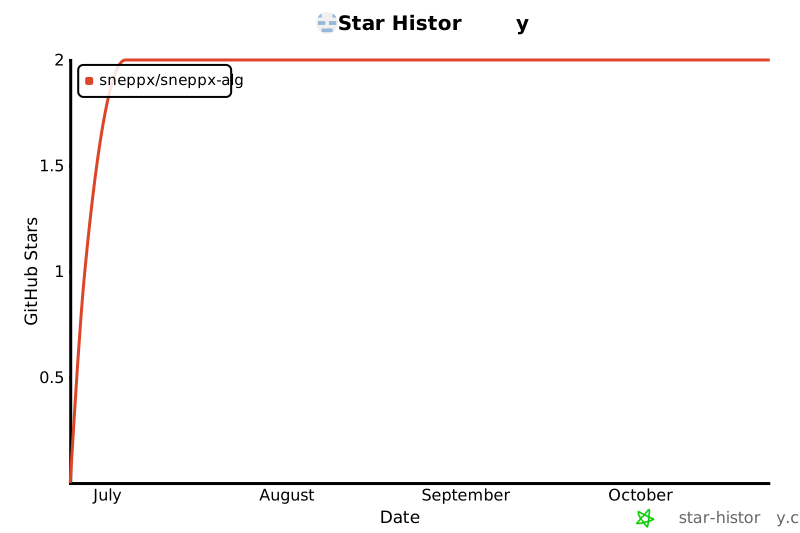
⭐ Star History
License
MIT — see LICENSE. Maintained by Ammar.
1 maintainer

Metadata
1 maintainer
Release files for sneppx-alg 1.5.1
For a detailed explanation of source distributions (sdists) and built distributions (wheels), please see the package formats documentation.
Source distribution (sdist)
| File | Size | Uploaded | Provenance | |
|---|---|---|---|---|
| sneppx_alg-1.5.1.tar.gz | 419.1 kB | Without provenance | Details |
Built distribution (wheel)
| File | Interpreter | ABI | Platform | Reset |
|---|---|---|---|---|
| sneppx_alg-1.5.1-py3-none-any.whl | Python 3 | none | any | Details |
Total release size: 893.3 kB
Release files / sneppx_alg-1.5.1.tar.gz
| Download URL | sneppx_alg-1.5.1.tar.gz |
|---|---|
| Size | 419.1 kB |
| Tags | Source |
|
SHA-256 checksum How to use checksums |
4f87d9cc8242be8138f0206d004f71bac14ee1120264e9e9ac04d30b3465426e
|
|
BLAKE2b-256 checksum How to use checksums |
03cb7c5faf825aeebfda9253be84ef8fc0d8f1b3d0713b5b7018262111fcd7c0
|
| Upload date | |
|
Uploaded using Trusted Publishing? What is trusted publishing? |
No |
| Uploaded via |
twine/6.2.0 CPython/3.11.9
|
Release files / sneppx_alg-1.5.1-py3-none-any.whl
| Download URL | sneppx_alg-1.5.1-py3-none-any.whl |
|---|---|
| Size | 474.2 kB |
| Tags | Python 3 |
|
SHA-256 checksum How to use checksums |
62dbd12d11254e6db9902a8aef17b6282853a75662ca03be26e46a13b96565cf
|
|
BLAKE2b-256 checksum How to use checksums |
7f3e64ce380ad0a7d929605b0a1256e0ca79b6ef4969595df8a8e517a70b60b1
|
| Upload date | |
|
Uploaded using Trusted Publishing? What is trusted publishing? |
No |
| Uploaded via |
twine/6.2.0 CPython/3.11.9
|
Security for sneppx-alg 1.5.1
Provenance
Provenance describes where a file came from. On PyPI, provenance is shared via attestations, which provide a verifiable record of the build or publishing details. View details, limitations and caveats.
No provenance found
None of the files in this release were uploaded with provenance metadata.
A note on package security
PyPI is a repository for distributing packages, not a service for auditing them. While third-party security researchers and our staff do their best to detect and remove malicious packages, PyPI cannot guarantee the quality, security or suitability of any given package.














