
snodo






Enforce your development process around whichever AI agent writes the code.
Built with snodo
From v0.19.0, snodo is developed with snodo. Each change to this repository
starts as a task spec, passes snodo's validators, is written by a coding agent
in its own worktree, is verified by the test gate, and arrives here as a pull
request that snodo opened. The protocol that governs this repository is
.snodo/protocol.yml, and every run is recorded in its audit
log.
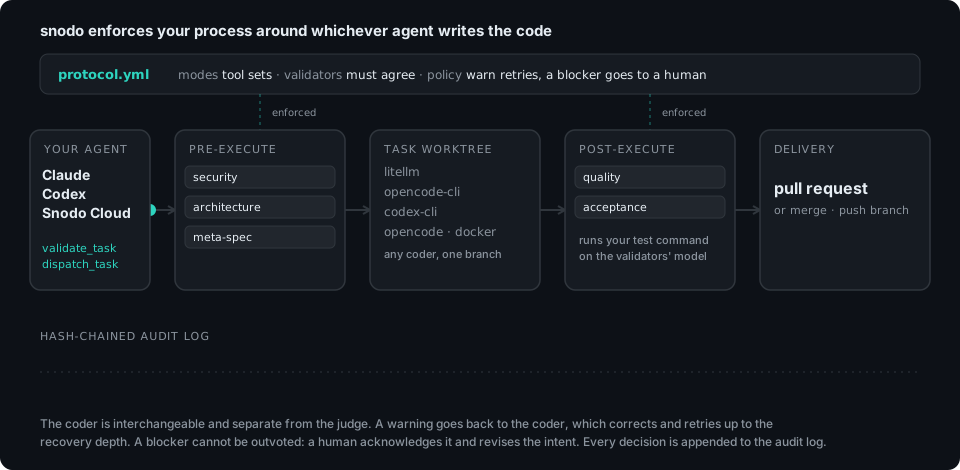
AI coding agents are fast, confident and non-deterministic. They will report a task as finished while a test is failing, while the change has drifted outside the task, or while it contradicts a decision your team recorded months ago. Asking the agent again does not settle any of that. snodo is built for the gap: you describe your development process as a protocol, and the engine enforces it around whichever agent writes the code.
The protocol is a YAML file. It declares modes — the stages of your process,
each with an explicit tool set — validators that must agree before work
proceeds, and the policy for when they disagree. Enforcement is structural,
not advisory: mutations are gated behind a signed validation token, a single
blocker halts execution before any vote (so a critical finding cannot be
outvoted), and every governance decision is written to a hash-chained audit log.
snodo does not make an agent more reliable. It makes the process hold whether or
not the agent cooperates.
The working loop
Connect an agent to Snodo over MCP. The orchestrator chooses the smallest
structure that fits—one task, a parallel wave, a multi-wave plan, or a queue of
plans—then validates and starts the work. Each task still passes through the
protocol's validator loop; jobs run asynchronously. Follow a live job with the
browser watch link returned when an HTTP/tunnel URL is configured, or with
snodo logs <job_id> --watch. watch_job also has an optional MCP Apps panel,
but some hosts (including Claude Desktop and relayed sessions) show only its
plain-text snapshot.
Register Snodo's mode-pinned MCP servers with snodo serve --mcp-install.
Installation supports Claude Desktop and the Codex family: ChatGPT desktop,
Codex CLI, and the IDE extension share ~/.codex/config.toml (relocated by
CODEX_HOME). Only clients with an existing config directory are updated;
restart each updated client to connect.
Optional job notifications can send project-named updates to ntfy, a generic
webhook, Slack, Discord, or Teams. Configure targets in
~/.snodo/config.yml ($SNODO_HOME/config.yml when overridden), then check
them with snodo config --notify-test. The configuration reference
covers all user-level settings.
orchestrator → MCP validate/dispatch or plan/queue → job → live browser watch
                                                     └→ snodo logs <job_id> --watch
That makes snodo an AI-SDLC protocol engine: a governance layer over the software development lifecycle, for teams where AI agents are first-class contributors. The coder is interchangeable and separate from the judge — an in-process LLM client, a host CLI authenticated against your own subscription, or a containerised server all converge on the same gate and the same merge path.
Install and first run
pip install snodo
snodo init --template solo
snodo config add anthropic sk-ant-...
snodo run "add a hello() function that returns the string 'world', with a test"
Python 3.12+. A key already exported in your environment (ANTHROPIC_API_KEY
and friends) is auto-detected. snodo run ... --mock needs no key and no
network at all.
Make an initial commit before the first run: each task executes in a git
worktree on a branch off HEAD, and on a repository with no commits snodo
refuses to run rather than silently dropping isolation (ADR 025).
Before spending anything on an existing repository, run snodo ready. Without
an LLM, it checks whether the artefacts the protocol expects — decision records,
a resolvable test command, coder configs — are committed, and scores what is
missing by how cheap it is to fix. Task worktrees only see HEAD, so "present
on disk" is not enough. See the runbook for readiness, the
full configuration surface, and the command reference.
What a run looks like
A project initialised from the solo template with its test command declared
(--test-command "python -m pytest -q"), then:
$ snodo run "add a hello() function that returns the string 'world', with a test" --mock

✓ Loaded protocol: Solo Developer Protocol
  Validators: security, architecture, quality, meta-spec, acceptance
  Policy: unanimous

  Validating (pre-execute): security, architecture, meta-spec
    meta-spec: finished
    architecture: finished
    security: finished
  Coder dispatched
  Coder returned (3 artifact(s))
  Post-validating: quality, acceptance
    acceptance: finished
    quality: finished
✓ Verified merge for task/task_ca8fd940fe5d/add-a-hello-function-that: task
  task_ca8fd940fe5d verified at commit 3e144ca (python -m pytest -q).

task_ca8fd940fe5d  resolved  (depth=0)
--mock swaps in a deterministic stub coder, so no key is spent and no network
call is made. The gates are not stubbed: the post-execute
quality validator ran this project's declared test command
(python -m pytest -q) against the change and passed it. Replace --mock with
a configured provider or --coder opencode-cli and the same gates judge the
real change. The transcript is trimmed for length; the protocol language is in
the protocol reference and the coder backends are in
Coder backends.
Project status
Actively-developed research implementation (beta). The enforcement invariants — token integrity, capability boundaries, non-overridable blockers, audit completeness — are verified by property-based tests over randomised inputs. Measured size, complexity and the CI gates are on the docs home.
Three honest boundaries, so you meet them here rather than an hour in:
- The
opencodecoder paths are experimental.litellm(the default),agyandmockare supported. The built-inlitellmcoder exists so snodo works with nothing else installed; if an expert CLI is available, prefer it. - The repository is trusted, not sandboxed. snodo runs your test and build
commands, and a protocol file is executable input, like a
Makefileor a CI config. ADR 014 is the threat model; do not point it at untrusted code. - This is a preprint-stage research artifact. The paper is under review; treat the code as a working implementation of the ideas, not a finished product.
Where to go next
| Page | What it covers |
|---|---|
| Protocol reference | The full protocol.yml language: modes, validators, constraints, disagreement policies, well-formedness, templates |
| Coder backends | Every --coder, how selection works, and how adapters are added |
| Runbook | Install, configure, the CLI reference, MCP serving, troubleshooting |
| Configuration | User settings, provider credentials, cloud, and job notifications |
| Architecture | How enforcement works end to end, the package map, the invariant-to-mechanism table |
| Machine interface | The versioned --json contract and validation-outcome exit codes |
| Authoring a plan | The contract for hand- and orchestrator-authored multi-wave plans |
| Design decisions | Every ADR, from PyJWT over custom HMAC to module-scoped governance |
| Docs home | The published site |
Research
Preprint: Specifying AI-SDLC Processes: A Protocol Language for Human-Agent Boundaries — arXiv:2606.20615.
Prifti, Y. (2026). Specifying AI-SDLC Processes: A Protocol Language for Human-Agent Boundaries. arXiv:2606.20615. https://doi.org/10.48550/arXiv.2606.20615
@misc{prifti2026snodo,
  title         = {Specifying AI-SDLC Processes: A Protocol Language for Human-Agent Boundaries},
  author        = {Prifti, Ylli},
  year          = {2026},
  eprint        = {2606.20615},
  archivePrefix = {arXiv},
  doi           = {10.48550/arXiv.2606.20615},
  url           = {https://arxiv.org/abs/2606.20615}
}
Empirical studies live in studies/, and the paper's claims are
mapped to code and tests in Research.
Contributing
See CONTRIBUTING.md.
License
Copyright (C) 2026 The snodo Authors. Licensed under the Apache License, Version 2.0 — see LICENSE.
1 maintainer

Metadata
1 maintainer
Release files for snodo 0.19.2
For a detailed explanation of source distributions (sdists) and built distributions (wheels), please see the package formats documentation.
Source distribution (sdist)
| File | Size | Uploaded | Provenance | |
|---|---|---|---|---|
| snodo-0.19.2.tar.gz | 246.4 kB | With provenance | Details |
Built distribution (wheel)
| File | Interpreter | ABI | Platform | Reset |
|---|---|---|---|---|
| snodo-0.19.2-py3-none-any.whl | Python 3 | none | any | Details |
Total release size: 519.6 kB
Release files / snodo-0.19.2.tar.gz
| Download URL | snodo-0.19.2.tar.gz |
|---|---|
| Size | 246.4 kB |
| Tags | Source |
|
SHA-256 checksum How to use checksums |
20388a96a98ee73c23d53b076c5b80ba36a504a097adefb0c7379a9c33a97127
|
|
BLAKE2b-256 checksum How to use checksums |
a012d096f2d767bdb7950e514f6aa2caf9d7ed51d63aefe7f3bad55d901db93a
|
| Upload date | |
|
Uploaded using Trusted Publishing? What is trusted publishing? |
Yes |
| Uploaded via |
twine/7.0.0 CPython/3.13.14
|
Provenance
Provenance describes where a file came from. On PyPI, provenance is shared via attestations, which provide a verifiable record of the build or publishing details. View details, limitations and caveats.


PyPI Publish Attestation
PyPI verified that this artifact, at this checksum, originated from the publisher listed below.
Signed by GitHub Actions, verified by PyPI on Oct 1, 2026.
Transparency logRelease files / snodo-0.19.2-py3-none-any.whl
| Download URL | snodo-0.19.2-py3-none-any.whl |
|---|---|
| Size | 273.2 kB |
| Tags | Python 3 |
|
SHA-256 checksum How to use checksums |
e88354b901fbd44384a76d79d819c88f3fd96e726d24e89b9dbd0a8370a8529f
|
|
BLAKE2b-256 checksum How to use checksums |
24b3721d9d1802de28b99f3a07dbcd2f5bc1e50bda44572a97df39518e23d719
|
| Upload date | |
|
Uploaded using Trusted Publishing? What is trusted publishing? |
Yes |
| Uploaded via |
twine/7.0.0 CPython/3.13.14
|
Provenance
Provenance describes where a file came from. On PyPI, provenance is shared via attestations, which provide a verifiable record of the build or publishing details. View details, limitations and caveats.
PyPI Publish Attestation
PyPI verified that this artifact, at this checksum, originated from the publisher listed below.
Signed by GitHub Actions, verified by PyPI on Oct 1, 2026.
Transparency logSecurity for snodo 0.19.2
Provenance
Provenance describes where a file came from. On PyPI, provenance is shared via attestations, which provide a verifiable record of the build or publishing details. View details, limitations and caveats.
Full provenance
All 2 files in this release have been uploaded with provenance metadata.
Attestation for snodo-0.19.2.tar.gz
PyPI Publish Attestation
PyPI verified that this artifact, at this checksum, originated from the publisher listed below.
Signed by GitHub Actions, verified by PyPI on Oct 1, 2026.
Transparency logA note on package security
PyPI is a repository for distributing packages, not a service for auditing them. While third-party security researchers and our staff do their best to detect and remove malicious packages, PyPI cannot guarantee the quality, security or suitability of any given package.
To learn more about protecting yourself from malicious actors, visit our package security documentation.














