
Process genomes with ease

Project description

snputils: A Python Library for Processing Genetic Variation and Population Structure




snputils is a Python package designed to ease the processing and analysis of genomic datasets, while handling all the complexities of different genome formats and operations very efficiently. The library provides robust tools for handling sequencing and ancestry data, with a focus on performance, ease of use, and advanced visualization capabilities.
Developed in collaboration between Stanford University's Department of Biomedical Data Science, UC Santa Cruz Genomics Institute, and more collaborators worldwide.
snputils is stable and ready for production workflows. The core API is documented, tested, and suitable for day-to-day genomic analysis. The project is actively maintained: we ship regular releases, welcome contributions, and continue to extend format support, analyses, and performance.
Why snputils?
- One API across genotype, local ancestry, global ancestry, phenotype, and IBD data
- Fast readers and writers for common population-genetics formats
- In-memory Python workflows and file-backed CLI workflows in the same package
- Ancestry-aware analyses including PCA and advanced alternatives, admixture mapping, and ancestry-specific allele frequencies
- Built-in plotting for embeddings, local ancestry, admixture, and association results
Quickstart
import snputils as su

snp = su.read_snp("cohort.vcf.gz")                    # VCF, BCF, BGEN, BED, PGEN
snp = snp.filter_biallelic_variants()
snp.save("cohort.pgen")                               # convert to PGEN

lai = su.read_lai("local_ancestry.msp")               # MSP or FLARE local ancestry
adm = su.read_admixture("admixture_prefix")           # ADMIXTURE-style global ancestry
pheno = su.read_pheno("phenotypes.tsv", col="trait")
ibd = su.read_ibd("segments.hapibd")

pcs = su.PCA(n_components=2).fit_transform(snp)
afr_af = snp.allele_freq(ancestry="AFR", laiobj=lai)
gwas = su.run_gwas(pheno, snp)
admix = su.run_admixture_mapping(pheno, lai)

su.viz.scatter(pcs, "labels.tsv", save_path="pca.png", show=False)
su.viz.chromosome_painting(lai, "chr_paintings/")
su.viz.qq_plot(gwas)
su.viz.manhattan_plot(admix)
Installation
Basic installation using pip:
pip install snputils
Optionally, for PyTorch-backed features, install with the [torch] extra:
pip install 'snputils[torch]'
Optional extras:
pip install 'snputils[tests]'for the test stackpip install 'snputils[docs]'for local documentation buildspip install 'snputils[demos]'for notebook demos
Key Features
File Format Support
snputils provides high-level dispatchers like read_snp, read_lai, read_admixture, read_pheno, and read_ibd, plus explicit reader and writer classes when you need finer control.
- VCF: Support for
.vcfand.vcf.gzfiles - BCF: Read support for
.bcffiles - BGEN: Support for
.bgenfiles - PLINK1: Support for
.bed,.bim,.famfilesets - PLINK2: Support for
.pgen,.pvar,.psamfilesets - GRG: Read and write graph-based genome representation files
- Local Ancestry: Handle
.mspand FLARE.anc.vcf.gzlocal ancestry formats - Global Ancestry / ADMIXTURE: Read and write
.Qand.Pfiles - IBD: Read
hap-IBDandancIBDoutputs into a unified object
Data Objects and Utilities
- SNPObject for genotype data, including filtering, saving, and allele-frequency helpers
- LocalAncestryObject and GlobalAncestryObject for ancestry-aware workflows
- PhenotypeObject, MultiPhenotypeObject, and CovariateObject for trait data
- IBDObject for segment filtering and ancestry-restricted trimming
- Synthetic dataset builders for SNP, mdPCA, maasMDS, chromosome-painting, admixture, and GRG examples
- Conversion helpers such as VCF-to-GRG workflows
Processing & Analysis Tools
-
Basic manipulation
- Filter variants and samples, correct SNP flips, and filter ambiguous SNPs
- Compute cohort and ancestry-specific allele frequencies via
SNPObject.allele_freq(...) - Stream allele frequencies with
snputils.stats.allele_freq_stream(...)for memory efficiency
-
Dimensionality reduction
- Standard PCA with optional PyTorch acceleration
- Missing-data PCA (
mdPCA) - Multi-array ancestry-specific MDS (
maasMDS)
-
Population-genetic statistics
- Compute $D$, $f_2$, $f_3$, $f_4$, the $f_4$-ratio, and $F_{ST}$ (Hudson, Weir-Cockerham, and Tsallis $F_{q}$)
- Block jackknife standard errors where applicable
- Optional ancestry masking in relevant workflows
-
Association analysis
- GWAS on SNP dosages for binary and quantitative traits
- Admixture mapping from local ancestry dosage
- Built-in Manhattan and Q–Q plotting utilities
-
IBD and ancestry-aware trimming
- Unified IBD ingestion from common upstream tools
- Segment filtering and ancestry-restricted trimming using local ancestry
-
Simulation
- Lightweight haplotype-based simulation of admixed mosaics from founder haplotypes
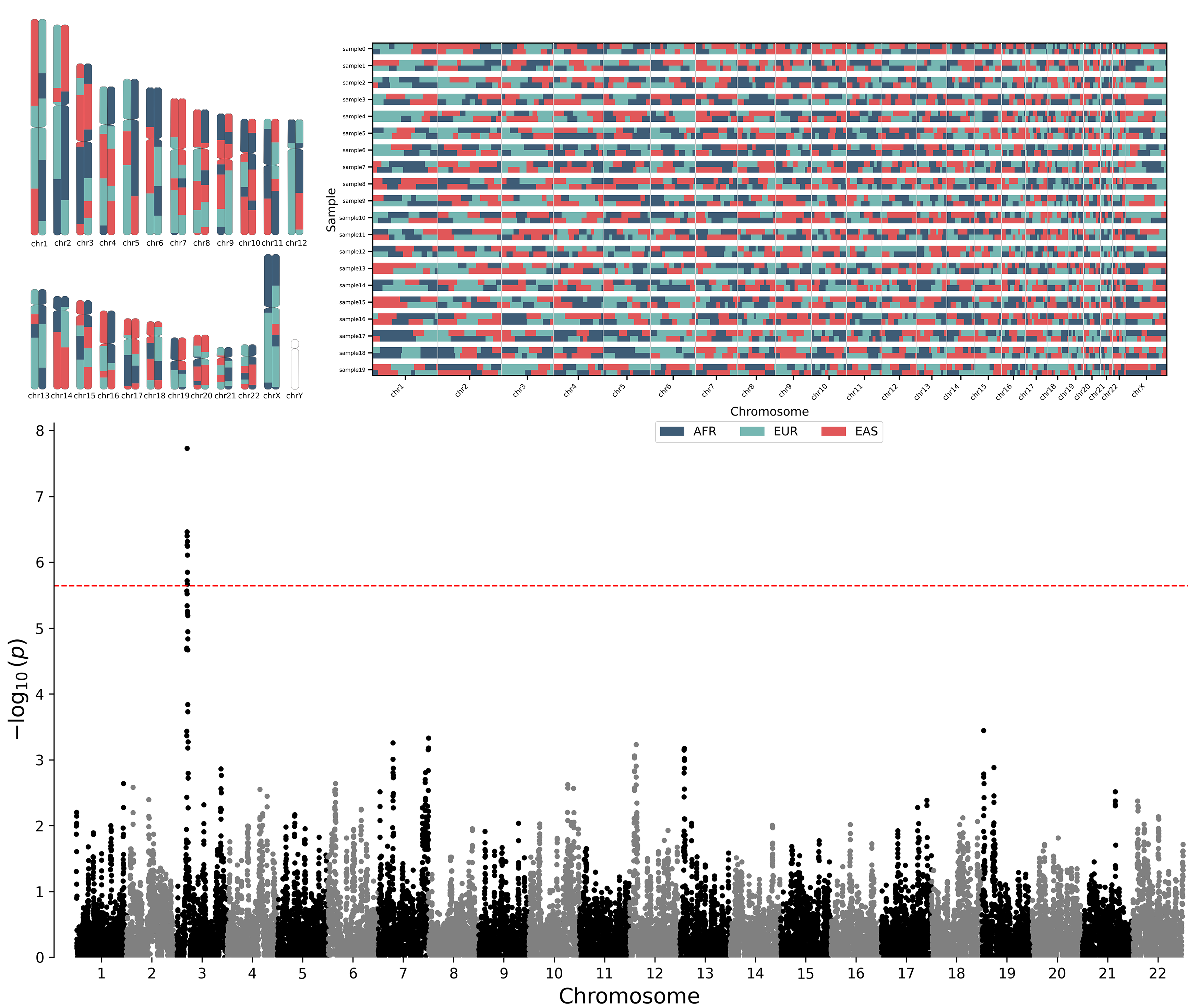
Visualization
- Scatter plots for PCA, mdPCA, and maasMDS embeddings
- Global ancestry bar plots
- Local ancestry visualization
- Chromosome painting
- Dataset-level cohort summaries
- Association plots
- Manhattan plots
- Q–Q plots
Performance
- Fast file I/O through built-in methods or optimized wrappers (e.g., Pgenlib for PLINK files)
- Memory-efficient operations using NumPy and Polars, including streaming workflows
- Optional GPU acceleration via PyTorch for computationally intensive tasks
- Support for large-scale genomic datasets through efficient memory management
Our benchmark demonstrates superior performance compared to existing tools:
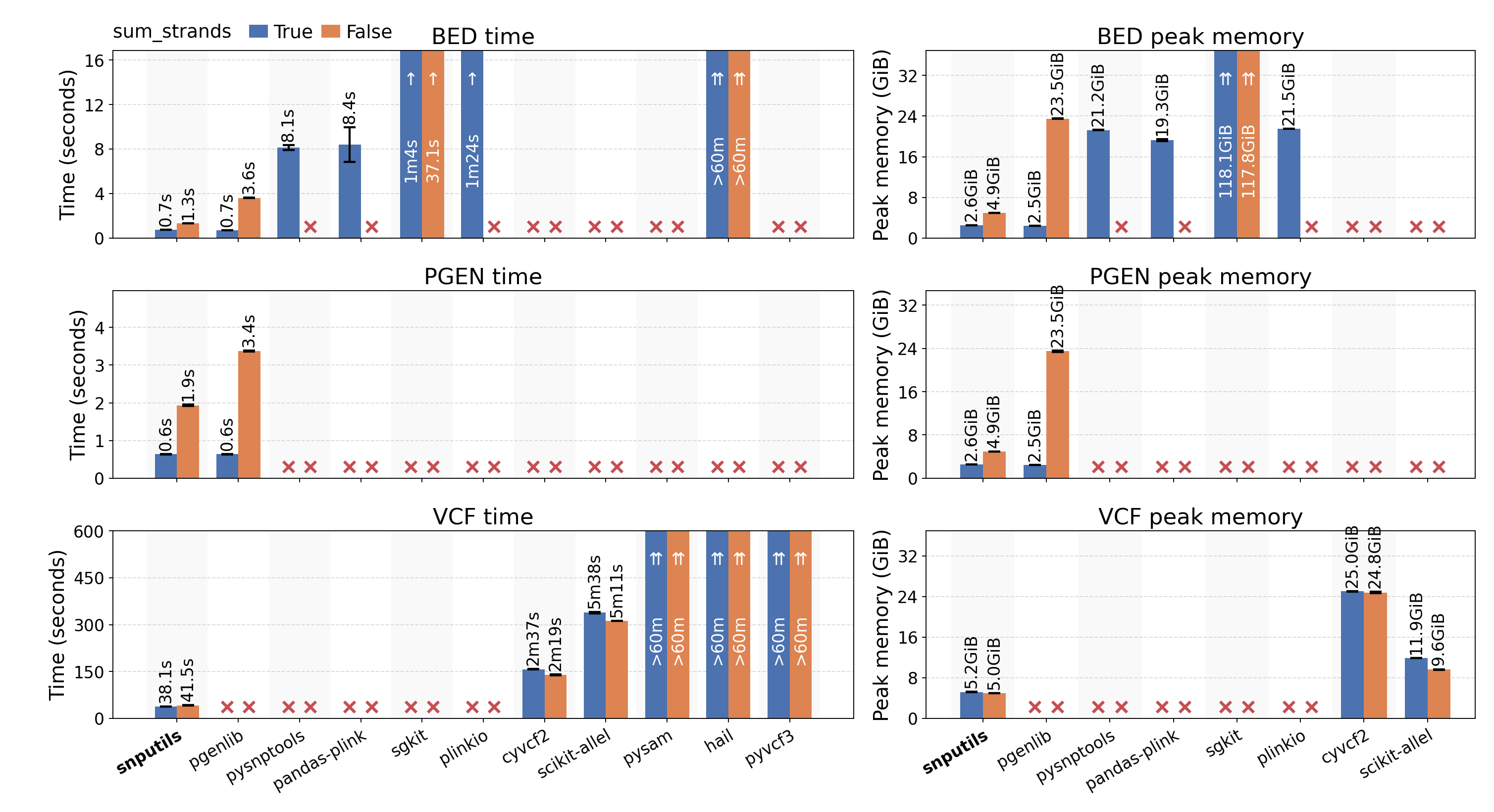
Reading time and peak-memory comparison for chromosome 22 data across different tools. See the benchmark directory for detailed methodology and results.
Command-Line Interface
Installing the package provides a snputils command for common file-backed workflows:
snputils --help
snputils --version
Available subcommands include:
pca: run standard PCA and save coordinates/components and a scatter plot.mdpca: run missing-data PCA and save an embedding table.maasmds: run ancestry-specific MDS and save an embedding table.admixture-map: run admixture mapping from phenotype and local ancestry files.gwas: run variant-level association testing from phenotype and genotype files.simulate: simulate admixed haplotype batches from phased founder haplotypes.plot-manhattanandplot-qq: render association result visualizations.
The Python API remains the full surface for low-level readers/writers, object manipulation, IBD filtering and trimming, f-statistics, allele-frequency helpers, custom visualizations, and notebook-oriented workflows. Use the CLI when a workflow naturally starts from files and produces files; use Python when you need programmatic composition or in-memory objects.
Documentation and Examples
- Documentation: docs.snputils.org
- Quickstart: Quickstart guide
- Tutorials: PCA, mdPCA, maasMDS, SNP objects, allele frequency, local ancestry visualization, admixture mapping, and GRG workflows
- API Reference: Readers, writers, data objects, processing classes, statistics, datasets, and visualization helpers
- Issues and feature requests: GitHub Issues
Public API Highlights
Top-level imports include:
- Readers and objects:
read_snp,read_lai,read_admixture,read_ibd,read_pheno,SNPObject,LocalAncestryObject,GlobalAncestryObject,IBDObject - Analysis:
PCA,mdPCA,maasMDS,run_gwas,run_admixture_mapping,allele_freq_stream - Datasets:
load_dataset,available_datasets_list,build_synthetic_* - Visualization namespace:
snputils.viz
Citation
If you use snputils in your research, please cite our paper:
@article{snputils2026,
    author    = {Bonet, David and Comajoan Cara, Marçal and Barrabés, Míriam and Smeriglio, Riccardo and Agrawal, Devang and Aounallah, Khaled and Geleta, Margarita and Dominguez Mantes, Albert and Thomassin, Christophe and Shanks, Cole and Huang, Edward C. and Franquesa Monés, Marc and Luis, Aina and Saurina, Joan and Perera, Maria and López, Cayetana and Sabat, Benet Oriol and Abante, Jordi and Moreno-Grau, Sonia and Mas Montserrat, Daniel and Ioannidis, Alexander G.},
    title     = {{snputils}: A High-Performance {Python} Library for Genetic Variation and Population Structure},
    year      = {2026},
    doi       = {10.64898/2026.02.28.708618},
    url       = {https://www.biorxiv.org/content/10.64898/2026.02.28.708618},
    journal   = {bioRxiv},
    publisher = {Cold Spring Harbor Laboratory},
}
Acknowledgments
We would like to thank the open-source packages that make snputils possible.
Release history Release notifications | RSS feed


Download files
Download the file for your platform. If you're not sure which to choose, learn more about installing packages.
Source Distribution
Built Distribution
Filter files by name, interpreter, ABI, and platform.
If you're not sure about the file name format, learn more about wheel file names.
Copy a direct link to the current filters
File details
Details for the file snputils-1.0.4.tar.gz.
File metadata
- Download URL: snputils-1.0.4.tar.gz
- Upload date:
- Size: 4.2 MB
- Tags: Source
- Uploaded using Trusted Publishing? No
- Uploaded via: twine/6.1.0 CPython/3.13.12
File hashes
| Algorithm | Hash digest | |
|---|---|---|
| SHA256 |
9a2143896738123467826dd3f964858ef91cd75dc5b3d6fa516b9344d30c6d34
|
|
| MD5 |
3d07433c2d789df8f5a9b917d4d8e18c
|
|
| BLAKE2b-256 |
145f61c84cd120ce1cdb161853d9250a4b3f35be6c26ea301e22ebf0bfafa466
|
File details
Details for the file snputils-1.0.4-py3-none-any.whl.
File metadata
- Download URL: snputils-1.0.4-py3-none-any.whl
- Upload date:
- Size: 430.8 kB
- Tags: Python 3
- Uploaded using Trusted Publishing? No
- Uploaded via: twine/6.1.0 CPython/3.13.12
File hashes
| Algorithm | Hash digest | |
|---|---|---|
| SHA256 |
f2e5478660d98afa4320654f740850b5e8e5ba1ee835fcc170b93e2f93aea5bb
|
|
| MD5 |
1fcb8a3460b3a778799d1ca18d8b1daa
|
|
| BLAKE2b-256 |
a381d50bbed9bfb0fe52a29506b99d715a3b0b34c215b2ec536343497790beb6
|






