
Software Intake Gatekeeper




Before you install, approve or ship a third-party app, find out what is inside it.
Software Intake Gatekeeper reads an installed application, an Electron .asar archive or a
compiled binary. It never runs or unpacks it. It produces:
- a CycloneDX 1.6 SBOM of the components that are actually bundled,
- known vulnerabilities for those exact versions from OSV.dev (only when you opt in),
- Electron hardening checks for the fuse wire inside the executable and risky
BrowserWindowsettings in the app code, - an APPROVE / REVIEW / REJECT decision from a versioned policy, with expiring waivers,
- an update check that compares two versions and gates on what the update adds: new vulnerabilities, weakened Electron fuses, new network endpoints, new native modules,
- SARIF for GitHub code scanning, a Markdown summary for pull requests and a full JSON evidence report.
Every finding names the file and, for scripts, the line, column and snippet that produced it. Anything the scanner could not verify is reported as a coverage gap. A blocking gap can never lead to APPROVE: an unknown result is not treated as safe.
Status: v0.2.1, an alpha release on PyPI and the GitHub Marketplace. The CLI is tested on Windows and Linux with real Go binaries in three object formats, an ASAR archive packed by the official
@electron/asartool and the live OSV API; the action also runs on macOS. The results are static, version-level evidence, not proof of exploitability.
Part of a small software trust toolkit with Privacy Flow Inspector: this tool checks what is inside an app; the inspector checks which personal data the app sends out.
Where it helps
| Who | Situation | What they get |
|---|---|---|
| IT / security intake | An employee requests a desktop tool (an Electron or Go CLI) | An SBOM, known CVEs and Electron hardening issues before approval, with a decision a reviewer can sign off |
| Product teams shipping Electron | A release candidate is ready | A CI gate that fails when contextIsolation is off, RunAsNode is enabled or bundled packages have critical advisories |
| Supply-chain / compliance (EU CRA, medical-device SBOM expectations) | A vendor delivers a binary without an SBOM | A CycloneDX SBOM built from evidence inside the binary, with occurrences pointing to the source files |
| Procurement / vendor review | Comparing two vendor builds | Reproducible JSON and SBOM output that can be compared across versions |
Quick start
Install from PyPI (Python 3.11+):
python -m pip install software-intake-gatekeeper
To verify build provenance first, install the wheel from the GitHub release instead:
gh release download v0.2.1 -R Sushant-Nemade/software-intake-gatekeeper -p "*.whl"
gh attestation verify software_intake_gatekeeper-0.2.1-py3-none-any.whl -R Sushant-Nemade/software-intake-gatekeeper
python -m pip install software_intake_gatekeeper-0.2.1-py3-none-any.whl
Or install from a clone (needed for the demo below):
git clone https://github.com/Sushant-Nemade/software-intake-gatekeeper
cd software-intake-gatekeeper
python -m pip install .
Then scan:
# Offline inventory and Electron checks (no network):
intake-gatekeeper scan "C:\Program Files\SomeApp"

# Add known-vulnerability lookup and write every report:
intake-gatekeeper scan "C:\Program Files\SomeApp" --osv `
  --json reports/report.json --sarif reports/report.sarif `
  --cyclonedx reports/sbom.cdx.json --markdown reports/summary.md
Exit status: 0 the decision passed the --fail-on threshold (default reject), 1 the gate
failed, 2 usage or input error. Run intake-gatekeeper rules to list the configuration rules.
Try the fictional vulnerable demo
examples/vulnerable-demo is a deliberately insecure, fictional target. It contains an ASAR
archive packed by the official @electron/asar tool, a .deps.json file and, after the build
step, a real Go binary and a synthetic Electron executable stand-in.
python scripts/build_demo.py      # Go is optional; it builds the real Go demo binary
intake-gatekeeper scan examples/vulnerable-demo --osv --policy examples/intake-policy.toml
Real output (2026-10-14, live OSV):
Decision: REJECT
  - 19 finding(s) at or above high.
  - 41 finding(s) between low and high.
Target: vulnerable-demo | files 5 | archive entries 8 | lookup osv
Components: Go 3, NuGet 2, npm 5
Findings: critical 1, high 18, medium 31, low 10, info 0
Electron 28.0.0 at bin/electron-runtime-stand-in.bin
  [CRITICAL] GHSA-xvch-5gv4-984h minimist 1.2.5: Prototype Pollution in minimist @ resources/app.asar!/node_modules/minimist/package.json
  [HIGH    ] EGK-FUSE-RUN-AS-NODE RunAsNode fuse is enabled @ bin/electron-runtime-stand-in.bin
  [HIGH    ] EGK-JS-CONTEXT-ISOLATION-OFF Context isolation is disabled @ resources/app.asar!/main.js:12
  [HIGH    ] EGK-JS-NODE-INTEGRATION Renderer has Node.js integration enabled @ resources/app.asar!/main.js:11
  [HIGH    ] GHSA-5crp-9r3c-p9vr Newtonsoft.Json 12.0.1: Improper Handling of Exceptional Conditions in Newtonsoft.Json @ dotnet/IntakeDemo.deps.json
  [HIGH    ] GHSA-69ch-w2m2-3vjp golang.org/x/text v0.3.7: golang.org/x/text/language Denial of service via crafted Accept-Languag... @ bin/intake-demo-tool.exe
  ...
The Markdown summary also includes a table of components with known vulnerabilities and the
smallest listed fixed version above the current one (for example minimist 1.2.6,
Newtonsoft.Json 13.0.1). One lodash advisory shows as waived because the example policy
accepts it until 2026-12-31 with a written reason.
Check an update before rolling it out
diff scans the version you run today and the new one, then decides on what the update adds.
Persisting issues are listed but do not block the update; run scan for an absolute assessment.
intake-gatekeeper diff examples/update-demo/v1 examples/update-demo/v2 --osv `
  --json reports/update.json --markdown reports/update.md --sarif reports/update.sarif
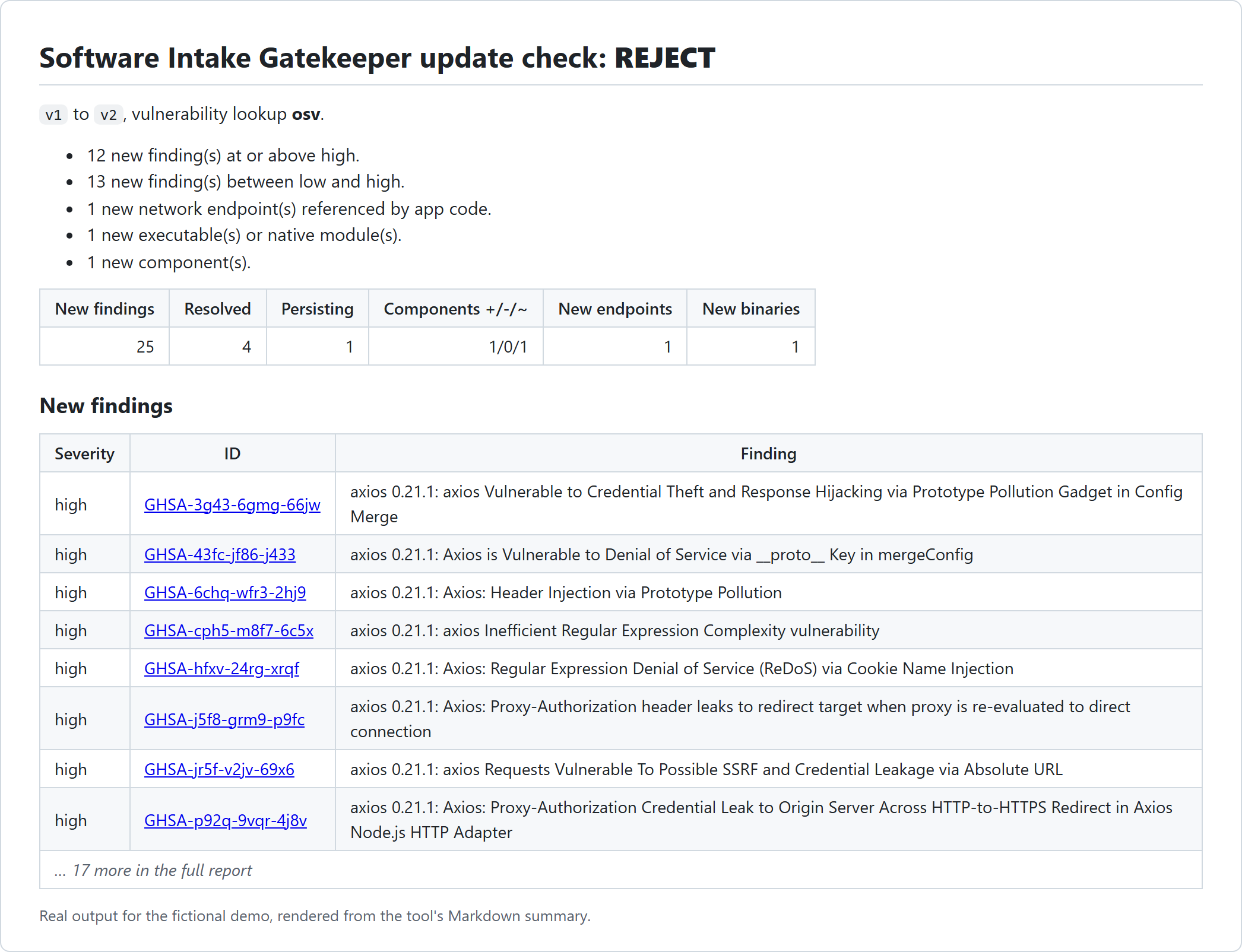
Real output for the fictional update demo (2026-10-14, live OSV). Version 2
fixes a nodeIntegration setting and upgrades lodash, but adds axios 0.21.1, a telemetry endpoint and
a native module:
Update decision: REJECT
  - 12 new finding(s) at or above high.
  - 13 new finding(s) between low and high.
  - 1 new network endpoint(s) referenced by app code.
  - 1 new executable(s) or native module(s).
  - 1 new component(s).
Findings: 25 new, 4 resolved, 1 persisting
Components changed: 2 | endpoints +1/-0 | binaries +1/-0/~0
  NEW [HIGH    ] GHSA-cph5-m8f7-6c5x axios 0.21.1: axios Inefficient Regular Expression Complexity vulnerability
  ...
  NEW endpoint collect.metrics-collector.example
| The update check reports | How it is matched |
|---|---|
| New and resolved findings | Advisory id plus package name (so a version bump that keeps the bug counts as persisting), or rule plus file |
| Component changes | Added, removed or changed versions per ecosystem and name |
| Electron | Runtime version change and every fuse change; a fuse moving into its risky state is weakened |
| Network endpoints | Hosts in http(s):// and ws(s):// URLs in app code (outside node_modules), without XML namespaces or local addresses |
| Executables and native modules | Added, removed or changed (SHA-256) PE, ELF and Mach-O files, including .node modules |
REJECT if a new finding reaches reject_at. REVIEW for new findings at review_at, weakened
fuses, new endpoints, new binaries, new components or blocking gaps in the new version.
APPROVE otherwise. The SARIF output contains only the new findings.
What it inspects
| Evidence | Source inside the target | Output |
|---|---|---|
| Go modules and toolchain | Build info embedded by the Go linker (Go 1.18+) in PE, ELF and Mach-O executables | pkg:golang/... components, including stdlib and replace directives |
| npm packages | node_modules/**/package.json on disk and inside .asar archives |
pkg:npm/... components; the app's own manifest is recorded but not queried |
| NuGet packages | *.deps.json (package and self-contained runtimepack entries) |
pkg:nuget/... components |
| .NET shared framework | *.runtimeconfig.json |
Minimum framework version, plus a note that the host runtime decides the patch level |
| Electron runtime | The fuse sentinel and Electron/x.y.z string in the executable |
Electron version (queried as npm electron) and the fuse states |
| Electron app code | .js/.cjs/.mjs/.ts files outside node_modules, on disk or in .asar |
webPreferences rule findings with line, column and snippet |
| Network endpoints | http(s):// and ws(s):// hosts referenced by that app code |
Host list with up to three source files each (used by the update check) |
| Executables and native modules | PE, ELF and Mach-O files, including .node add-ons |
Path, size, SHA-256 and kind (Go, Electron, native) |
Electron rules
| Rule | Default | Detects |
|---|---|---|
EGK-JS-NODE-INTEGRATION |
high | nodeIntegration: true (also minified !0) |
EGK-JS-CONTEXT-ISOLATION-OFF |
high | contextIsolation: false |
EGK-JS-WEB-SECURITY-OFF |
high | webSecurity: false |
EGK-JS-INSECURE-CONTENT |
high | allowRunningInsecureContent: true |
EGK-JS-SANDBOX-OFF |
medium | sandbox: false within a webPreferences object |
EGK-JS-NODE-INTEGRATION-EXTENDED |
medium | Node.js in sub-frames or workers |
EGK-JS-REMOTE-MODULE |
medium | enableRemoteModule: true |
EGK-JS-WEBVIEW-TAG / EGK-JS-EXPERIMENTAL-FEATURES |
low | <webview> or experimental features enabled |
EGK-JS-OPEN-EXTERNAL |
info | shell.openExternal( call sites to review |
EGK-FUSE-RUN-AS-NODE, -NODE-OPTIONS, -NODE-INSPECT |
medium | Fuses that let a trusted binary run arbitrary Node.js code |
EGK-FUSE-ASAR-INTEGRITY-OFF, -LOAD-OUTSIDE-ASAR, -COOKIE-ENCRYPTION-OFF, -FILE-PROTOCOL-PRIVILEGES |
low | Integrity and hardening fuses left at their defaults |
Each rule links to the matching section of Electron's security checklist or fuses guide.
Decision model
flowchart LR
    T[Target: folder / .asar / binary] --> S[Read-only scanner]
    S --> C[Components + evidence]
    S --> F[Electron findings]
    S --> G[Coverage gaps]
    C -->|--osv, opt-in| O[OSV.dev: ecosystem, name, version only]
    O --> V[Alias-grouped advisories + nearest fix]
    F --> P[Policy: thresholds, overrides, expiring waivers]
    V --> P
    G --> P
    P --> D{APPROVE / REVIEW / REJECT}
    D --> R[JSON, SARIF, CycloneDX, Markdown]
- REJECT: any unwaived finding at or above
reject_at(defaulthigh). - REVIEW: findings at or above
review_at(defaultlow), or any blocking coverage gap, such as a skipped lookup, an OSV failure, a size or file limit, an unparseable artifact or no recognised content. - APPROVE: none of the above.
Advisories that describe the same issue (for example GHSA-69ch-w2m2-3vjp and GO-2022-1059) are
merged into one finding. Severity comes from the GitHub-reviewed database rating, including linked
GHSA aliases. Advisories that no database rates (common for Go) are treated as
unrated_vulnerability (default medium) and labelled as such.
Policy
See examples/intake-policy.toml. Unknown keys are rejected. Every waiver needs an id or alias, a written reason and an expiry date, and may be limited to one package URL. Expired or unused waivers are reported.
GitHub Action
Available on the GitHub Marketplace. It runs on Linux, Windows and macOS runners; CI exercises all three.
Gate a packaged Electron app and publish alerts to code scanning
name: Intake gate
on: [pull_request, workflow_dispatch]

permissions:
  contents: read
  security-events: write   # only needed for the SARIF upload step

jobs:
  intake:
    runs-on: ubuntu-latest
    steps:
      - uses: actions/checkout@v7
      # ... build or download the app you want to check into dist/linux-unpacked ...
      - name: Software Intake Gatekeeper
        id: intake
        uses: Sushant-Nemade/software-intake-gatekeeper@v0
        with:
          path: dist/linux-unpacked
          fail-on: reject
      - name: Upload SARIF
        if: always() && steps.intake.outputs.sarif != ''
        uses: github/codeql-action/upload-sarif@v4
        with:
          sarif_file: ${{ steps.intake.outputs.sarif }}
          category: software-intake-gatekeeper
      - name: Keep the SBOM and evidence
        if: always()
        uses: actions/upload-artifact@v7
        with:
          name: intake-gatekeeper-reports
          path: intake-gatekeeper-reports/
For supply-chain hardening, pin the action to the full commit SHA of a release instead of @v0.
Inputs
| Input | Default | Description |
|---|---|---|
path |
(required) | Installed app directory, .asar archive or executable to scan. |
compare-to |
"" |
Previous version of the same app. When set, the action runs the update check and gates on what the update adds. |
osv |
true |
Look up known vulnerabilities on OSV.dev. Sends only ecosystem, name and version. Set false for fully offline runs. |
policy |
"" |
Path to a policy TOML file (see examples/intake-policy.toml). |
fail-on |
reject |
Decision that fails the step: reject, review or never. |
output-dir |
intake-gatekeeper-reports |
Where report.json, report.sarif, sbom.cdx.json and summary.md are written. |
Outputs
| Output | Description |
|---|---|
decision |
approve, review or reject (error if no report was produced). |
sarif |
Path to the SARIF 2.1.0 report. Paths inside it are relative to the workspace so code scanning can link them. |
sbom |
Path to the CycloneDX 1.6 SBOM. |
The Markdown summary is appended to the job summary. The action installs hash-pinned
dependencies into a private virtual environment under RUNNER_TEMP, so it does not change the
job's Python. Inputs reach the script only through environment variables and are never
interpolated into shell code. No token or secret is required.
Versioning
Releases follow Semantic Versioning and are listed in CHANGELOG.md.
v0 always points to the latest v0.x.y release. Release artifacts carry
build provenance attestations
and a SHA256SUMS file.
Privacy and network use
- Without
--osvthe tool makes no network requests. - With
--osv, it sends only{ecosystem, name, version}for each queryable component tohttps://api.osv.dev(or a mirror set with--osv-url). It sends no file paths, hashes or file contents. Private package names are sent as well, so use an internal OSV mirror if those names are sensitive. - TLS verification uses the operating-system trust store through truststore, so corporate TLS inspection works without disabling verification.
Verification
| Check | How |
|---|---|
| Go build info decoding | Compared with go version -m on real binaries built in CI for Windows PE, Linux ELF and macOS Mach-O |
| ASAR parsing | Fixture packed by @electron/asar 4.3.1; listing matches the official tool |
| Fuse decoding | Wire layout taken from @electron/fuses. A read-only local check on an installed Electron app (VS Code) matched npx @electron/fuses read for all 9 fuses |
| Output formats | CycloneDX validated with cyclonedx-python-lib against the 1.6 schema in tests. SARIF validated against the OASIS 2.1.0 schema during development |
| OSV client | Mocked transport tests (batching, pagination, retries, alias grouping, withdrawn advisories) plus an opt-in live test (INTAKE_LIVE_OSV=1) |
| Scale | Read-only scan of a locally installed VS Code: 3,243 files and 5,451 archive entries in about 19 s with a warm file cache |
| CI | Ubuntu (Python 3.11 and 3.13) and Windows (3.13): pytest, ruff, mypy --strict, build, twine, pip-audit. The action itself runs on Ubuntu, Windows and macOS against the demo with live OSV, plus fail-on, invalid-input and update-check (compare-to) runs |
No third-party application files are committed. The local real-app checks are listed for transparency only.
Limitations
- Version matching is not reachability. A vulnerable function may never be called; use waivers with reasons when you have checked this.
- It reads Go build info only for Go 1.18+ (older binaries are reported as gaps). It does not yet
read Rust
cargo auditablesections, Python wheels, Java JARs or native C/C++ libraries. - Electron code rules are pattern-based. They catch literal settings, including minified ones, but not values computed at runtime.
- Installers (
.exe/.msi/.dmg) must be extracted or installed first. The tool does not unpack archives to disk. - Electron versions are detected from the
Electron/x.y.zstring; if none or several are found, this is reported as a gap.
Roadmap
- Rust
cargo auditable, Python*.dist-infoand Javapom.propertiesinventories. - Signature and publisher changes (Authenticode, code signing) in the update check.
- An optional adapter for reverse-engineering evidence tools behind an approval gate.
Shipped from earlier roadmap items: the version-to-version update check (v0.2.0) and the PII-in-HAR inspector, released as the separate Privacy Flow Inspector.
Development
python -m pip install uv
uv sync --frozen --extra dev
$env:INTAKE_GO = "C:\path\to\go.exe"   # optional; enables real Go binary tests
uv run --frozen --extra dev pytest -q
uv run --frozen --extra dev ruff check .
uv run --frozen --extra dev mypy
Background and license
The idea came from studying evidence-first reverse-engineering tools, which show the evidence for every conclusion and state what they could not determine. This project applies that approach to software intake. All code here is original; no third-party tool source is included.
MIT © 2026 Sushant Nemade. See SECURITY.md for vulnerability reporting.
1 maintainer

Metadata
1 maintainer
Release files for software-intake-gatekeeper 0.2.1
For a detailed explanation of source distributions (sdists) and built distributions (wheels), please see the package formats documentation.
Source distribution (sdist)
| File | Size | Uploaded | |
|---|---|---|---|
| software_intake_gatekeeper-0.2.1.tar.gz | 60.6 kB | Details |
Built distribution (wheel)
| File | Interpreter | ABI | Platform | Reset |
|---|---|---|---|---|
| software_intake_gatekeeper-0.2.1-py3-none-any.whl | Python 3 | none | any | Details |
Total release size: 107.0 kB
Release files / software_intake_gatekeeper-0.2.1.tar.gz
| Download URL | software_intake_gatekeeper-0.2.1.tar.gz |
|---|---|
| Size | 60.6 kB |
| Tags | Source |
|
SHA-256 checksum How to use checksums |
abe4b86072f07edadfa8fe4f074579d4c127fc84b0543592dd6c64467cfd395b
|
|
BLAKE2b-256 checksum How to use checksums |
924329ffb239b453e6cac2643527e16b4b72900b9cb1295cdbed5cb48bac7a95
|
| Upload date | |
|
Uploaded using Trusted Publishing? What is trusted publishing? |
Yes |
| Uploaded via |
twine/7.0.0 CPython/3.13.14
|
Provenance
Provenance describes where a file came from. On PyPI, provenance is shared via attestations, which provide a verifiable record of the build or publishing details. View details, limitations and caveats.


PyPI Publish Attestation
PyPI verified that this artifact, at this checksum, originated from the publisher listed below.
Signed by GitHub Actions, verified by PyPI on Oct 14, 2026.
Transparency logRelease files / software_intake_gatekeeper-0.2.1-py3-none-any.whl
| Download URL | software_intake_gatekeeper-0.2.1-py3-none-any.whl |
|---|---|
| Size | 46.3 kB |
| Tags | Python 3 |
|
SHA-256 checksum How to use checksums |
8f6eea6fcf55b1a1cda7b18453aa52ed498fb4022c3e5dfdb98aabd120b4a2a1
|
|
BLAKE2b-256 checksum How to use checksums |
bf48f64ac3bfb373b1cf12f15e2d900869c48639f0d14c36e3577d0012a80862
|
| Upload date | |
|
Uploaded using Trusted Publishing? What is trusted publishing? |
Yes |
| Uploaded via |
twine/7.0.0 CPython/3.13.14
|
Provenance
Provenance describes where a file came from. On PyPI, provenance is shared via attestations, which provide a verifiable record of the build or publishing details. View details, limitations and caveats.
PyPI Publish Attestation
PyPI verified that this artifact, at this checksum, originated from the publisher listed below.
Signed by GitHub Actions, verified by PyPI on Oct 14, 2026.
Transparency log













