
Solarian


Solarian is an open-source robotics framework designed to build, simulate, teleoperate, train, and deploy robots. From hardware to AI control in one Python stack.
Solarian brings the developer experience of a modern Python library to robotics, and it is built around low level control using learned policies: ACT, diffusion policies, rather than hand-programmed logic alone. Plus high level control using an agentic harness around VLMs. At the structural level, a robot is a Python class made of modules, each module a class made of sensors and actuators. The same project runs in simulation and on hardware, and recording, training, and serving a policy all happen inside the framework.
The goal is to have modularized robots, that can be reused, not only their structure, but their skills. Solarian adopts UMI as its main path to learning manipulation: demonstrations come from a handheld gripper, and policies describe the gripper's motion rather than one arm's joints, so a trained skill can run on another compatible arm without new data. Open hardware and models live alongside the code, as building blocks for people and AI agents alike. Read more in Why I created Solarian.
Features
- Real-time modules. A robot is built from modules such as an arm, a gripper, or a camera. Each runs in its own process at its own rate, so a 500 Hz arm never waits on a 30 Hz camera.
- Kinematics built in. Command the end effector, and the module solves inverse kinematics every tick. Command the joints, and the module solves forward kinematics too.
- AI Agentic Controller. Agentic control for any robot: a harness around any vision-language model (Anthropic, OpenAI, or any OpenAI-compatible server) takes a high-level task from chat, plans it, and carries it out by calling your physical skills as tools, while a fast monitor model watches each one through the cameras.
- Simulation built in.
solarian run-robot --simruns the same robot class and YAML in MuJoCo instead of on hardware. - Plugins. Solarian is extensible by design: actuators and sensors (servos, cameras, etc), modules (arms, grippers, etc), skills (low level learned policies and heuristics) install as plugins, config included.
solarian create-pluginstarts your own. - Recording, datasets, and training. Record every camera and signal at its native rate, curate episodes, train diffusion, ACT, or UMI policies, and serve them back to the robot.
- Typed observations and actions and Hydra configuration. Pydantic schemas bound to your modules, and composable YAML you can override from the command line.
Getting started
pip install solarian
pip install "solarian[all]"   # optional: AI, agentic controller, and simulation extras
Visit our Documentation to get started with Solarian.
Visit the Tutorials to learn Solarian by building a demo robot arm project.
A quick look
This is a trimmed version of arm1, a Solarian Arm 1 with a UMI-style gripper and a wrist camera. A robot is a class whose attributes are its modules. The scene is what --sim uses to build the MuJoCo world.
from solarian.core import Robot
from solarian.sim import CameraMount, ModuleAttachment, SceneConfig
from solarian_arm1 import ARM_MJCF_PATH
from solarian_arm1.arm import Arm1Module
from solarian_picamera import PiCameraModule
from solarian_umi_skill import UMISkill
from solarian_gripper1 import MJCF_FEETECH_PATH as GRIPPER_MJCF
from solarian_gripper1.gripper_feetech import Gripper1FeetechModule


class Arm1Robot(Robot):
    right_arm = Arm1Module(ik_tcp=Gripper1FeetechModule.tcp_from_flange)
    right_gripper = Gripper1FeetechModule()
    right_wrist_camera = PiCameraModule()

    skills = (UMISkill,)

    scene = SceneConfig(
        world_mjcf="assets/sim_scene.xml",
        attachments=[
            ModuleAttachment(module="right_arm", mjcf=ARM_MJCF_PATH, parent_body="world", prefix="right/"),
            ModuleAttachment(
                module="right_gripper",
                mjcf=GRIPPER_MJCF,
                parent_site="right/flange",
                child_site="flange",
                prefix="right_gripper/",
            ),
        ],
        # A MuJoCo camera looks down -Z; the exported camera frame's +Z points away from the gripper.
        cameras=[CameraMount(name="right_wrist_cam", site="right_gripper/camera", quat=[0.0, 1.0, 0.0, 0.0], fovy=160.0)],
    )
The controller decides what the robot does. Here it teleoperates the arm from the keyboard, binds keys to skills, and lists the skills the agentic controller may call as tools:
from solarian.core import Controller
from solarian.core.event import Event, EventType, event_handler
from solarian.core.skill import Tool
from solarian_move_skill import MoveSkill
from solarian_umi_skill import UMISkill
from solarian_gripper1.aperture import APERTURE_CLOSED_MM, APERTURE_OPEN_MM

from arm1.skills import CartesianTeleopSkill

ARM = {"arm": "right_arm", "gripper": "right_gripper"}
TELEOP = {**ARM, "frame": "ee", "gripper_min_mm": APERTURE_CLOSED_MM, "gripper_max_mm": APERTURE_OPEN_MM}


class Arm1Controller(Controller):
    skills = (CartesianTeleopSkill, MoveSkill, UMISkill)

    tools = {
        "move_to_pose": Tool(MoveSkill, ARM),
        "pick_object": Tool(UMISkill, {"config": "pick_object.yaml"}),
    }

    def on_start(self):
        self.start_skill(CartesianTeleopSkill(params=TELEOP))

    @event_handler(EventType.KEY_DOWN)
    def start_bound_skill(self, event: Event) -> None:
        match event.data.get("key"):
            case "0":
                self.start_skill(MoveSkill(params={"pose": "home", **ARM}))
            case "4":
                self.start_skill(UMISkill(params={"config": "pick_object.yaml"}))
Run the relay server, the robot, and the controller from the project directory. Each can run on a different machine; --deployment picks the profile in conf/deployment/ that says where.
solarian run-server
solarian run-robot --sim     # drop --sim to drive the real arm
solarian run-controller
The simulated arm going to its ground pose, jogged from the keyboard, then back home:
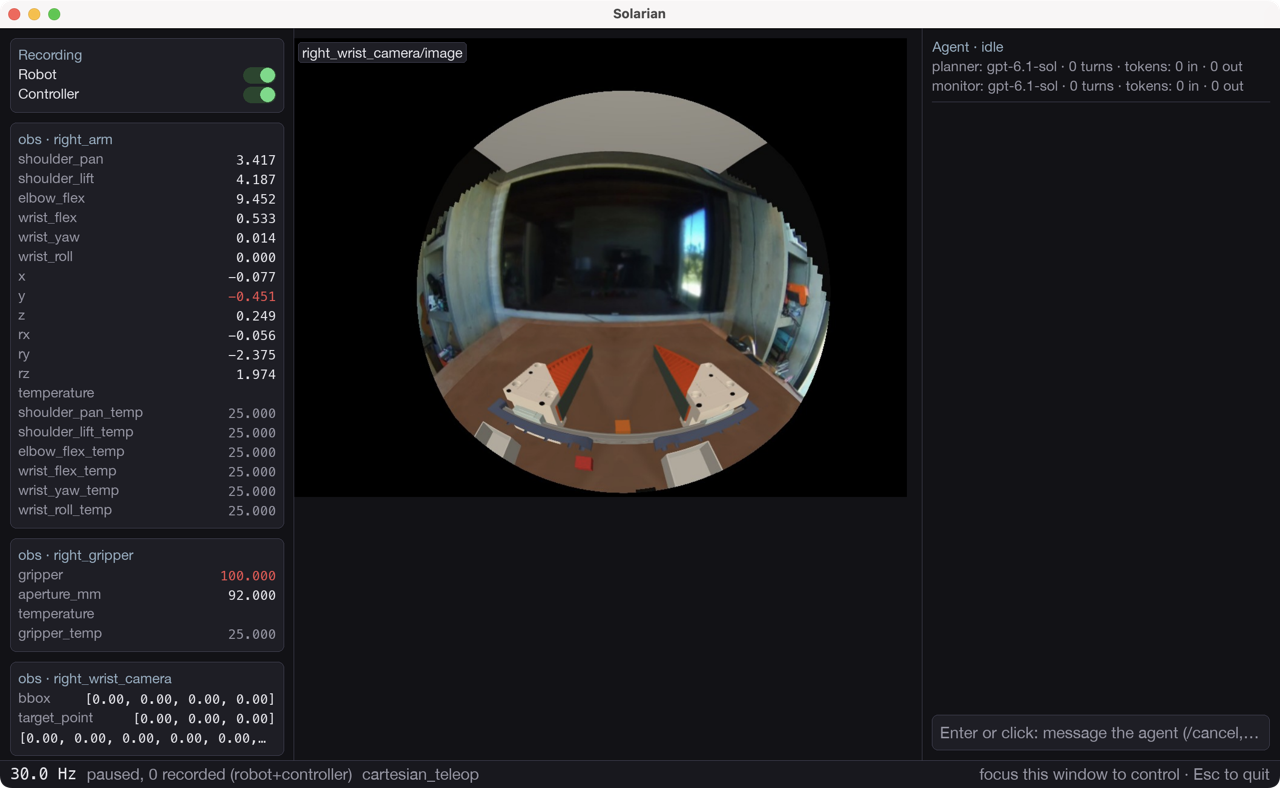
The controller window shows the live observations, the wrist camera, and the agentic controller's chat:
Community
To chat with other community members, you can join the Solarian Discord server.
Contributing
Solarian is early, and contributions are welcome. A few guidelines to start with:
-
For anything larger than a small fix, open an issue or ask on Discord before writing the code, so we can agree on the approach.
-
To work on Solarian itself, install it from source and run the tests:
git clone https://github.com/solarian-dev/solarian.git
cd solarian
pip install -e ".[all]"
pytest tests/
On Apple Silicon that install builds
atomicsfrom source, andxformerswith theaiextra (.[all]includes it). It needs git and a C compiler. -
New hardware support and skills usually belong in a plugin rather than in the core. Start one with
solarian create-plugin, and list it in the Plugin Directory.
A CONTRIBUTING.md and a code of conduct are coming.
License
Solarian is licensed under the Apache License 2.0. Copyright 2026 PrimaryKey Inc. Vendored third-party code keeps its own license; see NOTICE. Model weights are downloaded separately and keep their upstream licenses.
Solarian and the Solarian logo are trademarks of PrimaryKey Inc. See the trademark policy.
1 maintainer

Metadata
1 maintainer
Release files for solarian 0.4.0
For a detailed explanation of source distributions (sdists) and built distributions (wheels), please see the package formats documentation.
Source distribution (sdist)
| File | Size | Uploaded | Provenance | Actions |
|---|---|---|---|---|
| solarian-0.4.0.tar.gz | 645.5 kB | With provenance | Details for solarian-0.4.0.tar.gz |
Built distribution (wheel)
| File | Interpreter | ABI | Platform | Actions Reset |
|---|---|---|---|---|
| solarian-0.4.0-py3-none-any.whl | Python 3 | none | any | Details for solarian-0.4.0-py3-none-any.whl |
Total release size: 1.4 MB
Release files / solarian-0.4.0.tar.gz
| Download URL | solarian-0.4.0.tar.gz |
|---|---|
| Size | 645.5 kB |
| Tags | Source |
|
SHA-256 checksum How to use checksums |
16b07f0a725e73e48d756ba9dfeeb6884ec75fb25065a93f78b17c4c38ff116b
|
|
BLAKE2b-256 checksum How to use checksums |
245fa652128f84ea86a73dd3aeaf097573c460e29231ddee9f399a5328a49399
|
| Upload date | |
|
Uploaded using Trusted Publishing? What is trusted publishing? |
Yes |
| Uploaded via |
twine/7.0.0 CPython/3.13.16
|
Provenance
Provenance describes where a file came from. On PyPI, provenance is shared via attestations, which provide a verifiable record of the build or publishing details. View details, limitations and caveats.


PyPI Publish Attestation
PyPI verified that this artifact, at this checksum, originated from the publisher listed below.
Signed by GitHub Actions, verified by PyPI on Nov 16, 2026.
Transparency logRelease files / solarian-0.4.0-py3-none-any.whl
| Download URL | solarian-0.4.0-py3-none-any.whl |
|---|---|
| Size | 757.8 kB |
| Tags | Python 3 |
|
SHA-256 checksum How to use checksums |
1c3ebd4f1b4af2ea855d2e8709d32c417963adf2a25e761939cc429c287915bd
|
|
BLAKE2b-256 checksum How to use checksums |
17c06aef5fd2919dcc872fc570c277c49a992d0aff469a0fa1e58f4523dd1724
|
| Upload date | |
|
Uploaded using Trusted Publishing? What is trusted publishing? |
Yes |
| Uploaded via |
twine/7.0.0 CPython/3.13.16
|
Provenance
Provenance describes where a file came from. On PyPI, provenance is shared via attestations, which provide a verifiable record of the build or publishing details. View details, limitations and caveats.
PyPI Publish Attestation
PyPI verified that this artifact, at this checksum, originated from the publisher listed below.
Signed by GitHub Actions, verified by PyPI on Nov 16, 2026.
Transparency logSecurity for solarian 0.4.0
Provenance
Provenance describes where a file came from. On PyPI, provenance is shared via attestations, which provide a verifiable record of the build or publishing details. View details, limitations and caveats.
Full provenance
Both files in this release have been uploaded with provenance metadata.
Attestation for solarian-0.4.0.tar.gz
PyPI Publish Attestation
PyPI verified that this artifact, at this checksum, originated from the publisher listed below.
Signed by GitHub Actions, verified by PyPI on Nov 16, 2026.
Transparency logA note on package security
PyPI is a repository for distributing packages, not a service for auditing them. While third-party security researchers and our staff do their best to detect and remove malicious packages, PyPI cannot guarantee the quality, security or suitability of any given package.
To learn more about protecting yourself from malicious actors, visit our package security documentation.














