
GPU-accelerated framework for computing topological solitons in 2D field theories.
Verified details
These details have been verified by PyPIProject links
GitHub Statistics
Maintainers

Project description

GPU-based finite-difference PDE solver for topological solitons in 2D nonlinear field theories, with Numba CUDA and CUDA–OpenGL rendering.




Installation • Quickstart • Models • Features • Architecture • Background • License
soliton_solver is a GPU-accelerated scientific computing framework for nonlinear
partial differential equations describing topological solitons in two-dimensional
field theories.
The solver is designed around a theory-agnostic numerical core implemented with Numba CUDA kernels. Physical models are introduced as modular components using a dependency injection (DI) architecture, allowing new theories to be added without modifying the numerical engine.
The framework supports a wide range of models spanning condensed matter physics, topological magnetism, and high-energy gauge field theories.
Real-time visualization is provided via CUDA–OpenGL interoperability, enabling interactive exploration of nonlinear field dynamics directly on the GPU.
The project follows modern software engineering practices including continuous integration via GitHub Actions and continuous deployment to PyPI.
Pre-installation
Before installing soliton_solver, a few system-level dependencies must be
available. These provide the OpenGL context and CUDA bindings required for
GPU computation and real-time visualization.
Install the Python interface packages:
pip install glfw PyOpenGL cuda-python
These packages provide:
- glfw – window creation and input handling for the OpenGL viewer
- PyOpenGL – Python bindings for OpenGL rendering
- cuda-python – low-level CUDA driver bindings used for CUDA–OpenGL interoperability
System requirements
In addition to the Python packages above, the following system software must be installed:
- NVIDIA GPU with CUDA support
- CUDA Toolkit compatible with your GPU
- OpenGL drivers (normally included with NVIDIA drivers)
You can verify CUDA installation with:
nvidia-smi
and
nvcc --version
Once these dependencies are available, the soliton_solver package itself can be installed.
Installation
Install from PyPI (in progress, not currently implemented):
pip install soliton-solver
Or install from source:
git clone https://github.com/paulnleask/soliton_solver.git
cd soliton_solver
pip install -e .
Requirements
- Python 3.10+
- CUDA-capable GPU
- NVIDIA drivers compatible with Numba CUDA
Quickstart
Run a built-in example:
python -m soliton_solver.examples.chiral_magnet_gl
Typical Python usage (including OpenGL visualization): Simulate magnetic skyrmions in chiral magnets with the DM interaction and demagnetization
from soliton_solver.theories import load_theory
from soliton_solver.core.simulation import Simulation

theory = load_theory("Chiral magnet")

def run_gl_simulation():
    params = theory.params.default_params(
        xlen=320, ylen=320, xsize=10.0, ysize=10.0,     # Grid params
        J=40e-12, K=0.8e+6, D=4e-3, M=580e+3, B=0e-3,   # Chiral magnetic params
        mu0=1.25663706127e-6,                           # Override vacuum permeability
        dmi_term="Heusler", ansatz="anti",              # DMI + skyrmion type
        demag=True,                                     # Demagnetization flag
        newtonflow=False,                               # Start simulation with flow on/off (True/False)
        unit_magnetization=True                         # Required flag for magnetization
        )
    sim = Simulation(params, theory)
    sim.initialize({"mode": "ground"})
    theory.render_gl.run_viewer(sim, sim.rp, steps_per_frame=5)

if __name__ == "__main__":
    run_gl_simulation()
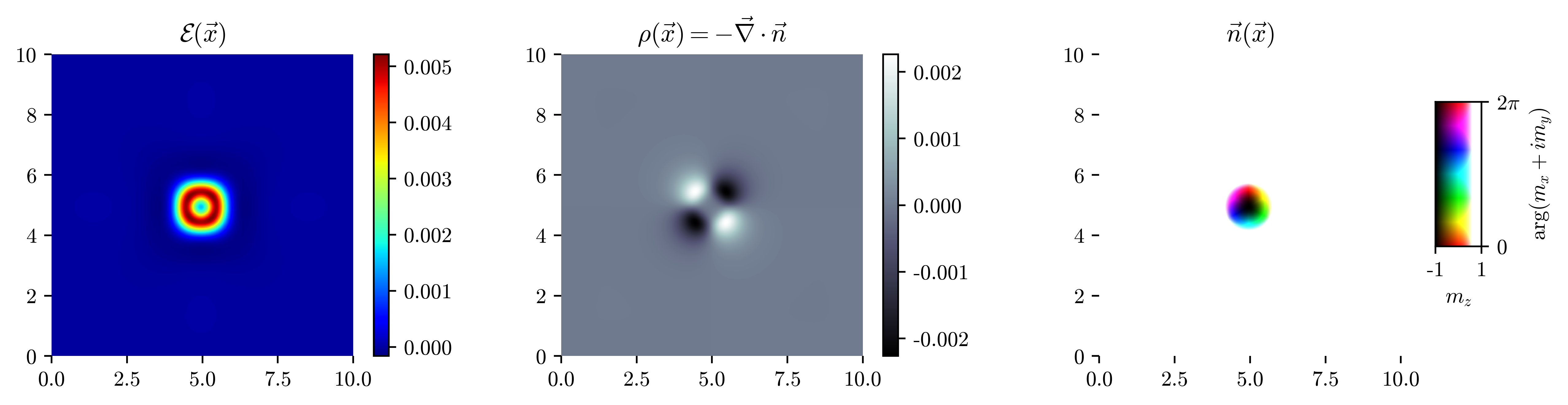
Simulations execute entirely on the GPU. Field data streams directly from CUDA memory into OpenGL buffers using zero-copy CUDA–OpenGL interop. The results can be plotted by running
python -m soliton_solver.theories.chiral_magnet.results.plotting
Currently Supported Built-In Theories
| Theory | Fields | Energy functional |
|---|---|---|
| Abelian Higgs (Ginzburg-Landau) | $\psi \in \mathbb{C}$, $\vec{A} \in \mathbb{R}^2$ | $E_{\textup{AH}}[\psi, \vec{A}] = \int_{\mathbb{R}^2} \textup{d}^2x \left( \frac{1}{2}|\vec{D}\psi|^2 + \frac{1}{2}|\vec{\nabla}\times\vec{A}|^2 + \frac{\lambda}{8} \left( u^2 - |\psi|^2 \right)^2\right)$ |
| Baby Skyrme | $\vec{m} \in \mathbb{R}^3$ | $E_{\textup{BS}}[\vec{m}] = \int_{\mathbb{R}^2} \textup{d}^2x \left( \frac{1}{2} |\nabla \vec{m}|^2 + \frac{\kappa^2}{4} \left( \partial_i \vec{m} \times \partial_j \vec{m} \right)^2+ V(\vec{m}) \right)$ |
| Chiral Magnet | $\vec{n} \in \mathbb{R}^3$, $\psi \in \mathbb{R}$ | $E_{\textup{CM}}[\vec{n}] = \int_{\mathbb{R}^2}\textup{d}^2x \left( \frac{J}{2}|\textup{d}\vec{n}|^2 + \mathcal{D} \sum_{i=1}^3 \vec{d}_i\cdot(\vec{n}\times\partial_i\vec{n}) + M_sV(\vec{n}) + \frac{1}{2\mu_0} |\vec{\nabla}\psi|^2 \right), \quad \Delta \psi = -\mu_0\vec{\nabla}\cdot(M_s\vec{n})$ |
| Ferromagnetic Superconductor | $\vec{m} \in \mathbb{R}^3$, $\psi \in \mathbb{C}$, $\vec{A} \in \mathbb{R}^3$ | $E_{\textup{FS}}[\vec{m}, \psi, \vec{A}] = \int_{\mathbb{R}^2} \textup{d}^2x \left( \frac{1}{2}|\vec{D}\psi|^2 + \frac{1}{2}|\vec{\nabla}\times\vec{A}|^2 + \frac{b}{4} \left( u^2 - |\psi|^2 \right)^2 + \frac{1}{2}|\nabla\vec{m}|^2 - \vec{m}\cdot(\vec{\nabla}\times\vec{A})\right)$ |
| Liquid Crystal (GL-type) | $\vec{n} \in \mathbb{R}^3$, $\phi \in \mathbb{R}$ | $E_{\textup{LC}}[\vec{n}] = \int_{\mathbb{R}^2} \textup{d}^2x \left( \frac{K}{2} |\nabla \vec{n}|^2 + K q_0 \vec{n}\cdot(\vec{\nabla} \times \vec{n}) + V(\vec{n}) + \frac{\varepsilon_0}{2} |\vec{\nabla} \Phi|^2 \right), \quad \Delta \Phi = -\frac{1}{\varepsilon_0}\vec{\nabla} \cdot \vec{P}[\vec{n}]$ |
| Maxwell-Chern-Simons-Higgs | $\psi \in \mathbb{C}$, $\vec{A} \in \mathbb{R}^3$ | $E_{\textup{CSLG}}[\psi,\vec{A}] = E_{\textup{AH}}[\psi,\vec{A}] + \int_{\mathbb{R}^2} \textup{d}^2x \left( \frac{1}{2}|\vec{\nabla} A_0|^2 + \frac{1}{2}q^2|\psi|^2 A_0^2 \right), \quad \left(-\nabla^2+q^2|\psi|^2\right)A_0 = -\kappa B[\vec{A}]$ |
| Spin-Triplet Superconducting Magnet | $\vec{m} \in \mathbb{R}^3$, $\psi_1, \psi_2 \in \mathbb{C}$, $\vec{A} \in \mathbb{R}^3$ | $E_{\textup{ST}}[\vec{m}, \psi_\alpha, \vec{A}] = \int_{\mathbb{R}^2} \textup{d}^2x \left( \frac{1}{2} |\vec{D}\psi_\alpha|^2 + \frac{1}{2}|\vec{\nabla}\times\vec{A}|^2 + \frac{a}{2} |\psi_\alpha|^2 + \frac{b_1}{4} |\psi_\alpha|^4 + b_2 |\psi_1|^2 |\psi_2|^2 + c \left( \psi_1 \psi_2^* + \psi_1^* \psi_2 \right) + \frac{\alpha}{2}|\vec{m}|^2 + \frac{\beta}{4}|\vec{m}|^4 + \frac{\gamma^2}{2}|\nabla\vec{m}|^2 - \vec{m} \cdot (\vec{\nabla}\times\vec{A}) +\frac{(a+2c)^2}{2(b_1+2b_2)} +\frac{\alpha^2}{4\beta} \right)$ |
All models are GPU-accelerated and compatible with real-time rendering. New theories can be added by implementing a theory module and registering it with the theory registry.
Features
- GPU-accelerated nonlinear PDE solver
- Numba CUDA kernels for high-performance finite-difference evolution
- Real-time visualization via CUDA–OpenGL interoperability
- Object-oriented simulation architecture
- Plug-and-play theory registry
- Theory-agnostic numerical core
- Dependency injection design
- Continuous integration via GitHub Actions
- Continuous deployment to PyPI
Architecture
soliton_solver/
├── core/            GPU numerical engine
├── theories/        modular physics models
├── visualization/   OpenGL rendering backend
├── examples/        runnable demonstrations
├── version.py
└── pyproject.toml
Core
The numerical core implements the GPU PDE solver:
- finite-difference operators
- time-stepping integrators
- simulation driver
- GPU memory management
These components are independent of any specific physical theory.
Theories
Each theory defines:
- energy functional
- field variables
- parameter set
- initialization routines
- optional visualization helpers
Theories are injected into the solver via dependency injection, allowing the numerical infrastructure to remain completely theory agnostic.
Numerical Method
Topological solitons are obtained by relaxing the field configuration toward a local minimum of the discrete energy functional. Given a discretized energy $E_h[\phi]$, we evolve the field using arrested Newton flow
$$ \ddot{\phi} = - \nabla_\phi E_h[\phi]. $$
The system is integrated numerically using explicit time-stepping schemes such as Runge–Kutta methods implemented on the GPU.
A flow arrest condition ensures stability: If the energy increases,
$$ E_h[\phi^{n+1}] > E_h[\phi^{n}], $$
the velocity is reset
$$ \dot{\phi}^{n+1} = 0. $$
This second-order relaxation scheme accelerates convergence along shallow directions of the energy landscape while preventing oscillations near the minimum.
In practice this method converges significantly faster than gradient descent for multi-soliton configurations.
Research Doamins
Intended research domains include:
- Topological defects and vortices in superconductors and cosmic strings
- Skyrmions in chiral magnets and liquid crystals
- Multi-component Ginzburg–Landau models
- Competing order parameter systems
License
MIT License. See LICENSE for details.
Project details
Verified details
These details have been verified by PyPIProject links
GitHub Statistics
Maintainers


Download files
Download the file for your platform. If you're not sure which to choose, learn more about installing packages.
Source Distribution
Built Distribution
Filter files by name, interpreter, ABI, and platform.
If you're not sure about the file name format, learn more about wheel file names.
Copy a direct link to the current filters
File details
Details for the file soliton_solver-0.1.1.tar.gz.
File metadata
- Download URL: soliton_solver-0.1.1.tar.gz
- Upload date:
- Size: 171.1 kB
- Tags: Source
- Uploaded using Trusted Publishing? Yes
- Uploaded via: twine/6.1.0 CPython/3.13.7
File hashes
| Algorithm | Hash digest | |
|---|---|---|
| SHA256 |
c7f6b9789508a6d06b27e0ef5ede9fb98450861e50a6356ca77a84a66ac3b9e0
|
|
| MD5 |
cf66305e664d6dcd2a73c320e56c52f1
|
|
| BLAKE2b-256 |
fc3af409bcac5e7405cafdaf1b3c6d594cf751c72167a62f0f152cc9b0de4922
|
Provenance
The following attestation bundles were made for soliton_solver-0.1.1.tar.gz:
Publisher:
python-publish.yml on Paulnleask/soliton_solver
-
Statement:
-
Statement type:
https://in-toto.io/Statement/v1 -
Predicate type:
https://docs.pypi.org/attestations/publish/v1 -
Subject name:
soliton_solver-0.1.1.tar.gz -
Subject digest:
c7f6b9789508a6d06b27e0ef5ede9fb98450861e50a6356ca77a84a66ac3b9e0 - Sigstore transparency entry: 1042628153
- Sigstore integration time:
-
Permalink:
Paulnleask/soliton_solver@622d3d7936188c9ee2d2e8e3856a7f3cfc726a01 -
Branch / Tag:
refs/tags/v0.1.1 - Owner: https://github.com/Paulnleask
-
Access:
public
-
Token Issuer:
https://token.actions.githubusercontent.com -
Runner Environment:
github-hosted -
Publication workflow:
python-publish.yml@622d3d7936188c9ee2d2e8e3856a7f3cfc726a01 -
Trigger Event:
release
-
Statement type:
File details
Details for the file soliton_solver-0.1.1-py3-none-any.whl.
File metadata
- Download URL: soliton_solver-0.1.1-py3-none-any.whl
- Upload date:
- Size: 202.7 kB
- Tags: Python 3
- Uploaded using Trusted Publishing? Yes
- Uploaded via: twine/6.1.0 CPython/3.13.7
File hashes
| Algorithm | Hash digest | |
|---|---|---|
| SHA256 |
392ba5de7f5e51672c406aa6ce8b1b4cef17959fd6551f525d9497843ca216b6
|
|
| MD5 |
155fa093e09b8500547bf4fb2b106694
|
|
| BLAKE2b-256 |
1534faa862f0c7d344ad576e18ab4b59bde72268d4e7aa739e5a7531b69acd63
|
Provenance
The following attestation bundles were made for soliton_solver-0.1.1-py3-none-any.whl:
Publisher:
python-publish.yml on Paulnleask/soliton_solver
-
Statement:
-
Statement type:
https://in-toto.io/Statement/v1 -
Predicate type:
https://docs.pypi.org/attestations/publish/v1 -
Subject name:
soliton_solver-0.1.1-py3-none-any.whl -
Subject digest:
392ba5de7f5e51672c406aa6ce8b1b4cef17959fd6551f525d9497843ca216b6 - Sigstore transparency entry: 1042628199
- Sigstore integration time:
-
Permalink:
Paulnleask/soliton_solver@622d3d7936188c9ee2d2e8e3856a7f3cfc726a01 -
Branch / Tag:
refs/tags/v0.1.1 - Owner: https://github.com/Paulnleask
-
Access:
public
-
Token Issuer:
https://token.actions.githubusercontent.com -
Runner Environment:
github-hosted -
Publication workflow:
python-publish.yml@622d3d7936188c9ee2d2e8e3856a7f3cfc726a01 -
Trigger Event:
release
-
Statement type:






