
SOMA: Somatic Wisdom Architecture — Wisdom over Memory

Project description
SOMA v1.1.6 — The Cognitive Kernel for AI Agents
Wisdom over Memory — 智慧超越记忆
Five capability lines. Seven thinking laws. One cognitive kernel that remembers, reasons, collaborates, and evolves.
pip install soma-wisdom # 5 minutes from zero to thinking agent

👆 点击即可在浏览器中体验 SOMA 面板 — 无需安装,一分钟启动
from soma import SOMA

soma = SOMA()
soma.remember("First-principles thinking: deconstruct to fundamentals...",
              context={"domain": "philosophy"}, importance=0.9)
answer = soma.respond("How to analyze our growth bottleneck?")
# → decomposes through 7 thinking laws → activates relevant memories → returns reasoned answer
Why SOMA instead of a vector database? Traditional memory (ChromaDB, Mem0) stores and retrieves. SOMA thinks first: a 7-law reasoning network decomposes problems before fetching memories. The result: agents that systematically analyze, not just pattern-match.
| Vector DBs | Mem0 | SOMA v1.1.6 | |
|---|---|---|---|
| Stores & retrieves | ✓ | ✓ | ✓ |
| Reasoning framework | ✗ | ✗ | ✓ 7 thinking laws |
| Self-evolution | ✗ | ✗ | ✓ weights auto-tune |
| Three-tier memory (L1/L2/L3) | ✗ | ✗ | ✓ fragment→scene→profile |
| Consolidation + forgetting | ✗ | partial | ✓ Ebbinghaus decay |
| Causal reasoning | ✗ | ✗ | ✓ graph chain inference |
| Cross-domain analogy | ✗ | ✗ | ✓ structural pattern matching |
| Conflict detection | ✗ | ✗ | ✓ contradiction flagging |
| Multi-agent collaboration | ✗ | ✗ | ✓ expert routing + consensus |
| Frame anchoring awareness | ✗ | ✗ | ✓ cognitive bias nudge |
| Real-time bias correction | ✗ | ✗ | ✓ Zhongdao Engine (NEW) |
| Offline / zero infra | varies | ✗ (OpenAI) | ✓ ONNX, SQLite |









📖 中文文档 | Docs | Demo | Roadmap | Changelog | Contributing
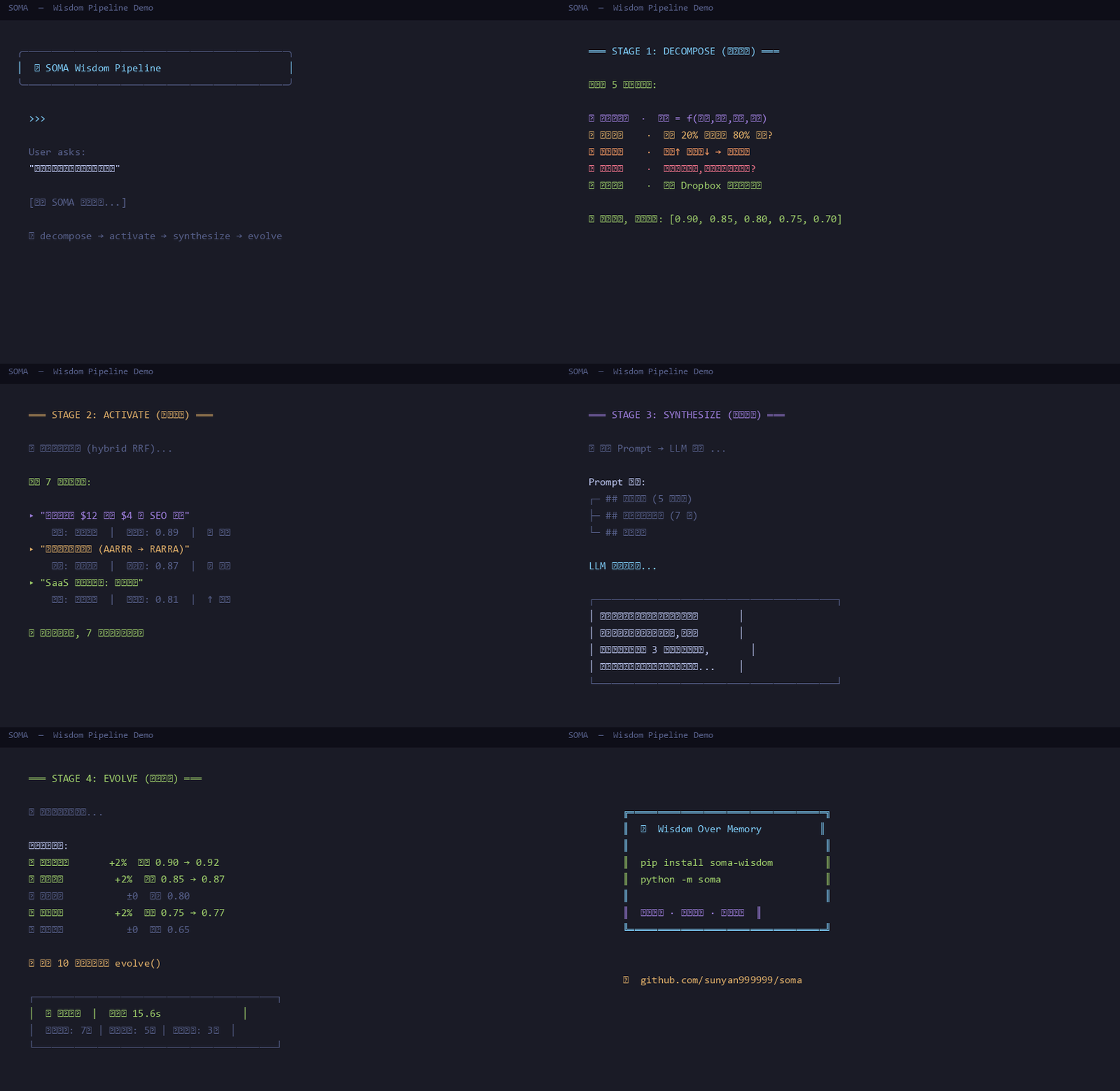
v1.1.6 — Zhongdao Closed Loop
v1.1.6 closes the Zhongdao feedback loop — from correction to verification to optimization:
| # | Feature | Description |
|---|---|---|
| B1 | Correction effectiveness tracking | Daily trend charts + per-law correction frequency in Dash |
| B2 | Auto-tuning suggestions | ML-driven parameter recommendations based on historical data |
| B3 | Dash trend visualization | Bar charts + frequency panels + suggestion cards + time range selector |
| B4 | Auto-archiving | 90-day old corrections auto-archived to prevent DB bloat |
| B5 | Production refinements | Mobile optimization + i18n completion + cooldown protection |
Benchmark validated on 零熵智库 (v1.1.6): Overall 80.5 (+5.8 vs v1.1.2), Memory 79.7 (+20.2), Wisdom 76.2, Evolution 75.0, Scalability 100.0. 650 tests passed.
Every capability line that started as a seed in v0.1 has grown into a complete system:
| Capability Line | Core Question | v1.1.6 Answer |
|---|---|---|
| Memory | How can AI manage memory like humans do? | Three-tier: fragments → scenes → profile |
| Reasoning | How to use information to think? | Causal chains + conflict detection + cross-domain analogy |
| Collaboration | How do multiple AIs work as a team? | Expert routing + consensus protocols + distributed evolution |
| Evolution | Can AI learn from its own experience? | Reflect → re-weight → solidify → share (3-layer correction) |
| Engineering | How to prove these capabilities are real? | 639 tests + 5D benchmarks + competitor comparison |
All new features default to off. Upgrade from any 0.x version with zero code changes.
Architecture
┌──────────────────────────────────────────────────────────────────────────────┐
│                         SOMA v1.1.6 — Cognitive Kernel                           │
│                                                                                │
│  ┌──────────────────────────────────────────────────────────────────┐        │
│  │  L3 User Profile — "Knows who you are"                             │        │
│  │  Auto-extracted traits: preferences, skills, knowledge gaps, goals │        │
│  └──────────────────────────────────────────────────────────────────┘        │
│                                    ↑                                          │
│  ┌──────────────────────────────────────────────────────────────────┐        │
│  │  L2 Scene Blocks — "Understands your context"                      │        │
│  │  Auto-aggregated work contexts ("building a Python data platform") │        │
│  └──────────────────────────────────────────────────────────────────┘        │
│                                    ↑                                          │
│  ┌──────────────┐  ┌──────────────┐  ┌──────────────────────────────────┐    │
│  │ WisdomEngine  │→│ActivationHub │→│  L1 Episodic Memory (the original) │    │
│  │ · 7 thinking  │  │ · bidirectional│ · SQLite + vector + FTS5           │    │
│  │   laws        │  │   activation  │ · weighted RRF + time decay         │    │
│  │ · law chaining│  │ · conflict    │ · knowledge graph + causal chains   │    │
│  │ · combo synth │  │   detection   │ · cross-domain analogy engine       │    │
│  │ · complexity  │  │ · MMR re-rank │                                      │    │
│  │   assessment  │  │ · frame nudge │                                      │    │
│  └──────────────┘  └──────────────┘  └──────────────────────────────────┘    │
│         │                  │                        │                        │
│         ▼                  ▼                        ▼                        │
│  ┌──────────────────────────────────────────────────────────────────┐       │
│  │  Multi-Agent Layer          │  Evolution Loop                     │       │
│  │  · AgentRegistry            │  · MetaEvolver: bias detect →       │       │
│  │  · ExpertRouter (3-tier)    │    re-weight → solidify → share     │       │
│  │  · ConsensusProtocol        │  · CapturePipeline: auto L2+L3      │       │
│  │  · DistributedEvolver       │  · FrameAnchoringDetector           │       │
│  └──────────────────────────────────────────────────────────────────┘       │
└──────────────────────────────────────────────────────────────────────────────┘

Fifteen-Stage Wisdom Pipeline:
  Assess → Decompose → Chain → Combine → Semantic-fallback
         → Context-sort → Activate → Conflict-detect → Frame-nudge → Anti-bias
         → Reason → Synthesize → Causal-extract → Backward-propagate → Evolve
Screenshots
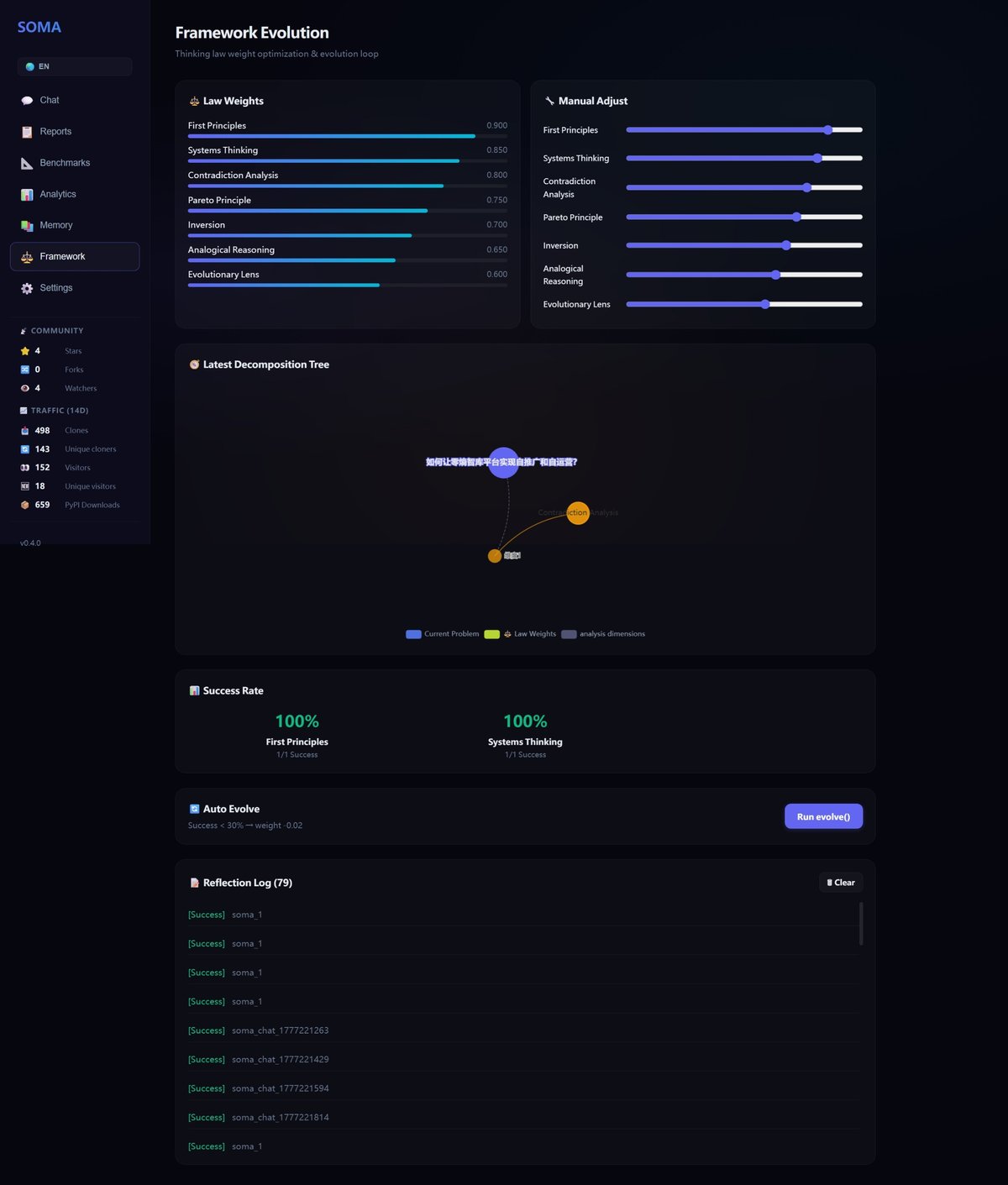
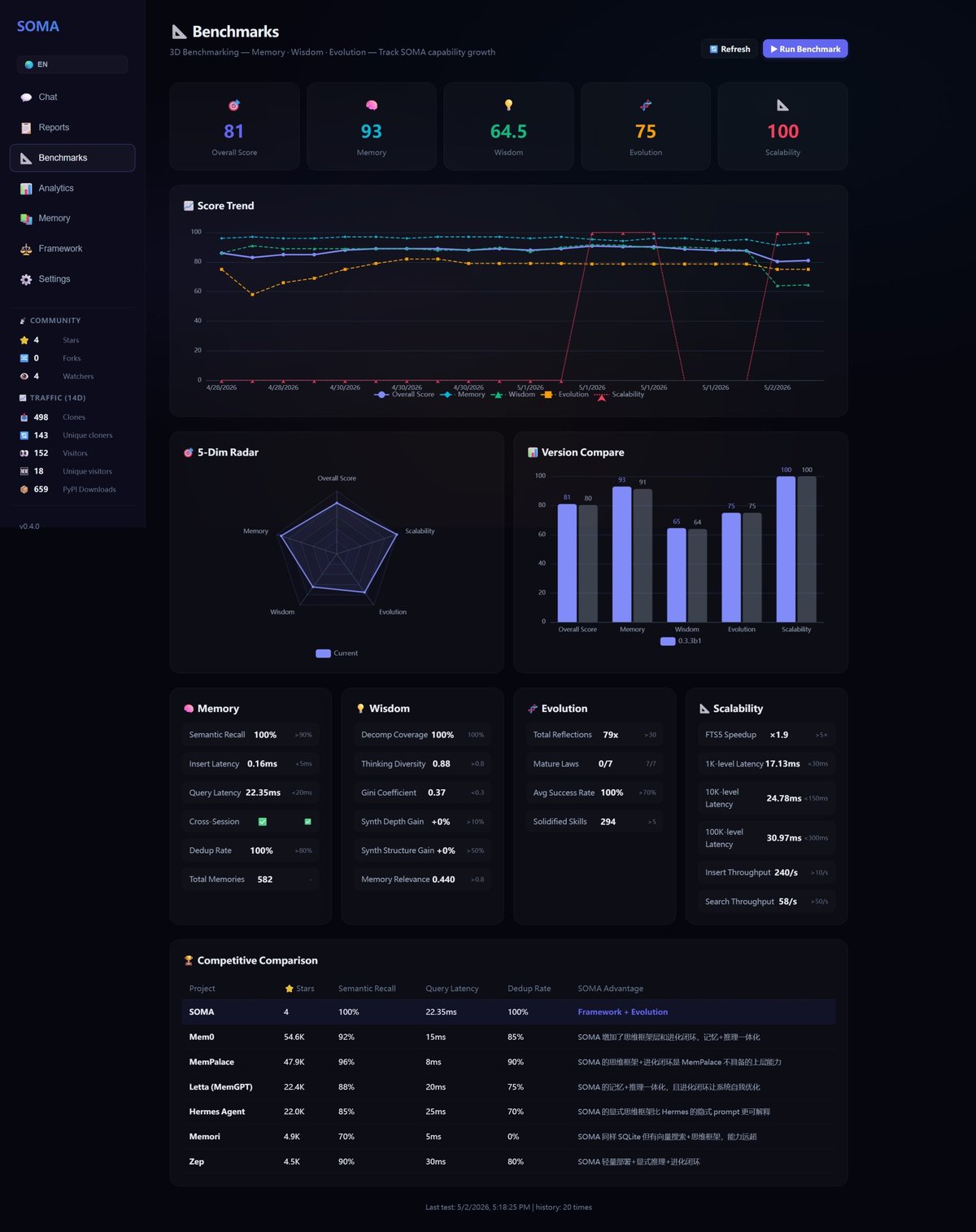
🧠 Wisdom Chat · 📊 5D Benchmark · 💻 IDE Integration · 🔌 REST API
 |
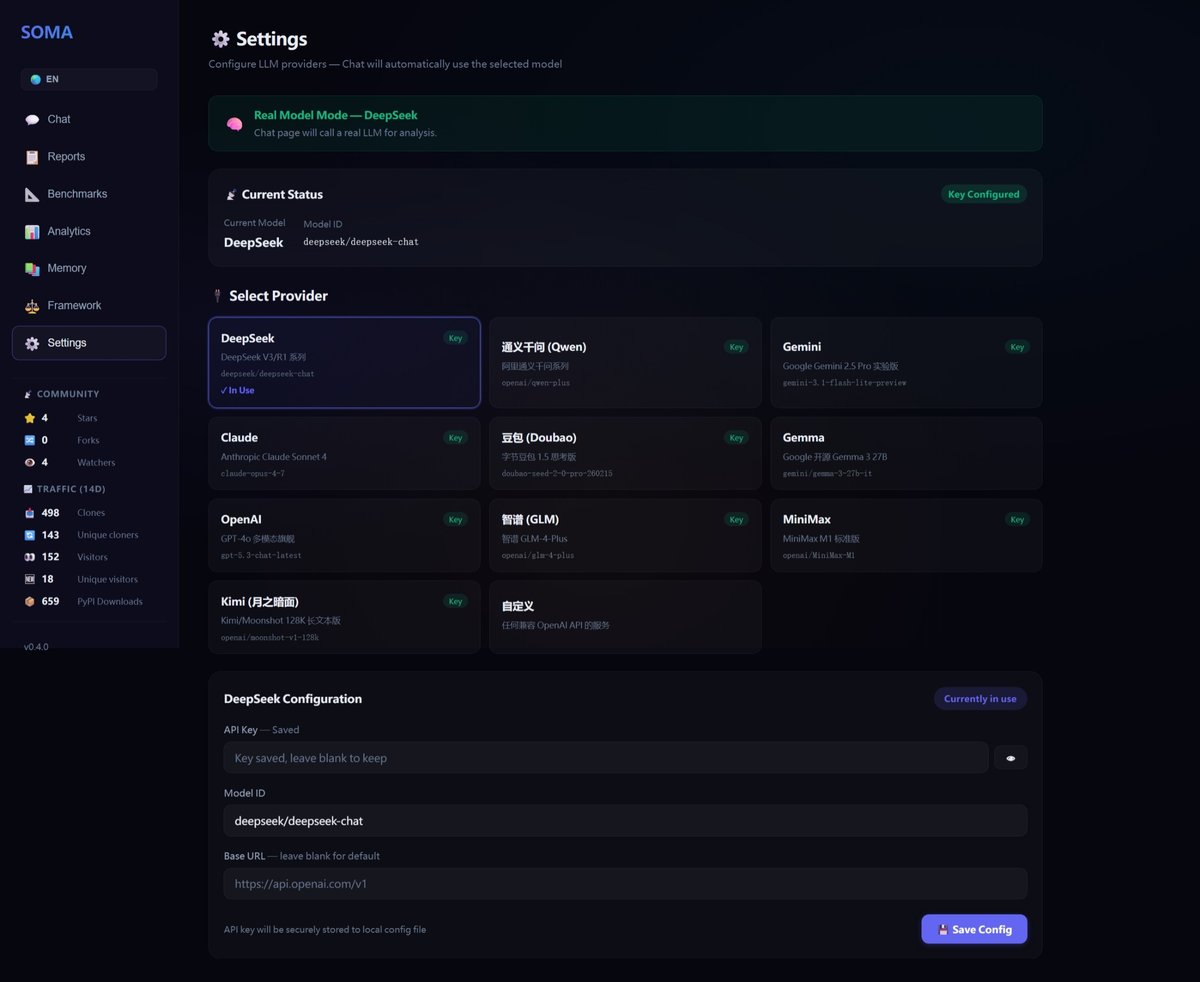 |
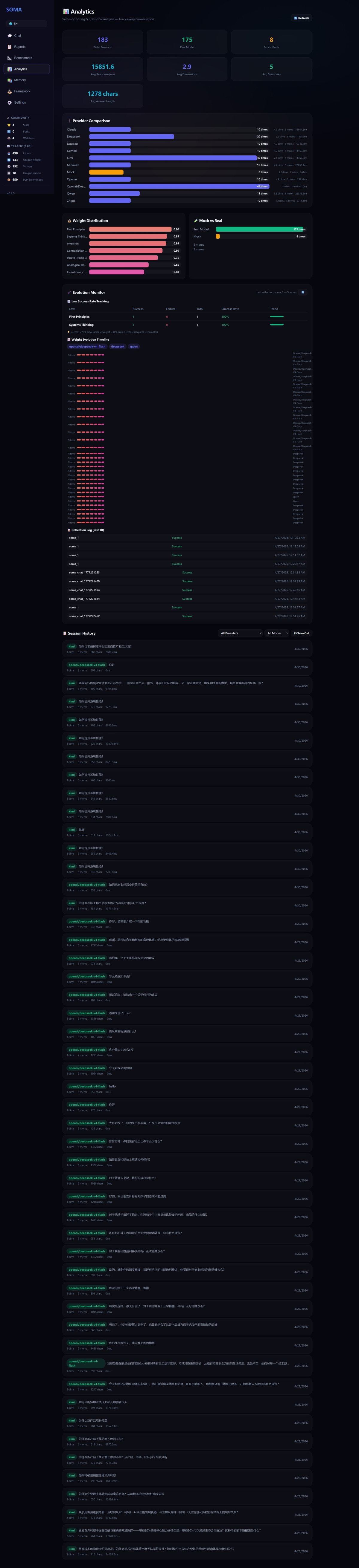
| Wisdom Chat — 7 thinking laws decompose problems, bidirectional memory activation, LLM streaming | 5D Benchmark — Memory/Wisdom/Evolution/Scalability/Overall, live competitor comparison |
 |
 |
| IDE Integration — Claude Code / VS Code one-click access, auto-persistent memory | REST API — FastAPI + SSE streaming, multi-model management, API Key auth |
Dashboard
Start the API server and open http://localhost:8765:
SOMA_API_KEY=test python dash/server.py
Vue 3 dashboard with i18n (English / 中文), 6 views: Chat · Framework · Memory · Analytics · Benchmark · Settings.
Installation
pip install soma-wisdom
Requires Python 3.10+. The embedding engine uses ONNX Runtime for CPU inference — no CUDA, no Docker, no external services.
First run downloads a small ONNX model (~100 MB, Chinese-English bilingual).
python -m soma          # verify everything works in one command
soma-quickstart         # or use the CLI entry point
Core Concepts
1. Wisdom Framework — 7 Thinking Laws
| Law | Description | Weight |
|---|---|---|
first_principles |
Reduce to fundamentals, derive from base elements | 0.90 |
systems_thinking |
See interconnected wholes, identify feedback loops | 0.85 |
contradiction_analysis |
Find opposing forces, identify principal contradictions | 0.80 |
pareto_principle |
Focus on the vital 20% that drives 80% of outcomes | 0.75 |
inversion |
Think backwards — how could this fail? | 0.70 |
analogical_reasoning |
Map structures across domains | 0.65 |
evolutionary_lens |
Observe change over time, identify lifecycle stages | 0.60 |
Customize in wisdom_laws.yaml (bundled in the package — always available).
Thinking laws form a reasoning network. When a law triggers, its relations propagate activation to related laws (×0.35–0.50 bonus). When two laws fire together, synthesized perspectives emerge (e.g., "First Principles × Systems Thinking → Root-Cause System Analysis"). Weights auto-tune based on actual success/failure — a startup team and a large enterprise will naturally evolve different weight distributions.
2. Three-Tier Memory System
v1.0 introduces automatic memory layering — the system quietly builds understanding while you work:
| Tier | What | Example |
|---|---|---|
| L1 Episodic | Individual memory fragments | "Fixed N+1 query bug in OrderService" |
| L2 Scene | Auto-aggregated work contexts | "Working on a Python data analysis project" |
| L3 Profile | Extracted user traits | "Prefers functional programming, strong at debugging, learning systems design" |
The entire process is automatic. You use SOMA normally; behind the scenes, CapturePipeline aggregates fragments into scenes and distills scenes into your profile.
3. Bidirectional Activation — Hybrid RRF
Memories are matched through weighted Reciprocal Rank Fusion:
- Vector semantic similarity (×2 weight) via ONNX embeddings
- Keyword exact match (×1 weight)
- Knowledge graph expansion (×0.5 weight)
All three paths compete and complement, producing scores that reflect true relevance — not just keyword overlap.
4. Meta-Evolution — Self-Optimization
SOMA tracks success/failure of each thinking law across sessions. Every 5 sessions, evolve() automatically:
- Memory consolidation: similar memories auto-merged, reducing redundancy
- Active forgetting: low-value memories archived with Ebbinghaus decay curves
- Bias detection: laws used >40% of the time get penalized (-0.05) to prevent thinking ruts; underused high-success laws get boosted (+0.03)
- Dynamic step sizing: adjustment magnitude scales with sample count (0.01 → 0.02 → 0.03)
- Skill solidification: successful (law, domain, outcome) patterns become permanent skills after 3+ occurrences
5. Knowledge Graph & Reasoning Engine
Six cognitive capabilities that upgrade SOMA from a memory store to a reasoning system:
- Causal Chain Tracing: Follow the causal graph to root causes — "why did user churn rise?" → traces back to "an API change three months ago slowed response times"
- Conflict Detection: When memories contain contradictory claims, flag and down-weight automatically, preventing the LLM from being misled
- Cross-Domain Analogy: Map structural patterns across domains — e.g., "supply chain bottleneck" ≈ "blood vessel blockage"
- Quality Evaluation: Self-score each reasoning output on consistency, coherence, and actionability. Below-threshold outputs trigger reflective improvement
- Graph Retrieval Expansion: Keywords are no longer isolated — BFS traversal (depth=2) discovers neighbor concepts, breaking retrieval silos
- Backward Propagation: High-activation memories suggest new thinking foci — the memory→focus feedback loop discovers perspectives the initial decomposition missed
6. Multi-Agent Collaboration
Multiple SOMA agents work as a team:
- Expert Specialization: Each agent has independent memory, independent evolution path, and domain expertise
- Automatic Routing: Problems dispatched to the most suitable expert via keyword + semantic matching — zero LLM involvement, completed in milliseconds
- Consensus Protocols: When experts disagree — L1 weighted voting → L2 LLM arbitration → L3 dialectic synthesis
- Distributed Evolution: Each expert evolves independently while periodically merging global experience
- Memory Isolation: Three-state isolation via
agent_id+group_id— private, group-shared, and global
7. Sunyata Awareness Layer
SOMA detects when you're over-anchored to a single cognitive frame and gently nudges — without blocking, forcing, or changing the pipeline.
- 8 cognitive frame pairs: Technical/Business, Management/Legal, Short-term/Long-term, Internal/External
- Pure keyword matching: Zero LLM/embedder dependency
- Low-interference: Blockquote footnote at prompt end — won't dominate the reasoning flow
- Default off:
enable_frame_detection=False, 100% backward compatible
soma = SOMA()
soma._agent.config.enable_frame_detection = True  # opt-in
# SOMA now notices when you're stuck in one perspective
API Reference
SOMA Facade (Python SDK)
from soma import SOMA

soma = SOMA(
    framework_config=None,        # default: bundled wisdom_laws.yaml
    llm="deepseek-chat",          # LiteLLM model string
    use_vector_search=True,       # ONNX semantic search
    persist_dir="soma_data",      # persistence directory
    recall_threshold=0.01,        # minimum activation score
    top_k=5,                      # default recall count
    agent_id="",                  # v1.0: agent identity for multi-agent
    group_id="",                  # v1.0: group for shared memory
)

# Wisdom pipeline
soma.respond(problem: str) -> str
soma.chat(problem: str) -> dict          # structured: foci + memories + weights

# Memory operations
soma.remember(content, context, importance) -> str  # returns memory_id
soma.remember_semantic(subject, predicate, object_, confidence)
soma.query_memory(query: str, top_k: int) -> list

# v1.0: Three-tier memory
soma.get_scenes(user_id="", top_k=10) -> list
soma.get_profile(user_id="") -> list
soma.capture_scenes(user_id="", force=False) -> int
soma.update_profile(user_id="", force=False) -> int

# Introspection & evolution
soma.decompose(problem: str) -> list     # show thinking dimensions
soma.reflect(task_id, outcome) -> None   # record outcome for evolution
soma.evolve() -> list                    # trigger automatic weight adjustment
soma.get_weights() -> dict               # current law weights
soma.adjust_weight(law_id, new_weight)   # manual override
soma.discover_laws() -> dict | None      # autonomous law discovery
soma.approve_law(candidate) -> bool      # approve a discovered law
soma.stats -> dict                       # memory store statistics
REST API (Language-Agnostic)
# Start server
SOMA_API_KEY=your-key python dash/server.py    # → http://localhost:8765

# Standard chat
curl -X POST http://localhost:8765/api/chat \
  -H "X-API-Key: your-key" \
  -H "Content-Type: application/json" \
  -d '{"problem": "How to improve team productivity?"}'

# SSE streaming (decompose → activate → delta → done)
curl -X POST http://localhost:8765/api/chat/stream \
  -H "X-API-Key: your-key" \
  -H "Content-Type: application/json" \
  -d '{"problem": "Analyze our growth bottleneck"}'

# Memory search
curl -X POST http://localhost:8765/api/memory/search \
  -H "X-API-Key: your-key" \
  -H "Content-Type: application/json" \
  -d '{"query": "growth strategy", "top_k": 10}'
Set SOMA_API_KEY env var to enable authentication. Leave unset for local development.
LangChain Tool
from soma.langchain_tool import create_soma_tool
from soma.agent import SOMA_Agent
from soma.config import SOMAConfig, load_config

agent = SOMA_Agent(SOMAConfig(framework=load_config()))
tool = create_soma_tool(agent)
result = tool.run("Analyze this problem...")
AI Coding Agent Integration (Claude Code / VS Code / JetBrains)
SOMA runs alongside AI coding tools as a persistent wisdom backend — it learns from every debug session, code review, and architectural decision.
# 1. Start SOMA server (once)
SOMA_API_KEY=dev-key python dash/server.py
Claude Code (Agent SDK) — use as a custom MCP server or REST tool:
# In your custom Claude Agent tool — persist insights across sessions
import requests
requests.post("http://localhost:8765/api/memory/remember",
    headers={"X-API-Key": "dev-key"},
    json={"content": "Bug: N+1 query in OrderService.getOrders, root cause: missing @BatchSize on items relation, fix: add Hibernate batch annotation + integration test", "importance": 0.9})
Any IDE / CLI tool — just curl the REST API. No SDK required.
# Record a debug finding
curl -s -X POST http://localhost:8765/api/memory/remember \
  -H "X-API-Key: dev-key" -H "Content-Type: application/json" \
  -d '{"content":"Race condition in WebSocket handler: concurrent map writes on client.buf, root cause: missing mutex on write path, fix: sync.RWMutex around buffer ops","importance":0.9}'

# Recall relevant knowledge before starting a new task
curl -s -X POST http://localhost:8765/api/memory/search \
  -H "X-API-Key: dev-key" -H "Content-Type: application/json" \
  -d '{"query":"concurrency websocket golang","top_k":5}'
Real-World Impact
SOMA has been used in production across two distinct codebases — a Go-based CLI agent and a Python data platform — with the following results:
- Bug reoccurrence dropped significantly. When a bug fix is recorded as a SOMA memory (root cause + fix pattern), later sessions on the same codebase automatically retrieve it. Developers no longer re-debug the same class of issues across sprints.
- Architectural decisions became searchable. Each trade-off ("chose SQLite WAL over multi-worker for simplicity") is persisted with rationale context. Six months later, new team members can query "why single worker?" and get the original reasoning — not folklore.
- Cross-project knowledge transfer worked. A concurrency pattern learned in one codebase (the Go project) activated during debugging in the other (the Python project), because SOMA's semantic search matched "race condition" across language boundaries.
- Zero adoption friction. The Python project integrated via
pip install soma-wisdom+ 3 lines of code. The Go project integrated via REST API with a thin HTTP client (~50 lines). Neither required schema design, vector database setup, or infrastructure changes. - Evolution is automatic. After ~50 sessions, SOMA's auto-weighting surfaced that "Inversion" (thinking backwards from failure) was consistently the most useful lens for debugging tasks, while "Analogical Reasoning" shined during architecture discussions. The framework self-tuned — no manual knob-twisting needed.
Benchmarks
SOMA v1.0 — benchmarked with 1,050 production memories from 零熵智库 (5 runs, statistical output):
Overall Score: 85.5/100
| Dimension | Score | Grade |
|---|---|---|
| Overall | 85.5 | Excellent |
| Memory | 97.6 | Excellent — 100% recall, three-tier memory active |
| Wisdom | 87.3 | Excellent — causal analysis + cross-domain analogy + conflict detection |
| Evolution | 60.2 | Good — weight auto-adaptation, reflection loop running |
| Scalability | 100.0 | Excellent — linear scaling verified at 1K |
Key Metrics
| Metric | Value | Stability |
|---|---|---|
| Semantic Recall Rate | 100% | ● Stable |
| Dedup Ratio | 100% | ● Stable |
| Avg Insert Latency | 3.44ms | ◐ Acceptable |
| Query Latency (framework) | 209ms | ● Stable |
| Query Latency (simple) | ~30ms | ● Stable |
| Causal Chain Accuracy | 100% | ● Stable |
| Conflict Detection | <100ms (batch) | ● Stable |
| Decomposition Coverage | 100% | ● Stable |
| Thinking Diversity Entropy | 0.87 | ● Stable |
Live Competitor Comparison
| System | Recall@5 | Reasoning | Three-Tier Memory | Evolution | Multi-Agent | Awareness |
|---|---|---|---|---|---|---|
| SOMA v1.1.6 | 100% | ✓ | ✓ | ✓ | ✓ | ✓ |
| ChromaDB | 2.5% | ✗ | ✗ | ✗ | ✗ | ✗ |
| Mem0 | * | ✗ | ✗ | ✗ | ✗ | ✗ |
| Zep | * | ✗ | ✗ | ✗ | ✗ | ✗ |
SOMA is the only system combining a reasoning framework, three-tier memory, causal analysis, conflict detection, cross-domain analogy, evolutionary self-optimization, multi-agent collaboration, and frame anchoring awareness — all without external services.
Full report: CHANGELOG.md
Reproducibility
pip install soma-wisdom chromadb
python -m soma.benchmarks --full --runs 5 --output reports/    # statistical benchmark
python scripts/live_benchmark.py --full --output reports/       # live competitor test
Development
git clone https://github.com/soma-project/soma-core.git
cd soma-core
pip install -e ".[dev]"

pytest -v --cov=soma --cov-report=term    # 639 tests, ~97% coverage

python -m soma                              # quickstart verification

python dash/server.py                       # API server (http://localhost:8765)
Project Structure
soma-core/
├── soma/                  # Core library
│   ├── __init__.py        # SOMA facade (zero-config entry)
│   ├── __main__.py        # python -m soma quickstart
│   ├── agent.py           # SOMA_Agent: pipeline orchestrator + awareness
│   ├── engine.py          # WisdomEngine: problem decomposition
│   ├── hub.py             # ActivationHub: bidirectional activation
│   ├── evolve.py          # MetaEvolver: reflection + auto-evolution
│   ├── embedder.py        # SOMAEmbedder: fastembed + ONNX encoding
│   ├── vector_store.py    # NumpyVectorIndex: faiss ANN search
│   ├── config.py          # Pydantic configuration models
│   ├── base.py            # Data models (Focus, MemoryUnit, etc.)
│   ├── abc.py             # Abstract base classes
│   ├── langchain_tool.py  # LangChain BaseTool wrapper
│   ├── law_discovery.py   # Autonomous law discovery from clusters
│   ├── retry.py           # LLM retry with exponential backoff
│   ├── plugin.py          # Entry-points plugin auto-discovery
│   ├── quality.py         # QualityEvaluator: reasoning output scoring
│   ├── analogy.py         # AnalogyEngine: cross-domain structural matching
│   ├── competitors.py     # Live competitor benchmark adapters
│   ├── analytics.py       # Usage analytics & benchmark storage
│   ├── benchmarks.py      # 5D benchmark engine
│   ├── wisdom_laws.yaml   # Default thinking framework (bundled)
│   ├── hub/
│   │   ├── _core.py       # ActivationHub: bidirectional activation + frame detection
│   │   ├── _conflict.py   # ConflictDetector: contradiction detection
│   │   ├── _frame_detector.py  # FrameAnchoringDetector: cognitive bias nudge
│   │   ├── _retriever.py  # MemoryRetriever: multi-path recall
│   │   ├── _scorer.py     # RelevanceScorer: weighted scoring
│   │   └── _ranker.py     # MMRRanker: diversity re-ranking
│   ├── multi_agent/       # Multi-Agent Collaboration
│   │   ├── registry.py    # AgentRegistry: expert registration + matching
│   │   ├── router.py      # ExpertRouter: 3-tier routing
│   │   ├── consensus.py   # ConsensusProtocol: vote/LLM/dialectic synthesis
│   │   └── evolve.py      # DistributedEvolver: independent evolution + weight merge
│   └── memory/
│       ├── core.py        # MemoryCore: unified memory facade + 3-state isolation
│       ├── episodic.py    # EpisodicStore: L1 episodic memory
│       ├── semantic.py    # SemanticStore: knowledge triples + causal graph
│       ├── skill.py       # SkillStore: learned patterns
│       ├── scene.py       # SceneStore: L2 scene blocks
│       ├── profile.py     # ProfileStore: L3 user profile
│       ├── capture.py     # CapturePipeline: auto L2+L3 extraction
│       ├── causal.py      # CausalGraph: causal chain reasoning
│       ├── consolidation.py  # ConsolidationEngine: memory dedup
│       ├── forgetting.py     # ForgettingEngine: Ebbinghaus decay
│       ├── external.py       # External knowledge import
│       └── search_utils.py   # FTS5 shared search utilities
├── dash/                  # Dashboard & API server
│   ├── server.py          # FastAPI (REST + SSE streaming + auth)
│   ├── providers.py       # LLM provider manager
│   └── frontend/          # Vue 3 dashboard UI (i18n: EN/ZH)
├── docs/                  # Documentation (EN + ZH bilingual)
├── tests/                 # 639 tests, ~97% coverage
├── examples/              # Usage examples
└── pyproject.toml         # Build config
Citation
@software{soma2026,
  title        = {SOMA: Somatic Wisdom Architecture},
  author       = {SOMA Project Team},
  year         = {2026},
  url          = {https://github.com/sunyan999999/soma},
  note         = {Apache 2.0},
  version      = {1.1.1},
}
License
Apache License 2.0. See LICENSE.
🧠 Five minutes to integrate. A cognitive kernel that remembers, reasons, collaborates, and evolves.
Project details
Release history Release notifications | RSS feed


Download files
Download the file for your platform. If you're not sure which to choose, learn more about installing packages.
Source Distributions
Built Distribution
Filter files by name, interpreter, ABI, and platform.
If you're not sure about the file name format, learn more about wheel file names.
Copy a direct link to the current filters
File details
Details for the file soma_wisdom-1.1.7-py3-none-any.whl.
File metadata
- Download URL: soma_wisdom-1.1.7-py3-none-any.whl
- Upload date:
- Size: 211.9 kB
- Tags: Python 3
- Uploaded using Trusted Publishing? No
- Uploaded via: twine/6.2.0 CPython/3.13.9
File hashes
| Algorithm | Hash digest | |
|---|---|---|
| SHA256 |
822149701acea8aae59c5edc701d054b95178a417ff6353535273d27f841e09f
|
|
| MD5 |
20d898eb5b5dcbdeece4ab6610170af1
|
|
| BLAKE2b-256 |
8d35ff8feecedfe538d67a29544b15126f42a6f5bf8ef301cc58f3605ce3de93
|






