
SonicMoE: Accelerating MoE with IO and Tile-aware Optimizations


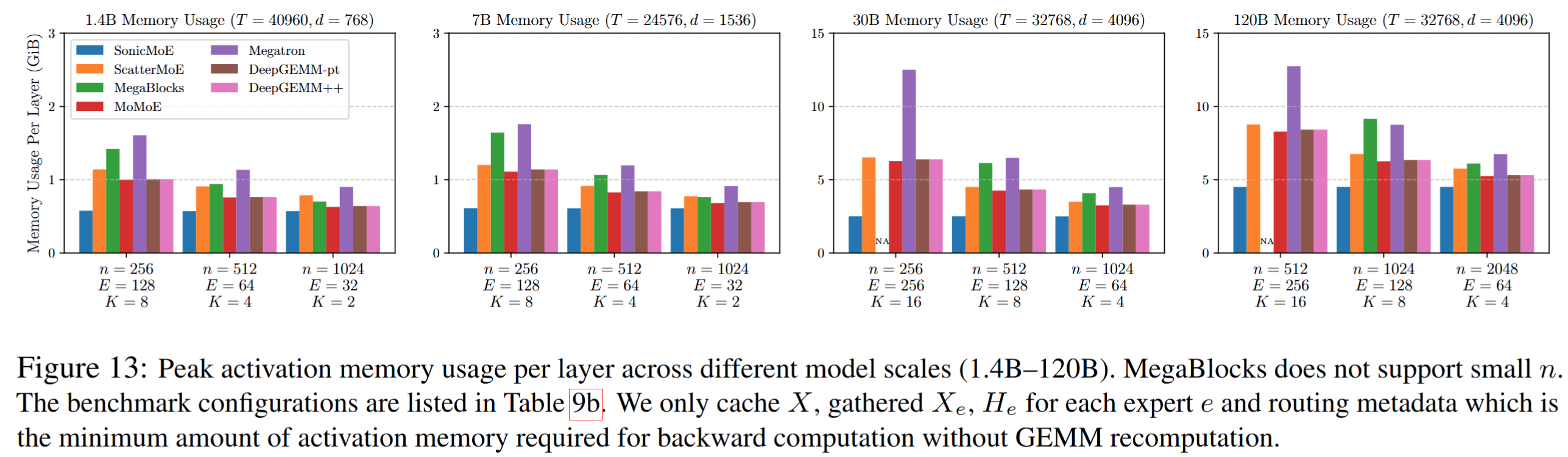
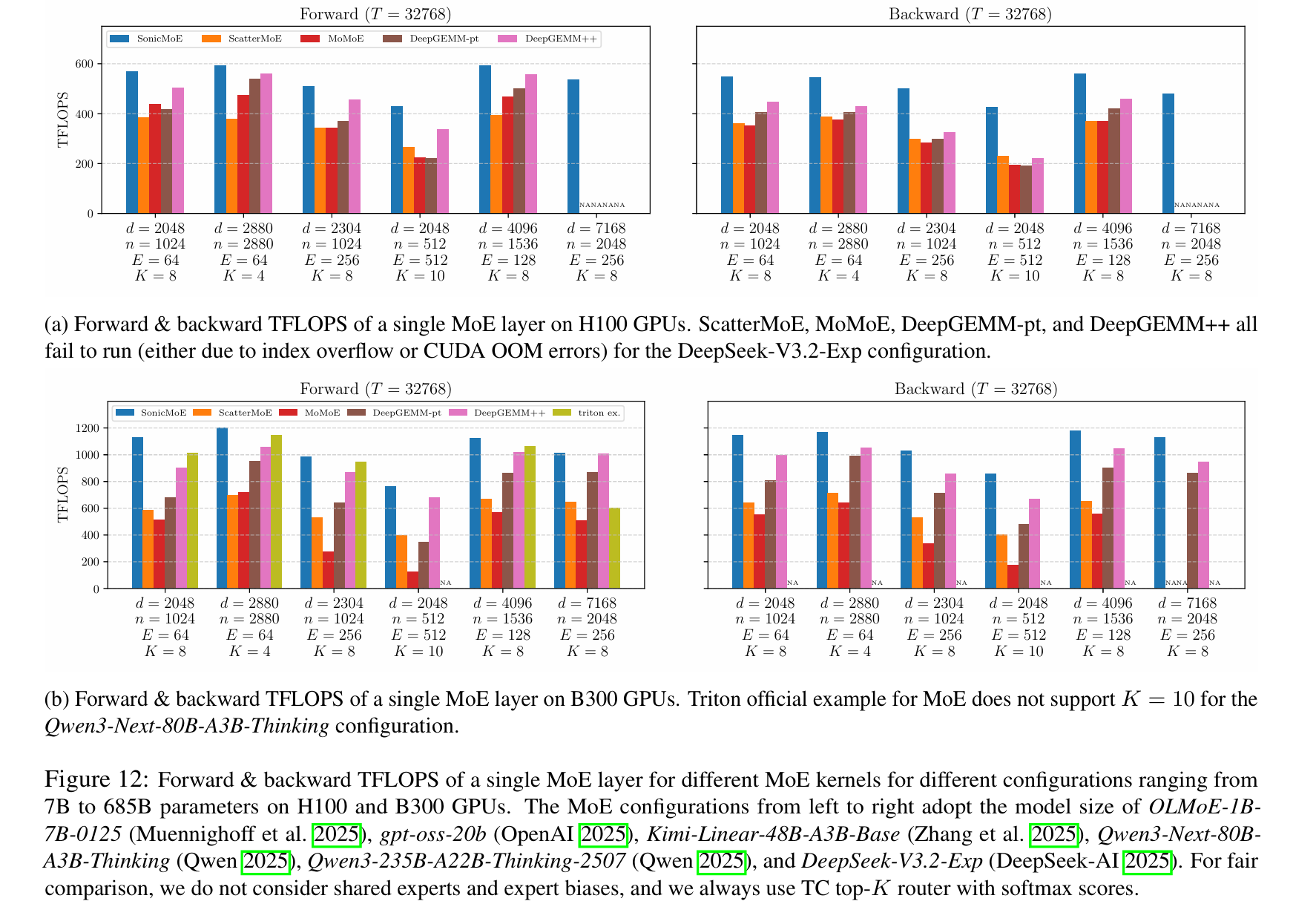
SonicMoE is a simple but blazing-fast Mixture-of-Experts (MoE) implementation optimized for NVIDIA Hopper and Blackwell architecture GPUs. It mainly leverages CuTeDSL and Triton to deliver state-of-the-art performance through IO-aware optimizations. These 2 figures provide an overview of activation memory usage and training throughput on Hopper GPUs (H100) and Blackwell GPUs (B300). The current version of SonicMoE builds on the Grouped GEMM kernels from the QuACK library which is itself built on CUTLASS.
News
- 04/19/2026: we release SonicMoE with Blackwell (SM100) support, built on QuACK's Grouped GEMM kernels.
📦 Installation
Prerequisites
- NVIDIA Hopper GPUs (H100, H200, etc.) or Blackwell GPUs (GB200, B200, B300, etc.)
- CUDA 12.9+ (13.0+ for B300 GPUs)
- Python 3.12+ recommended
- PyTorch 2.7+ (2.9.1 recommended)
B300 users: please manually upgrade Triton to 3.6.0 after installing PyTorch.
Install from pip
pip install sonic-moe
Install from Source
# Clone the repository
git clone https://github.com/Dao-AILab/sonic-moe.git
cd sonic-moe

# Install dependencies
pip install -r requirements.txt

# Install SonicMoE
pip install -e .
🎯 Quick Start
Basic Usage
import torch
from sonicmoe import MoE, KernelBackendMoE
from sonicmoe.enums import ActivationType

# Create MoE layer
moe = MoE(
    num_experts=128,                           # Number of experts
    num_experts_per_tok=8,                     # Top-k experts per token
    hidden_size=4096,                          # Hidden dimension
    intermediate_size=1536,                    # Expert intermediate size
    activation_function=ActivationType.SWIGLU, # SwiGLU activation
    add_bias=False,                            # Add bias to linear layers
    std=0.02,                                  # Weight initialization std
).to(device="cuda", dtype=torch.bfloat16)

# Forward pass
x = torch.randn(32768, 4096, device="cuda", dtype=torch.bfloat16)
output, aux_loss = moe(x, kernel_backend_moe=KernelBackendMoE.sonicmoe)
🧪 Testing
Run the test suite to verify correctness:
make test
Example usage
-
SonicMoE with TC top-K routing (softmax-over-topk, or
softmax(topk(logits))) and interleaved weight layout format for up-proj weightspython benchmarks/moe-cute.py --thiek 32768,4096,1024,128,8 --activation swiglu
-
SonicMoE with Qwen3-style routing (topk-over-softmax, or
topk(softmax(logits))) with topk probabilities renormalization and interleaved weight layout format for up-proj weightspython benchmarks/moe-cute.py --thiek 32768,4096,1024,128,8 --topk_over_softmax --norm_topk_probs
-
SonicMoE with token rounding routing (SwiGLU activation) and interleaved weight layout format for up-proj weights
python benchmarks/moe-token-rounding.py --routing nr --thiekq 16384,4096,1024,256,8,128
-
SonicMoE with concatenated weight layout format for up-proj weights
By default, SonicMoE expects
w1(the gated up-projection weights) in interleaved format:[gate_0, up_0, gate_1, up_1, ...]. HuggingFace models (Qwen3, Mixtral, DeepSeek, etc.) storegate_up_projin concatenated format:[gate_0, gate_1, ..., gate_{I-1}, up_0, up_1, ..., up_{I-1}].# Concatenated weight layout format with TC top-K routing python benchmarks/moe-cute.py --thiek 32768,4096,1024,128,8 --concat_layout
🤝 Contributing
We welcome contributions! Please feel free to submit issues, feature requests, or pull requests.
📄 License
This project is licensed under the Apache License 2.0 - see the LICENSE file for details.
📚 Citation
If you use SonicMoE in your research, please cite:
@misc{guo2025sonicmoeacceleratingmoeio,
      title={SonicMoE: Accelerating MoE with IO and Tile-aware Optimizations},
      author={Wentao Guo and Mayank Mishra and Xinle Cheng and Ion Stoica and Tri Dao},
      year={2025},
      eprint={2512.14080},
      archivePrefix={arXiv},
      primaryClass={cs.LG},
      url={https://arxiv.org/abs/2512.14080},
}
1 maintainer

Release files for sonic-moe 0.1.2.post1
For a detailed explanation of source distributions (sdists) and built distributions (wheels), please see the package formats documentation.
Source distribution (sdist)
| File | Size | Uploaded | |
|---|---|---|---|
| sonic_moe-0.1.2.post1.tar.gz | 32.9 kB | Details |
Built distribution (wheel)
| File | Interpreter | ABI | Platform | Reset |
|---|---|---|---|---|
| sonic_moe-0.1.2.post1-py3-none-any.whl | Python 3 | none | any | Details |
Total release size: 71.2 kB
Release files / sonic_moe-0.1.2.post1.tar.gz
| Download URL | sonic_moe-0.1.2.post1.tar.gz |
|---|---|
| Size | 32.9 kB |
| Tags | Source |
|
SHA-256 checksum How to use checksums |
0bebfd7355998fc60b6b1a944e450c290e7fd2c2d954f0def1e6d68c6f434816
|
|
BLAKE2b-256 checksum How to use checksums |
a842710f29935d71356a46a128e05fc0e72d948b1bcbca5a9199b0a3177bb21a
|
| Upload date | |
|
Uploaded using Trusted Publishing? What is trusted publishing? |
No |
| Uploaded via |
twine/6.2.0 CPython/3.12.13
|
Release files / sonic_moe-0.1.2.post1-py3-none-any.whl
| Download URL | sonic_moe-0.1.2.post1-py3-none-any.whl |
|---|---|
| Size | 38.3 kB |
| Tags | Python 3 |
|
SHA-256 checksum How to use checksums |
de103b91c3e5fab09c10b45c989d38b5204ce0fe1e97bec596359b59aed76932
|
|
BLAKE2b-256 checksum How to use checksums |
a3dfd2c226105528c509ac62678302cb61c41acf8cec0e5f024e230425506357
|
| Upload date | |
|
Uploaded using Trusted Publishing? What is trusted publishing? |
No |
| Uploaded via |
twine/6.2.0 CPython/3.12.13
|














