

Spatial omics pipeline and analysis


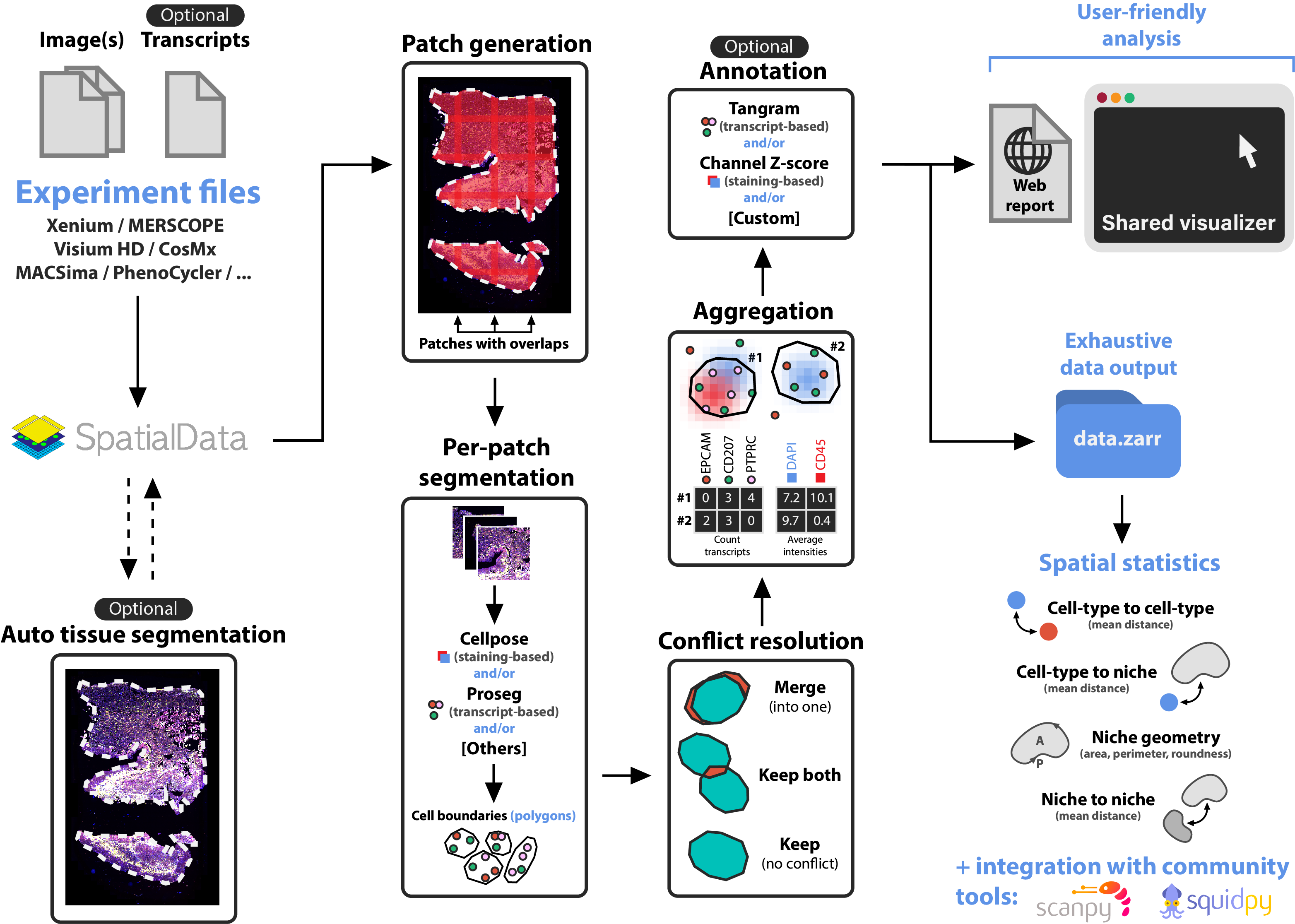
Built on top of SpatialData, Sopa enables processing and analyses of spatial omics data with single-cell resolution (spatial transcriptomics or multiplex imaging data) using a standard data structure and output. We currently support the following technologies: Xenium, Visium HD, MERSCOPE, CosMx, PhenoCycler, MACSima, Molecular Cartography, and others. Sopa was designed for generability and low memory consumption on large images (scales to 1TB+ images).
Documentation
Check Sopa's documentation to get started. It contains installation explanations, CLI/API details, and tutorials.
Overview
The following illustration describes the main steps of sopa:
Installation
Sopa can be installed from PyPI on all OS, for any Python version >=3.12. On a new environment, run the following command:
pip install sopa
Usage modes
Sopa comes in four different flavours, each corresponding to a different use case:
API: use directlysopaas a Python package for complete flexibility and customization (example below).nf-core/sopa: run Sopa with Nextflow (see this repo and the corresponding usage guide).Snakemake pipeline: choose a config, and run our pipeline on your spatial data in a couple of minutes (deprecated in favor ofnf-core/sopa, see the public archive here).CLI: use our command-line-interface for prototyping quickly your own pipeline (advanced users).
API usage
Below is a minimal example of API usage. For a complete API description, please refer to the documentation.
import sopa

sdata = sopa.io.xenium("path/to/data") # reading Xenium data

sopa.make_image_patches(sdata) # creating overlapping patches
sopa.segmentation.cellpose(sdata, "DAPI", diameter=30) # running cellpose segmentation
sopa.aggregate(sdata) # counting the transcripts inside the cells
Cite us
Our article is published in Nature Communications. You can cite Sopa as below:
Blampey, Q., Mulder, K., Gardet, M. et al. Sopa: a technology-invariant pipeline for analyses of image-based spatial omics.
Nat Commun 15, 4981 (2024). https://doi.org/10.1038/s41467-024-48981-z
1 maintainer

Metadata
1 maintainer
Release files for sopa 2.3.0
For a detailed explanation of source distributions (sdists) and built distributions (wheels), please see the package formats documentation.
Source distribution (sdist)
| File | Size | Uploaded | Provenance | Actions |
|---|---|---|---|---|
| sopa-2.3.0.tar.gz | 142.9 kB | Without provenance | Details for sopa-2.3.0.tar.gz |
Built distribution (wheel)
| File | Interpreter | ABI | Platform | Actions Reset |
|---|---|---|---|---|
| sopa-2.3.0-py3-none-any.whl | Python 3 | none | any | Details for sopa-2.3.0-py3-none-any.whl |
Total release size: 331.8 kB
Release files / sopa-2.3.0.tar.gz
| Download URL | sopa-2.3.0.tar.gz |
|---|---|
| Size | 142.9 kB |
| Tags | Source |
|
SHA-256 checksum How to use checksums |
5c3d028a9a8b6c01a4a06e7a621e2a5d29ccc6cca6b2700964bae676217f2c7e
|
|
BLAKE2b-256 checksum How to use checksums |
42504a47e1fc583eafca2f86faf5a46e257e9fe38e475143bc59d90cbbf32844
|
| Upload date | |
|
Uploaded using Trusted Publishing? What is trusted publishing? |
No |
| Uploaded via |
uv/0.5.20
|
Release files / sopa-2.3.0-py3-none-any.whl
| Download URL | sopa-2.3.0-py3-none-any.whl |
|---|---|
| Size | 188.9 kB |
| Tags | Python 3 |
|
SHA-256 checksum How to use checksums |
eb3b5b9f6d91cb44b0aec915fff0dfe1073cc4aed963335d7afd114cc044eded
|
|
BLAKE2b-256 checksum How to use checksums |
1053f30810dbddc47e840d2dd9bd18716ad33269dd169bbb2840bda1845b8270
|
| Upload date | |
|
Uploaded using Trusted Publishing? What is trusted publishing? |
No |
| Uploaded via |
uv/0.5.20
|
Security for sopa 2.3.0
Provenance
Provenance describes where a file came from. On PyPI, provenance is shared via attestations, which provide a verifiable record of the build or publishing details. View details, limitations and caveats.
No provenance found
None of the files in this release were uploaded with provenance metadata.
A note on package security
PyPI is a repository for distributing packages, not a service for auditing them. While third-party security researchers and our staff do their best to detect and remove malicious packages, PyPI cannot guarantee the quality, security or suitability of any given package.
To learn more about protecting yourself from malicious actors, visit our package security documentation.














