
sounddifff




Origin and maintenance. sounddifff is the continuation of sounddiff, created by systemBlue and released under the MIT license (original package on PyPI, last version 0.2.1). The original repository is no longer available. This project is maintained by Jaime Fernández González (jaimefgdev): the original idea and the code up to March 2026 are systemBlue's; everything added from October 2026 onward is listed in the CHANGELOG.
sounddifff is a CLI tool for audio producers and developers to compare two audio files (or two folders) and see exactly what changed, and to check a single file against the loudness targets of Spotify, YouTube, Apple Music, podcasts and broadcast. It reports differences in loudness, spectral balance, timing, and flags issues like clipping and silence. Output comes as colored terminal text, structured JSON, or a self-contained HTML report.
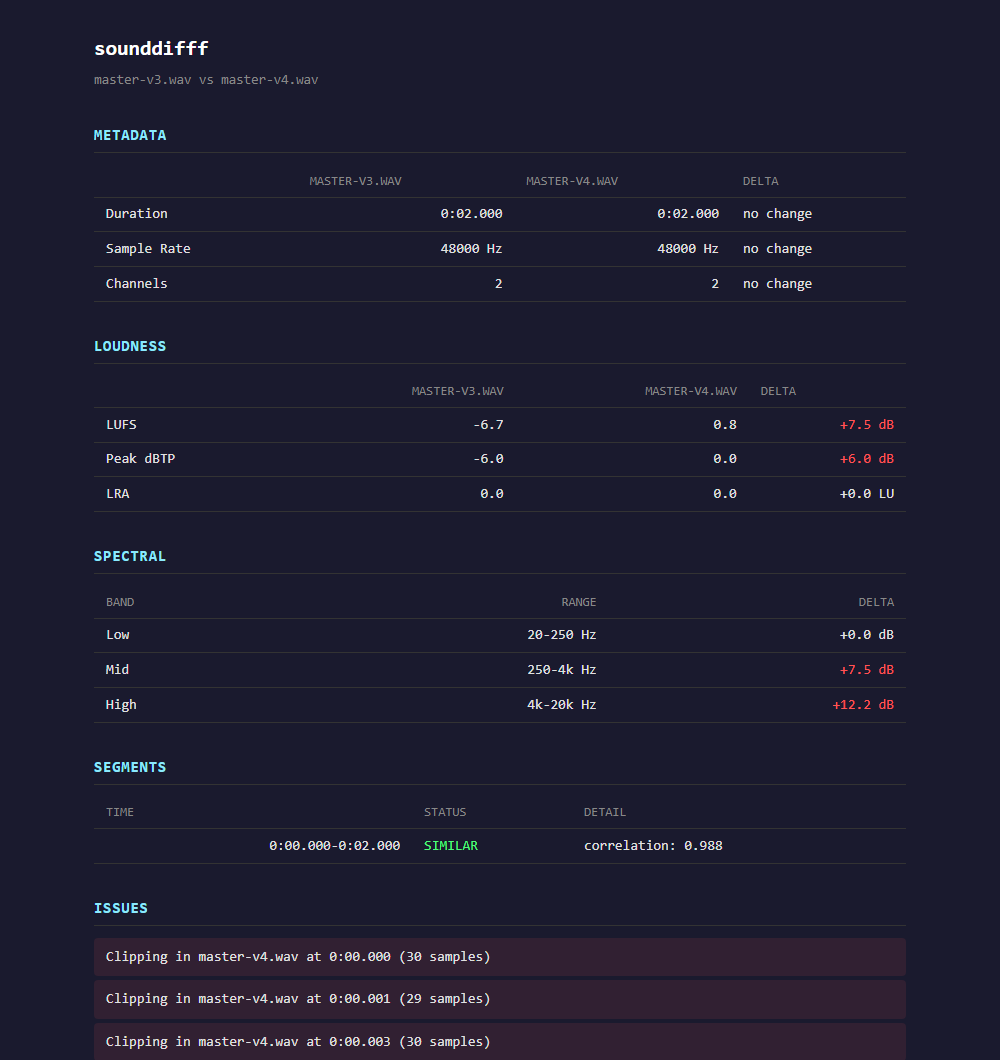
Example
$ sounddifff mix-v3.wav mix-v4.wav

sounddifff: mix-v3.wav vs mix-v4.wav

Duration     3:42.108 → 3:42.108  (no change)
Sample Rate  48000 Hz → 48000 Hz  (no change)
Channels     stereo   → stereo    (no change)

Loudness (integrated)
  LUFS       -14.2    → -12.8     (+1.4 dB)
  Peak dBTP  -1.1     → -0.3      (+0.8 dB)
  LRA         8.2     →  6.4      (-1.8 LU)

Spectral
  Low  (20-250 Hz)    +0.8 dB avg
  Mid  (250-4k Hz)    +0.3 dB avg
  High (4k-20k Hz)    +1.9 dB avg

Segments
  0:00-1:12   similar (correlation: 0.97)
  1:12-1:14   ADDED (new content, 2.1s)
  1:14-3:42   similar (correlation: 0.98, shifted +2.1s)

Issues
  ⚠ Clipping detected in mix-v4.wav at 2:31.4 (3 samples)
Installation
pip install sounddifff
The name has three f's: the original sounddiff package on PyPI belongs to systemBlue and stopped at 0.2.1.
Package, command and Python module are all called sounddifff.
Requires Python 3.10 or later. Supports WAV, FLAC, OGG, and AIFF natively. For MP3 and AAC support, install ffmpeg.
Usage
Compare two files with colored terminal output:
sounddifff old-mix.wav new-mix.wav
Get structured JSON for scripts and CI pipelines:
sounddifff old.wav new.wav --format json
Generate an HTML report:
sounddifff old.wav new.wav --format html -o report.html
Audio regression checks in CI
--fail-if turns sounddifff into a test: it prints the report as usual and exits with code 3 if any rule is broken
(code 1 is reserved for errors such as unreadable files).
sounddifff reference.wav render.wav --fail-if "lufs>1,peak>0.5,band>3,clipping"
| Rule | Fails when |
|---|---|
lufs>N |
integrated loudness changes by more than N LU |
peak>N |
true peak changes by more than N dB |
lra>N |
loudness range changes by more than N LU |
band>N |
any spectral band changes by more than N dB |
duration>N |
duration changes by more than N seconds |
correlation<N |
overall waveform correlation drops below N |
clipping |
the second file clips |
silence |
the second file has more silent regions than the first |
format |
sample rate or channel count differ |
Check one file against a delivery target
sounddifff check episode.wav --preset podcast
sounddifff check: episode.wav against Podcasts (Apple Podcasts, Spotify for Podcasters)

  FAIL  loudness   -11.2 LUFS     target -16.0 +/- 1 LUFS
  PASS  true peak  -10.5 dBTP     target <= -1.0 dBTP
  PASS  clipping   0 event(s)     target none

  Gain to reach the target: -4.8 dB
| Preset | Integrated loudness | True peak |
|---|---|---|
spotify, youtube |
-14 LUFS ± 1 | ≤ -1 dBTP |
apple-music, podcast |
-16 LUFS ± 1 | ≤ -1 dBTP |
ebu-r128 (European broadcast) |
-23 LUFS ± 0.5 | ≤ -1 dBTP |
atsc-a85 (US broadcast) |
-24 LUFS ± 2 | ≤ -2 dBTP |
True peak is measured with 4x oversampling (ITU-R BS.1770-4), so inter-sample peaks that would clip after
encoding are caught. Override any value with --lufs, --tolerance or --max-peak; add --format json for
scripts. Exit code 3 when the file misses the target.
Compare folders
sounddifff renders/v1/ renders/v2/ --fail-if "lufs>1,clipping"
Files are paired by relative path (sub-folders included) and compared one by one; files that exist in only one
folder are listed. Useful for game sound banks, voice lines or any batch of renders. --format json is supported.
GitHub Action
permissions:
  contents: read
  pull-requests: write   # only needed for comment: true

steps:
  - uses: actions/checkout@v4

  # Compare a render with its reference (files or folders)
  - uses: jaimefgdev/sounddifff@v0.4.0
    with:
      reference: audio/reference.wav
      candidate: build/render.wav
      fail-if: lufs>1,peak>0.5,clipping
      comment: true

  # Or check one file against a delivery target
  - uses: jaimefgdev/sounddifff@v0.4.0
    with:
      candidate: build/episode.wav
      preset: podcast
      artifact-name: podcast-check
The result goes to the job summary and, with comment: true, to a pull request comment that is updated on
every push. File comparisons also upload the HTML report as an artifact. The step fails when a rule or target
is missed. Outputs: passed (true/false) and report (path of the HTML file).
--fail-if, sounddifff check, folder comparison and the GitHub Action were added by Jaime Fernández González
(jaimefgdev) in October 2026.
What it analyzes
| Category | Measurements |
|---|---|
| Loudness | Integrated LUFS, true peak (dBTP), loudness range (LRA) per ITU-R BS.1770 |
| Spectral | Average energy per frequency band (low, mid, high) with configurable ranges |
| Temporal | Segment-level cross-correlation, added/removed/shifted section detection |
| Detection | Clipping events (timestamp, channel, sample count), silence regions |
| Metadata | Duration, sample rate, channels, bit depth, format |
Output formats
Terminal is the default. Colored, grouped by category, designed to be read top to bottom. Uses rich for formatting.
JSON outputs the same data in a structured format. Pipe it to jq, parse it in Python, or use it in CI pipelines for automated regression testing.
HTML generates a self-contained report with inline styles. No external dependencies. Open it in any browser, share it with your team, or archive it alongside your session files.
How it's built
sounddifff is written in Python with a modular architecture. Each analysis type (loudness, spectral, temporal, detection) lives in its own module with no cross-dependencies. The core orchestrator loads two audio files, runs all analyzers, and passes the results to a formatter.
| Dependency | Purpose |
|---|---|
| soundfile | Audio I/O via libsndfile |
| numpy | Array math, FFT, cross-correlation |
| scipy | Signal processing |
| pyloudnorm | ITU-R BS.1770 loudness measurement |
| click | CLI framework |
| rich | Terminal formatting |
| jinja2 | HTML report templates |
See docs/architecture.md for the full module breakdown and data flow.
Documentation
- Installation - system dependencies, shell completions, ffmpeg setup
- Usage - CLI options and examples
- API Reference - using sounddifff as a Python library
- Architecture - module layout and design decisions
Contributing
Contributions are welcome. See CONTRIBUTING.md for setup instructions and our development workflow.
The issue board has open work organized by milestone. Issues labeled good first issue are scoped for newcomers and have enough context to get started without deep DSP knowledge.
Security
Report vulnerabilities privately through GitHub security advisories. See SECURITY.md for our disclosure policy.
License
1 maintainer

Metadata
1 maintainer
Release files for sounddifff 0.4.0
For a detailed explanation of source distributions (sdists) and built distributions (wheels), please see the package formats documentation.
Source distribution (sdist)
| File | Size | Uploaded | |
|---|---|---|---|
| sounddifff-0.4.0.tar.gz | 89.6 kB | Details |
Built distribution (wheel)
| File | Interpreter | ABI | Platform | Reset |
|---|---|---|---|---|
| sounddifff-0.4.0-py3-none-any.whl | Python 3 | none | any | Details |
Total release size: 119.1 kB
Release files / sounddifff-0.4.0.tar.gz
| Download URL | sounddifff-0.4.0.tar.gz |
|---|---|
| Size | 89.6 kB |
| Tags | Source |
|
SHA-256 checksum How to use checksums |
25e911cbb0735906a66c2859c739fdb62f7e8516bb3f1c3963c15214fdbae0e0
|
|
BLAKE2b-256 checksum How to use checksums |
a178c5e2dfc7602c2431efbf21fc2f5cc7d1b470208368039839960e6980f9f3
|
| Upload date | |
|
Uploaded using Trusted Publishing? What is trusted publishing? |
Yes |
| Uploaded via |
twine/7.0.0 CPython/3.13.14
|
Provenance
Provenance describes where a file came from. On PyPI, provenance is shared via attestations, which provide a verifiable record of the build or publishing details. View details, limitations and caveats.


PyPI Publish Attestation
PyPI verified that this artifact, at this checksum, originated from the publisher listed below.
Signed by GitHub Actions, verified by PyPI on Oct 4, 2026.
Transparency logRelease files / sounddifff-0.4.0-py3-none-any.whl
| Download URL | sounddifff-0.4.0-py3-none-any.whl |
|---|---|
| Size | 29.5 kB |
| Tags | Python 3 |
|
SHA-256 checksum How to use checksums |
af9e0641a56bec4435be3e20d6ce1c9e4a158223d5870636f15a12a70daf1cfe
|
|
BLAKE2b-256 checksum How to use checksums |
a51c0a8f71c71d6d3e7a298da6541875853b7f800ed6eb135110236685ee6430
|
| Upload date | |
|
Uploaded using Trusted Publishing? What is trusted publishing? |
Yes |
| Uploaded via |
twine/7.0.0 CPython/3.13.14
|
Provenance
Provenance describes where a file came from. On PyPI, provenance is shared via attestations, which provide a verifiable record of the build or publishing details. View details, limitations and caveats.
PyPI Publish Attestation
PyPI verified that this artifact, at this checksum, originated from the publisher listed below.
Signed by GitHub Actions, verified by PyPI on Oct 4, 2026.
Transparency log













