
SounderPy
Atmospheric vertical-profile retrieval, analysis, and visualization for Python
Retrieve observations, forecasts, and reanalyses.
Analyze thermodynamic and kinematic environments.
Create publication-ready soundings and hodographs.





Documentation · Tutorials · Plot Gallery · Operational Site · PyPI
What is SounderPy?
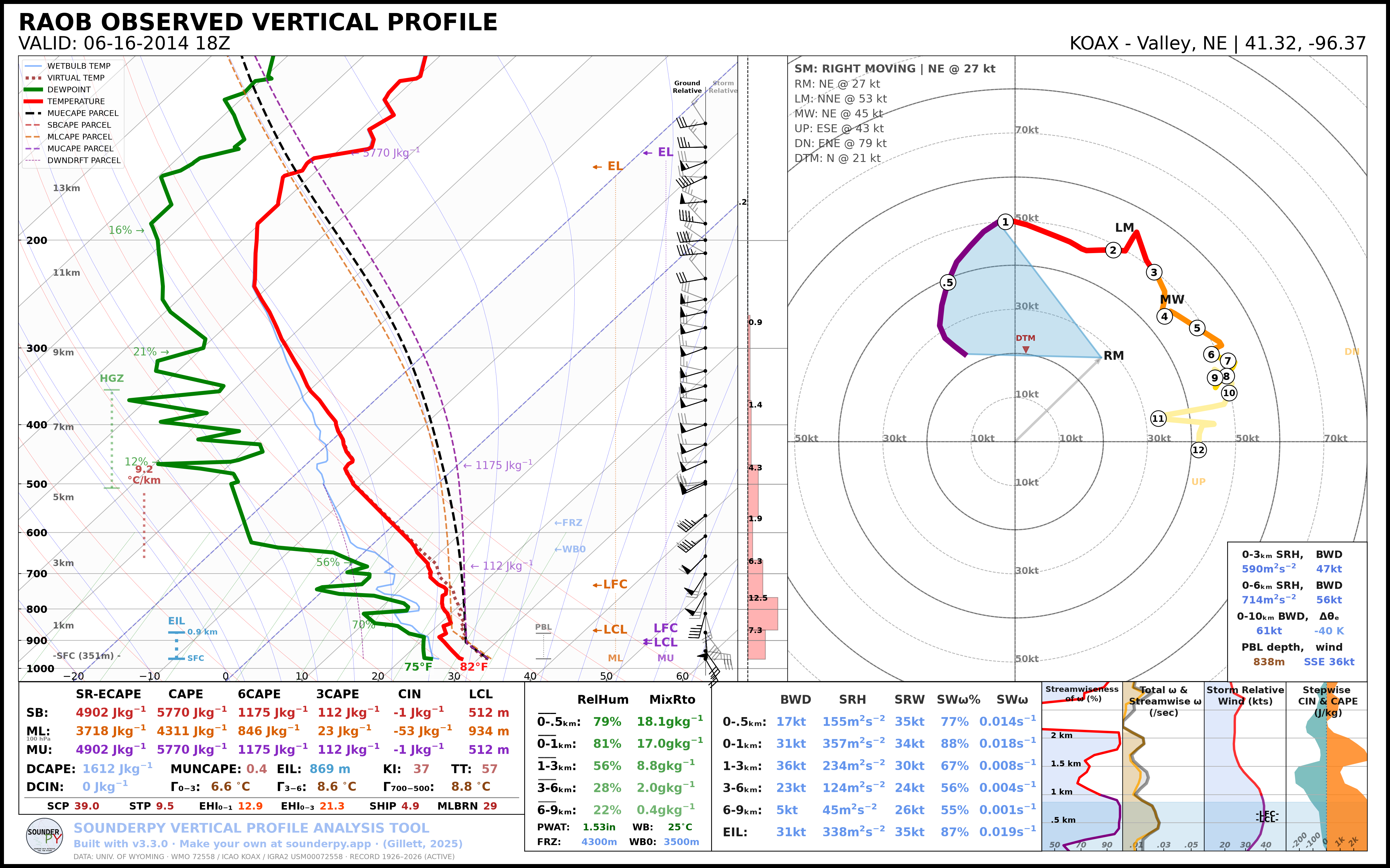
ABSTRACT: SounderPy is a simple, open-source Python package for retrieving and plotting vertical profile (sounding) data. Built for simplicity and reliability for all uses and users, this project’s goal is to provide a uniform method for sounding analysis across multiple data types. Severe weather analysis and forecasting requires a sound comprehension of thermodynamic and kinematic properties of the environment. SounderPy makes this possible with robust access to data and custom visualizations. The tool creates complex yet effective sounding and hodograph plots with high readability which are designed specifically for severe weather analysis and forecasting. SounderPy is capable of retrieving and plotting model forecast data, observed radiosonde data, Aircraft Communications Addressing and Reporting System (ACARS) observation data, and model reanalysis data. All of this functionality can be completed in three simple lines of code or less, making SounderPy an accessible tool for both Python experts and novices. A number of scientific Python libraries build the base of SounderPy’s efficient and durable functionality, such as NumPy, Matplotlib, xarray, Metpy, and SHARPpy. SounderPy is available through GitHub and PyPi and is distributed under an MIT license.
SounderPy has been used by several institutions. For example, this tool has been implemented by the Des Moines, Columbia, and Grand Rapids National Weather Service Offices, the State University of New York at Albany, Mississippi State University, the University of North Dakota, and others. Many students at various universities have used SounderPy in projects, posters, and papers, such as students at The University of Oklahoma, Ohio State University, Central Michigan University, Iowa State University, & Rizal Technological University.
Why SounderPy?
- Retrieve data without writing retrieval/parsing code yourself.
- Use one workflow across observations, forecasts, reanalyses, and model data.
- Calculate severe-weather thermodynamic and kinematic parameters.
- Create sounding, hodograph, VAD, and composite-sounding figures.
- Customize parcels, storm motion, radar, maps, themes, and plot accessibility.
- Export profiles to CSV, SHARPpy, and CM1 formats.
- Use SounderPy from Python or directly from the command line.
Installation
pip
pip install sounderpy
conda-forge
conda install conda-forge::sounderpy
or:
mamba install conda-forge::sounderpy
Then import SounderPy:
import sounderpy as spy
Quickstart
Retrieve the 18 UTC OAX observed sounding from 16 June 2014:
import sounderpy as spy

data = spy.get_obs_data(
    "OAX",
    "2014", "06", "16", "18",
    hush=True,
)

spy.build_sounding(data)
That's it.
data is now a SounderPy clean_data dictionary containing the vertical profile
and associated metadata.
Typical fields include:
p          pressure
z          height
T          temperature
Td         dewpoint
u          u-component wind
v          v-component wind
site_info  profile metadata
Explore more examples in the SounderPy Plot Gallery.
Command Line Interface
SounderPy can also be used without writing a Python script.
Retrieve an observation
sounderpy obs OAX 2014-06-16 18
Retrieve RAP/RUC
sounderpy model rap-ruc 44.58 -100.82 2024-08-28 18 \
    --box-size 0.25
Create a plot
sounderpy obs OAX 2014-06-16 18 \
    --plot sounding \
    --map-zoom 0 \
    --plot-file oax_sounding.png
Export data
sounderpy obs OAX 2014-06-16 18 \
    --output oax.csv
Case Studies and Tutorials
The documentation includes task-oriented tutorials that build complete SounderPy workflows rather than simply listing function arguments.
Topics include:
- plot appearance and accessibility;
- maps and radar;
- parcel settings;
- hodograph configuration;
- observations, forecasts, and reanalyses;
- composite soundings;
- data export;
- command-line workflows;
- real severe-weather case studies.
Start here: SounderPy Tutorials →
What's New in SounderPy 3.3
Version 3.3 rebuilds the plotting module, adds winter and publication figures, and makes every figure easier to customize.
📈 Figure Updates
- Rebuilt plot module: most figures are about 50% faster, with custom colors (
theme), a custom watermark (spy.set_watermark()), and aylimto zoom the skew-T. - New
build_sounding()kwargs:max_levels(reduce the number of vertical levels of a profile),ylim(zoom the skew-T into a particular layer),theme(custom figure colors),sr_hodo(storm-relative hodograph),mode('severe','winter', or'auto'),show_obs(the nearest surface observation formode='winter'figures),map_layersandmap_label(adding your own data to the map inset), andreturn_fig(return the figure and its panels for customization). Many of these also work onbuild_hodograph(),build_composite(), andbuild_vad_hodograph(). - Publication figures (experimental):
spy.build_publication_sounding()draws journal-sized figures for AMS and AGU journals, and everybuild_*function takesreturn_fig=Trueto hand back its figure (custom figures tutorial). - Your own data on the map inset with
map_layersandmap_label(custom map data tutorial). - Rebuilt composite soundings with figure improvements and parameter read-outs, and rebuilt VAD hodographs with map, radar, and boundary options.
- New parameter readouts on the full sounding: composite indices in the thermodynamics box, EIL depth and heights, 0-10 km bulk shear and theta-e difference, PBL height and transport wind, improved layout for ML/MU parcel heights, updated watermark, new data source attribution line, and numerous other small improvements to the plot layout.
❄️ NEW Winter Soundings
build_sounding(mode='winter')draws a winter-focused sounding built around precipitation type, snow growth, and winter hazards. Settingmode='auto'will generate a winter figure when the surface wet-bulb is below 35°F, and a newshow_obs=Truekwarg adds the latest (nearest) surface observation to the figure (See the winter soundings tutorial!).spy.winter_params(clean_data).calc()returns the dictionary of winter parameters.
🧮 Calculations
- NEW severe parameters: 0-10 km bulk shear and the low-to-midlevel theta-e difference (for MCSs; Cohen et al. 2007), PBL depth and transport wind (for air quality), EIL bottom height, top height, and depth, SHIP, MLBRN, TT, KI, and 700-500 hPa lapse rate.
- UPDATED/CORRECTED parameters: Streamwise vorticity bug counted antistreamwise layers as streamwise; STP/SCP used EIL shear in kts (now m/s).
- Every parameter, its units, and its source are listed on the Parameters & References documentation page.
- Settings:
modify_sfcadds'mix','blend', and'replace'methods, and the NEWspy.modify_surface()returns the modified profile itself, to compare or save;spy.smooth_profile()adds a Savitzky-Golay filter.
🌦️ Data Sources
- BUFKIT now serves the RRFS; NAM, NAMNEST, SREF, and HIRESW are no longer available as "latest runs" (discontinued; but NAM and NAMNEST are available as archived runs)
- RRFS, HRRR, and RAP may now fall back to NOMADS NCEP's BUFR dataset when Penn State is behind or an archived run is missing.
- NEW Station list: observed soundings use a packaged WMO/ICAO/IGRAv2 station list, with an ICAO fallback for the Wyoming archive. This list is a best-guess combination of 5 data sources to limit incorrect site names, IDs, and locations.
- Dewpoints are now calculated (when possible) for older IGRA v2 soundings that don't ship dewpoint.
- Thread-safe RAP/RUC GRIB parsing.
💻 Command Line Interface Updates
- NEW
filecommand: read a local SHARPpy-format sounding (--latlon LAT LONadds its location for the map). - NEW options:
--params: print key calculated parameters (CAPE, SRH, shear, and precip type with--mode winter);--mode {severe,winter,auto}and--obs: winter soundings and the nearest surface observation;--storm-motion:right_moving,left_moving,mean_wind, or a direction and speed such as270 25;--modify-sfc: change the surface, e.g.T=30 Td=21orT=-6 method=blend depth=300;--radar {mosaic,single,none}and--radar-time {sounding,now}: the map's radar;--parcelsand--background-parcels: custom parcel codes.
- Options now match the Python functions, with clearer warnings.
🐞 Bug Fixes
- ACARS airport elevations corrected, CIN doesn't accumulate above the LFC, HGZ identification, extra moist adiabats on thin zoomed skew-Ts, and figures now close after
save=Trueto preserve memory.
📚 NEW HOME for Documentation!
- Freshly redesigned docs now live at sounderpy.app/docs, with new Plot Settings, Publication Figures, and Parameters & References pages.
- Also, each source module now includes a text header with its docs and references.
⚠️ Changes to Note
sounding_params(...).calc()andvad_params(...).calc()return a dictionary instead of a tuple.- Renamed, with the old names still working (with a
FutureWarning) until a later release:build_composite()'scolors_to_use,ls_to_use,alphas_to_use, andlw_to_use(nowcolors,linestyles,alphas, andlinewidths),make_cm1_profile()/make_wrf_profile()(nowspy.from_cm1()/spy.from_wrf()), and the data modules (now insounderpy.data). spy.smooth_profile()defaults to the Savitzky-Golay filter (passingsigmaalone still uses the Gaussian filter).
See the full What's New on the docs landing page and the repository's release history.
Documentation and Project Links
- Documentation: https://sounderpy.app/docs/
- Tutorials: https://sounderpy.app/docs/tutorials/index.html
- Plot Gallery: https://sounderpy.app/docs/gallery/examplegallery.html
- GitHub: https://github.com/kylejgillett/sounderpy
- PyPI: https://pypi.org/project/sounderpy/
- conda-forge: https://anaconda.org/conda-forge/sounderpy
- Operational SounderPy site: https://sounderpy.app/
Questions, bugs, and feature ideas are welcome through GitHub Issues.
Citing SounderPy
If SounderPy contributes to research or a publication, please cite the SounderPy JOSS article:
Gillett, K. J., 2025: SounderPy: An atmospheric sounding visualization and analysis tool for Python. J. Open Source Software, 10 (112), 8087. https://doi.org/10.21105/joss.08087
BibTeX:
@article{Gillett2025SounderPy,
  author  = {Gillett, Kyle J.},
  title   = {SounderPy: An atmospheric sounding visualization and analysis tool for Python},
  journal = {Journal of Open Source Software},
  year    = {2025},
  volume  = {10},
  number  = {112},
  pages   = {8087},
  doi     = {10.21105/joss.08087}
}
Authors and Contributors
Author
- Kyle J. Gillett — University of North Dakota
Contributors
- Scott Thomas, NWS Grand Rapids — VWP hodograph and buoy-site listing
- Amelia R. H. Urquhart, University of Oklahoma —
ecape-parcels - Daryl Herzmann, Iowa State University — SounderPy conda-forge feedstock
- Ryan Vandersmith — stepwise CAPE/CIN plot
- David E. Levin, NOAA/NWS — Alaskan RAOB site identifiers
Additional contributors are recognized through the repository history.
License
SounderPy is distributed under the MIT License.
Documentation · GitHub · PyPI · JOSS
1 maintainer

Metadata
1 maintainer
Release files for sounderpy 3.3.0
For a detailed explanation of source distributions (sdists) and built distributions (wheels), please see the package formats documentation.
Source distribution (sdist)
| File | Size | Uploaded | Provenance | Actions |
|---|---|---|---|---|
| sounderpy-3.3.0.tar.gz | 652.9 kB | Without provenance | Details for sounderpy-3.3.0.tar.gz |
Built distribution (wheel)
| File | Interpreter | ABI | Platform | Actions Reset |
|---|---|---|---|---|
| sounderpy-3.3.0-py3-none-any.whl | Python 3 | none | any | Details for sounderpy-3.3.0-py3-none-any.whl |
Total release size: 1.3 MB
Release files / sounderpy-3.3.0.tar.gz
| Download URL | sounderpy-3.3.0.tar.gz |
|---|---|
| Size | 652.9 kB |
| Tags | Source |
|
SHA-256 checksum How to use checksums |
7b4961eb3c2e95d5c0a005fabe93ddbc0c1fdbe4b98bb2dd92d8e71d12e226b2
|
|
BLAKE2b-256 checksum How to use checksums |
8b51341c2b5db17ba8fc9d81a4699810b95f2e8b1c19a5e1c8bf516c382dd0f2
|
| Upload date | |
|
Uploaded using Trusted Publishing? What is trusted publishing? |
No |
| Uploaded via |
twine/7.0.0 CPython/3.12.3
|
Release files / sounderpy-3.3.0-py3-none-any.whl
| Download URL | sounderpy-3.3.0-py3-none-any.whl |
|---|---|
| Size | 626.5 kB |
| Tags | Python 3 |
|
SHA-256 checksum How to use checksums |
40f294ac7299cdfd2de0cee64c5cdfe185a3b7b7a6288de6e66eee13137a07a9
|
|
BLAKE2b-256 checksum How to use checksums |
e3dab09c127249217644f08d6800274e0f8a707a927883aaa79c26016ce5df14
|
| Upload date | |
|
Uploaded using Trusted Publishing? What is trusted publishing? |
No |
| Uploaded via |
twine/7.0.0 CPython/3.12.3
|
Security for sounderpy 3.3.0
Provenance
Provenance describes where a file came from. On PyPI, provenance is shared via attestations, which provide a verifiable record of the build or publishing details. View details, limitations and caveats.
No provenance found
None of the files in this release were uploaded with provenance metadata.
A note on package security
PyPI is a repository for distributing packages, not a service for auditing them. While third-party security researchers and our staff do their best to detect and remove malicious packages, PyPI cannot guarantee the quality, security or suitability of any given package.
To learn more about protecting yourself from malicious actors, visit our package security documentation.














